
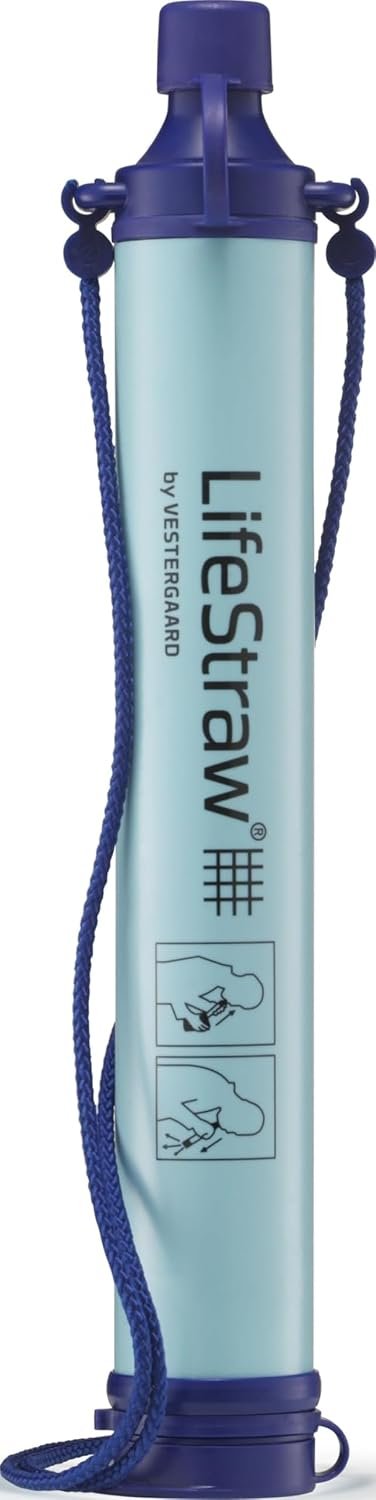
A stream can look pristine and still carry the one contaminant a pocket filter cannot catch.
At the point where the bottle runs low, a cold stream running over pale stones can make a palm-size filter feel like a complete answer. Its appearance reveals almost nothing. Giardia or Cryptosporidium may come from wildlife upstream; bacteria can enter through livestock, camps, or runoff; viruses become more plausible near human waste; and dissolved chemicals, salt, or mining-related metals remain invisible.
A filter only “works” in relation to that particular mix. Most trail filters use fine hollow-fiber membranes that physically strain out protozoa and bacteria when intact and used correctly. Many do not reliably address viruses, and membrane filtration does not remove dissolved contaminants. Flow rate, freezing damage, sediment loading, and whether the water is treated before collection can also change the practical result. Clear water is therefore a visual detail, not a safety test.
- Hollow-fiber pore ratings are commonly around 0.1–0.2 microns: useful against many bacteria and protozoa, not a dependable virus barrier.
- Activated carbon can improve taste and reduce some chemicals, but its effect varies by compound and cartridge condition.
Three hazards, three different answers
Biological hazards
Bacteria, protozoa, and viruses can be present in water that looks pristine. Hollow-fiber and ceramic filters commonly remove bacteria and protozoa; virus control may require a purifier, chemical treatment, or heat.
Particulate hazards
Silt, algae, rust, and organic debris make water cloudy and can clog equipment. Settling, a cloth prefilter, or a cartridge improves clarity, but this is not the same as disinfection.
Dissolved chemical hazards
Fuel residues, pesticides, mining contaminants, salts, and some industrial compounds are dissolved rather than trapped as visible grit. Most lightweight microfilters are not designed to remove them.
Purification
In outdoor use, this usually means reducing pathogens to a defined performance level, sometimes including viruses. It does not automatically mean removal of every chemical contaminant.
A mountain spring may be visually clear yet contain Giardia, Cryptosporidium, or contamination introduced upstream. Conversely, muddy water may be mainly a clogging problem once pathogens are addressed.
Technology follows the hazard:
Mechanical filtration captures particles and many microbes by pore size. UV, chemicals, and heat inactivate microbes but do little for sediment. Activated carbon can reduce some taste- and chemical-related compounds, with limits that vary by compound and cartridge.No pocket treatment is a universal answer for unknown industrial or agricultural pollution.
What the filter is actually doing
Hollow-fiber filters route water through bundles of tiny, straw-like tubes. Their walls contain pores around 0.1–0.2 micron. These pores are small enough to exclude protozoan cysts such as Giardia and Cryptosporidium, and most bacteria. Water may be forced from the outside of each fiber inward, or the reverse direction may be used. The specified direction matters. It determines which side collects contamination and how backflushing works. Viruses are far smaller than these pores, so ordinary backpacking hollow-fiber filters do not reliably remove them.
Ceramic filters use a porous mineral body as the barrier. They can provide similar bacteria and protozoa reduction at a given pore rating, and their element can often be gently scrubbed when flow slows. Ceramic is comparatively brittle: a crack, poor seal, or damaged O-ring can create a bypass that makes the nominal micron rating irrelevant.
Activated carbon works differently. Its immense internal surface adsorbs some taste and odor compounds, chlorine, and selected organic chemicals. It is not a dependable pathogen barrier, and performance against dissolved contaminants varies sharply by compound, contact time, and cartridge design.
A filter removes specified contaminants, generally by size exclusion or adsorption. Disinfection inactivates microbes through chemicals, ultraviolet light, or heat rather than trapping them. Purification is a broader claim whose meaning depends on the stated test standard; it does not automatically mean removal of every microbe or chemical.
A rating describes pore size, not device condition or the full contaminant list. Freezing, crushing, cracked ceramic, worn seals, or using the wrong flow path can compromise a barrier. Manufacturer integrity checks and maintenance instructions are therefore part of the treatment system.
What a hiking filter can—and cannot—screen out
Most backpacking filters are built to physically reduce protozoa and bacteria. Giardia cysts and Cryptosporidium oocysts are several microns across; many bacteria are roughly 0.2–10 microns. A properly functioning hollow-fiber or ceramic filter with an appropriate pore rating can therefore make a meaningful difference against these organisms.
Viruses change the calculation. Viral pathogens are often smaller than the pathways many trail filters target, so a label that says “filter” or even claims bacterial reduction does not guarantee viral reduction. Some systems combine filtration with a purifier stage, such as chemical treatment or UV, with a distinct virus claim.
Source conditions matter
Virus risk tends to rise where water may receive human sewage: downstream of settlements, near poorly maintained sanitation, in flood-affected areas, or where wastewater discharge is plausible. In a remote headwater with little human presence, protozoa and bacteria from wildlife or livestock may be the more relevant biological concern—though no source can be judged safe by appearance alone.
Useful label details include:
- the organisms explicitly named or the log-reduction claim;
- whether the product is described as a filter or a purifier;
- any limits for turbid water, freezing, damage, or expired treatment components.
Clear alpine water can still carry what a filter cannot catch
Remoteness lowers some risks but does not rule out dissolved contaminants.
Mining districts, agricultural headwaters, wildfire runoff, natural mineral deposits, and upstream camps can affect water that looks and tastes exceptionally clean.
These pore ratings chiefly describe physical exclusion of particles and microbes, not dissolved molecules.
Dissolved salts, nitrate, many metals in ionic form, and small organic compounds pass through hollow-fiber and ceramic filter pathways with the water.
Activated carbon can reduce selected compounds, but its capacity is finite and highly contaminant-specific.
It tends to work better for some taste- and odor-causing organics and certain pesticides than for salts, nitrate, fluoride, and many dissolved minerals. Once adsorption sites are occupied, reduction falls off; cartridge age, contact time, and flow rate matter.
A product’s carbon component may be intended mainly to improve taste and odor. Meaningful reduction claims identify the specific contaminant, the tested conditions, and the cartridge’s rated service life. Salt removal generally requires processes such as reverse osmosis or distillation—methods outside the usual pocket-filter design.
Match the source to the limit
Read the landscape
Source selection reduces exposure before treatment; it never proves water safe. A cold, fast alpine stream is often less burdened by sediment and upstream activity than a pond, yet wildlife and campers can still contaminate it.
On busy trail corridors, collect upstream of campsites, bridges, and crossings where possible; convenient access points are often heavily used. Stagnant pools concentrate sediment and organic matter, clogging filters and signaling a difficult source.
Below livestock range, fecal contamination is plausible; a pocket filter may address bacteria and protozoa, not necessarily viruses or nitrate. Floodwater and waterways near weak sanitation can carry sewage, fuel, pesticides, and other dissolved pollutants beyond filtration.
A pocket fishing kit planned alongside water treatment can keep collection gear separate from drinking-water gear. Favor the clearest moving water upstream of visible disturbance, but regard that as risk reduction—not certification.
Is alpine water automatically low risk?
No. Elevation does not prevent wildlife or human contamination upstream.
Can a filter make stagnant water routine drinking water?
It may remove target microbes and particles, but heavy sediment rapidly reduces flow. Dissolved pollutants and viral risk remain source-specific.
Why are livestock areas different?
Manure can introduce protozoa and bacteria, while agricultural runoff can add dissolved compounds. A filter’s microbial rating is not a claim against every runoff contaminant.
When is source avoidance especially important?
After floods or near sewage discharges, industrial activity, or unreliable sanitation. Such water can combine microbial hazards with chemicals outside a pocket filter’s scope.
When an intact filter is not enough
Clogging reduces flow; freezing, cracks, worn seals, or dirty bottle threads can create a bypass or re-contaminate treated water. Manufacturer directions govern backflushing, drying, storage, and integrity tests; ignoring them turns a rated barrier into an unknown.
A frozen filter can require replacement under its manufacturer’s instructions.
Maintaining a Pocket filter
Sportsman’s Guide introduces the Katadyn Pocket Water Filter and its long-service filtration role.
Choose treatment by the water and the trip
A pocket water filter is the quickest option for clear backcountry water. It removes sediment and targets protozoa and bacteria, with no chemical wait. Its limits are viruses, dissolved pollutants, and flow paths damaged by freezing or poor cleaning.
| Method | Strong fit | Main trade-off |
|---|---|---|
| Filter | Clear water; fast refills | Usually no virus or dissolved-contaminant protection |
| Tablets | Lightweight backup; virus concern | Contact time; cloudy water reduces reliability |
| UV | Clear water; broad microbe inactivation | Batteries, electronics, and pre-filtering needed |
| Boiling | Microbial uncertainty, including viruses | Fuel, time, cooling, and no chemical removal |
Chlorine dioxide tablets can complement a filter when viral contamination is plausible, but particles can shelter organisms, so turbid water benefits from settling or pre-filtration first. UV also depends on low turbidity because light must reach organisms; it adds no residual protection after treatment.
Boiling inactivates microbes when adequate heat exposure is achieved, yet it cannot remove salts, metals, agricultural chemicals, or fuel residues. Where both microbial and dissolved hazards are credible, the safer decision may be a different source rather than adding devices.
A compact water plan therefore pairs a primary method with a backup, a clean collection vessel, and enough capacity for delays. Treatment is one small part of staying warm, navigating out, and avoiding a bad source in the first place.
- Read the source Source conditions often matter as much as the device: runoff, livestock, sanitation failures, and industrial activity change the hazard picture.
- Read the claim The label must specifically cover the organisms of concern; a general “filter” claim does not imply virus or chemical removal.
- Trust condition Cracks, freezing, bypasses, dirty outlets, and poor flow can make a tested design perform unlike its rating.
- Add a second barrier Boiling, disinfection, or another source may materially reduce risk when the filter’s limits overlap likely hazards.
The practical bottom line
A pocket water filter can be a credible treatment tool for an appropriate source when its specific rating, physical condition, and maintenance history support that use. It is not a universal answer to water that may contain viruses, dissolved pollution, or contamination beyond its stated capability.
The useful decision is not whether water looks clean, but whether the likely hazards fit the device’s verified limits—and whether a second method changes that assessment in a meaningful way.

LifeStraw Personal Water Filter for Hiking, Travel and Emergency, Blue, 1PK
Features
| Model Number | LSPHF038 |
| Product Benefits | Reduce Parasites,Removes Bacteria |
| Brand Name | LifeStraw |
| UPC | 764014282943 |
| Global Trade Identification Number | 00724716428377, 00764014282943, 07640144282943 |
| Manufacturer Warranty Description | 1 Year |
| Unit Count | 1 Count |
| Number of Items | 1 |
| Included Components | Lifestraw Personal Water Filter |
| Item Type Name | water filter |
| Manufacturer | LifeStraw |
| Manufacturer Part Number | LSPHF017 |
| ASIN | B006QF3TW4 |
| Material Type | Plastic |
| Item Dimensions D x W x H | 3.75"D x 1.39"W x 12"H |
| Item Weight | 0.04 kg |
| External Testing Certification | NSF |
- Removes Bacteria & Parasites: The Microfiltration Membrane Removes 99.999999% of Waterborne Bacteria (Including E. Coli and Salmonella), and 99.999% of Waterborne Parasites (Including Giardia and Cryptosporidium) - Essential for Your Survival Kit
- Removes Microplastics: Removes the Smallest Microplastics Found in the Environment (Down to 1 Micron), and Reduces Turbidity Down to 0.2 Microns - Ideal for Hiking and Camping Essentials
- Rigorous Testing: All Claims Are Verified with Laboratories Using Standard Testing Protocols Set by the US EPA, NSF, ASTM for Water Purifiers
- Long Lifetime: The Microbiological Purification System Will Provide 4,000 Liters (1,000 Gallons) of Clean and Safe Drinking Water - a Must-Have for Your Bug Out Bag
- Make an Impact: For Every LifeStraw Product Purchased, a School Child in Need Receives Safe Drinking Water for an Entire School Year. Essential Camping Accessory Made With BPA Free Materials

Sawyer Squeeze Water Filtration System
Features
| Other Special Features of the Product | Protects against 99.999999% of bacteria (including Salmonella, Cholera, and E. coli), 99.9999% of protozoa (such as Giardia and Cryptosporidium), 100% of microplastics |
| Container Type | Bag,Bottle |
| Installation Type | Potable Drinking Water |
| Purification Method | Hollow Fiber Membrane |
| Power Source | Ac/DC |
| Maximum Flow Rate | 1.7 liters per minute |
| Upper Temperature Rating | 40 °C |
| Supported Water TDS Level Maximum PPM | 1000 |
| Item Dimensions L x W x H | 4"L x 2.5"W x 7.5"H |
| Capacity | 100000 gallons |
| Item Weight | 71 g |
| Material Type | Blend |
| Brand Name | Sawyer |
| Included Components | 1 Squeeze water filter; 1 32-oz collapsible pouches; 1 replaceable pop-up drinki |
| Model Name | Squeeze Filter |
| Model Number | SP129 |
| Warranty Description | Manufacturer Lifetime Warranty from Defects on the Filter |
| UPC | 050716001297 |
| Global Trade Identification Number | 00050716001297 |
| Manufacturer | Sawyer Products |
| Number of Items | 1 |
| Unit Count | 1 Ounce |
| Number of Packs | 2 |
| Manufacture Year | 2024 |
| Item Type Name | Water Filter |
| Part Number | SP129 |
| ASIN | B00B1OSU4W |
- Lightweight, easy to use portable water filter removes harmful bacteria, protozoa, cysts, sediment, And 100% of microplastics; Perfect for outdoor adventures, travel, or emergency preparedness
- High-Performance 0.1 micron absolute inline filter fits in the palm of your hand and weighs just 2 ounces
- 100% of squeeze units individually tested three times to performance standards by sawyer
- Removable cap; Filter water straight Into mouth or bottle from included pouch; Also fits standard water bottles with 28 mm threads; Use in gravity system
- Includes two reusable 32-Oz, BPA-Free collapsible pouches that roll up tightly for easy packing, drinking straw, one set of Sawyer inline hydration pack adapters for filter, and mesh storage bag

Katadyn Hiker Pro Transparent Hand Pump Water Filter
Features
| Other Special Features of the Product | Durable |
| Container Type | Cartridge |
| Installation Type | Freestanding |
| Purification Method | Pleated glassfiber |
| Power Source | Manual Winding |
| Maximum Flow Rate | 1 liters per minute |
| Supported Water TDS Level Maximum PPM | 1000 |
| Item Dimensions L x W x H | 3"L x 3"W x 6"H |
| Capacity | 1150 liters |
| Item Weight | 11.2 ounces |
| Material Type | Synthetic |
| Brand Name | Katadyn |
| Included Components | Hiker Pro Transparent filter unit, Intake hose with modular pre-filter, Output hose with Easy Fill bottle adapter, Hydration system connector (1/4in), Cleanable filter protector, Carry bag, Instructions |
| Model Name | 8019857 |
| Model Number | 8019857 |
| Warranty Description | Manufacturer Warranty |
| UPC | 604375198579 |
| Global Trade Identification Number | 00604375198579 |
| Manufacturer | Katadyn North America |
| Number of Items | 1 |
| Unit Count | 1 Count |
| Item Type Name | fishing reel,bait cast,fishing rod |
| Part Number | 8019857 |
| ASIN | B075TTTX2R |
- Hiker PRO TRANSPARENT Microfilter
- Hiker PRO TRANSPARENT Microfilter
- Katadyn





10 Comments
What counts as a damaged filter in practice? Obviously a cracked housing is bad, but can you actually tell if hollow fibers were compromised by freezing, or do you just replace it after a suspected freeze? I’ve seen wildly different advice and it’s a little frustrating.
With many hollow-fiber filters, freeze damage can be internal and not visible, so a normal-looking housing and normal flow do not prove the filter remains intact. The conservative approach is to prevent freezing by keeping the filter close to your body in cold conditions and to replace it if the manufacturer says a freeze exposure may have damaged it.
Some models have an integrity-check procedure; if yours does, use that exact procedure. If it does not, there is usually no reliable field inspection that restores confidence after a possible freeze.
This happened to me on a shoulder-season trip. I kept mine in the tent instead of my sleeping bag and it got cold enough overnight that I just retired it afterward. Annoying cost, but less annoying than gambling with it.
One thing I wish more articles said plainly: “filter” is not a magic word. My friend once wanted to use his squeeze filter on water near a road because it looked crystal clear. Nope nope nope 😬 Dissolved stuff doesn’t politely form little chunks for the membrane to catch.
The point about carbon being selective and exhaustible is the bit most packaging seems to bury. People see “removes chemicals” and imagine it turns farm runoff or old mine drainage into spring water. It absolutely does not work like that, right?
How should we think about UV in silty water? I know it can be effective against viruses, but if the water is cloudy, are you supposed to pre-filter it first and then use UV? Seems like carrying both starts to defeat the “pocket” part of pocket treatment.
Yes—UV depends on the light reaching organisms in the water, so turbidity can reduce reliability. Pre-filtering cloudy water through a cloth, settling it when practical, or using a real particulate filter first can improve the conditions for UV treatment; follow the UV device’s stated turbidity guidance rather than assuming any pre-filter is enough.
The tradeoff is real. A compact setup can be excellent for a known trip, but no single lightweight method is ideal for every source and every hazard.
If I’m filling from a clear, fast-moving creek above treeline, is a standard hollow-fiber filter generally the sensible default? I get that “clear” proves basically nothing, but I’m trying to understand the practical risk difference between that and water downstream from a grazing area.
Also, would you carry tablets as a virus backup in the U.S., or is that mostly extra weight unless the sanitation situation is questionable?
That is the right comparison to make. A protected, fast-flowing headwater source often has a narrower hazard profile than water below livestock, heavy recreation, flooding, or poor sanitation, so a properly maintained filter may be a reasonable primary tool for protozoa and bacteria there. But it is still a source judgment, not a guarantee.
Tablets can be a useful backup when viral contamination is plausible, when the filter fails, or when you want redundancy on a longer trip. In many remote U.S. backcountry settings they may not be necessary for every liter, but carrying a small backup treatment is often a modest penalty for a meaningful contingency.
I carry a few tablets mostly because a filter freezing overnight is an easy mistake. They weigh almost nothing, and then I’m not trying to convince myself that a possibly cracked filter is “probably fine.”