This post contains affiliate links. If you buy through one, we may earn a commission at no extra cost to you. It never changes what we recommend.
Same 1,800W inverter, same four AC outlets, roughly the same battery. The difference is what you carry and how you recharge it.
When BLUETTI retired the AC70, these two became the obvious next step up. On paper they look almost identical, which is exactly why the choice is confusing.
The AC180 holds a little more energy and charges faster from the wall. The Elite 100 V2 is the newer, smaller design, with double the solar input and a faster UPS switch. Which one wins depends on how you plan to refill it.
- Elite 100 V2: about 10 pounds lighter and a third smaller, with twice the solar input.
- AC180: about 12% more stored energy, faster wall charging and a wireless charging pad.
- Both deliver roughly the same lifetime energy, so durability is not the tiebreaker.
BLUETTI AC180 vs Elite 100 V2: what actually differs
The BLUETTI AC180 vs Elite 100 V2 question comes down to three numbers: weight, solar input and wall-charging speed. Everything else is close enough to call a draw.
Both run a 1,800W pure sine wave inverter with 2,700W Power Lifting mode for resistive loads like kettles and hair dryers. The cells are LiFePO4 in each, and each has four 120V AC outlets. So the output side will not decide this for you.
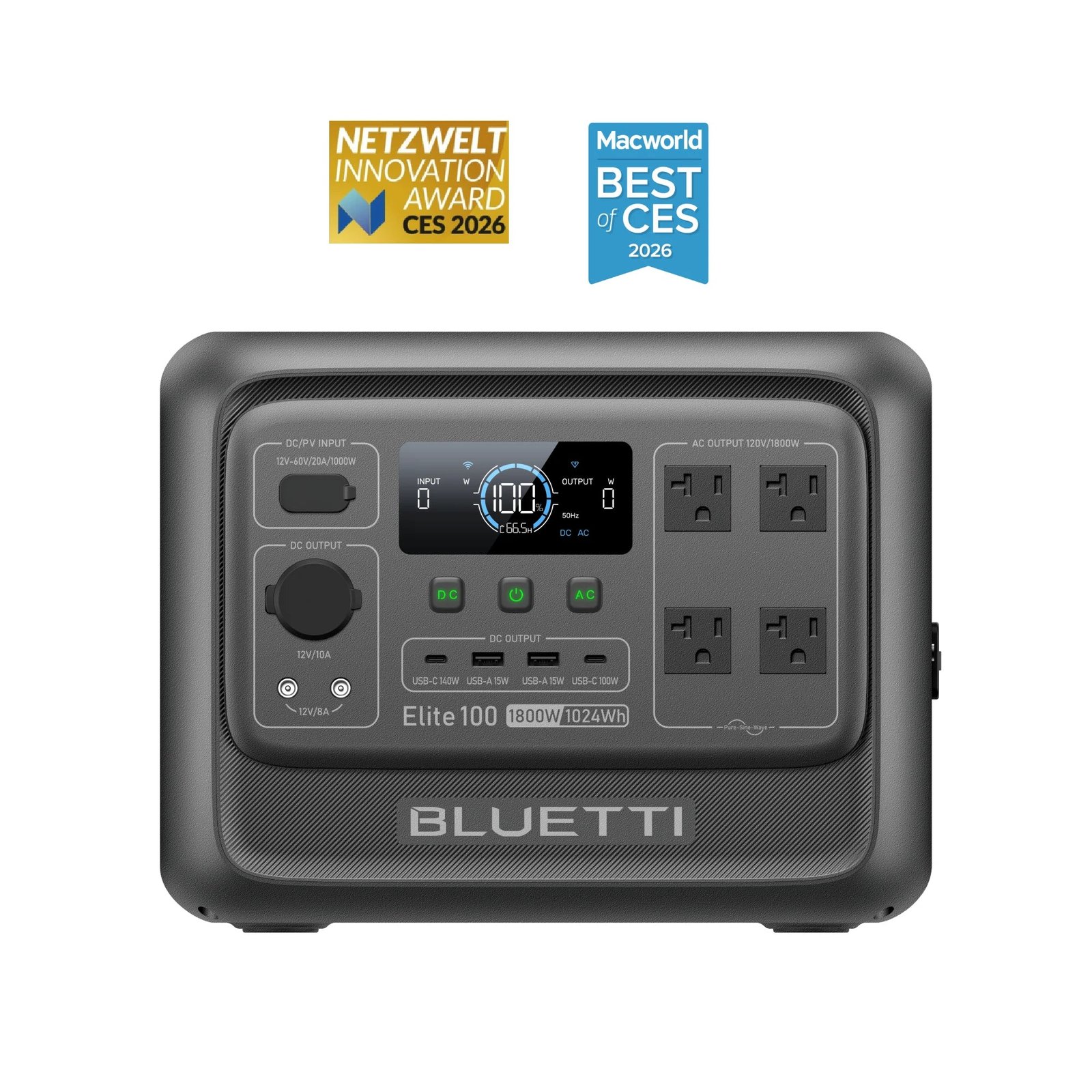
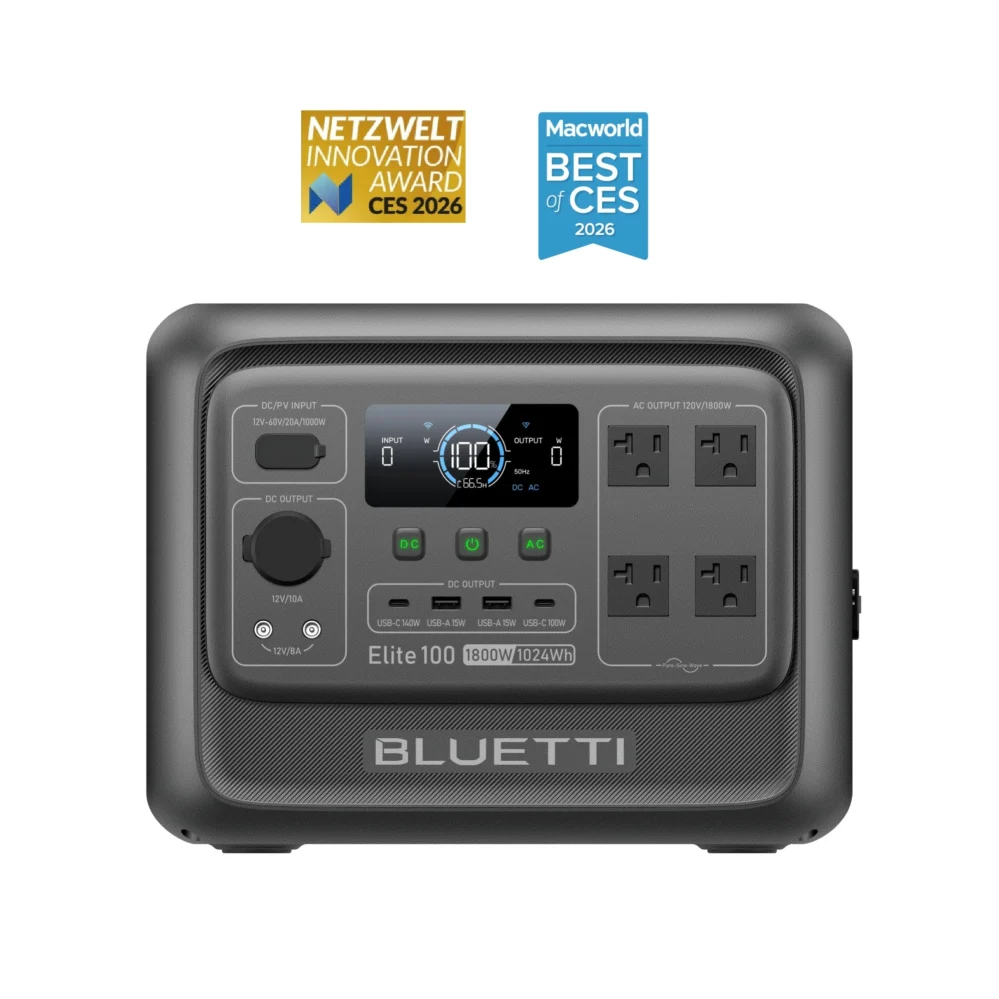
The Elite 100 V2 is the newer design. It is about 35% smaller by volume and roughly 10 pounds lighter than the AC180, according to the official Elite 100 V2 page and the AC180 product page.
Two 1kWh stations, two different jobs
Weight and size: where the Elite 100 V2 pulls ahead
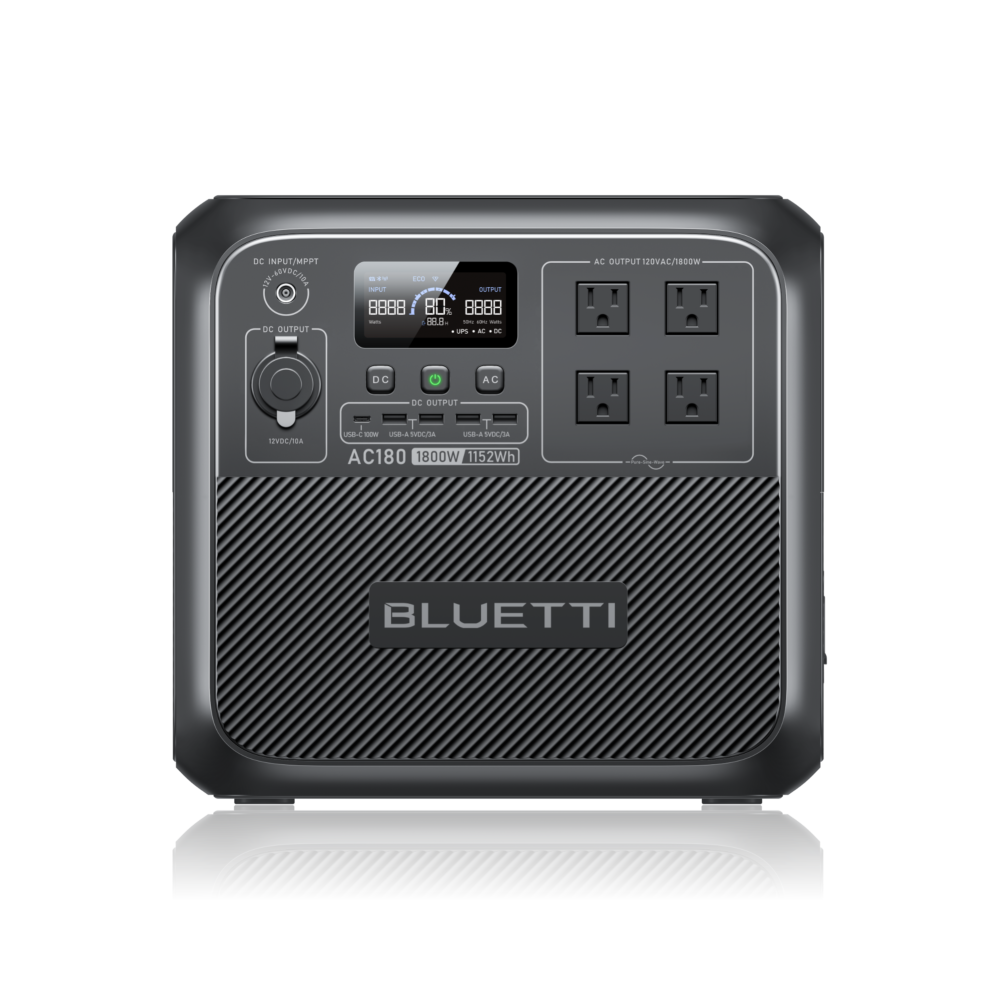
This is the biggest practical gap in the BLUETTI AC180 vs Elite 100 V2 matchup. The AC180 weighs 35.3 pounds in a 13.4 x 9.7 x 12.5 inch case, while the Elite 100 V2 comes in at 25 pounds and 12.6 x 8.5 x 9.8 inches.
A useful way to compare that is energy per pound. The Elite 100 V2 stores about 41Wh per pound (1,024 ÷ 25). The AC180 stores about 33Wh per pound (1,152 ÷ 35.3). That is roughly a quarter more energy for every pound you lift.
Ten pounds matters more than it sounds. It is the difference between a one-hand carry from the truck to the campsite and a two-hand carry with a rest halfway. For anyone who moves it often, this alone can decide it.
Recharging: solar favors the Elite, the wall favors the AC180
The two stations recharge in opposite ways, so think about where your power comes from.
Solar. The Elite 100 V2 accepts up to 1,000W of solar at 12 to 60V. The AC180 tops out at 500W. In practice, that means the Elite can refill from empty in roughly an hour and a quarter of strong sun with enough panels, while the AC180 needs about three hours at its limit. For off-grid camping, that is a real advantage.
Wall outlet. In Turbo mode the AC180 takes up to 1,440W, with 0 to 80% in 45 minutes and a full charge in about 1.3 to 1.8 hours, per the spec sheet. The Elite 100 V2 takes 1,200W and quotes the same 45 minutes to 80%. So the gap here is small, but it favors the AC180.
Car. A standard 12V socket is slow on both. One review measured the AC180 at about 100W from a car outlet, so a full charge takes over ten hours (The Gadgeteer). BLUETTI sells an alternator charger for faster driving top-ups, but that is an extra purchase for either unit.


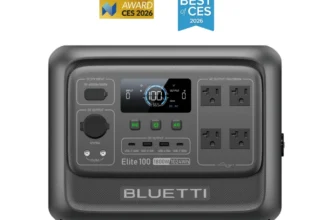
BLUETTI Elite 100 V2: the better carry
01
1,024Wh LiFePO4, 1,800W output, 25 lb
The Elite 100 V2 gives up 128Wh to the AC180 and gets a lot back for it. It is ten pounds lighter, it takes twice the solar input, and its UPS switches over in 10 milliseconds or less, which is fast enough for most desktop PCs and network gear.
It also adds Wi-Fi to the app, so you can check it from another room. And it has two USB-C ports, one rated at 140W, which charges a large laptop at full speed. For a deeper look at this unit on its own, see our Elite 100 V2 review.
- About 41Wh per pound, the best ratio of the two
- 1,000W solar input refills it in a single sunny afternoon
- UPS switchover of 10 ms or less
- Two USB-C ports, including a 140W port
- Wi-Fi and Bluetooth app control
- 4,000+ rated cycles to 80% capacity
- About 12% less stored energy than the AC180
- Slightly slower wall charging (1,200W vs 1,440W)
- No wireless charging pad
- The US product page does not state the warranty term
BLUETTI AC180: more energy, faster wall charging
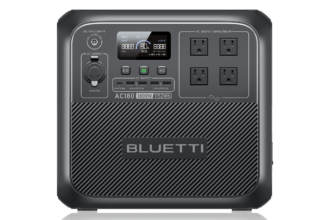
1,152Wh LiFePO4, 1,800W output, 35.3 lb
The AC180 is the older design, and it carries the weight to prove it. But it still holds about 12% more energy than the Elite 100 V2, and it refills faster from a wall outlet. For a unit that sits in a closet or rides in a truck bed, the extra weight rarely matters.
It also has a 15W wireless charging pad on top, four USB-A ports and a clearly stated 5-year warranty. Its UPS switchover is slower, rated under 20 ms according to the manual, so very sensitive electronics may not ride through an outage. It replaced the AC70 as our step-up pick in the AC70 review.
- 1,152Wh, the larger battery of the two
- 1,440W Turbo wall charging, 80% in 45 minutes
- 15W wireless charging pad
- Five-year warranty stated on the product page
- Quiet 45 dB Silent charging mode
- About 10 pounds heavier and a third larger
- Solar input capped at 500W
- Bluetooth only, no Wi-Fi
- UPS switchover rated under 20 ms, slower than the Elite
Durability: closer than the cycle ratings suggest
The Elite 100 V2 is rated for 4,000+ cycles to 80% capacity. The AC180 is rated for 3,500+. At first glance, that looks like a win for the Elite.
But multiply cycles by capacity and the two land in the same place. The AC180 can deliver about 4.0 megawatt-hours over its rated life (1,152Wh × 3,500). The Elite 100 V2 can deliver about 4.1 megawatt-hours (1,024Wh × 4,000). So the lifetime energy is effectively identical.
In other words, neither battery will wear out first in any way you would notice. Daily cycling for ten years still sits inside either rating. Pick on weight and charging, not on cycle count.
| Elite 100 V2 | VS | AC180 |
|---|---|---|
1,024Wh | Capacity |
1,152Wh |
25 lb | Weight |
35.3 lb |
~41 Wh/lb | Energy per pound |
~33 Wh/lb |
1,000W | Max solar input |
500W |
1,200W | Max AC charging |
1,440W |
≤10 ms | UPS switchover |
<20 ms |
4,000+ | Rated cycles (to 80%) |
3,500+ |
1 | Wi-Fi app control |
– |
– | Wireless charging pad |
1 |
| Check price | Check price |
Ports and features
Both stations have four 120V AC outlets and a 12V car outlet. The differences are in the low-voltage ports.
The Elite 100 V2 has two USB-C ports, rated at 100W and 140W, plus two USB-A ports and two DC5521 barrel jacks. The 140W port is the one to note, because it can charge a 16-inch laptop at full speed without the AC inverter running. That matters because the inverter typically loses 10 to 15% of the energy it converts.
The AC180 has one 100W USB-C port, four USB-A ports and a 15W wireless charging pad on the lid. So it suits a household that charges several phones at once. But it gives up the second high-wattage USB-C port.
For app control, the Elite 100 V2 connects over Wi-Fi and Bluetooth. The AC180 uses Bluetooth only, so you need to be within range to check it.
What runtime looks like in practice
| Assumption | Constant 100W AC load and about 85% inverter efficiency (a typical figure, not a BLUETTI rating) |
| Elite 100 V2 | About 8.7 hours (1,024Wh × 0.85 ÷ 100W) |
| AC180 | About 9.8 hours (1,152Wh × 0.85 ÷ 100W) |
| Difference | Roughly one extra hour for the AC180 at this load |
| DC loads | Running devices from USB-C instead of AC skips the inverter loss and stretches either figure |
How to choose between the BLUETTI AC180 vs Elite 100 V2
Start with how you will recharge it. If solar is part of the plan, the Elite 100 V2 is the clear pick, because its 1,000W input doubles what the AC180 can accept.
Then think about how often you will move it. If it lives in a closet for outages and only comes out a few times a year, the AC180's extra weight costs you little. In return, you get a bit more energy and faster wall charging.
Finally, check what you are protecting. For a desktop PC, NAS or modem, the Elite 100 V2's faster UPS switch is the safer choice. If you are sizing a unit for a CPAP machine instead, our BLUETTI X30 CPAP review covers a smaller, lighter option. To compare the whole lineup on value, see which BLUETTI power station is worth it.
Frequently asked questions
Is the Elite 100 V2 a replacement for the AC180?
BLUETTI positions the Elite 100 V2 as the more compact successor, but the AC180 is still sold on BLUETTI’s US store. The Elite trades a little capacity for a much lighter, smaller case and double the solar input.
Can either one run a full-size refrigerator?
Often, yes, but check your fridge first. Most full-size fridges draw far less than 1,800W while running. The compressor’s startup surge is the real test, and it varies by model, so look at the label or measure it with a plug-in meter. Expect roughly a day of runtime or less from about 1kWh, depending on how often the compressor cycles.
What does Power Lifting mode actually do?
It lets either unit run resistive appliances rated up to 2,700W, like a hair dryer or kettle, by lowering the voltage instead of shutting off. The appliance runs slower or cooler. It does not work for motors or electronics that need full voltage.
Which is better for a desktop computer during outages?
The Elite 100 V2. BLUETTI rates its UPS switchover at 10 ms or less, while the AC180’s manual rates it under 20 ms. Desktop power supplies are typically designed to ride through a gap of about 16 ms, so the Elite sits comfortably inside that and the AC180 may not.
Which one is quieter?
BLUETTI quotes 30 dB for the Elite 100 V2 under light loads and 45 dB for the AC180 in its Silent charging mode. Those figures come from different conditions, so they are not a direct comparison. But the Elite is the one designed around low noise, which matters if it runs in a bedroom or tent.
Buy the Elite 100 V2 if you will carry it, charge it from solar, or protect a computer with it. Buy the AC180 if it will mostly sit still, charge from a wall outlet, and you want every extra watt-hour. Lifetime durability is effectively a tie, so weight and charging are what decide it.
Weight and solar, or capacity and wall charging
- Elite 100 V2: lighter, smaller, 1,000W solar, faster UPS switch.
- AC180: 12% more energy, faster wall charging, wireless pad.
- Lifetime energy is about equal, so durability is not the tiebreaker.
The BLUETTI AC180 vs Elite 100 V2 decision is simpler than the spec sheets make it look. Both have the same inverter and the same outlets, and both will outlast your need for them. The Elite 100 V2 is the better buy for most people because it is lighter and far better on solar. The AC180 still earns its place as a stationary backup with a little more energy.
BLUETTI Elite 100 V2 Portable Power Station | 1,800W 1,024Wh Elite 100 V2