

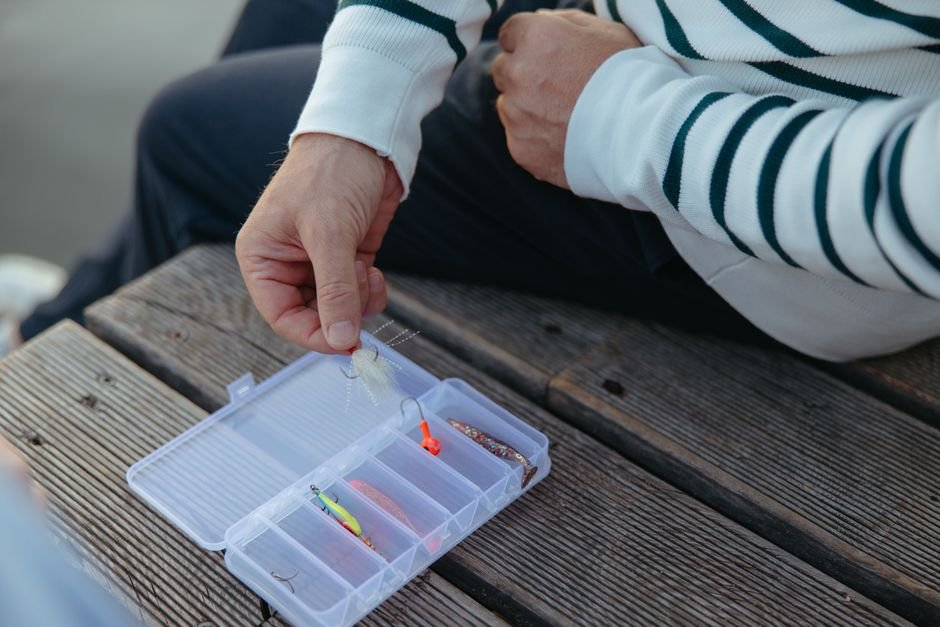
A full tin is useless if its hook, line, bait, and target fish are mismatched.
A tiny hook tied to heavy, stiff line can kill natural bait movement; a fine line paired with an oversized hook can fail at the first snag. Catchability is a chain, and its weakest mismatch—not the number of gadgets—sets the result.
For small freshwater fish, a compact setup usually works around a single line class, two nearby hook sizes, and bait that fits the hook’s gape. Clear 4–6 lb mono is a practical middle ground for many ponds and slow streams; 2 lb line is less conspicuous but sacrifices abrasion margin. Carrying a few proven components also leaves room for line wrapped on a flat winder and keeps tangles from turning a fishing opportunity into loose hardware.


Build for the water actually ahead
The pocket fishing kit contents are rarely one universal kit.
Additionally, for an opportunistic hiking kit, favor compact terminal tackle that works with found bait.
Moreover, this suits short pauses at clear creeks, ponds, and accessible banks.
An emergency-oriented kit prioritizes durable line, several bait-holder hooks, and simple weights for soaking natural bait. It is more credible around waters with dependable small fish, crayfish, insects, or worms than on large, wind-exposed lakes where casting distance matters.
For an angler already carrying a rod, the tin is a failure-proofing reserve: spare hook sizes, leaders, snaps, weights, and one confidence lure. Choose hook gape and line strength for the likely fish, then reduce bulk according to conditions:
- Tight, snag streams: stronger line, fewer exposed trebles, compact weights.
- Open ponds: lighter line and a small lure can be more useful.
- Remote water: add redundancy; replacing lost terminal tackle may be impossible.
- Known bait availability: carry hooks and rigging, not duplicate bait.
Every item must earn its cubic inch
- More than one job
A hook, split shot, swivel, and short leader can build a bait rig, handline, float rig, or repair a failed connection.
Look forTerminal pieces that combine into several simple rigs.Leave outSingle-purpose tools with no fishing role. - Still usable when soaked
Hooks and swivels need corrosion-resistant finishes; line and bait must remain separated from damp metal in a gasketed or tightly closing case.
Look forProtected tackle that can be handled with cold, wet fingers.Leave outLoose components that rust or tangle after one wet outing. - Effective without a rod
Line must be long enough to handline, and the hook-and-weight combination must be manageable beside cover, under banks, or from a dock.
Look forCompact rigs that fish vertically or at close range.Leave outLures that only work with repeated casting. - Sized for real bait and real strain
A few proven hook patterns that hold worms, insects, and cut bait outperform novelty gadgets. Compartments keep sharp points, sinkers, and line accessible.
Look forStrong small tackle, bait-holding hooks, and deliberate separation.Leave outBulky survival trinkets and mixed, loose hardware.
A small selection of hooks, split shot, swivels, and dependable line solves more fishing problems than a gimmick-heavy tin. Versatility comes from compatible parts, not clever packaging.
Line is the kit’s load-bearing component
A pocket kit fails quickly when its line is too light for the cover, too visible for the water, or too bulky to leave room for hooks and weights. Line connects every improvised rig: handline, fixed bait rig, leader, snare-like branch presentation, or a repair to damaged tackle. Its reliability matters more than carrying several lure styles.
Match diameter to the situation
Clear, open water and wary small fish favor roughly 4–6 lb clear monofilament.
Its smaller diameter is less conspicuous, lets tiny baits move naturally, and packs densely.
The trade-off is limited abrasion resistance. Rock edges, mussels, timber, and a hard-running fish can damage it quickly.
Mixed water with brush, rock, or larger fish calls for about 8–12 lb mono. It is easier to grip and manage as handline, tolerates rougher cover, and still works with common hooks and natural bait. Heavier line may reduce bites in very clear water and makes delicate presentations less convincing.
A useful capacity rule is one dependable spool, not a closet of line: about 30–60 yards is ample for several rigs, reties, and a lost section while preserving tin space. Inspect the first few feet after every snag; nicks and whitening are reasons to cut back and retie.
Hooks that fit bait and fish
A pocket kit rarely needs trophy-hook patterns. For worms, grubs, bread, insects, and small baitfish, six to twelve hooks in three useful sizes generally cover more real fishing than dozens of oversized models. Exact numbering is not universal between makers, so compare the actual gap and wire rather than trusting the printed size alone.
Build a small working spread
- Small short-shank hooks suit maggots, insect pieces, and small worms; they also hide readily in compact bait.
- Medium baitholder or Aberdeen-style hooks handle a full worm, dough, or a small baitfish without excessive bulk.
- Keep one slightly wider-gap pattern for thicker bait or deeper-bodied panfish and small carp.
Shank length matters: a longer shank makes baiting and unhooking easier, while a short shank can look less intrusive with tiny baits. Gap matters more than overall hook length; once bait is on, enough open gap must remain to find purchase.
Inspect points before packing. A sharp hook grabs a thumbnail lightly, not skims across it. Dull or bent hooks waste more chances than an expanded size assortment restores.
High-carbon steel hooks are strong, but salt exposure requires rinsing, thorough drying, and a sealed compartment.
Keep each size separated in a rigid micro box. Loose hooks blunt points, tangle line, and turn a fast rig into a frustrating search.
Pack Components That Become Fishable Rigs
-
Set up the close-range split-shot rig
Tie a hook directly to the main line, then pinch one or two small split shot 12–24 inches above it. The short, simple rig drops a worm, grub, insect, or other natural bait beside bank cover with little casting effort. Start with the least weight that reaches bottom and holds contact.
-
Move the shot when the water dictates
Keep the weight closer to the hook in current or when bites need to be felt clearly on bottom. Slide it farther up for a slower, more natural fall over softer bottom. In snaggy brush, a single small shot is usually easier to free than a heavy cluster.
-
Build the float rig for weed edges
Thread on a small fixed float, add a light split shot below it, and tie on the hook. Set the float so bait hangs just above the weed tops or bottom rather than disappearing into them. This presentation keeps the offering visible to cruising fish and signals delicate takes.
-
Match float size to bait and wind
A slim, sensitive float suits small bait and calm water; a slightly larger body remains readable in ripple or when casting farther. The shot should barely cock the float upright. Too much weight makes a fish feel resistance before the signal is seen.
-
Use swivels only where twist earns them
A tiny swivel can prevent line twist below a spinning lure, a rotating bait, or a repeatedly retrieved float rig. For a short bait rig lowered close to cover, direct line-to-hook connection is lighter and less conspicuous. Extra clips, swivels, and beads can also collect weeds and create weak, bulky junctions.
Pre-tie neither rig permanently: adjustable shot placement and float depth are their main advantages.
Weight, floats, and only workable lures
A few removable split shot make the bottom rig adaptable. One or two shot near the hook settle bait in a mild current. While several spaced along the line add sink rate without one bulky weight.
Carry assorted small, non-toxic shot if possible. Oversized shot can kink light monofilament and make delicate bait presentation look unnatural. This choice keeps the rig neat and helps fish respond to natural currents. If you must use larger weights, space them farther apart to reduce snag risk.
A slim pencil float or small fixed bobber gives the suspended-bait rig a visible depth reference. It is most useful around weed edges, shallow margins, and slow pools. Choose a float light enough that a small fish can pull it under, but buoyant enough to carry the selected shot and bait.
A bait-first kit can stop there. It leaves room for more hooks, line, and bait security—the items most likely to produce fish when worms, insects, or other local bait are available.
A lure-capable kit needs only one or two compact options: perhaps a small inline spinner and a plain soft-plastic grub with a light jig head. These can cover moving water and baitless moments, but only when the line can be retrieved steadily. Large crankbaits, surface walkers, diving plugs, and heavy spoons demand casting distance, rod action, or a controlled retrieve that a handline and improvised rod rarely provide.
Tiny multi-lure assortments often consume space with duplicates and rigid plugs. A lure earns its slot only if it can be cast, retrieved, and controlled on the kit’s actual line and rod substitute.
Protect the small tools that make rigs work
A pocket kit needs one dependable line cutter: compact snips, folding scissors, or a small nipper that cleanly cuts the heaviest line carried. Blades that crush mono leave curled, weakened ends that are harder to thread and knot. A knife already carried in a pocket survival kit checklist may cover this job, so a second cutter only earns space when it is demonstrably easier to use on fine line.
Hooks deserve their own secure compartment—not a loose corner of the tin. A small divided box, hook wallet, or short section of closed-cell foam keeps points separated from line, fingers, and soft-plastic baits. Store hooks dry, with points covered or embedded, and discard any showing corrosion.
Keep moisture from becoming the failure point
Choose a waterproof, transparent container with a gasket and positive latches, then organize contents so the most-used hooks and shot are visible at once. The Plano 3440-10 Waterproof Stowaway is a compact single-compartment option with a Dri-Loc O-ring seal and three cam-action latches; it suits protected storage when internal mini-packets provide the divisions.
Small forceps or split-ring pliers can help unhook fish and pinch shot, but they are optional. If multitool pliers are already carried, avoid duplicating their bulk. After rain or immersion, open the kit when practical and dry every component before repacking.
Make a small kit fish well
A pocket kit gains reach from observation, not extra hardware. Before rigging, watch shaded banks, current seams, undercut edges, weed gaps, and the quiet water immediately downstream of cover. Polarized glasses help, but a few still minutes often reveal dimples, cruising fish, or bait movement.
Use only natural bait that is lawful to collect and use on a day hike. A small worm, insect, grub, or other permitted local offering generally needs a hook size that leaves enough point exposed. Keep handling quiet: avoid stamping the bank, throwing shadows across clear shallows, or dropping the tin beside the water.
Set the bait at the fish’s level
Begin shallow enough to avoid weeds, then move the float stop or pinch-on shot in small increments. Suspended fish may take a bait held just above cover; bottom-feeding fish often respond when the weight lets it touch down without pinning the offering in silt. In moving water, let the bait travel naturally rather than dragging it against the current.
A handline deserves rehearsal. Practice tying the chosen knots, threading bait neatly, balancing the float so only its tip shows, and retrieving with steady hand-over-hand pressure. That preparation makes a snag, sudden run, or low-light rig change far less clumsy.
At home, rig the line from the closed tin, set the float, and retrieve a light pull without tangling. Familiarity is more valuable than an extra lure when the kit is finally needed.
Pack the core before the extras
-
Line first
Carry one wrapped spool or card of abrasion-appropriate monofilament; without sound line, every other component is inert.
-
Three hook sizes
Include a small, medium, and larger bait hook in a dry divided compartment. Check that points are sharp and gaps are unobstructed.
-
One depth-control set
A few removable split shot and one compact float cover bottom fishing, suspended bait, and changing current.
-
One cutting tool
A protected line cutter or small scissors is essential for tying, trimming, and replacing damaged terminal sections.
-
Add only proven extras
A few swivels, a compact lure, or forceps belong only when they support the intended water and handline method. Before leaving, inspect line for nicks, open each hook compartment, test the cutter, and confirm the tin closes dry.
Pocket Fishing Kits: Common Questions
What line strength works best for a pocket fishing kit?
For clear, open water and wary small fish, roughly 4–6 lb clear monofilament works well since it’s less conspicuous and lets bait move naturally. For mixed water with brush, rock, or larger fish, about 8–12 lb mono tolerates rougher cover and is easier to manage as a handline.
How many hook sizes should actually be carried?
Six to twelve hooks in three useful sizes generally cover more real fishing than dozens of oversized models: a small short-shank size for maggots and insect pieces, a medium baitholder or Aberdeen-style size for a full worm, and one wider-gap pattern for thicker bait or deeper-bodied fish.
Is a swivel necessary for every rig?
No. A tiny swivel helps prevent line twist below a spinning lure or rotating bait, but for a short bait rig lowered close to cover, a direct line-to-hook connection is lighter and less conspicuous. Extra clips and swivels can also collect weeds and create bulky junctions.
What's the difference between a hiking kit and an emergency fishing kit?
An opportunistic hiking kit favors compact terminal tackle that works with found bait—a few hooks, split shot, small swivels, and perhaps one micro lure—for short pauses at accessible banks. An emergency-oriented kit prioritizes durable line, several bait-holder hooks, and simple weights for soaking natural bait over longer, more deliberate sessions.
How do I know if my fishing line needs to be retied?
Inspect the first few feet of line after every snag. Nicks and whitening along the line are signs of abrasion damage and are reasons to cut back and retie rather than risk a failure on the next fish.
- Prioritize a fishable bait rig over a larger assortment of specialized tackle.
- Inspection is where a compact kit reveals failures before they reach the water.
A capable pocket kit is deliberately plain: dependable line, correctly sized hooks, adjustable weight and float, and a cutter. Optional pieces remain worthwhile only when they make that core system more reliable for the water at hand.
SF Ultra Smooth Monofilament Mono Fishing Line with Spool Mono String Nylon Invisible Line Clear 2 4 6 8 10 12 14 17 20 20LB Fishing Wire Freshwater Saltwater
Features
| Brand Name | SF |
| Item Length | 330 yard |
| Number of Items | 1 |
| Unit Count | 1 Count |
| Manufacturer | SF |
| Model Number | SF-US-30002CL |
| Manufacturer Part Number | SF-US-30002CL |
| ASIN | B0CDGLRS7Q |
| Line Weight | 20 pounds |
| Size | 300m |
| Line Size | 0.12 millimeters |
| Material Type | Nylon |
| Strand Type | Single |
| Fishing Line Type | Monofilament |
| Breaking Strength | 20 pounds |
| Color | Clear-2LB/0.12MM |
- Break Strength: 2LB/0.9KG, Dia:0.005in/0.12MM, Length: 330yds/300m, Color: Clear.
- Ultra Smooth and Good Strength: SF monofilament fishing line can achieve smooth casting and resists twists and kinks, which allows you to land your lure exactly the place you want. And this line features excellent abrasion resistance, strong and durable holding power.
- Low Absorption and Great Sensitivity: SF mono fishing line possess a constant uniform diameter. The quicker retrieval, letting you feel even the slightest bite from fish.
- Premium spool affords quick, tangle-free availability, and very convenient to carry around. Smooth casting for maximum manageability, resists twists and kinks.
- Superior clarity, the invisible line is of excellent transparency for ultra-low visibility, are available for freshwater and can also be used to tie balloons.
300PCS Small High-Carbon Steel Barbed Fishing Hooks,Hole,10 Sizes | Small High-Carbon Steel Barbed Fishing Hooks with Holes, 10 Specifications of Fishing...
Features
| Brand Name | OstWony |
| Number of Pieces | 300 |
| Unit Count | 1 Count |
| Manufacturer | OstWony |
| UPC | 661918876486 |
| Set Name | 300PCS Fishing Hook Set |
| Number of Items | 300 |
| Fishing Hook Type | J Hook |
| ASIN | B08XQQ8K7Q |
| Color | Silver |
| Material Type | High Carbon Steel |
| Style Name | Modern |
| Size | Varies (Small To Large) |
| Item Weight | 1 g |
| Point Style | Needle Point |
| Target Species | Bass, Catfish, Salmon |
- OUR PRODUCTS: A reasonable combination of fish hooks, 3#, 4#, 5#, 6#, 7#, 8#, 9#, 10#, 11#, 12#, a total of 10 types of fish hooks 30PCS each.
- SPECIAL DISIGN: Sharp tip with barbs, to ensure that the fish caught by the hook is not easy to break free, tail with holes, easy to thread quickly and lock the fish hooks.
- HIGH QUALITY MATERIAL: The fishhook is made of high carbon steel, excellent material, high strength, high toughness, corrosion resistance.
- HIGH APPLICABILITY: Fishing hooks are suitable for all kinds of fresh and saltwater environments, allowing you to catch salmon, carp, bass and many other fish easily.
- AFTER-SALES SERVICE: Thank you for your purchase!If you have any quality problem when you receive the product or use the product, please contact us in time. We will ensure to provide you with satisfactory service.
Plano 3440-10 Waterproof Stowaway (3400 Series)
Features
| Item Dimensions L x W x H | 7.38"L x 4.5"W x 1.75"H |
| Capacity | 10 liters |
| Item Weight | 0.27 g |
| Number of Items | 1 |
| Storage Volume | 7375 liters |
| Number of Compartments | 1 |
| Unit Count | 1 Count |
| Package Quantity | 1 |
| Maximum Weight Recommendation | 5 kg |
| Color | Multi |
| Style Name | Regular |
| Shape | Rectangular |
| Pattern | Solid |
| Material Type | Plastic |
| Other Special Features of the Product | Lockable |
| Closure Type | Latch |
| Water Resistance Level | Waterproof |
| Opening Mechanism | Latch |
| Lock Type | Latch |
| Brand Name | Plano |
| Recommended Uses For Product | Für Aufbewahrung |
| UPC | 024099134408 |
| Global Trade Identification Number | 00024099134408 |
| Included Components | Great Product |
| Item Type Name | Great Product |
| Manufacturer | Plano |
| Model Number | 344010 |
| Manufacturer Part Number | 344010 |
| Manufacturer Warranty Description | Warranty |
| ASIN | B00469G31G |
- Fishing equipment tackle bags and boxes
- Dri Loc O ring seal
- Three tight sealing cam action latches
- Perfect for phones and other small valuables



9 Comments
Maybe I’m missing something, but handlining a lure sounds like a recipe for a terrible bird’s nest and one very annoyed fish 😂 Are there any lures you genuinely think belong in a kit, or would you skip them entirely for a beginner?
That skepticism is fair. For most beginners, bait rigs should come first because they work with a simple drop, drift, or controlled retrieve. If you add one lure, choose something compact that can be worked slowly and directly—such as a small jig or tiny spoon—rather than a lure that needs long casts or high-speed retrieves. Practice winding line around a flat spool or handline winder; loose coils are what create most tangles.
I keep one 1/16 oz marabou jig in mine. It is not elegant on a handline, but around dock posts or little creek pools it has saved a slow bait day.
The “lawful bait” reminder is important. People talk about digging worms anywhere like the rules don’t exist, then act surprised when a park ranger is unimpressed. A tiny kit is nice because I can bring a few legal worms in a small container instead of trying to live off the landscape.
For a creek with a lot of roots and fallen branches, would you go straight to 10 lb mono, or is 6 lb still worth trying? I get hung up constantly, but I also worry thicker line will make small bait look weird to panfish.
For rooty, snaggy creek water, 8–10 lb mono is the more practical pocket-kit choice. Panfish usually care far more about a naturally presented bait, quiet approach, and correct depth than the difference between 6 and 10 lb line. Use the smallest shot you can, keep the hook modest, and try to fish just beside the worst cover rather than deep inside it.
This is the first pocket-kit advice I’ve read that doesn’t try to cram a whole sporting-goods aisle into an Altoids tin. The point about a sharp cutter earning its space makes total sense.
Could you explain what makes a float “sensitive” in this situation? Is a tiny fixed bobber fine, or do you specifically mean a slip float? I’d be fishing pond edges with weeds, probably for bluegill and small bass, and I don’t have a rod—just the kit.
When you say three hook sizes, what sizes are you actually thinking? I mostly have access to worms, bits of bread, and occasionally crickets. The hook packages at my local store use different numbering systems and it gets confusing fast.