
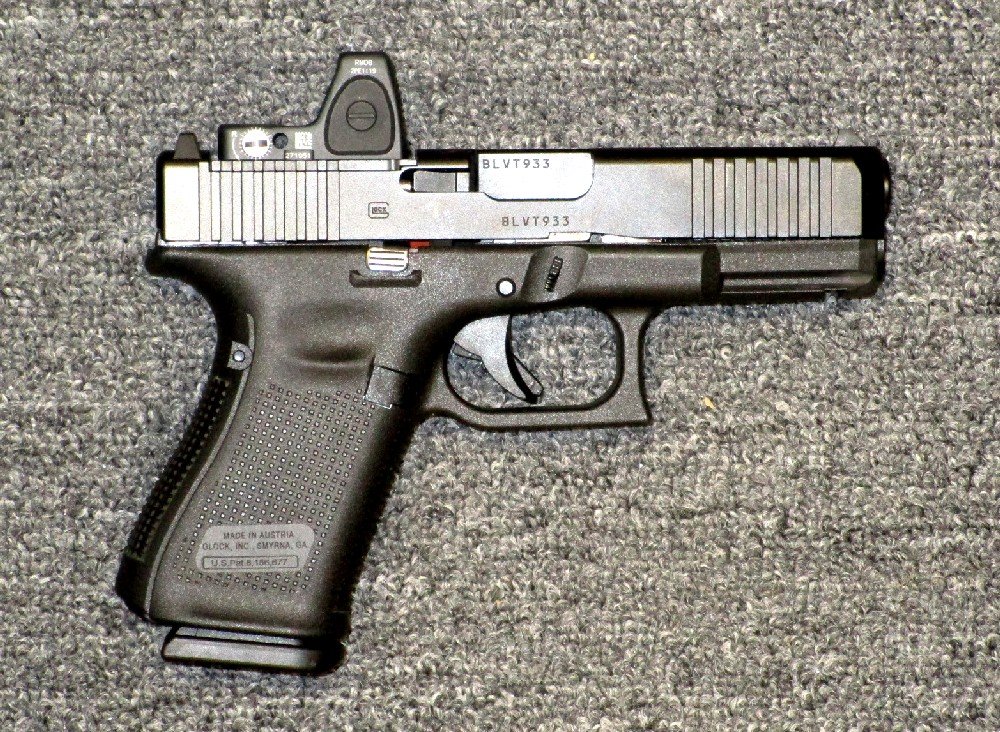
An MOS slide is only the beginning of the mounting system.
A Glock 19 MOS can arrive labeled optics-ready and still leave its owner sorting through four interlocking variables: the slide cut, adapter plate, optic footprint, and screw set. Add iron-sight height, and a seemingly simple red-dot purchase becomes a stack-up problem.
The useful question is not whether a sight is broadly “Glock MOS compatible.” It is whether its complete mounting stack is known: which plate (if any) it uses, whether the screws match both the optic and slide engagement requirements, how high the optic sits, and whether the existing sights remain visible through its window. A direct-mount MOS-specific optic eliminates a plate but limits choices; an RMR-footprint model expands the field while adding plate selection and height. The strongest purchase is the one with a documented, repeatable interface—not the broadest compatibility claim.

Choosing the right Glock MOS red dot comes down to verifying the full mounting stack — plate, footprint, and screws — rather than trusting a broad compatibility claim on the box.
Choose the mount before the reticle


A footprint is not an MOS fit
The Glock MOS cut and an optic’s footprint answer different questions. The slide cut accepts a Glock-pattern mounting plate; the footprint describes the lug positions and screw pattern on the optic’s underside. An RMR-footprint 407C or 507C is therefore not automatically direct-mount compatible with a Glock 19 MOS—it needs a plate that bridges those two interfaces.
Plate details matter more than broad labels. Glock has supplied different MOS plate sets across production periods and packages, while aftermarket plates may change lug geometry, screw hardware, and thickness. A plate marked for an RMR-pattern sight must still match the specific slide’s plate interface and the optic’s recoil-lug pockets.
Check the stack, not the claim
A real fit consists of four parts:
- Slide to plate: the plate seats fully in the MOS pocket and its locating features engage correctly.
- Plate to optic: recoil lugs fit the sight’s pockets without forcing or rocking.
- Screws: thread pitch, length, and head style suit that exact plate-and-optic combination; screws that bottom out can feel tight without clamping the sight.
- Height and clearance: the completed stack clears the ejection port and determines whether factory-height irons remain visible.
The Holosun SCS MOS is the exception in this group: its dedicated MOS interface eliminates the separate conversion plate, but it must still match the intended Glock MOS slide pattern. The TSA and ARORY options warrant the same stack check, especially when an included adapter is described only as “Glock MOS.”
Mounting Is Only the Starting Point
Each optic was assessed as a complete Glock 19 MOS installation, not merely as a footprint match. A workable setup needed to preserve a usable sight picture and remain practical to service after installation.
The check included the MOS plate or direct-mount interface, recoil-lug engagement, correct screw length and thread clearance, and whether the assembled optic avoided slide-contact issues.
Direct mounting and plate-mounted optics sit at different heights. Each configuration was considered for window position, factory-sight visibility where applicable, and whether a sensible backup-sight solution remained possible.
The standard also favored accessible battery changes, identifiable replacement hardware, and mounting arrangements that can be removed and reinstalled without turning routine maintenance into a fitment experiment.
Included hardware can change by seller or production run; plate, screw, and clearance details merit confirmation against the specific optic package and Glock slide.
Holosun SCS MOS: the Glock-specific low-stack answer
01
Top choice for direct-mount Glock MOS setups
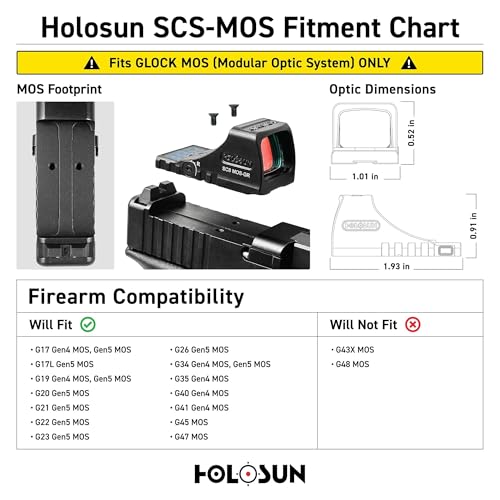
The Holosun SCS MOS is built around the full-size Glock MOS cut rather than adapted to it. It seats directly on the slide, eliminating the intermediate plate and producing one of the cleanest, lowest optic stacks available for compatible Glock MOS pistols.
Its solar-charged internal power system and automatic brightness management suit a pistol intended to stay configured rather than be routinely swapped among hosts. The key limitation is equally clear: this is a dedicated solution, not a broadly transferable optic footprint. It is not compatible with Glock 43X MOS or 48 MOS.
- Direct slide mount eliminates the plate layer
- Very low optic height supports a natural presentation
- Solar charging reduces routine battery-change concerns
- Circle-dot reticle offers fast acquisition options
- Dedicated Glock MOS interface limits host interchangeability
- Not compatible with Glock 43X MOS or 48 MOS
- Internal battery is not user-replaceable like a conventional cell
In brief The SCS MOS makes the strongest case when a compatible Glock MOS is its long-term home. Its direct interface trades ecosystem flexibility for unusually tidy integration.
For a compatible full-size Glock MOS, the SCS MOS removes the most failure-prone variable in a pistol-dot setup: the adapter plate. Direct mounting, low sight height, and automatic solar-assisted power management make it the high-confidence choice for a streamlined dedicated build.
A conventional footprint optic remains more adaptable across pistols. But where the goal is a clean Glock-first installation rather than cross-platform reuse, the SCS MOS is difficult to surpass.
Holosun 407C/507C X2: mature RMR ecosystem, taller MOS stack
Proven feature set at a lower price
The 407C X2 and 507C X2 take the Glock 19 MOS in a different direction from a direct-mount optic: both use the ubiquitous RMR footprint, so the slide needs a Glock MOS-to-RMR adapter plate. That extra interface is not a footnote. Plate geometry, recoil-lug engagement, included screws, and clearance beneath the optic all need verification for the specific Glock generation and plate.
The 407C X2 is the straightforward choice: a 2 MOA dot, solar assist, and Shake Awake in a familiar open-emitter housing. The 507C X2 adds Holosun’s Multi-Reticle System, switching among a 2 MOA dot, 32 MOA circle, and circle-dot combination. That flexibility can speed initial visual acquisition, while the dot-only 407C keeps the aiming presentation simpler.
An RMR plate raises the window above the MOS cut. Compared with the SCS MOS, the resulting sight picture is taller and factory-height irons may sit lower in the window or disappear entirely. The payoff is access to a broad, mature plate ecosystem and easier optic portability across other RMR-cut handguns.
- Broad RMR plate ecosystem
- Solar assist and Shake Awake
- 507C offers selectable reticles
- Portable across RMR-cut pistols
- Plate adds stack height
- Fit depends on plate hardware
- More interfaces to inspect
Choose the 407C X2 for a clean 2 MOA-dot setup, or the 507C X2 when a large acquisition circle and alternate reticles matter. Both make sense on a Glock 19 MOS only after the chosen RMR plate, screws, and final sight height have been confirmed as one stack.
Best for flexible Glock mounting options
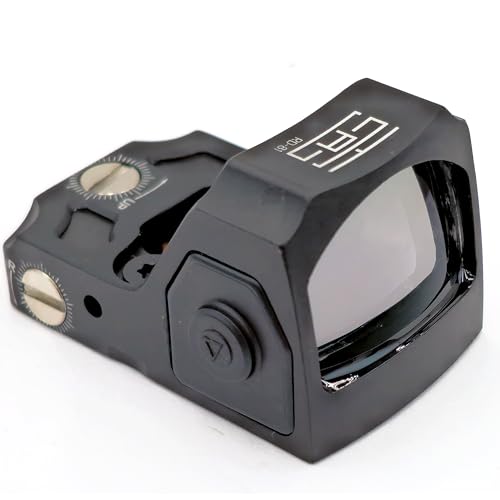
The TSA 2 MOA green-dot sight is the low-cost, multi-mounting alternative: an RMR-pattern optic packaged with plates or mounts intended for Glock MOS, non-MOS Glock slides, and Picatinny rails. Its appeal is straightforward—a green emitter, motion-activated wake function, and several brightness settings at an entry-level price.
For a Glock 19 MOS, the adapter deserves more scrutiny than the feature list. The listing’s broad fit claim does not establish which MOS plate version is supplied, how it indexes in a particular Gen 3–5 slide, or whether the included screws are the correct thread pitch and engaged length for that exact plate-and-optic stack. Confirmation should come from current adapter documentation and the hardware package itself, not the RMR-footprint label.
- Green 2 MOA dot
- RMR-pattern optic body
- Shake-awake function
- Multiple mounting paths
- Adapter details need verification
- Screw specification is unclear
- Limited long-term support record
- Broad fit claims warrant caution
Includes mounting hardware for several pistol footprints
ARORY RMU1: multi-reticle features with a verification step
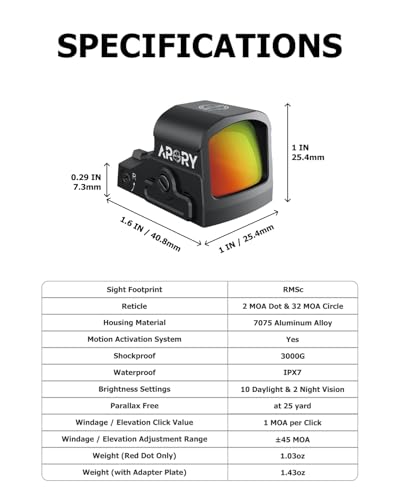
The RMU1 packages a 2 MOA dot, 32 MOA circle, side-loading battery, motion activation, and an RMSc-pattern body into a compact 7075-aluminum optic. Its included Glock MOS adapter plate makes it a potentially appealing value-oriented route for shooters who want a circle-dot presentation without moving into the established Holosun 507C X2 ecosystem. The important caveat is fitment: the supplied plate, its interface with the MOS slide, screw lengths, recoil-lug engagement, and installed sight height all merit independent confirmation before the optic is treated as a ready-made Glock 19 MOS solution.
- Selectable 2 MOA dot and 32 MOA circle
- Side-loading battery preserves the mounted zero
- Compact RMSc-pattern housing
- Glock MOS plate and varied screws are listed
- Actual MOS plate architecture needs verification
- Less proven support and accessory ecosystem
- Plate-mounted setup adds hardware variables
- Durability claims lack the long field record of Holosun
| Mounting priority | Reticle approach | Carry stack | Best fit | ||
|---|---|---|---|---|---|
|
Holosun SCS MOS Solar Multi-Reticle Reflex Sight Lowest stack | Direct MOS | Green multi-reticle | Lowest | Carry-focused Glock | View optic |
|
Holosun 407C/507C X2 RMR Footprint Sight RMR ecosystem | RMR plate required | Dot or circle-dot | Taller plate stack | Reticle experimentation | View optic |
|
TSA Green Dot Glock MOS Adapter Sight Lower entry | Included MOS plate | Green 2 MOA dot | Plate-dependent | Budget range use | View optic |
Verify the Mount Before Zeroing
-
Clear and inspect the pistol
With the magazine removed and chamber visually and physically confirmed empty, inspect the MOS cut, recoil bosses, plate, and optic underside for oil, burrs, or trapped debris.
-
Confirm the entire interface
Match the specific Glock MOS generation, plate part number, and optic footprint—not merely the optic brand. The SCS MOS uses its dedicated direct interface; RMR-pattern 407C/507C setups depend on the exact conversion plate.
-
Use hardware supplied for that stack
Screw length, head style, and thread pitch must suit the slide, plate, and sight together. A screw that is correct for one RMR plate can bottom out or protrude in another arrangement.
-
Check seating before final torque
The optic and plate should sit flat with no rocking or visible gap. Cycle the slide by hand and inspect from the underside and ejection-port area for screw intrusion or interference.
-
Torque and recheck deliberately
Apply the optic and plate manufacturers’ documented values and threadlocker instructions. Proper red-dot screw torque is meaningful only when it matches the documented stack and fastener, not a universal number.
More engagement is not automatically safer if a screw reaches the bottom of a hole, contacts internal slide components, or prevents the plate from clamping. After the specified cure time for any threadlocker, a visual inspection and a controlled function check can reveal a seating problem before zeroing.
Frequently Asked Questions
Is an RMR-footprint optic automatically compatible with a Glock 19 MOS?
No. The Glock MOS cut and an RMR footprint are different interfaces. An RMR-footprint sight like the 407C or 507C needs a Glock MOS-to-RMR adapter plate to mount on an MOS slide.
What does a complete mounting stack check include?
Four parts: the plate seating fully in the MOS pocket, the recoil lugs fitting the optic without rocking, screws with correct thread pitch and length, and confirmed clearance and sight height.
What is the advantage of the Holosun SCS MOS over plate-mounted optics?
The SCS MOS mounts directly to the Glock MOS cut with no adapter plate, producing one of the lowest optic stacks available, though it is not compatible with Glock 43X MOS or 48 MOS.
Why choose an RMR-footprint optic like the 407C or 507C instead?
RMR-footprint optics access a broad, mature plate ecosystem and are portable across other RMR-cut pistols, at the cost of a taller stack once the adapter plate is added.
What should be verified before torquing a red dot to final spec?
The optic and plate should sit flat with no rocking or visible gap, and screw length and thread engagement should match the specific slide, plate, and sight combination before applying the manufacturers documented torque value.
Buy the interface, not just the optic
- Confirm the Glock 19 is MOS and identify its exact plate system.
- Match plate-to-slide, plate-to-footprint, screw length, and recoil-lug clearance.
- Verify the sight seats flat before applying the specified torque.
For the cleanest Glock 19 MOS installation, the Holosun SCS MOS is the category winner: its direct slide interface eliminates the plate and keeps the optic notably low. The 407C/507C X2 is the stronger choice when access to the broad RMR-footprint ecosystem matters; choose 407C for a single dot or 507C for selectable reticles. The TSA is best treated as a low-commitment budget experiment, while the ARORY RMU1 suits shoppers seeking multi-reticle features with included hardware.
At checkout, every interface must be named: MOS slide, correct adapter plate where required, optic footprint, screws, and clearance around the lugs. A confirmed stack is simpler—and safer to service—than an optic labeled merely “MOS compatible.”
HOLOSUN SCS MOS Green Multi-Reticle 2 MOA Dot & 32 MOA Circle Parallax-Free Reflex Pistol Sight Compatible with Glock MOS Full-Size Handguns - Solar Charging...
Features
| Brand | HOLOSUN |
- HOLOSUN GREEN DOT SIGHT - The SCS-MOS (Solar Charging Sight) is compatible with full-size GLOCK MOS systems; This pistol sight is designed to attach directly to the slide without an adapter plate and uses our innovative solar charging system with multi-directional light sensors to automatically adjust brightness in dynamic situations; NOT compatible with GLOCK 43X MOS or GLOCK 48 MOS, please refer Holosun's "K" or "EPS Carry" optic for those models
- HIGH PERFORMANCE - The SCS handgun sight can potentially operate indefinitely using an internal, rechargeable 20,000-hour battery; This pistol sight also includes an intensity override function which locks the optic into a high brightness mode for 30 minutes and a low power indicator which warns of low battery days before charging is needed
- MULTI-RETICLE SYSTEM - This Holosun sight is equipped with MRS to let you select a fast sight picture for shorter distances with a 32 MOA circle with a 2 MOA dot; The large circle allows for a hold-over reference and helps guide your eye to the 2 MOA dot; Either the large ring or dot can be deactivated leaving 2 MOA Dot Only or 32MOA Circle Only
- MULTILAYER REFLECTIVE GLASS - This green dot sight is manufactured using optical-quality glass lenses with multilayer coatings applied to facilitate maximum light transmission and wear resistance while reducing glare and facilitating reduced power requirements; Holosun's highly reflective coatings produce industry-leading reticle intensity, clarity, and battery efficiency
- SPECIFICATION - Reticle: Green 2 MOA Dot & 32 MOA Circle; Light Wavelength: 540nm; Magnification: 1x; Parallax Free & Unlimited Eye Relief; Power Source: Solar & Battery; Battery Type: Internal Rechargeable; Battery Life (Hours): Unlimited; Brightness Setting: Auto; Housing Material: Titanium; Window Size: 0.58x0.77; Adjustment per Click: 1 MOA; W&E Travel Range: ±30 MOA
HOLOSUN 407C/507C-X2 Series, 2 MOA Dot, 32 MOA Circle Dot Options, 7075 Aluminum, Open, Solar, Shake Awake, RMR Footprint (Red, Green Reticle) (Black, Burnt...
Features
| Magnification Maximum | 1 x |
| Objective Lens Diameter | 23 Millimeters |
| Magnification Minimum | 1 x |
| Compatible Devices | Handgun |
| Mounting Type | Weaver Mount |
| Night vision | Yes |
| Aiming Scope Sight Pin Size | 2 Inches |
| Thread Type | 1/4"-20 |
| Reticle Type | 2 MOA Dot - Red |
| Item Dimensions L x W x H | 1.78"L x 1.15"W x 1.15"H |
| Item Weight | 1.44 ounces |
| Item Display Weight | 0.09 Pounds |
| Color | Black |
| Product Style | HS407C-X2 Classic Open Reflex Red Dot Sight |
| Lens Color | Red |
| Brand Name | HOLOSUN |
| Sport Type | Airsoft, Benchrest Shooting, Hunting |
| Model Name | HS407C X2 |
| Manufacturer | Holosun |
| UPC | 810047071181 |
| Global Trade Identification Number | 00810047071181 |
| Model Number | HS407CX2 |
| Manufacturer Part Number | HS407C-X2 |
| Unit Count | 1.0 Count |
| Warranty Description | 2 Year Manufacturer |
| Included Components | Product |
| Item Type Name | Holster |
| ASIN | B08G6NR7RR |
| Material Type | Aluminum |
- HOLOSUN RED DOT SIGHT - The HS407C X2 is an open reflex sight designed for full-sized pistol applications; It provides a large field of view that will help you increase accuracy and quickly acquire targets; This handgun sight features Lock Mode that locks the buttons preventing inadvertent setting changes
- HIGH PERFORMANCE - The HS407C X2 pistol sight features Holosun's Red Super LED with up to 50k hour battery life, Solar Failsafe, and precision 2MOA dot; The durable housing is made from 7075 Aluminum, uses an industry standard footprint, and houses the 1632 battery in a side-mounted tray for easy replacement when needed
- SHAKE AWAKE TECHNOLOGY - Extends battery life by deactivating the optic's LED while not in use; Shake Awake offers settings from 10 minutes to 12 hours depending on the model and can be deactivated altogether if preferred; The slightest touch of the optic instantly reactivates the LED so your Holosun reflex sight for pistol is ready when needed
- SOLAR FAILSAFE - If your battery fails, this red dot sight for pistol has a backup power source when natural or artificial light is available; Solar Failsafe is activated while in Auto Mode where reticle intensity is automatically adjusted: in brighter conditions, you have a brighter reticle and in lower-light conditions, the reticle will step down in intensity to match any lighting conditions
- SPECIFICATION - Reticle: Red 2MOA Dot Light Wavelength: 650nm; Magnification: 1x; Parallax Free & Unlimited Eye Relief; Power Source: Solar & Battery; Battery Type: CR1632; Battery Life (Hours): 50000; Brightness Setting: 10 DL & 2 NV; Window Size: 0.63x0.91; Housing Material: 7075 T6 Aluminum; Surface Finish: Anodize; Adjustment per Click: 1 MOA; W&E Travel Range: ±50 MOA
TSA® Red Dot Optic Sight – Green MOA Dot – Shake Awake, RMR Footprint – incl. Adapter Plate for Glock® MOS & Non-MOS 17 19 19X Gen3 - Gen5
Features
| Compatible Devices | 21mm Picatinny Rail Platforms, GLOCK® MOS 17 19 19X 22 23 34 35 40 41 45 47, GLOCK® MOS Gen4/Gen5, GLOCK® Non-mos Slides, RMR-pattern Slides |
| Mounting Type | Dovetail Mount |
| Night vision | No |
| Aiming Scope Sight Pin Size | 2 Mils |
| Hand Orientation | Ambidextrous |
| Thread Type | Dovetail/Picatinny |
| Reticle Type | 2 Moa Green Dot |
| Item Dimensions L x W x H | 3"L x 1"W x 0.5"H |
| Item Weight | 2 Ounces |
| Color | Type 3 Black Anodized Aluminum |
| Product Style | 2 Moa Green Dot |
| Lens Color | Clear |
| Brand Name | TSA |
| Sport Type | Benchrest Shooting |
| Model Name | TSA-RD-81 |
| Manufacturer | TSA® Product Line |
| UPC | 850077373282 |
| Model Number | TSA-RD-81 |
| Unit Count | 1.0 Count |
| Warranty Description | No-Hassle 30-Day Warranty |
| Included Components | 1 x Battery Tray Tool, assorted Screws & Hex Keys & User Manual, 1 × 21mm Picatinny Low Mount, 1 × GLOCK® Non-MOS Dovetail Adapter Plate, 1 × TSA® Adapter Plate 00083 for GLOCK® MOS (RMR Footprint), 1 × TSA® RD-81 2 MOA Micro Green Dot Optic Sight |
| ASIN | B0G4HTWTPH |
| Material Type | 7075-t6 Aircraft-grade Aluminum |
- 3-in-1 Mounting System: Fits GLOCK MOS, standard GLOCK slides (non-MOS), and any 21mm Picatinny rail using the included mounts.
- Crisp 2 MOA GREEN dot with unlimited eye relief and parallax-corrected target acquisition for fast, precise aiming.
- Shake-Awake Power System: Automatically powers down after 2 minutes of inactivity and instantly reactivates with motion. Conserves battery life and returns to the last brightness setting.
- RMR Footprint Optic: Compatible with RMR-pattern slides and plates.
- 12 Illumination Levels: Adjustable brightness for indoor, outdoor, and low-light shooting. Fully multi-coated lens delivers a sharp, clear aiming point with minimal glare.
- Durable 7075-T6 Aluminum Housing: 1000G shockproof, sealed, and nitrogen-purged for waterproof and fog-proof performance. Built to withstand heavy recoil while maintaining zero.
ARORY RMU1 Micro Red Dot Sight for RMSc Pistol Cut, Multi-Reticle 2 MOA Dot & 32 MOA Circle Reflex Sight, 7075 Aluminum Optic with Shake Awake Tech (Adapter...
Features
| Compatible Devices | Handgun |
| Mounting Type | RMSc Footprint |
| Night vision | Yes |
| Reticle Type | 2 MOA Dot & 32 MOA Circle |
| Item Dimensions L x W x H | 1.6"L x 1"W x 1"H |
| Item Weight | 1.03 Ounces |
| Color | Black |
| Product Style | Tactical |
| Material Type | Aluminum |
| Brand Name | ARORY |
| Sport Type | Shooting |
| Model Name | RMU1 |
| Manufacturer | ARORY |
| UPC | 762765927786 |
| Model Number | RMU1 |
| Manufacturer Part Number | RMU1 |
| Unit Count | 1.0 Count |
| Warranty Description | LIFETIME |
| Included Components | ARORY RMU1 Red Dot Sight, GL-RMU Adapter Plate, Installation & Adjustment Tool, Picatinny Mount, Rubber lens Cover |
| ASIN | B0F943WH3D |
- 𝗥𝗢𝗖𝗞-𝗦𝗢𝗟𝗜𝗗 𝗥𝗘𝗟𝗜𝗔𝗕𝗜𝗟𝗜𝗧𝗬, 𝗭𝗘𝗥𝗢 𝗡𝗘𝗩𝗘𝗥 𝗤𝗨𝗜𝗧𝗦: Forged from elite aerospace 7075-T6 & brutal 3000G shock-tested. This optic WILL NOT BUDGE. IPX7 waterproof. Because "almost" ISN'T an option. Count on every round
- 𝗥𝗘𝗔𝗗𝗬 𝗪𝗛𝗘𝗡 𝗬𝗢𝗨 𝗔𝗥𝗘, 𝗭𝗘𝗥𝗢 𝗛𝗢𝗟𝗗𝗦 𝗧𝗜𝗚𝗛𝗧: Smart Motion Awake – it’s ALIVE with motion! Side-load battery means NO RE-ZEROING frustration. Actual usage battery data (NO FLUFF, JUST FACTS!). Pure, unwavering readiness
- 𝗙𝗟𝗔𝗪𝗟𝗘𝗦𝗦 𝗙𝗜𝗧, 𝗔𝗟𝗟 𝗚𝗘𝗔𝗥 𝗜𝗡𝗖𝗟𝗨𝗗𝗘𝗗: RMSc footprint for M&P Shield Plus, P365 (Optics Ready), G43X MOS, Hellcat OSP, and similar. All high-tensile M3, M4, 6-32, 4-40 screws and MOS plate are in the box. Zero-fuss Mounting
- 𝗕𝗥𝗜𝗟𝗟𝗜𝗔𝗡𝗧 𝗔𝗜𝗠, 𝗧𝗢𝗧𝗔𝗟 𝗩𝗜𝗦𝗨𝗔𝗟 𝗖𝗢𝗠𝗠𝗔𝗡𝗗: Premium multi-coat optics CRUSH glare & starbursts. Get a crisp 2MOA dot & adaptable 32MOA circle. With 12 brightness levels (2 NVG), you'll OWN THE LIGHT in any scenario
- 𝗢𝗨𝗥 𝗨𝗡𝗖𝗢𝗡𝗗𝗜𝗧𝗜𝗢𝗡𝗔𝗟 𝗦𝗨𝗣𝗣𝗢𝗥𝗧 𝗣𝗟𝗘𝗗𝗚𝗘: We stand behind our optics without condition or expiration. Should you ever have an issue, our US-based support team is empowered to make it right by sending a new unit, at our expense. 𝗬𝗼𝘂𝗿 𝘁𝗿𝘂𝘀𝘁 𝗶𝘀 𝗼𝘂𝗿 𝗯𝗼𝘁𝘁𝗼𝗺 𝗹𝗶𝗻𝗲





16 Comments
The “buy the interface, not just the optic” conclusion is spot on. Reticle color debates get way more oxygen than whether the thing actually seats flat on the slide.
I still wish Glock had made the MOS system less of a plate scavenger hunt from the start, but here we are 🙃
Could you give a simple recommendation between the 407C and 507C for someone who only wants a dot? I keep talking myself into the 507C because it has more options, then remembering I probably won’t use the circle-dot at all.
Also, does either one sit differently once they’re both on the same RMR-to-MOS plate?
With the same plate, their mounting height is effectively the same because they share the RMR-pattern interface. If you genuinely prefer a single dot and want fewer controls/settings to think about, the 407C is the sensible buy. The 507C is worthwhile when you know you want to test or regularly use the selectable circle-dot reticles, not merely because it offers more features.
How much should people care about factory-height iron sights with the SCS versus a 507C on an RMR plate? The article mentions sight picture but I’d love a plain-English answer: can most people still use their irons, or are suppressor sights basically inevitable?
Thank you for saying mounting is only the starting point. Every optic review seems to jump straight to glass clarity and battery life while the actual plate stack gets one blurry photo.
I had a plate screw bottom out on a previous MOS setup and it turned a 10-minute install into an annoying afternoon. “Just torque it” is not a universal instruction.
For a carry Glock 19, is the SCS MOS really the clear winner if I don’t want to deal with batteries? The low height sounds great, but the lack of being able to move it to another pistol later gives me pause.
That is the central SCS trade-off. On a Glock MOS it is exceptionally tidy: no separate adapter plate, a very low stack, and solar-assisted internal power. But it is a Glock-specific solution rather than an optic you can easily transfer to an RMR-cut pistol, so it makes the most sense when the G19 is your long-term host.
I went SCS on my 19 MOS for exactly that reason. It’s basically married to the Glock, sure, but I wasn’t planning to shuffle optics around anyway. The lower sight picture was worth it to me.
No Holosun EPS Carry mention? I know it isn’t one of the products you were comparing, but for daily carry I’d take an enclosed emitter over another open-window optic after enough pocket lint and rain. Curious whether its plate/footprint situation on MOS is just as fiddly.
The TSA green-dot package is tempting strictly as a range toy, but “independent confirmation” on plate and screw specs is doing a lot of work there lol. Has anyone actually found consistent documentation on which MOS plates/screws come in the box?
One thing I wish more guides covered: do NOT assume the screws packaged with the optic are right for the plate you bought. I learned that lesson with a Glock MOS and a stripped screw head. Do you keep a preferred screw source or just use what the plate maker provides?
Plate maker’s hardware first, assuming it’s a reputable plate and the instructions specify it. Mixing random screws from an “optic screw kit” is how people get bad thread engagement or bottoming-out issues.
What’s your confidence level in the ARORY RMU1? Included MOS hardware is convenient, but I’m wary of an all-in-one budget bundle when the mount is the thing holding the sight on.
Not trying to be snobby about cheap optics—I’d like one for a spare range Glock—but support and replacement screws matter more than people admit.
Same concern. A cheap dot can be fun, but if the supplied plate is proprietary or customer service disappears, the “deal” gets expensive fast. I’d rather buy a known plate separately.
That is why the article treats the RMU1 as a cautious range-experiment option rather than a default carry recommendation. The included hardware may simplify the initial purchase, but buyers should verify the exact plate interface, screw dimensions, return policy, and availability of replacement parts before relying on it. A more established RMR optic plus a known-quality MOS plate costs more, but has a clearer service path.
Glad you kept hammering on the plate part. I see “RMR footprint” used like it automatically answers everything, then somebody ends up with the wrong screws or an optic sitting crooked.
Why didn’t you include the Trijicon RMR or RMR HD as direct comparison options, though? They seem like the obvious established choices for a Glock MOS.