
A lower receipt total means little if the optic becomes the question mark on a daily-carry pistol.
A pistol optic earns its place long after the first range session: after holster contact, lint, rain, recoil, and a battery that has been sitting for months. The buyer avoiding premium micro-dot pricing is not necessarily compromising; the real goal is to avoid unknowns.
That makes footprint verification more important than a tempting feature list. The slide’s cut, included screw lengths, recoil-lug engagement, and any adapter plate all affect whether an optic mounts securely and sits low enough for usable backup sights. Reliability is equally practical: a crisp dot at daylight settings, controls that do not change under concealment, sensible battery access, and an emitter that remains clear when conditions are imperfect. Under $200, the strongest choices are the ones with transparent specifications, a proven mounting interface, and enough real-world durability to inspire confidence rather than constant checking.
- Confirm the exact slide cut and screw depth; a shared “RMSc-style” description does not guarantee identical lug geometry.
- For carry, enclosed emitters reduce the chance that debris or moisture blocks the projected dot.
Why budget pistol red dots matter
We compared budget pistol red dots on the details that matter most for daily carry. Additionally, they focus on emitter protection, mounting fitment, and battery access, not price alone.


A listing can slip below the budget threshold while the required plate, taller backup sights, or replacement mounting screws push the installed cost beyond it. Bundled bases also vary: a Picatinny mount does not make an optic direct-fit on a pistol slide.
Treat footprint, screw depth, and recoil-lug engagement as separate checks. RMSc, K-series, and RMR patterns differ in lug geometry and screw placement. For daily concealed carry, the Osight SE’s sealed emitter is the meaningful distinction; for a range-oriented budget build, the WolfCloak’s bundle may carry more value. Live pricing and included hardware can reverse that comparison quickly.
OSIGHT SE: enclosed protection for daily carry
01
Best for concealed carry in demanding conditions
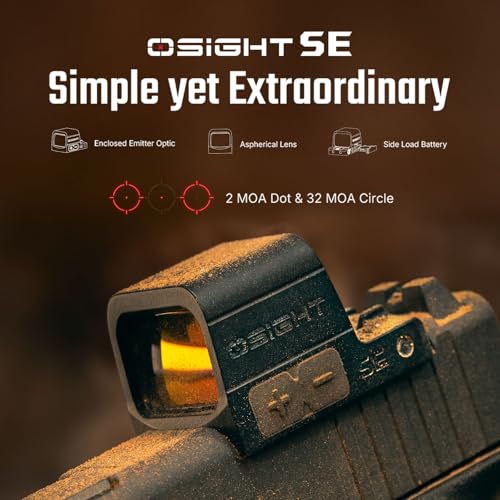
The OSIGHT SE is built around the failure point open-emitter pistol dots cannot fully avoid: a blocked emitter. Its sealed optical system keeps the projection path protected from pocket lint, dried sweat, rain, and fine debris, making it a compelling compact option for an RMSc/K-cut carry pistol. The listed 27.5 g weight and compact format also fit the role without adding much bulk to a slide.
Confirmed listing details include a 7075-aluminum housing, side-loading replaceable battery with low-power indication, RMSc/K compatibility, and selectable 2 MOA dot/32 MOA circle or 6 MOA-dot configurations; red and green versions are offered. An adapter plate is required for slides outside that direct-mount pattern and is not included. Long-term hard-use durability and support responsiveness remain less documented than on established premium enclosed optics, so those are informed uncertainties rather than proven strengths.
- Sealed emitter resists carry contamination
- Side battery access preserves the mount
- Direct RMSc/K fit on compatible slides
- Large-window aspherical lens design
- Circle-dot option aids rapid pickup
- Shorter field history than premium rivals
- No adapter plate for non-RMSc slides
- No night-vision setting listed
- Reticle and color vary by version
Quick take A well-specified enclosed micro dot whose carry-first design is easy to understand. Its strongest claim is protection from emitter obstruction; its weakest evidence area is long-term independent history.
The OSIGHT SE makes its case through a fully enclosed emitter, the feature most directly tied to keeping a carry optic usable when clothing debris and moisture accumulate. Side battery replacement is equally practical because it avoids a routine removal-and-rezero cycle.
Its footprint, housing material, and reticle options are confirmed specifications; claims about years of abuse tolerance are not yet supported by the same breadth of field record as longstanding premium designs. For a direct-fit RMSc/K slide, it is one of the most complete carry-oriented options in this class.
Nautilus2: stripped-down micro-dot value with backup sights
Best for built-in backup sights and value
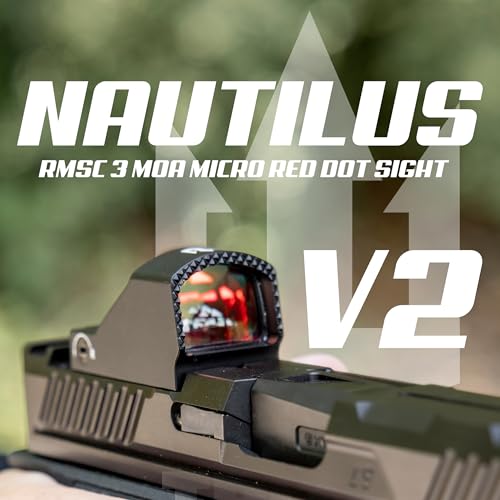
The Triton Nautilus2 is aimed at the buyer who wants a conventional 3-MOA open-emitter pistol dot and an integrated rear-sight reference without moving into premium pricing. Its stated RMSc/407K/507K compatibility makes the exact slide cut especially important: those patterns are often discussed together, but pin geometry and screw depth still need to be checked against the host pistol.
This is a basic, carry-sized optic rather than a feature-heavy system. The appeal is straightforward: a small dot, motion activation, and a housing that incorporates a rear reference if the emitter is unavailable.
- 3-MOA dot suits precise pistol work
- Integrated rear-sight reference
- Shake-awake function
- Claimed 50,000-hour battery life
- Broadly stated RMSc/K compatibility
- Open emitter can collect debris
- Brightness-control layout is not clearly documented
- Battery-access method needs confirmation
- Included screw lengths are not fully specified by the listing data available here
For a low-cost carry-dot candidate, the Nautilus2 makes a credible case through its 3-MOA presentation, wake-from-motion feature, and integrated rear reference. The claimed battery life is attractive, but it is not a substitute for knowing how the battery is accessed or whether the supplied screws properly match the slide.
Manufacturer recoil-simulation claims are not the same as broad, independent long-term durability evidence. That leaves the Nautilus2 best viewed as a value-forward option for a carefully checked direct mount, rather than a demonstrated hard-use benchmark.
CVLIFE WolfCloak: low-cost motion-awake convenience
Affordable choice with broad mounting flexibility
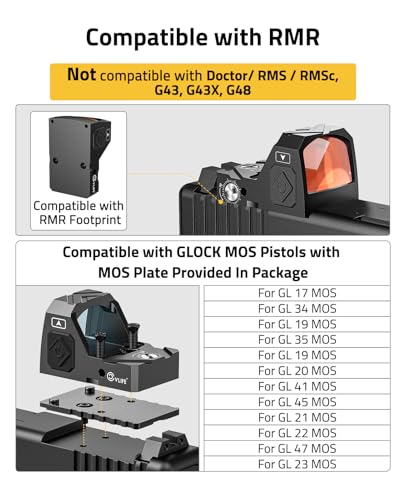
The WolfCloak targets the shopper who wants an optic that can sleep between uses rather than remain continuously illuminated. Its claimed RMR-pattern interface, plus included MOS and 21 mm Picatinny adapter options, make it more of a flexible entry-level package than a purpose-built direct-mount carry optic.
That flexibility requires careful verification: the adapter determines sight height, screw engagement, and whether the optic sits low enough for the host pistol’s sights. The listed 2-MOA dot is a sensible all-round size, but the actual reticle color configuration should be confirmed by the specific listing or variant.
- Motion-awake claim conserves battery
- 2-MOA dot suits precision
- Twelve claimed brightness settings
- RMR-style mounting flexibility
- MOS and Picatinny adapters listed
- Wake behavior is implementation-dependent
- Adapter height can hinder co-witness
- IP65 is not full submersion sealing
- 1,000 G rating is a maker claim only; independent recoil history is limited
The WolfCloak’s appeal is the claimed motion-awake system: it can preserve battery while keeping the dot available after movement. That promise depends on sensor sensitivity, wake latency, and the auto-shutoff schedule—details that can vary more in execution than a headline suggests. Confirm the footprint, supplied screw length, zero retention, dot shape at several brightness levels, and gasket fit on the actual pistol; low-cost open emitters can vary noticeably from sample to sample.
A carry dot has to clear more than a bench-test bar
The list favors optics that remain practical after holster exposure, recoil, and ordinary maintenance—not merely dots that illuminate on a range day.
Current street pricing was checked against the roundup’s ceiling, then each optic’s direct slide footprint, plate requirement, screw engagement, and resulting sight height were examined. A bargain that needs an uncertain adapter is not treated as a simple carry solution.
Enclosed emitters receive credit for resisting lint and moisture; open emitters are assessed for access and cleaning. The dot must remain usable in daylight, while battery type, loading method, motion wake, and control placement must support predictable upkeep.
Mounting hardware, torque guidance, zero retention reports, warranty terms, and credible sustained-use accounts carry more weight than marketing drop ratings. Limited independent evidence is identified as a limitation rather than converted into a toughness claim.
Specifications and bundled hardware can change by production run; slide and plate compatibility still merits confirmation against the pistol maker’s documentation.
The decisive failure points are often mundane: a loose screw, a dead battery discovered late, a washed-out setting, or an emitter obscured by debris. That is why the roundup does not rank an optic on advertised battery life, waterproof labels, or a single favorable range session alone.
For newer budget models, an honest limited field record can still be a useful buying signal—provided it is presented as uncertainty, not proof of long-term abuse resistance.
Fitment comes before features
“Micro” describes size, not a universal mounting standard.
Additionally, RMSc/K, RMR, Docter/Noblex, and proprietary interfaces differ in screw spacing.
They differ in locating geometry and deck dimensions.
A sight can look correct on a product page yet fail to seat securely on a particular pistol.
Start with the pistol maker’s documented optic-ready cut.
Additionally, use the exact adapter plate already installed, then compare it with the optic maker’s published footprint drawing.
A broad pistol red-dot guide can explain the terminology.
But the relevant evidence is the specific slide, plate, and optic combination—not a retailer’s “fits most” claim.
Details that decide whether it actually mounts
- Recoil lugs: These posts or bosses take shear load under recoil. Their position and diameter must match the optic or plate’s recesses.
- Screws: Thread pitch, head style, and usable length vary. Incorrect length can prevent full clamping or create clearance problems.
- Rear-sight clearance: An optic’s rear overhang or built-in reference may conflict with a retained rear sight, plate, or slide geometry.
- Mounting height: Adapter plates can raise the window enough to change backup-sight visibility and holster clearance.
The OSIGHT SE’s RMSc/K-style positioning, the Nautilus2’s stated interface, and the WolfCloak’s RMR-pattern claim still require confirmation.
However, they must prove fit against the host pistol.
Footprint labels alone do not establish a safe, repeatable fit.
Confirm the slide cut or plate, footprint document, recoil-lug layout, screw specification, and rear-sight clearance before purchase. Product photos and shared “micro” dimensions are not compatibility evidence.
The OSIGHT SE earns its carry-focused position because its enclosed layout addresses the open emitter’s most vulnerable component without relying on an adapter plate for RMSc/K-pattern direct mounting. That advantage is strongest where lint, precipitation, and daily handling are routine.
It is not proof that every buyer needs an enclosed optic. For a budget enclosed-versus-open-emitter comparison, an open model can still make sense when its lower profile, simpler package, and maintenance demands match the intended conditions.
What the spec sheet cannot show
For budget pistol red dots, a 3-MOA dot is not automatically cleaner than a 6-MOA dot. Additionally, lens tint can darken a target or shift its color. Distortion near the window edge can make the dot appear to wander as the eye moves. Moreover, both are easier to judge against a bright background than under indoor lighting.
Brightness matters more than the number of settings.
The useful range is a setting visible in hard daylight without blooming into a starburst.
It also includes low settings that do not overpower the target in dim conditions.
Astigmatism, dry eyes, corrective lenses, and dominant-eye differences can turn a nominally round dot into a comma or flare.
Therefore, an individual look through the optic is more revealing than a published reticle image.
Additionally, check the practical interface:
- Controls: Buttons should be reachable without accidental activation or awkward hand changes.
- Battery access: A side or top tray avoids disturbing the mount; bottom-loading designs typically require a zero check after service.
- Co-witness height: Direct mounting generally keeps backup sights more usable than a tall adapter plate, but the sight picture should not be unnecessarily crowded.
Treat the purchase as a support commitment
Before installation, compare the maker’s current manual with the pistol cut or plate for budget pistol red dots.
Additionally, it should identify the footprint, screw thread and length guidance, torque specification, and sealing plates or gaskets.
Also note the battery type and any restrictions on included hardware.
However, a screw with inadequate thread engagement can loosen.
Buy from a seller with a clear return process.
Retain the order record and save the manual and warranty terms locally.
Additionally, warranty language, authorized-seller requirements, and service contacts can change, particularly with newer budget brands.
After mounting, confirm zero with the intended ammunition and inspect fasteners at the manufacturer’s stated interval.
Reconfirming zero is prudent after battery replacement, a hard impact, or removal and re-installation.
As a result, that small record turns a bargain optic into a trackable carry component rather than an unknown.
- Best Carry Shield Choose the OSIGHT SE when an enclosed emitter and direct RMSc/K fit are the priority for exposed daily carry.
- Value First Choose the Nautilus2 for the simplest low-cost micro-dot route, provided the specific slide cut and hardware are confirmed.
- Convenience Pick Choose the WolfCloak when motion wake matters most and an RMR-pattern mounting solution is already established.
A low sticker price does not replace a confirmed mounting and support record.
Frequently Asked Questions
Which budget pistol red dot is best for concealed carry?
The OSIGHT SE is the top pick for carry because its fully enclosed emitter resists lint, moisture, and debris — the most common failure point for open-emitter optics carried daily.
Is an enclosed emitter always better than an open emitter?
Not automatically. An enclosed design better shields the LED from contamination but adds housing bulk and cost. A well-built open-emitter dot can remain dependable if its emitter channel and lenses are kept clear.
How do I know if a red dot will actually fit my pistol's slide?
Compare the pistol maker’s documented optic-ready cut or installed adapter plate against the optic maker’s published footprint drawing. RMSc, K-series, and RMR patterns differ in screw spacing and recoil-lug geometry, so a shared “micro” label doesn’t guarantee fit.
Does the Triton Nautilus2 have a backup sight built in?
Yes, its housing incorporates CNC-milled rear iron sights, so you still have a sighting reference if the dot washes out or the battery dies.
What does the WolfCloak's motion-awake feature do?
It uses motion sensing to let the optic sleep between uses and wake on movement, which helps conserve battery life instead of leaving the dot continuously illuminated.
Choose for the carry environment
- Check the live listing, not an old specification page.
- Verify the exact footprint, screw set, and any required plate before ordering.
- Inspect battery access, brightness controls, return terms, and warranty support alongside the optic itself.
For a carry pistol exposed to lint, rain, and awkward handling, the OSIGHT SE is the strongest pick of this group because its enclosed design addresses the emitter’s most vulnerable point. The Nautilus2 makes the most sense where basic dot capability and low buy-in outweigh a more developed feature set; the WolfCloak earns consideration chiefly for motion-awake operation.
None becomes carry-ready merely by costing less than $200. Confirm direct fit, included hardware, power arrangement, controls, and current support terms before installation.
OSIGHT SE Enclosed Micro Red Dot Sight, 2 MOA Dot & 32 MOA Circle or 6 MOA Dot, Red & Green Reticle Options, RMSc/K Footprint Compatible, Compact Reflex...
Features
| Compatible Devices | Handgun |
| Mounting Type | Integral Mount |
| Night vision | No |
| Thread Type | RMSc/K |
| Reticle Type | 2 MOA Dot & 32 MOA Circle |
| Item Weight | 27.5 Grams |
| Color | Red |
| Product Style | High-Tech, Compact, Professional |
| Material Type | Aluminum |
| Brand Name | Osight |
| Sport Type | Hunting |
| Model Name | US-OSIGHTSE-RD-300115 |
| Manufacturer | Osight |
| Global Trade Identification Number | 06978095650155 |
| Model Number | Osight SE |
| Manufacturer Part Number | 6978095650155 |
| Unit Count | 1.0 Count |
| Warranty Description | Lifetime Warranty |
| Included Components | Adjustment Tool × 1, Battery Compartment Screw x 2, Cleaning Cloth × 1; User Manual × 1, Osight SE Screw Kit x 1, Osight SE x 1 |
| ASIN | B0F9W41DQ6 |
- 𝗥𝗠𝗦𝗰 𝗙𝗼𝗼𝘁𝗽𝗿𝗶𝗻𝘁: Designed for RMSc Footprint-cut, optics-ready slides. Non-RMSc slides require an adapter plate (not included). Please verify compatibility before purchase.
- 𝗘𝗻𝗰𝗹𝗼𝘀𝗲𝗱 𝗘𝗺𝗶𝘁𝘁𝗲𝗿 𝗢𝗽𝘁𝗶𝗰: Designed with a fully sealed system, the optic offers unmatched protection against the elements, ensuring reliable performance in any environment.
- 𝗔𝘀𝗽𝗵𝗲𝗿𝗶𝗰𝗮𝗹 𝗟𝗲𝗻𝘀: The aspherical lens ensures zero distortion and parallax-free performance, delivering exceptional clarity through the large window for rapid and precise target acquisition.
- 𝗦𝗶𝗱𝗲 𝗟𝗼𝗮𝗱 𝗕𝗮𝘁𝘁𝗲𝗿𝘆: Effortless battery replacement without removing the optic ensures hassle-free re-zeroing. A premium-grade battery features easy accessibility but still offers steady performance.
- 𝟮 𝗠𝗢𝗔 𝗗𝗼𝘁 & 𝟯𝟮 𝗠𝗢𝗔 𝗖𝗶𝗿𝗰𝗹𝗲: Switching between dot-and-circle, dot-only, or circle-only reticles, you can tailor your aiming solution to any operational conditions. The sharp and bright dot-and-circle reticle provides a cutting-edge aiming experience.
Triton Nautilus2 Micro Red Dot Sight for Pistol - RMSc 407K 507K Footprint - 3 MOA Red Dot Optic with Integrated Rear Sights - Shake Awake - 50000-Hour Battery
Features
| Magnification Maximum | 1 x |
| Magnification Minimum | 1 x |
| Compatible Devices | K-Series Foot Print, RMSc Footprint |
| Mounting Type | RMSc |
| Night vision | No |
| Aiming Scope Sight Pin Size | 0.87 Mils |
| Thread Type | M1913 |
| Reticle Type | Dot |
| Item Dimensions L x W x H | 1.7"L x 0.8"W x 1.15"H |
| Item Weight | 3 Ounces |
| Color | Black |
| Product Style | Tactical |
| Brand Name | Triton |
| Sport Type | Airsoft, Archery, Benchrest Shooting, Hunting, Paintball |
| Model Name | Nautilus2 |
| Manufacturer | Triton |
| UPC | 850071798241 |
| Model Number | RD-NAU-RS-2 |
| Warranty Description | Unconditional Lifetime |
| Included Components | Nautilus2 MRDS, Mounting Hardware, Cleaning Cloth, Manual |
| ASIN | B0FXZ8JKFC |
| Material Type | Aluminum, Glass, Mil-Spec Hard Anodization Coating |
- Built-In Backup Iron Sights: Rear iron sights are CNC-milled directly into the Nautilus2 optic housing - no bolted-on accessories, no extra parts to buy or align. If your dot washes out or the battery dies mid-string, your backup sighting system is already there, already zeroed. For concealed carry and defensive handgun use, that redundancy is not optional - it is engineered in from day one
- True RMSc Direct Mount - No Adapters Needed: The Nautilus2 uses a true RMSc/407K/507K footprint and mounts directly to RMSc-cut slides including the Glock 43X MOS, P365, and Hellcat - no adapter plates needed for a secure, repeatable fit. Every production batch is stress-tested on a recoil-simulation rig replicating .50 BMG impulse, so your zero holds through full-caliber pistol recoil and hot handgun loads without compromise
- 10 Brightness Settings with Daylight Mode: All 10 brightness levels are tunable from low-light dawn sessions to full midday sun, with a daylight-rated maximum that keeps your 3 MOA dot crisp and visible against bright backgrounds. Shake Awake motion-activation powers the optic on the instant you draw from the holster; when holstered and idle, it sleeps to conserve power. Pair that with a 50,000-hour battery life and your CCW optic is always ready without constant battery swaps
- Rugged Concealed Carry Construction: The Nautilus2 is CNC-machined from 6061-T6 aircraft-grade aluminum for impact resistance, rated IP64 for dust ingress protection and water spray resistance, and weighs just 4.66 oz so it disappears on your slide without adding carry fatigue. Every production batch receives a batch control number and is recoil-tested on a .50 BMG impulse simulation rig before it ships - duty carry, daily CCW, and range abuse covered
- Multi-Coated Glass Lens for Any Condition: Anti-reflective and hydrophobic coatings cut glare in bright light, shed water in rain, and keep your sight picture clean from low-light dawn drills to midday range sessions. The 3 MOA reticle delivers a crisp, fast-acquisition dot sized for defensive distances without obscuring your target - purpose-built for competitive shooting, home defense, and duty optic use across any condition
CVLIFE WolfCloak Motion Awake 2MOA Red/Green Dot Scope for RMR Cut Footprint, Shockproof and Waterproof Red Dot Sight, Open Reflex Optics with Adapter Plate...
Features
| Objective Lens Diameter | 50 Millimeters |
| Compatible Devices | Handgun |
| Mounting Type | Picatinny Mount |
| Night vision | No |
| Reticle Type | MOA Dot |
| Item Dimensions L x W x H | 1.77"L x 1.04"W x 1.07"H |
| Color | Red Dot |
| Product Style | Handgun Scope |
| Material Type | Aluminum |
| Brand Name | CVLIFE |
| Sport Type | Airsoft |
| Model Name | WolfCloak C02 |
| Manufacturer | CVLIFE |
| Unit Count | 1.0 Count |
| Warranty Description | 1 Year |
| Included Components | Adapter Plates, Batteries, Red Dot, Screws, User manual |
| Item Type Name | Handgun Scope |
| ASIN | B0CTLSJDNY |
- Motion Awake: The red dot scope features Motion Awake sensing technology to help save battery life.The battery life is 50000H, battery life is nothing to worry about.
- 1000GS Shockproof: This red dot sight is constructed from aircraft-grade aluminum, shockproof up to 1000G forces and IP65 waterproof.Can withstand strong recoil.
- Multi-Coated Lenses: The fully multi-coated lens intensifies the reticle and optimizes clarity across all environments.And the red dot scope for handgun can reduce glare and make your eyes more comfortable.
- Diverse brightness settings: The red dot features a clear and bright 2 MOA dot and 12 brightness settings. Windage/altitude settings are easily adjustable. Can be applied to different environments.
- Universal Compatibility:The CVLIFE red dot is a red dot optics for pistols compatible with RMR footprint . It comes with an adapter plate for the MOS and the picatinny base.




13 Comments
I run an open emitter now and the first time it got packed with shirt lint made the “enclosed vs open” argument very real lol. But I’m not buying an enclosed dot just because it sounds tougher—direct fit and warranty would still decide it for me.
Would love to see a follow-up after these have more sustained-use reports, especially the Nautilus2 and WolfCloak.
I appreciate that you didn’t present motion wake as some automatic carry upgrade. It’s convenient, sure, but I’d rather have a dot with documented mounting hardware and a battery setup I can service without removing the optic.
The WolfCloak might still be fine for somebody’s range pistol, but adapter-driven height on a carry gun would make me pause. Cheap gets expensive when you are buying plates, taller sights, and replacement screws afterward.
This is the first budget-dot roundup I’ve read that didn’t act like battery life alone determines quality. Side-load battery on the OSIGHT SE is a practical plus because re-zeroing after every battery change would get old fast.
Any reason the Holosun 407K wasn’t included? I know it is usually above $200, but sales put it close enough that I’d wait rather than gamble on a newer brand with a thin field record.
Can you clarify why the Nautilus2 made the article when you say independent durability is still an open question? That reads a little like “maybe it’s good, maybe it isn’t,” which is not super comforting for something intended to ride in a holster every day.
I’m shopping under $200 and honestly would prefer one clear pick for a Shield Plus rather than three shades of “verify everything.” 😅
Fair criticism. The Nautilus2 is included as a value-oriented option, not as a fully proven carry recommendation on the same evidence level as a long-established duty optic. Its direct-fit claim, simple controls, rear reference, and advertised battery life are relevant, but buyers should treat the limited independent record as a real tradeoff. For a Shield Plus, confirm the exact slide cut and screw/clearance requirements before choosing any of these.
I’d take the “verify everything” advice over a fake definitive recommendation. Shield-family fitment gets confusing fast, especially once versions, plates, and screw lengths enter the chat.
The part about post-installation zero checks needs to be shouted louder. A dot can look great on the kitchen table and still walk loose after a couple range trips. “Comes with screws” is not really a mounting record.
Glad you put fitment ahead of the feature checklist. I keep seeing people say an optic is “RMR pattern” as if that answers every question, then they discover the screw length or recoil lugs don’t work.
For a budget carry setup, would you pick the OSIGHT SE over an open-emitter dot even if the pistol needs a plate? The enclosed design sounds useful, but plate height is exactly what I’m trying to avoid.
Usually, I would favor a direct-fit option over adding a plate, assuming both choices have acceptable durability and support. A plate adds another interface, more screws to monitor, and often extra height. The OSIGHT SE makes the most sense when your slide is genuinely RMSc/K compatible and its dimensions clear the gun’s factory geometry.
That was my experience too. I bought a cheap plate setup first and it worked, but it sat high enough that the backup sights were basically decorative.
The integrated rear reference point is interesting, but I wouldn’t count it as a replacement for actual backup irons. If the window gets lint, rain, or a weird reflection, that little notch is not magically a sighting system. Still, nice to see it mentioned instead of treated like a bonus feature nobody needs to evaluate.
Why no Vortex Defender CCW? It often lands near this price range on sale, and at least there seems to be more real-world feedback on it than the Nautilus2. Not knocking the list, just curious where you drew the line.