This post contains affiliate links. If you buy through one, we may earn a commission at no extra cost to you. It never changes what we recommend.
Most people size a CPAP battery by the number on the box. The number that matters is what your machine draws with your humidifier settings.
A CPAP machine is one of the few loads where running out of power at 3 a.m. is a real problem, not an inconvenience. So the job is not finding the biggest battery. It is finding the smallest one that reliably covers your nights, at your settings, with a margin.
This guide shows the sizing math first, then the four BLUETTI units that fit the four situations people actually buy for: one night on the road, a flight, a long weekend of camping, and a multi-day outage at home.
- Humidifier and heated tube settings decide battery size more than anything else.
- Under 160 Wh is the only size that can board a passenger aircraft, and above 100 Wh needs airline approval.
- Plan on using roughly 85% of rated capacity once conversion losses are counted.
How to choose a power station for CPAP
Picking a power station for CPAP use comes down to three numbers: how many watts your machine draws, how many hours you sleep, and how many nights you need between recharges. The capacity rating on the box is the last number to look at, not the first.
Humidification is the swing factor. ResMed's own AirSense 11 user guide lists a 65 W power supply, and its 12/24 V Air11 DC converter is rated to draw up to 90 W when the heated humidifier and heated tube are connected. The same page notes that, with your doctor's agreement, you can skip humidification to cut consumption. That one decision can change the battery you need by a factor of three or more.
Four sizes for four situations


The sizing math, step by step
The formula is simple, so it is worth doing with your own numbers rather than trusting a runtime claim. Runtime claims assume a specific machine at a specific pressure, which is rarely yours.
Work out the watt-hours you actually need
- Measure your machine's real draw
Run your CPAP for one normal night on the power station you already own, or through a plug-in watt meter, and read the watt-hours used. Most BLUETTI units show live output watts on the screen and in the app. One measured night beats any estimate, because pressure, mask leak and room humidity all move the number.
- Multiply by your hours of sleep
Watts × hours = watt-hours per night. As an example only: a machine averaging 15 W with humidification off uses about 120 Wh over 8 hours. At 45 W with the humidifier and heated tube on, the same night uses about 360 Wh.
- Divide by 0.85 for conversion losses
Plugging the CPAP’s own AC brick into a power station runs DC to AC and back to DC, and each step wastes some energy. We budget 15% for that, which turns 120 Wh into roughly 141 Wh and 360 Wh into roughly 424 Wh. Running from a 12 V socket through a DC converter usually loses less.
- Multiply by nights, then add margin
Multiply by the number of nights between recharges. Then add 20% or more for cold weather, an aging battery or a leakier mask night. That total is the capacity to shop for.
If you have no way to measure, ResMed’s published peak figure for the AirSense 11 is in the low 70-watt range. Sizing to that ceiling (about 687 Wh for an 8-hour night after losses) guarantees you will not run short, at the cost of carrying more battery than you need.
What each pick covers per night
Here is the same math applied to every pick, using three example loads: 15 W (humidifier off), 45 W (humidifier and heated tube on) and 73 W (a worst-case ceiling). Each figure uses 85% of rated capacity.
- Elite 10 Mini (128 Wh): about 7 hours at 15 W. That is one short night with no humidification, and about 2.4 hours with the humidifier on.
- Elite 30 V2 (288 Wh): about 2 nights at 15 W, or about 5.4 hours with humidification. It will not cover a full humidified night.
- Elite 100 V2 (1,024 Wh): about 7 nights at 15 W, about 2.4 nights at 45 W, and about 1.5 nights even at the 73 W ceiling.
- Elite 200 V2 (2,073.6 Wh): about 14 nights at 15 W, about 4.9 nights at 45 W, and about 3 nights at the ceiling.
These are calculations, not test results. So treat them as a starting point and confirm with one measured night before you depend on a unit.
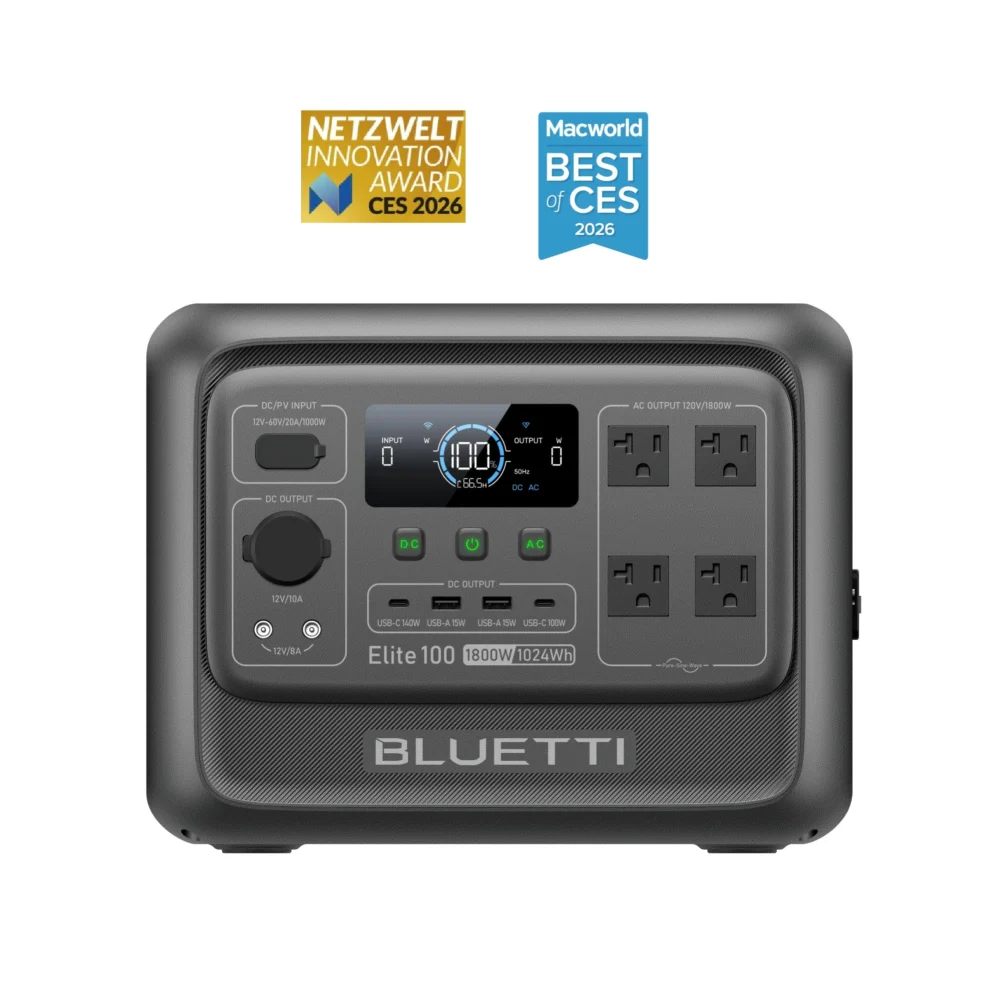
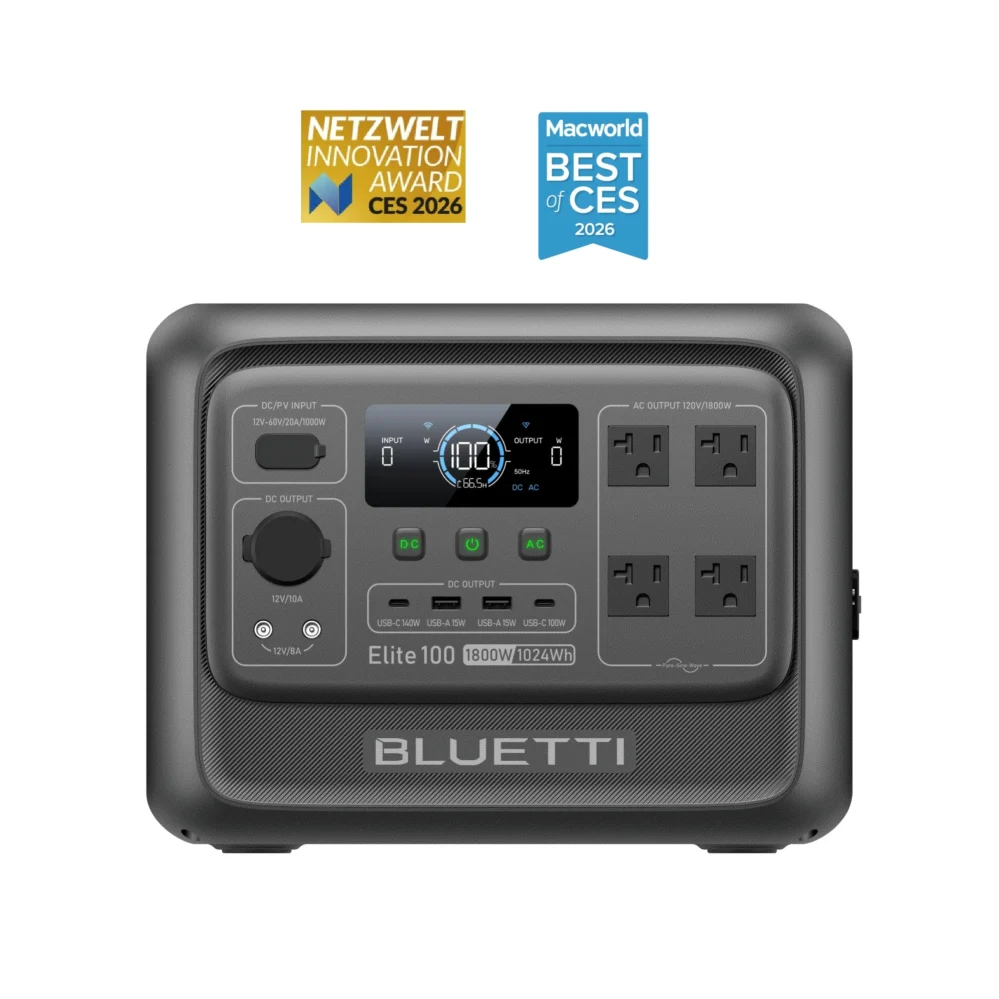
BLUETTI Elite 100 V2: the size most CPAP users should start with
01
1,024 Wh LiFePO₄, 1,800 W output, 10 ms UPS
The Elite 100 V2 lands where the sizing math says most people should be. At 1,024 Wh it covers a full night even at the worst-case ceiling, and roughly two humidified nights at a typical setting. BLUETTI lists it at 25 lb with a hidden handle, which is still a one-hand carry from the car to a campsite.
Two features matter specifically for CPAP. BLUETTI rates the UPS switchover at 10 ms or less, so a machine left plugged in through the station keeps running when grid power drops. It is also rated at 30 dB under light loads, which is the condition a CPAP puts it in all night.
Drawbacks: it is more battery than a single dry night needs, and at 25 lb it is not a flight or backpacking option. Our full Elite 100 V2 review covers its other outputs.
BLUETTI Elite 30 V2: one or two dry nights in a small box
288 Wh LiFePO₄, 600 W output, 10 ms UPS
If you sleep without humidification, the Elite 30 V2 is the smallest unit here that covers more than one night. It weighs 4.3 kg according to BLUETTI. It also has a 10 ms UPS mode, so it can double as a bedside backup at home.
The detail that matters on a small CPAP load is self-consumption. BLUETTI quotes 4.5 W in standby for this model. On a machine drawing 15 W, idle draw is a real share of the night, so a station engineered to keep it low gives you noticeably more sleep per charge.
Drawbacks: it will not carry a full humidified night, and at 288 Wh it is well over the 160 Wh limit for flying. See our Elite 30 V2 review for the rest of its ports.
BLUETTI Elite 10 Mini: the one you can take on a plane
128 Wh LiFePO₄, 200 W AC, 10 ms UPS
Every other pick on this page is too large to board a passenger aircraft. At 128 Wh, the Elite 10 Mini falls in the 100–160 Wh band, where the FAA allows a battery in the cabin with airline approval. Its 200 W AC outlet comfortably runs a CPAP’s own power brick.
Be realistic about what 128 Wh buys. It covers one night at a low, dry setting, about seven hours at 15 W, and only a couple of hours with the humidifier on. Think of it as a hotel-outage or red-eye battery, not a camping battery.
Drawbacks: it is not a humidifier battery, and approval is per airline, so request it before you fly. More detail is in our Elite 10 Mini review.
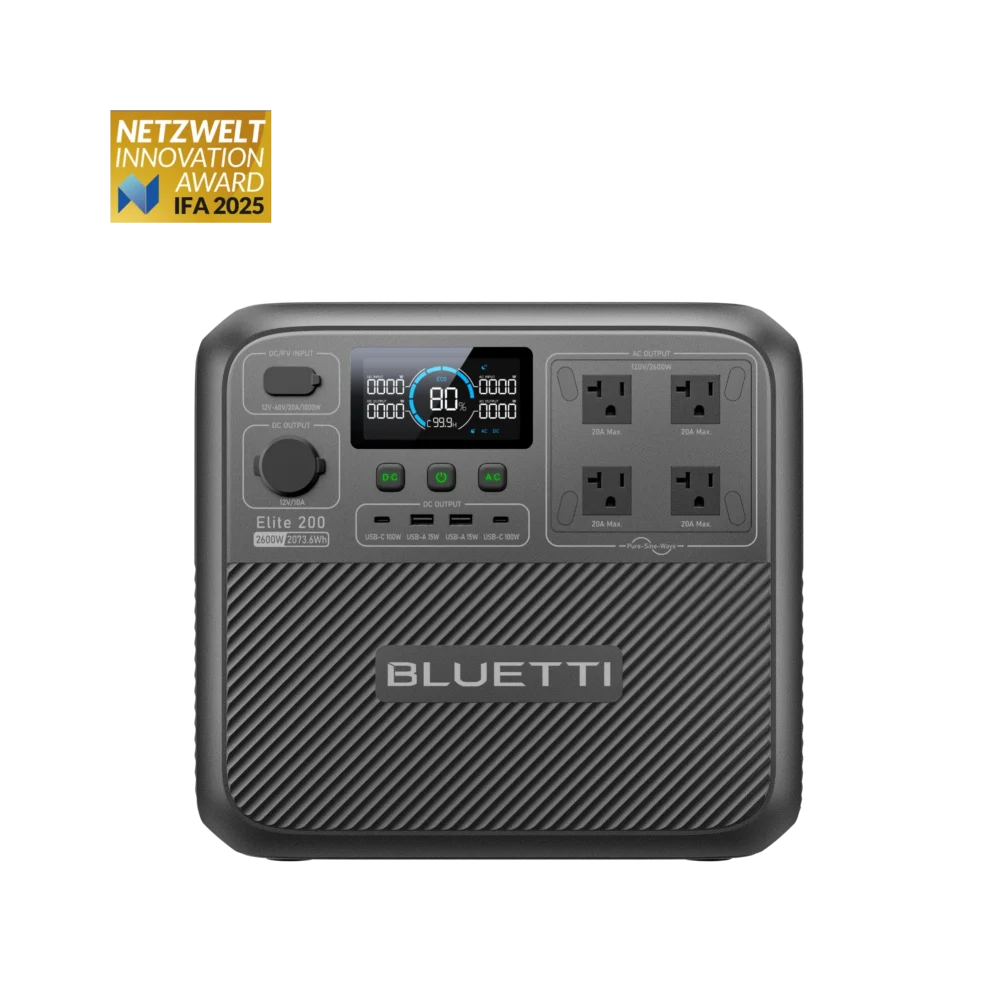
BLUETTI Elite 200 V2: humidified nights for a long weekend
2,073.6 Wh, 2,600 W output, 1,000 W solar input
The Elite 200 V2 is for people who refuse to compromise on humidification away from home. Its 2,073.6 Wh covers roughly five humidified nights at 45 W by our math, or three nights at the worst-case ceiling.
It also refills faster than the others in the field. BLUETTI rates solar input at up to 1,000 W (12–60 V), and car charging at 96 W from a 12 V socket or 192 W from 24 V. So a few hours of driving or a good solar day replaces most of a night’s use.
Drawbacks: BLUETTI lists it at 53.4 lb, which makes it a vehicle-camping unit rather than something you carry far. It is also overkill if you never use the humidifier.
Flying with CPAP power: the 160 Wh line
Air travel is where people buy the wrong battery most often, because the rules are about the battery and not the CPAP. The FAA's lithium battery guidance limits spare lithium-ion batteries to 100 Wh without approval, and allows up to two larger batteries in the 100–160 Wh range with airline approval. Its power station guidance is blunter. Devices above 160 Wh are not allowed on passenger aircraft at all, and power stations must never go in checked bags.
So of the picks here, only the Elite 10 Mini can fly, and only after your airline says yes. Ask well before the trip, and carry the approval with you. The CPAP itself is a separate question: ResMed's user guide states that the AirSense 11 meets FAA requirements for use on board.
AC outlet or DC converter?
The simplest setup is to plug your CPAP's normal power brick into the station's AC outlet. It works with every machine, and it is what the runtime math above assumes.
A DC converter is the more efficient path, because it skips the inverter. ResMed's Air11 DC converter accepts 12 or 24 V from a car-style socket and adjusts automatically. The trade-off is buying a model-specific accessory and confirming your station has a 12 V socket. If you camp often, it is worth it. For an occasional outage at home, the AC brick is fine.
Elite 100 V2 | Elite 30 V2 | Elite 10 Mini | Elite 200 V2 | |
|---|---|---|---|---|
|
|
|
|
| |
| Capacity | 1,024 Wh | 288 Wh | 128 Wh | 2,073.6 Wh |
| Nights at 15 W (8 h) | About 7 | About 2 | Under 1 | About 14 |
| Nights at 45 W (8 h) | About 2.4 | Under 1 | Under 1 | About 4.9 |
| Can fly (with airline approval) | – | – | 1 | – |
| Best for | Most users, home backup | Dry-setting weekends | Air travel | Humidified camping |
| Check price | Check price | Check price | Check price |
- Size to your humidifier setting
Humidification can multiply nightly consumption several times over. Decide whether you will run it before you choose capacity.
Look forCapacity that covers your measured night with humidification at the level you actually use.AvoidBuying from a runtime claim measured with the humidifier off. - A fast UPS switchover for home use
If the station sits between the wall and the CPAP, a quick switchover keeps therapy running through a blackout.
Look forA published switchover time of 10 ms or less.AvoidAssuming every station with an AC outlet behaves like a UPS. - Low noise and standby draw
The station runs beside your bed all night under a light load, so fan noise and idle consumption both matter.
Look forA quoted noise level near 30 dB at light loads and a low standby figure.AvoidUnits that only list noise at full output. - A recharge plan for multi-night trips
Capacity only buys nights. Solar and car charging decide whether you can keep going.
Look forSolar input well above your nightly use, and a 12/24 V car input.AvoidCounting on a small panel to refill a large humidified night in one day.
Frequently asked questions
How many watt-hours do I need for one CPAP night?
Measure one night if you can. As a guide, 8 hours at 15 W with humidification off needs about 141 Wh after a 15% loss allowance, and 8 hours at 45 W with the humidifier and heated tube on needs about 424 Wh. Add 20% or more for margin.
Can I take a power station on a plane for my CPAP?
Only if it is 160 Wh or less. The FAA allows batteries from 100 to 160 Wh in the cabin with airline approval, and never in checked bags. Anything larger, including most CPAP-sized power stations, is not allowed on passenger aircraft.
Should I turn off the humidifier to save battery?
It is the single biggest saving available, and ResMed itself notes that you can skip the humidifier and heated tube on DC power after talking with your doctor. Do not change your therapy settings without that conversation.
Is it safe to leave my CPAP plugged in through a power station every night?
Units with a published UPS mode are designed for that, and the three smaller picks here list a switchover of 10 ms or less. Keep the station ventilated and follow its manual for continuous pass-through use.
How much solar do I need to recharge between nights?
As a rough planning figure, a panel delivers about its rated watts × peak sun hours × 0.75. So a 200 W panel in 5 hours of good sun yields roughly 750 Wh, which refills a humidified night with room to spare. Cloudy days can cut that sharply.
Related reading
If you want the dedicated CPAP power-bank format, our BLUETTI X30 review covers it. Note that BLUETTI's store currently lists the X30 as unavailable. To compare every BLUETTI model on value, the cost-per-watt-hour guide ranks the lineup by what each watt-hour of storage costs.
Start with the Elite 100 V2 unless one of the other situations fits you exactly. It covers a humidified night at any realistic setting, survives a two-night outage, and is still portable. Choose the Elite 10 Mini only for flying, the Elite 30 V2 for dry-setting trips, and the Elite 200 V2 for several humidified nights in the field.
Measure, multiply, then buy
- Measure one night's draw before you buy.
- Divide by 0.85 for losses and add 20% margin.
- Only units at or under 160 Wh can board, and only with airline approval.
The right power station for CPAP use is the one sized to your measured draw, your sleep hours and your nights between recharges, with a loss allowance and a margin on top. Humidification is the variable that changes the answer most, and the 160 Wh line decides whether a battery can fly at all. Do the math with your own machine once, and the choice usually makes itself.
BLUETTI Elite 100 V2 Portable Power Station | 1,800W 1,024Wh Elite 100 V2
BLUETTI Elite 30 V2 Portable Power Station | 600W 288Wh Elite 30 V2
BLUETTI Elite 200 V2 Portable Power Station | 2,600W 2,073.6Wh