
A proven housing and a fuller feature set solve different problems.
A slide that sees hard holster wear, recoil, rain, and rough handling puts a premium on the RMR Type 2’s forged-aluminum, top-load design and stripped-down controls. Its 3.25-MOA dot is a practical middle ground: fine enough for deliberate shots without becoming slow to find.
The 507C generally trades some of that austerity for a side battery tray, solar assistance, manual brightness control, and selectable reticles. Those conveniences matter most when the optic’s settings may need to change with conditions. The decision also reaches beyond dot size: consider open- versus enclosed-emitter compromises where lint, mud, snow, or heavy rain are realistic. Neither optic is the universal answer; mounting footprint, carry exposure, lighting, and tolerance for controls determine which concession feels smaller.
- RMR RM01 uses a CR2032 battery and a 3.25-MOA red dot.
- Both designs are commonly chosen for RMR-footprint pistol slides.

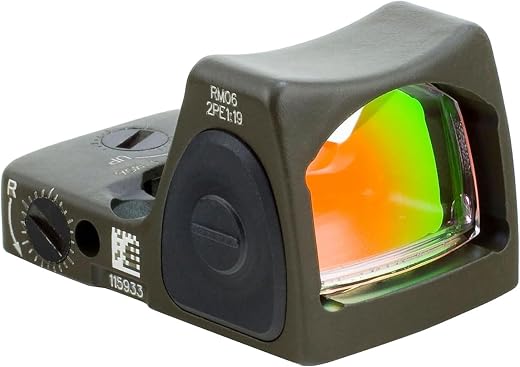

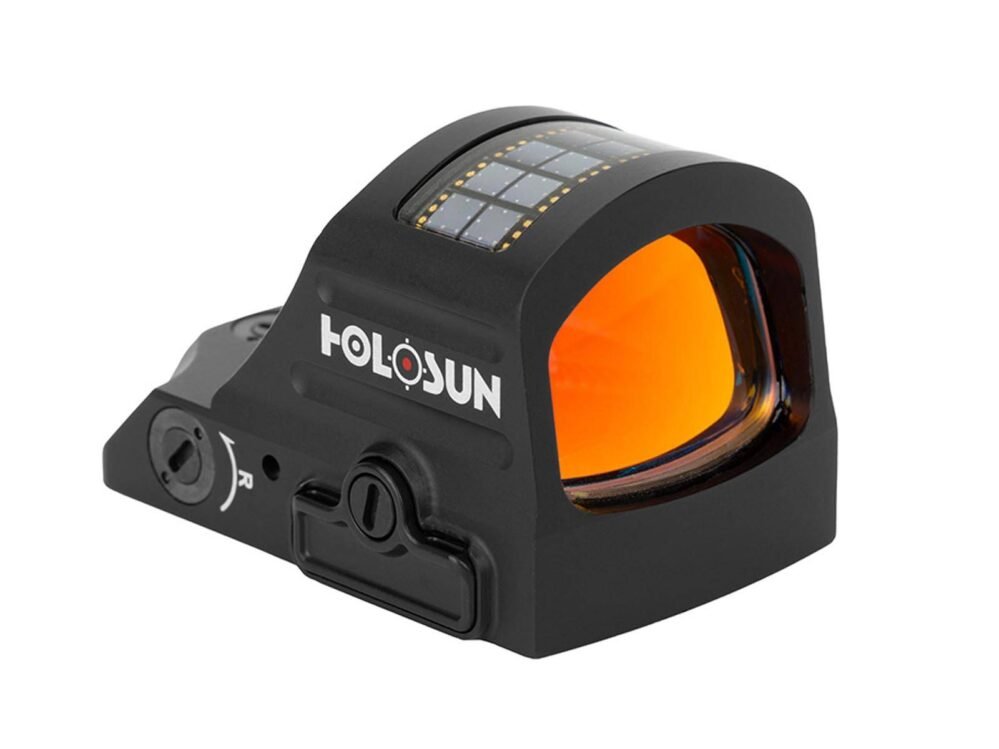
For the buyer who values proven simplicity

A solar panel and reticle choices can add flexibility; fewer controls can reduce accidental setting changes. Durability reputation and convenience are not opposing specifications—they are priorities expressed in hardware.
- Open-emitter reflex design
Both sights project a dot into an exposed viewing window rather than sealing the emitter inside a tube. Mud, lint, snow, or water on the emitter or lens can distort the aiming point, so the shared format matters as much as the brand.
- RMR footprint
Both use the widely adopted RMR mounting interface, allowing many direct-milled slides and adapter plates to accept either. Matching the pattern does not guarantee matching screw length, recoil-lug engagement, or slide clearance.
- Optical axis and presentation
Window height, lens tint, hood shape, and dot intensity determine how quickly the dot appears during presentation. A common footprint says nothing about these sight-picture behaviors; how pistol red dots work explains why alignment still matters.
- Brightness management
Automatic and button-driven brightness systems solve different problems. The relevant test is whether the dot remains visible through abrupt lighting changes without blooming enough to cover a precise aiming point.
- Zero retention
A durable housing is only part of reliability. The RMR RM01’s underside battery requires optic removal for replacement, while the 507C’s side tray avoids disturbing the mount; either system still merits a zero check after service.
| Rugged simplicity Trijicon RMR Type 2 3.25 MOA Automatic LED | VS | Feature-rich flexibility Holosun HS507C X2 Open Reflex Sight |
|---|---|---|
Open emitter | Optical format |
Open emitter |
RMR footprint | Mounting pattern |
RMR footprint |
RM01 automatic | Brightness control |
Button controlled |
3.25 MOA dot | Aiming reference |
Dot or circle-dot |
Underside battery | Battery access |
Side battery tray |
| View | View |
Why the RMR earned its hard-use reputation
The RMR Type 2’s reputation rests on more than its age or brand recognition. Its forged aluminum housing uses a thick top bridge and angled sidewalls that are intended to route impact loads around the window rather than leave the lens as the highest, most exposed point. The lens sits noticeably recessed within that structure, giving it meaningful protection from direct contact with gear, barricades, and incidental knocks.
That architecture has also accumulated an unusually visible service record. RMRs have appeared for years on duty pistols, military-adjacent programs, and high-round-count training guns, where repeated mounting cycles, weather exposure, and rough handling reveal weak controls or fragile windows quickly. The Type 2 revision addressed reported battery-contact and flicker concerns associated with earlier units, reinforcing the model’s standing as a mature design rather than a merely popular one.
Rugged does not mean consequence-free
A protected lens can still collect mud, rain, carbon, lint, or oil. An open-emitter sight can be obscured from either side, and a sufficiently hard impact can shift a mount, damage glass, or alter zero regardless of housing shape. The RMR’s battery compartment also remains underneath the optic; battery replacement generally means removing the sight and confirming zero afterward. Its hard-use advantage is best understood as greater tolerance for abuse, not freedom from inspection or maintenance.
Dot size changes the visual problem
A 3.25 MOA single dot, as used on the Automatic LED and Cerakote variants, presents a clean aiming reference. It covers roughly 3.25 inches at 100 yards, making precise placement easier to judge than with a larger dot while remaining prominent at typical handgun distances. The 6.5 MOA dot of the Adjustable LED model occupies more of the target but is easier to notice quickly, particularly against busy backgrounds or in compromised visual conditions.
The 507C’s circle-dot reticle addresses a different tradeoff. Its large outer ring can draw the eye into the window during presentation, while the central dot retains a smaller reference for deliberate shots. Yet that ring adds information: against patterned targets, reflective backgrounds, or astigmatism-induced starburst, some shooters find it more cluttered rather than more helpful. A single dot reduces visual noise; a circle-dot can improve orientation. Neither reticle is inherently faster outside the distance, lighting, target, and user-vision conditions in which it is evaluated.
An RMR’s housing cannot compensate for loose screws, an incorrect screw length, poor plate fit, or an unverified zero. Mounting interface quality is part of optic durability, especially on a reciprocating pistol slide.
Brightness control changes the maintenance equation
An automatic-brightness RMR is deliberately low-interaction: its sensor selects dot intensity from the light around the optic. In open daylight, that can be exactly the point—draw, acquire, and proceed without remembering a setting. The limitation appears when the optic and the target occupy very different light levels, such as standing in a dim interior while looking through a bright doorway. A sensor reading the darker shooting position may not drive the dot as bright as the target background demands.
The adjustable RMR Type 2 shifts that judgment to the operator. Its buttons allow a deliberately high daylight setting before exposure to mixed lighting, and a lower setting can reduce glare indoors or when a weapon light reflects from a nearby surface. This is more predictable than automatic adjustment in awkward angles, including shooting from cover or around a vehicle, where hands, gear, or the barricade can partially shade the sensor. It also creates a small but real operating burden: the selected setting has to fit the next environment rather than the previous one.
Solar assistance is not the same as self-sufficiency
The Holosun 507C combines manual controls with an automatic mode and a solar panel that can assist brightness management in strong ambient light. Its benefit is most apparent outdoors, where solar input can support the system and help the dot respond to changing sun and shade. It is not a substitute for a sound battery routine: dark interiors, covered optics, body-side carry, and weapon-light-only conditions offer little useful solar energy.
The 507C’s side-loading battery tray makes that routine simple: a battery can be changed without removing the optic or disturbing its mounting interface. An RMR uses a bottom-mounted battery, so replacement normally means removing and reinstalling the sight, followed by confirmation of zero. For an RMR owner, preventive replacement on a documented interval—followed by a zero check—avoids treating battery service as an emergency.
Neither approach is universally easier. The RMR automatic model minimizes controls; the adjustable RMR rewards deliberate setup; the 507C reduces service friction while asking the owner to understand its mode behavior.
Mounting determines the real-world sight picture
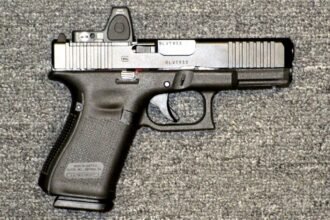
An “RMR cut” is a family resemblance, not a universal standard. Slide cuts differ in lug dimensions, recoil-pocket depth, screw-hole placement, and the amount of support provided around the optic. A direct-milled slide that properly locates an RMR may need different screws or lug fitment for a 507C, even though both use the RMR-pattern interface. That distinction matters particularly when comparing Glock 19 MOS optic options, where the factory plate system adds another interface to inspect.
Treat the mount as part of the optic
The optic should bear recoil on its locating lugs and mating surfaces—not primarily on the screws. Correct screw length is equally important: a screw that bottoms out can leave the sight apparently tight but insufficiently clamped, while one that is too long can intrude into slide components. Manufacturer-specified hardware, clean threads, the stated torque value, and witness marks make later movement easier to detect.
The bottom-loading RMR also needs its sealing plate where the slide/optic combination calls for it. That thin component helps protect the battery compartment from moisture, but it can slightly alter fit and stack height. The 507C’s side battery tray avoids disturbing the mount during a battery change; it does not eliminate the need to verify plate fit, lug engagement, and screw clearance.
Window size is only part of acquisition
A dot appears quickly when the pistol arrives at the same visual plane repeatedly. Grip geometry, presentation consistency, suppressor-height iron sights, plate height, and the optic housing’s shape all influence that outcome. A tall plate can make backup-sight co-witness easier, yet it also changes the relationship between bore, irons, and dot.
Reticle design changes the experience as well. A clean 3.25 MOA RMR dot rewards a stable presentation; a larger 6.5 MOA dot offers a more immediate reference at close range. On the 507C, a circle-dot reticle can provide an additional visual cue. Neither advantage is reliably predicted by window specifications alone—an optic that indexes naturally on a particular pistol is usually the faster one.
The low-intervention RMR option
Best overall balance of durability and price
The RM01 Type 2 with a 3.25 MOA dot is the classic RMR distilled to its most self-contained form: a compact, forged-aluminum open-emitter sight that sets its own LED output from ambient light. Its dot size sits in the practical middle—large enough to find quickly on a handgun, yet fine enough for deliberate hits at distance.
It suits shooters who value an established hard-use layout and prefer the optic to remain largely untouched after zeroing. The trade is intentional: this model treats automatic operation as the priority rather than offering the reticle and brightness tailoring found on the 507C.
- Proven forged-aluminum housing
- Clean, versatile 3.25 MOA dot
- No brightness controls to manage
- Compact RMR-footprint format
- Battery change requires optic removal
- No manual brightness override
- Single-dot reticle only
- Open emitter can collect debris
Bottom line The automatic 3.25 MOA RM01 is the balanced choice for a durable, uncomplicated RMR. Its limitations become more apparent when lighting control, fast battery service, or reticle options matter as much as ruggedness.
RMR Type 2 6.5 MOA: built for fast visual pickup
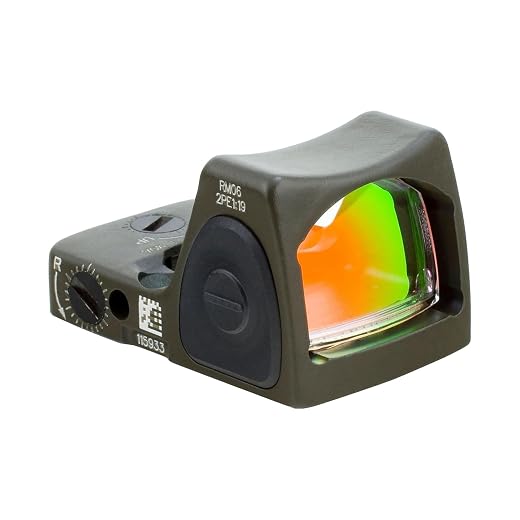
Best for rapid close-quarters target acquisition
The 6.5 MOA adjustable RMR is not simply the 3.25 MOA model with a less precise dot. Its bold aiming point is designed to appear quickly against busy backgrounds, making it a natural fit for short-range, high-speed presentation work and for shooters who find a larger reference easier to resolve.
Its controls preserve the RMR’s direct, no-menu character: brightness can be selected manually when lighting is predictable, or left to automatic mode. That makes this version especially appealing to shooters who want authority over dot intensity without moving to a more feature-dense optic.
- Large dot appears quickly
- Manual and automatic brightness
- Button lockout limits changes
- Rugged Type 2 housing
- Covers 1.6 inches at 25 yards
- Less refined on small targets
- No multi-reticle option
- Bottom battery access
At 25 yards, a 6.5 MOA dot subtends roughly 1.6 inches; at 100 yards, it covers about 6.5 inches. That coverage can obscure a small aiming point or much of a distant target, even though a careful shooter can still place shots accurately.
For work where fast acquisition matters more than a fine hold, the adjustable 6.5 MOA RMR makes a coherent case. Shooters prioritizing small groups, exact target discrimination, or more deliberate distance work will generally gain more from a smaller dot.
RMR Type 2 3.25 MOA in Cerakote FDE

A durable premium option in Flat Dark Earth
This is fundamentally the familiar automatic-illumination 3.25 MOA RMR Type 2, presented in Flat Dark Earth Cerakote rather than black. It suits a pistol or carbine build where the optic is meant to visually coordinate with an FDE slide, frame, mount, or accessories without departing from the established RMR operating concept.
Cerakote can add a durable barrier against surface wear and corrosion, but it does not make mounting hardware, battery contacts, lens edges, or damage through the coating maintenance-free. Finish matching also varies under different light; “FDE” is a family of tones, not a universal color standard.
Before ordering, confirm the exact SKU: RMR listings can differ in dot size, LED color, automatic versus adjustable illumination, and adjustment controls despite similar names and finishes.
- Coordinates with FDE builds
- Protective ceramic-polymer finish
- Same proven RMR form
- FDE shades rarely match exactly
- Finish does not replace care
- Configuration names can mislead
The FDE 3.25 MOA RMR makes sense when finish coordination matters alongside the RMR’s compact, hard-use design. Treat the coating as a secondary selection criterion: illumination behavior, dot specification, and adjustment layout will have a much greater effect on use. Verify those details from the precise manufacturer SKU rather than the color description.
Holosun HS507C X2: side-access battery and a multi-reticle option
Best for manual control and fast battery access
The HS507C X2 is the model this comparison has been describing throughout: a full-size, RMR-footprint open reflex sight built around a side-loading battery tray, a solar failsafe cell, and Shake Awake power management. Its multi-reticle system offers a 2 MOA dot alone or paired with a 32 MOA circle, giving shooters a choice between the cleanest possible aiming point and a faster-acquiring ring for close-range work.
Brightness is button-controlled with an automatic mode available, so intensity can be set deliberately before a known lighting condition rather than left entirely to a sensor. The side battery tray is the practical payoff: a battery swap doesn’t require pulling the optic off the slide or rechecking zero the way the RMR’s bottom-loaded design does.
- Side-loading battery tray avoids removing the optic to swap batteries
- Manual brightness control with an automatic mode available
- Multi-reticle option adds a fast-acquiring circle around the dot
- Solar failsafe cell provides backup power in strong ambient light
- Shake Awake helps extend battery life between uses
- More controls to learn and manage than an automatic-only RMR
- Solar assist depends on ambient light exposure, not a substitute for battery care
- Circle-dot reticle can read as busier against cluttered backgrounds
Bottom line The 507C X2 trades some of the RMR's stripped-down simplicity for side battery access, manual brightness control, and a multi-reticle option — worthwhile when service convenience and lighting control matter as much as housing pedigree.
The HS507C X2 makes the strongest case when service convenience and lighting control matter as much as housing pedigree. Its side battery tray removes the RMR’s biggest maintenance friction point, and manual brightness plus a multi-reticle option give the shooter more direct say over the sight picture than an automatic-only design allows.
It asks more of the owner in return: brightness settings and reticle choice have to be managed rather than left alone. For shooters who’d rather not think about the optic between range trips, that tradeoff cuts the other way.
Frequently Asked Questions
Is the Trijicon RMR or Holosun 507C more durable?
The RMR Type 2’s forged-aluminum housing and recessed lens have an unusually visible service record on duty pistols and high-round-count training guns, giving it a strong hard-use reputation. Its durability advantage means greater tolerance for abuse, not freedom from inspection.
How do the RMR and 507C handle battery changes?
The RMR uses a bottom-mounted battery, so replacement generally means removing and reinstalling the sight, then confirming zero. The 507C’s side-loading battery tray lets you change the battery without removing the optic or disturbing the mount.
What's the difference between the 3.25 MOA and 6.5 MOA RMR dot?
A 3.25 MOA dot covers about 3.25 inches at 100 yards, favoring precise placement. A 6.5 MOA dot covers roughly 6.5 inches at 100 yards and about 1.6 inches at 25 yards, making it easier to notice quickly but less refined for small targets.
Do the RMR and 507C use the same mounting footprint?
Both use the widely adopted RMR mounting interface, but a slide cut that properly locates an RMR may still need different screws or lug fitment for a 507C, so fitment should always be verified rather than assumed.
Does the 507C's solar panel remove the need for battery maintenance?
No. Solar assistance helps in strong ambient light, but dark interiors, covered optics, and weapon-light-only conditions offer little useful solar energy, so a normal battery routine is still needed.
Choose the priority, then support it
- Durability priority: RMR Type 2, especially the automatic 3.25 MOA model, suits low-intervention setups where a protected housing and minimal controls matter most.
- Feature priority: Holosun 507C suits users who value a side-loading battery, manual brightness access, and a selectable reticle more than the leanest possible operating scheme.
- Close-range emphasis: the 6.5 MOA adjustable RMR favors immediate dot pickup, while 3.25 MOA options preserve more precision at distance.
The decision is less about a universal winner than a tolerance for operational complexity. The RMR remains the durable-priority choice: its hard-use reputation comes from its housing geometry, restrained interface, and long-proven design. The 507C makes a stronger feature-priority case when service access and reticle flexibility outweigh that simplicity.
Neither housing compensates for a poor installation. Correct plate or direct-cut fit, proper lug engagement, appropriate screw length, and a confirmed zero determine whether the optic stays useful under recoil. Periodic inspection for screw movement, lens contamination, battery condition, and brightness setting turns claimed reliability into maintained reliability.
Trijicon RMR Type 2 3.25 MOA Automatic LED Red Dot Sight, Black – RM01-C-700600
Features
| Magnification Minimum | 1 |
| Compatible Devices | Handgun |
| Night vision | No |
| Reticle Type | 3.25 MOA dot |
| Item Dimensions L x W x H | 1.8"L x 1.1"W x 1"H |
| Item Weight | 1 Ounces |
| Color | Black |
| Product Style | No Mount |
| Lens Color | Black |
| Material Type | Plastic |
| Brand Name | Trijicon |
| Sport Type | Hunting |
| Model Name | RM01-C-700600 |
| Manufacturer | Trijicon |
| UPC | 719307613522 |
| Global Trade Identification Number | 00719307613522 |
| Model Number | RM01-C-700600 |
| Manufacturer Part Number | RM01-C-700600 |
| Unit Count | 1.0 Count |
| Warranty Description | 2 Year Manufacturer |
| Included Components | Product |
| Item Type Name | Holster |
| ASIN | B071GWH8FJ |
- 3.25 MOA LED RMR: Automatically adjusts illuminated reticle to available light conditions (No manual brightness adjusters in this model)
- DEPENDABLE ELECTRONIC DESIGN: Ruggedized Battery contacts and electronics ensure performance and survivability in harsh environments. Designed to be waterproof to 20 meters (66 ft.)
- UNIQUE PATENTED HOUSING SHAPE: Military-grade aluminum alloy forged housing shape diverts force of impact away from the lens, greatly increasing its durability
- TRUE-COLOR MULTI-COATED LENS: Creates a wide-band light transmission for minimal change in target area color
- ADJUSTABLE WINDAGE/ELEVATION: Easily adjustable without Special tools. 1 MOA per click
Trijicon RMR Type 2 6.5 MOA Adjustable LED Red Dot Sight
Features
| Magnification Minimum | 1 |
| Compatible Devices | Handgun |
| Mounting Type | Integral Mount |
| Night vision | No |
| Reticle Type | Dot |
| Item Dimensions L x W x H | 1.8"L x 1.1"W x 1"H |
| Item Weight | 1 Ounces |
| Color | OD Green |
| Product Style | No Mount |
| Lens Color | OD Green |
| Brand Name | Trijicon |
| Sport Type | Airsoft |
| Model Name | RMR/Adjustable LED |
| Manufacturer | Trijicon |
| UPC | 719307614680 |
| Global Trade Identification Number | 00719307614680 |
| Model Number | RM07-C-700716 |
| Manufacturer Part Number | RM07-C-700716 |
| Unit Count | 1.0 Count |
| Warranty Description | One Year Warranty |
| Included Components | Optic, allen wrench, manual, screws, sticker |
| Item Type Name | Trijicon RMR Type 2 6.5 MOA Adjustable LED Red Dot Sight with No Mount, Cerakote OD Green |
| ASIN | B071KHDTW7 |
- 6.5 MOA ADJUSTABLE LED RMR: Features an automatic brightness mode and easy push buttons for eight adjustable brightness settings including 2 nv and 1 Super bright
- DEPENDABLE ELECTRONIC DESIGN: Ruggedized Battery contacts and electronics ensure performance and survivability in harsh environments
- UNIQUE PATENTED HOUSING SHAPE: Military-grade aluminum alloy forged housing shape diverts force of impact away from the lens, greatly increasing its durability
- BATTERY CONSERVATION MODE: Automatically adjusts aiming dot to ambient lighting conditions after 16.5 hours
- BUTTON LOCKOUT: Sets RMR into automatic mode to prevent accidental adjustments. The Trijicon RMR Type 2V is tougher than any alternative.
Trijicon RMR/LED RMR Type 2 3.25 MOA LED Red Dot Sight with No Mount, Cerakote Flat Dark Earth
Features
| Magnification Maximum | 1 x |
| Magnification Minimum | 1 |
| Compatible Devices | Handgun |
| Night vision | No |
| Thread Type | 1/2"-28 |
| Reticle Type | Dot |
| Item Weight | 1.2 Ounces |
| Color | Cerakote Flat Dark Earth |
| Product Style | No Mount |
| Lens Color | Flat Dark Earth |
| Material Type | Aluminum |
| Brand Name | Trijicon |
| Model Name | RMR/LED |
| Manufacturer | Trijicon |
| UPC | 719307613768 |
| Global Trade Identification Number | 00719307613768 |
| Model Number | RM01-C-700624 |
| Manufacturer Part Number | RM01-C-700624 |
| Unit Count | 1.0 Count |
| Included Components | Optic, allen wrench, manual, screws, sticker |
| Item Type Name | Trijicon RMR Type 2 3.25 MOA LED Red Dot Sight with No Mount, Cerakote Flat Dark Earth |
| ASIN | B071KH4PKP |
- 3.25 MOA LED RMR: Automatically adjusts illuminated reticle to available light conditions (No manual brightness adjusters in this model)
- DEPENDABLE ELECTRONIC DESIGN: Ruggedized Battery contacts and electronics ensure performance and survivability in harsh environments
- UNIQUE PATENTED HOUSING SHAPE: Military-grade aluminum alloy forged housing shape diverts force of impact away from the lens, greatly increasing its durability
- TRUE-COLOR MULTI-COATED LENS: Creates a wide-band light transmission for minimal change in target area color
- ADJUSTABLE WINDAGE/ELEVATION: Easily adjustable without Special tools. 1 MOA per click


15 Comments
I had a 507C and an RMR Type 2 on different pistols for about a year. The 507C’s circle-dot was faster for me when I was still learning to find the window; the RMR’s plain dot became just as fast once my presentation improved.
The RMR also felt less fussy. That isn’t a scientific durability test, just my experience after getting both dirty, sweaty, and bounced around in range bags. I eventually kept the RMR on my carry gun and moved the Holosun to a range/competition-ish setup.
One minor gripe: the “FDE RMR” label can get confusing fast. Finish color doesn’t tell you whether it’s adjustable, automatic, 3.25, 6.5, etc. SKU checking is boring but way cheaper than ordering the wrong version 🙃
Is the automatic 3.25 MOA RM01 bright enough outdoors for most people? I understand the appeal of zero buttons, but I’m slightly wary of auto brightness choosing a level I don’t like when moving between a dark interior and bright daylight.
For typical outdoor use, the RM01’s automatic system is designed to provide a usable aiming point without user input. The limitation is exactly what you identified: you give up the ability to deliberately override the setting for unusual lighting transitions. If predictable manual control is your priority, an adjustable RMR Type 2 or the 507C better matches that preference.
Good breakdown of why shared footprint does NOT mean equal sight picture. My friend’s adapter plate put his RMR so high that it changed how quickly he found the dot, while my direct-cut setup was much more natural.
People will spend $500+ on the optic and then choose screws from the mystery bag. Bold strategy lol.
Height and presentation are easy to underestimate until you shoot the setup. A lower, well-supported installation can make acquisition feel much more natural, but compatibility still has to be verified for that specific slide cut or plate. Correct screws are not an accessory detail; they are part of the mounting system.
“Mystery bag screws” is painfully accurate. I once had screws that bottomed out before clamping the optic. It looked installed until recoil proved otherwise.
The mounting section is the part more people need to read twice. “RMR cut” gets treated like a universal answer, then somebody installs a bargain plate with questionable screws and blames the optic when it loosens.
I went direct-milled on my Glock and the sight sits noticeably better than it did on a plate. Which one did you end up choosing for the comparison gun?
For the comparison, we used RMR-pattern mounting as the common baseline rather than declaring one plate or cut universally best. Your point is exactly right: lug engagement, correct screw length, sealing, and a proper torque/inspection routine often matter more than a small spec difference between these optics.
Same experience here. My first plate setup was a tiny science project every time I changed batteries. Direct milling solved most of the annoyance, although it definitely commits you to the footprint.
The 507C side battery tray is a genuinely practical advantage for me. I train enough that I actually use brightness settings, and removing an RMR to change a battery means checking zero afterward—even if it usually returns close.
That said, I can see why the RMR wins for a duty-style, low-intervention setup. The article is fair not to pretend battery access alone settles the whole debate.
That is the core tradeoff. The 507C makes scheduled battery service and manual brightness management easier, while the RMR design puts more emphasis on a sparse, protected package. Neither approach eliminates the need to inspect the mount and confirm zero after service.
Exactly. People call the side tray a gimmick until they’ve had to pull an optic off a carry pistol the night before a class. I still prefer the RMR housing, but Holosun absolutely made that part easier.
I keep coming back to the RM01 for a carry gun. Bottom battery changes are annoying, sure, but I’d rather not have buttons/settings to second-guess when the gun lives in a holster most of the year.
I like the 6.5 MOA RMR more than I expected. It looks huge on paper, but for fast close-range presentation it’s basically a little red “look here” sign. Not the one I’d pick for trying to be cute with precise holds at distance, obviously.