

Small does not automatically mean precise, and long jaws do not automatically mean delicate.
A loose connector sits behind a crowded panel, or a tiny retaining clip needs turning without marking the surrounding plastic. The wrong pliers can skate off the part, flatten a thin tab, or simply run out of leverage.
Compact size and needle-nose shape solve different problems. Mini pliers reduce overall bulk, helping the hand and tool fit into tight assemblies; their shorter jaws also tend to feel more controlled at close range. Needle-nose pliers earn their place when the gripping point is recessed: tapered jaws pass through narrow gaps and reach around obstructions. Jaw clearance comes first, then the part’s material. Fine wire, electronics hardware, and soft metal favor smooth, accurately aligned jaws and modest force. Stubborn clips, heavier wire, or seized fittings may need thicker stock, serrations, and a longer handle—but those features raise the risk of crushing fragile work.
- The SHALL compact model favors close, detail-oriented handling; the WORKPRO long-nose design offers more reach and heavier-duty leverage.
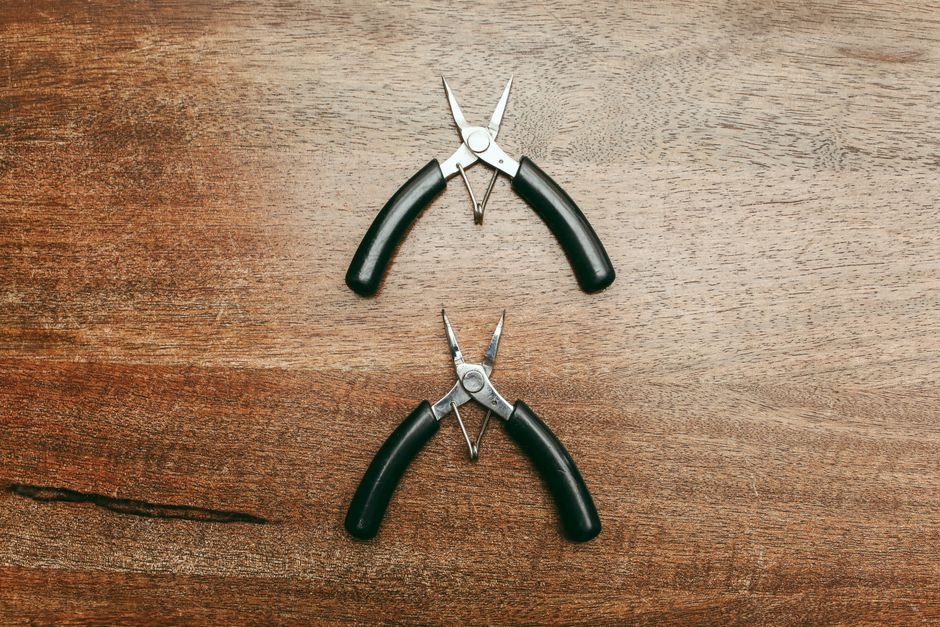
Two useful sizes, two different jobs

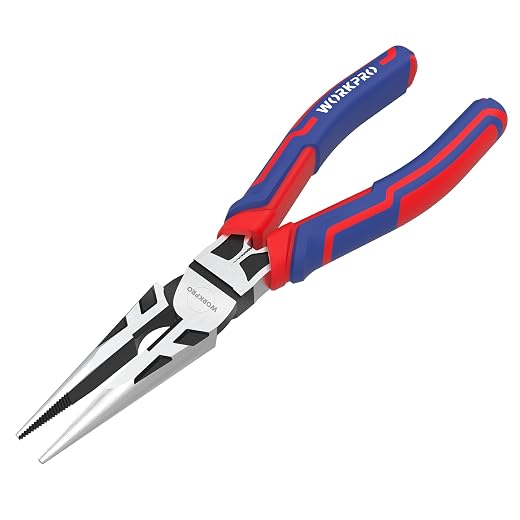
Size and nose profile are separate choices
Overall size
“Mini” describes the tool’s footprint: shorter handles, lighter weight, and usually a smaller head. A mini tool can still have needle-nose jaws; conversely, a full-size long-nose model may be too bulky for a crowded enclosure.
Taper and jaw length
A fine, long taper reaches behind terminals and into narrow gaps, but its tips trade surface area for access. Measure the opening, depth, and the part’s width first; measuring before a repair prevents choosing jaws that enter the space but cannot close around the work.
Pivot and handles
A pivot set close to the jaws can improve controlled movement at the tip. Longer handles increase leverage for bending heavier wire, yet their wider sweep may collide with nearby components.
Spring action and serrations
A return spring reduces repetitive opening effort during light precision work. Fine serrations hold smooth small parts with less force; coarse teeth bite harder but can mark soft metal, plastic, or finished hardware.
Cutters and working clearance
An integrated cutter adds utility but often thickens the head or shifts the cutter behind the pivot. Check both the jaw clearance and the room needed to rotate the handles before selecting a compact or heavy-duty pair.
| precision repair SHALL Compact Needle-Nose Pliers for Precision Repairs | VS | heavier repair WORKPRO Heavy-Duty Long-Nose Pliers with Cutter |
|---|---|---|
Tiny, delicate parts | Workpiece |
Larger, firmer parts |
Fine 2⅛-in jaws | Access |
Long nose, larger body |
Light control work | Grip and torque |
More handle leverage |
Non-serrated jaws | Surface contact |
Confirm jaw texture |
No cutter specified | Steel-wire cutting |
Built-in cutter; verify rating |
| Check fit | Check fit |
Start with the part, not the tool label. A thin electronic lead, jump ring, or small fastener rewards narrow, smooth jaws: they enter confined spaces and reduce marking on soft metals or finished surfaces. But fine tips concentrate force and can flex or twist when asked to bend hard wire or free a seized clip.
Broader jaws spread load across more material and generally tolerate firmer gripping, yet their extra width may prevent full engagement deep inside a housing. Longer handles can add useful torque, but that torque also raises the chance of crushing plastic, stripping a small fitting, or leaving tooth marks.
Treat the cutter as a separate tool feature. Before deciding whether mini pliers can cut steel wire, identify the wire’s diameter and alloy. Mild steel, hardened spring wire, and music wire impose very different loads; an integrated cutter may suit light wire but can nick or deform on material beyond its intended range. Avoid using gripping jaws as improvised cutters, since damaged jaw edges compromise later precision work.
SHALL for delicate, close-quarters handling
Best for tight spaces, crafts, and delicate repairs
The SHALL 6-inch mini needle-nose pliers suit work where the part matters more than brute force: aligning a tiny clip behind a cabinet hinge, retrieving a dropped fastener, shaping a light-gauge loop, or holding a small component steady during a power-disconnected electronics-adjacent mechanical repair.
Its long, smooth jaws place it naturally in craft benches, model kits, jewelry-style assembly, and careful household fixes. This is a detail tool for controlled contact rather than a substitute for full-size combination pliers.
- Long, fine 2-1/8-inch jaws reach past nearby obstructions
- Non-serrated jaws reduce marking on soft wire and finished parts
- Spring-assisted opening helps with repeated small placements
- Compact format remains manageable around miniature hardware
- Smooth jaws can slip on oily, hardened, or heavily rounded fasteners
- Short handles provide limited torque for stubborn bends
- Not intended as a high-output wire cutter or for heavy-gauge stock
- Fine tips can be damaged by twisting against rigid material
For fine household adjustments, crafts, models, and jewelry-style work, the SHALL’s smooth, extended nose offers unusually controlled access for its small footprint. The double-spring action can make repetitive positioning less tiring, while the drop-forged steel construction gives the tool a credible everyday feel.
Its boundary is leverage. Light bends and gentle gripping are appropriate territory; thick wire, seized fittings, and high-force twisting call for larger pliers with more handle length and a purpose-built cutter. Around electronics-adjacent hardware, use only on equipment that has been disconnected from power.
WORKPRO for force, reach, and routine wire work
Best for tougher jobs requiring reach and wire cutting
The 8-inch WORKPRO long-nose pliers occupy the sturdier end of this comparison. With CRV steel construction, soft grips, and an integrated cutter, they suit repair benches where parts need to be pulled, formed, or retrieved rather than merely positioned.
- Longer handles provide more leverage for pulling and bending.
- Long nose reaches behind brackets and into deeper cavities.
- Integrated cutter handles ordinary soft wire and light leads.
- Large soft grips support steadier work under load.
- Bulkier jaws can block sightlines in very small recesses.
- Serrated gripping surfaces may mark soft, polished, or plated parts.
- Not a substitute for cutters rated for hardened, heavy-gauge, or tensioned wire.
The cutter is appropriate for ordinary soft wire when the material and load are known. Hardened wire, springs, music wire, and any wire held under tension can chip cutting edges or release abruptly; their specification should be confirmed before cutting.
Eye protection matters when trimming wire or releasing bent hardware. Use Z87-rated glasses for project work where flying offcuts are possible.
WORKPRO is the more convincing choice for routine repairs that involve firmer pulling, bending, deeper reach, and common soft-wire cutting. Its larger format gives up some close-in visibility, and its jaws deserve caution around plated fittings, soft metal, and finished surfaces. For robust hardware rather than miniature mechanisms, that exchange is often sensible.
Match the pliers to the repair
A small screw, split ring, or dropped E-clip calls for jaw control before brute force.
Compact smooth-jaw pliers can hold a tiny part without crowding the work. Long-nose pliers can reach a clip lodged behind a bracket or guide wire through a narrow opening. In this mini comparison, mini pliers vs needle-nose pliers matter for reach and control.
For reshaping light wire, grip close to the bend and make several controlled adjustments rather than one sharp kink. The WORKPRO’s longer handles suit tougher soft-wire work and its cutter. The SHALL is more at home positioning small components where marks matter. Think of mini pliers vs needle-nose pliers for this kind of precision.
Cutting deserves its own decision.
When choosing mini pliers vs needle-nose pliers, use the cutter only on wire within the tool’s intended capacity.
Aim the cut end away from hands and finished surfaces, and support the off-cut so it cannot fly.
Mini vs. Needle-Nose Pliers: Common Questions
Does a mini plier automatically mean it's weak?
No. A compact tool can still apply substantial force at the jaws because short jaws and close hand placement improve control. What handle length actually limits is leverage, not overall usefulness—size changes how the tool behaves, not whether it can do real work.
Are needle-nose pliers always too delicate for tougher jobs?
Not necessarily. A long, tapered nose describes access—the ability to reach into narrow gaps or behind obstructions—not fragility. Some long-nose models, like the WORKPRO featured here, are built with CRV steel and an integrated cutter for routine gripping and soft-wire cutting.
When is it safe to use the built-in cutter?
Only on ordinary soft wire within the tool’s intended capacity. Hardened wire, springs, music wire, and wire under tension can chip the cutting edges or release abruptly, so the wire’s diameter and alloy should be confirmed first. Eye protection is worth wearing when trimming wire or releasing bent hardware.
Which pliers work better in tight, crowded spaces?
Compact, smooth-jaw pliers like the SHALL are better suited to crowded assemblies since their shorter jaws and narrower profile reduce the chance of marking nearby parts. Needle-nose pliers earn their place when the gripping point itself is recessed, since tapered jaws can pass through narrow gaps and reach around obstructions.
How do I decide between the SHALL and the WORKPRO?
Start with the repair that recurs most often. Choose the SHALL when the limiting factor is tiny jaw clearance or repeated fine-detail positioning around finished surfaces. Choose the WORKPRO when repairs regularly involve harder material, stubborn bends, longer reach, or routine wire cutting. A kit that moves between both types of work benefits from keeping both tools on hand.
Buy for the Work That Repeats
- Choose the narrowest jaws that can enter the space without forcing surrounding parts.
- Treat hard wire and high gripping loads as leverage-and-material questions, not merely jaw-length questions.
Start with the repair that recurs most often. SHALL makes more sense when the limiting factor is tiny jaw clearance, controlled handling around finished surfaces, or repeated fine-detail positioning. Its compact, smooth-jaw character is better aligned with small hardware, light bends, and parts where tooth marks would be unwelcome.
WORKPRO is the more suitable single-tool choice when repairs regularly involve harder material, stubborn bends, longer reach, or routine wire cutting. Its heavier build accepts that surfaces may need protection. Where a kit moves between delicate connectors and forceful general repairs, keeping both avoids asking one plier profile to compromise on either precision or leverage. Storage matters, too: SHALL suits a small precision pouch; WORKPRO earns space in a general repair bag or workshop drawer.
SHALL 6" Mini Needle Nose Pliers, Long Nose Pliers w/Comfort Grip Handles & Non-Serrated Drop Forged Steel Jaws, Small Needle Nose Pliers for Jewelry Making,...
Features
| Brand Name | SHALL |
| Specific Uses For Product | Gripping |
| Model Number | SH191012AE |
| UPC | 762983170575 |
| Unit Count | 1 Count |
| Set Name | 1PC |
| Included Components | 6" Mini Needle Nose Pliers |
| Item Type Name | 6" Mini Needle Nose Pliers |
| Manufacturer | SHALL |
| Manufacturer Part Number | SH191012AE |
| ASIN | B0CSFQ19SV |
| Item Dimensions L x W | 6"L x 6"W |
| Item Weight | 0.08 kg |
| Material Type | Alloy Steel |
| Handle Material | Rubber |
| Color | Black |
| Grip Type | Ergonomic |
- Long Reach Design: The compact size combined with the non-serrated 2-1/8’’ long jaws with its fine tips make the long needle nose pliers easy to reach into narrow spaces and gripping tiny objects
- Self-Opening Spring Shrapnel: Equipped with double spring shrapnel, the small needle nose pliers can open automatically to ensure smooth and consistent operation and reduce fatigue
- High-quality Material: The jewelry pliers are made of high-quality drop fogged steel that features high strength and durability, simultaneously the additional nickel-iron plating makes it resistant o rust and corrosion
- Widely Used: The mini needle nose pliers are widely used for precision work such as jewelry making, electrical and mechanical maintenance, bending wires, DIY, handicrafts, home repairs
- Comfortable Grip: The dual-color TPR handles with honeycomb textured design provide firm and comfortable grip and less fatigue in long-time use
WORKPRO Premium 8” Needle Nose Pliers, Paper Clamp Precision, Heavy-Duty CRV Steel, Large Soft Grip with Wire Cutter, Long Nose Cutting Pliers, W031269
Features
| Brand Name | WORKPRO |
| Specific Uses For Product | Amateur, Professional |
| Model Number | W031269 |
| UPC | 820909760573 |
| Unit Count | 1 Count |
| Set Name | No Set |
| Included Components | 8" Needle nose pliers |
| Item Type Name | long nose pliers |
| Manufacturer | Hangzhou Great Star Industrial Co.,LTD. |
| Manufacturer Part Number | W031269 |
| ASIN | B08F7F5C8N |
| Item Dimensions L x W | 8"L x 8"W |
| Item Weight | 260 g |
| Cutting width | 8 inches |
| Material Type | Anti-slip & Soft TPR, Chromium-Vanadium Steel |
| Handle Material | Tpr,Steel |
| Color | 8-inch |
| Grip Type | Ergonomic |
| Specification Met | Amateur, Professional |
- High Quality : Have your pliers reached the A4 clamping standard? Each piece of our pliers has passed a critical test
- Competitive : The heavy-duty material, premium process, and unique design make these needle nose pliers more competitive. Our 3rd generation new arrivals with low cost can be your better choice
- Heavy-Duty & Rust-Protection : These long nose pliers are made of heavy-duty chrome vanadium steel and processed with 5 boost crafts to improve their hardness and durability. Heat-treated hardness up to 48 HRC, high-frequency treated hardness up to 65 HRC. (find more in A+ content below)
- Ergonomic-Grip : Large grip with soft TPR material in ergonomic design provides extra comfort and reduce hand fatigue. Not only slip-against but also soft
- Human & Environment : Hand-friendly body and ergonomic design upgrade your user experience. Materials comply with environmental protection, all products will be tested for heavy metals and chemicals, the total content of three o-phenols less than 1000 ppm
- Trusted Quality : Manufactured by a globally recognized tool supplier, ensuring consistent performance and reliability



14 Comments
I have the WORKPRO-type long nose in my kitchen junk drawer, and it has earned its place for fishing things out of drains and reaching behind appliances. The extra leverage is nice, but the teeth absolutely leave marks on soft metal.
For a model-kit repair last month I used it once, saw the dent it was starting to make, and immediately wished I had a smooth mini pair. So yes, carrying both is less silly than it sounds.
That is exactly the split we were trying to highlight. The longer, toothed tool is excellent when a secure grip and reach matter more than appearance; smooth fine jaws are the safer choice when the part is thin, plated, painted, or otherwise easy to mar.
Tape can reduce marking in a pinch, but it also reduces grip and does not turn a heavy-duty plier into a precision tool.
I keep a strip of heat-shrink tubing over one jaw of my larger pliers for light-duty “don’t scratch it” jobs. Not ideal for force, but handy when I don’t feel like digging through three toolboxes.
I appreciate the reminder that longer is not automatically better. In a cramped cabinet I often need to rotate the tool, and an 8-inch handle can hit the sidewall before the jaw has even reached the fastener.
For that kind of close-quarters work, the compact SHALL seems genuinely useful rather than just cute.
The “mini” label is what confuses people. A short tool with chunky jaws is still useless behind a connector, while a longer tool with a properly tapered nose can reach it just fine. Glad the article separates handle size from jaw geometry.
I bought a very similar mini pair for jewelry fixes and was surprised how much the spring mattered. One-handed use while holding a clasp in the other hand is soooo much less annoying.
For anything involving wire thicker than a twist tie, though, I reach for my bigger pliers. Trying to make delicate pliers do heavy work is how tools get cursed at in my house 😅
Same here. The spring is a bigger deal than I expected, especially when you’re making repeated tiny adjustments. My cheap mini pair finally lost its spring, and now it mostly just lives in a drawer.
I keep a tiny smooth-jaw pair in my electronics drawer because serrated jaws have scratched too many little brackets for me. For bending component leads or retrieving a washer inside a cramped case, the SHALL style sounds like the better fit.
But I wouldn’t pretend it replaces a real long-nose plier for household stuff. The cutter and longer handles on the WORKPRO would win for hanging picture wire or dealing with a stubborn cotter pin.
Which one did you end up choosing for bicycle repairs? I mostly need to pull cable ends, bend small clips, and occasionally cut a zip tie. The 8-inch WORKPRO seems more practical, but I don’t want to mark up every little part.
For the jobs you listed, the WORKPRO is likely the more useful single pair because of its reach, leverage, and cutter. Just avoid gripping visible painted or polished pieces with the toothed jaws; use the SHALL, jaw covers, or a small piece of tape when finish protection matters.
Has anybody compared the two for repairing eyeglass hinges? I’m leaning SHALL because smooth jaws sound safer, but I still need enough grip to nudge a tiny pin without it slipping into another dimension. 😄
The SHALL looks better for getting under dashboard clips and around small connectors. Does anyone know if its limited leverage makes it frustrating for bending thin automotive wire, or is that still within its comfort zone?
My vote is WORKPRO if you can only buy one. Longer handles, cutter, tougher build—done. Mini pliers are great until the first time you need actual force and they become fancy tweezers.
A small caution on calling the WORKPRO a wire-cutting solution: “soft wire” is doing a lot of work there. Fine copper, floral wire, and zip-tie tails, sure. I would not use the cutter on hardened steel, piano wire, or random mystery wire from the garage and then blame the pliers when the edge chips.