
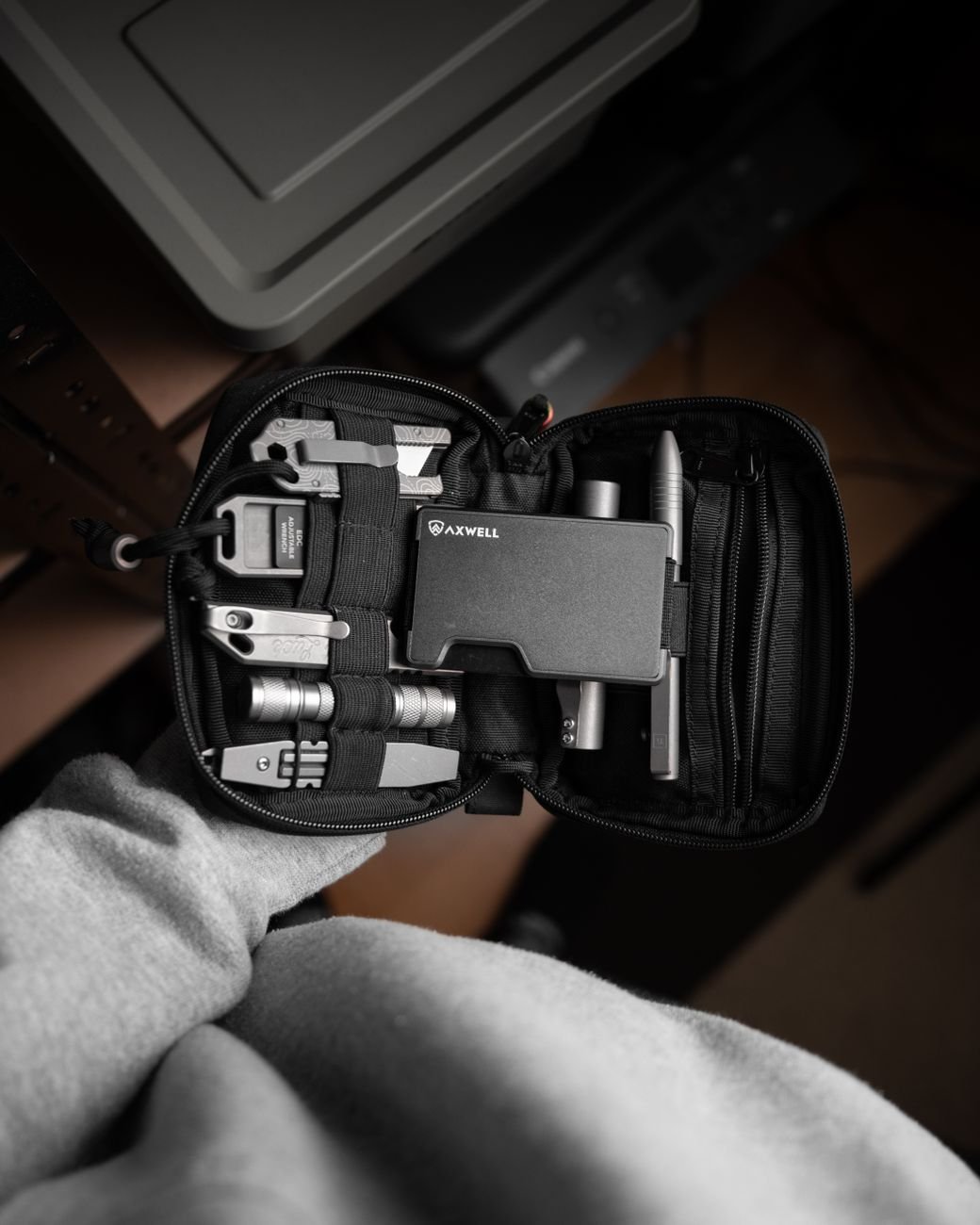
A loose screw or stubborn package seal rarely justifies carrying a workshop in a pocket.
The irritation usually arrives at the worst moment: a glasses hinge starts backing out, a battery compartment is secured with a tiny screw, or a parcel is taped like a vault. A novelty multitool may flex, slip, or lack the one implement that matters; a full-size tool kit is elsewhere.
A capable pocket setup is not measured by its implement count. It is measured by dependable task coverage: a driver that fits common fasteners, a blade or cutter that can be controlled safely, and enough handle geometry to apply torque without bruising fingers or rounding a screw head. The useful middle ground favors stout pivots, positive bit retention, and tools that remain accessible without dismantling the whole carry. Controlled force is the dividing line between a reassuring repair tool and an overloaded keyring trinket.
- Magnetic or mechanically retained bits reduce drops in awkward spaces.
- A longer driver reach can matter more than additional bit profiles around recessed screws.
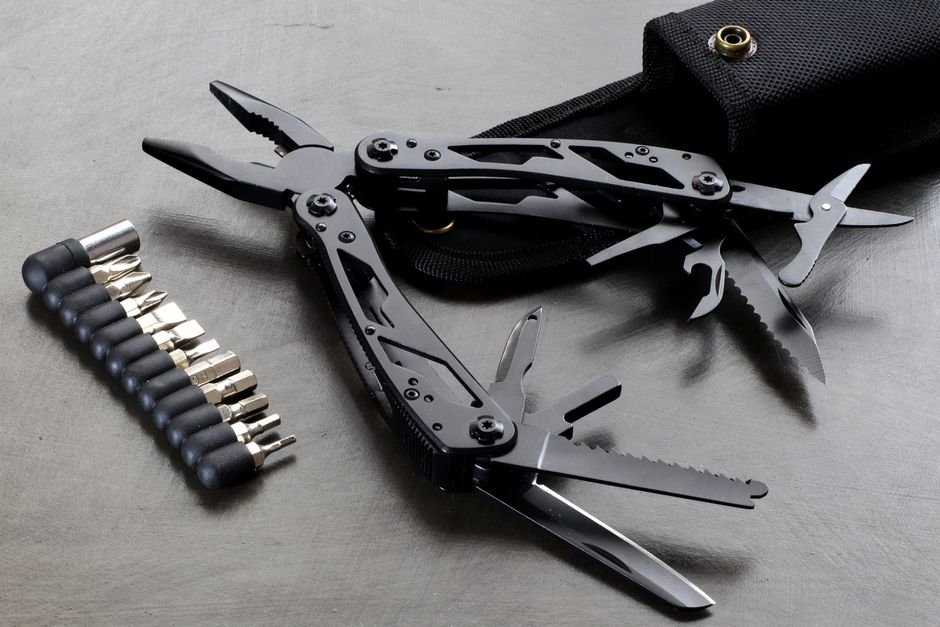
Know the pocket-tool boundary
A pocket tool earns its place among pocket tools for everyday repairs when it handles small interruptions.
Additionally, it tightens a loose cabinet pull, bends a small tab, or grips a nut while another tool turns it.
It opens a paint-can lid, snips a twist tie or thin wire, and checks a short dimension.
Its limits matter just as much. Compact handles provide little leverage, and folding joints are not substitutes for fixed pliers, a full screwdriver, or a pry bar. Stop when the work involves:
- High torque: seized screws, large fasteners, or screws driven into framing
- High leverage: lifting, separating bonded parts, or forceful prying
- Electrical risk: energized circuits, damaged insulation, or work requiring insulated tools
- Heavy cutting: hardened wire, cable, thick plastic, sheet metal, or padlocks
A useful capability-density test is simple: can one compact tool perform the task with controlled hand force, a secure grip, and no need to brace or strike it? If not, the job has outgrown the pocket.
Twisting a folding tool sideways can damage its pivot or cause a sudden slip. A dedicated tool is safer when force becomes the main requirement.
Build around four repair motions
A compact repair kit works because each piece owns a different motion. A bit driver turns fasteners; a thin pry tool separates clipped panels, lifts adhesive, or scrapes; compact pliers grip, bend, retrieve, and hold; and a rule or tape establishes diameter, spacing, and cut marks. None is interchangeable in practice: a driver used as a pry bar can damage bits, while pliers jaws cannot reliably locate a hole center.
This is why a large multitool is not automatically the more capable pocket choice. Folded tools often compromise the properties repairs demand: short driver reach, pinching pliers handles, awkward bit access, and scales obscured by hinges. A dedicated driver accepts common replaceable bits and, where needed, an extension; separate pliers provide a fuller, steadier grip. Worn bits and damaged pry tools can then be replaced without retiring the whole kit.
Some overlap is sensible.
Additionally, pliers with a small cutter and a pry tool with a nail-pull notch can reduce carry.
These configurations become pocket tools for everyday repairs.
Moreover, a driver carrying two bits can avoid extra tools.
Redundancy earns its place when it preserves access.
For example, a secondary Phillips bit can keep a repair moving after the primary bit is lost.
Make the driver earn its space
A compact bit driver is the fastener core of pocket tools for everyday repairs.
Its value lies more in a usable handle than in the number of bits.
Therefore, ensure the diameter grips securely, the length clears knuckles, and the shape avoids painful pressure under torque.
Very slim pen-style drivers travel well, but a slightly wider barrel or folding T-handle often gives more controlled turning.
Choose a driver that accepts a replaceable standard rather than captive proprietary bits. The common 1/4-inch hex format offers broad availability and robust shanks; 4 mm precision bits save space for electronics and small hardware but are less tolerant of high torque. A pocket-sized driver that still feels substantial in hand can bridge those needs when its handle and bit interface are matched to the work.
Retention matters more than bit count
A strong magnet is convenient, but it can release a bit when the driver is withdrawn from a recessed screw. A detent ball, locking collar, or captive bit carrier holds more reliably; the trade-off is extra mechanism and sometimes more thickness. Test retention by pulling the bit straight out and by rocking it side to side—noticeable wobble reduces control.
Carry only profiles encountered regularly:
- PH1 and PH2 for many household Phillips screws
- T10 and T15 for common Torx hardware
- Flat 4–5 mm for slotted fittings and light prying of screw covers
Match the recess precisely. Phillips and Pozidriv can look alike, while an undersized Torx bit can cam out and damage both screw and bit. Bits stored in a flat sleeve, side-mounted rail, or handle magazine add less pocket bulk than a round bit capsule; loose bits in the pocket eventually become noise, clutter, and loss.
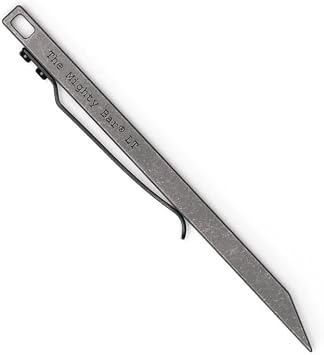
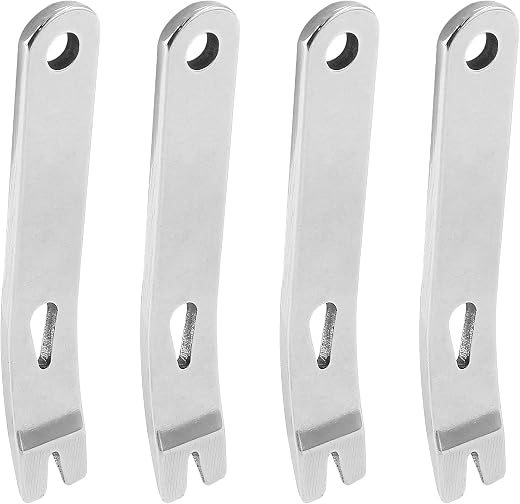
Add a pocket pry bar for controlled leverage
A pocket pry bar is a non-cutting sacrificial tool: its purpose is to take the scuffs, bending risk, and concentrated force that would damage a knife tip, screwdriver shaft, or fingernail. It can lift a staple edge, scrape softened adhesive, separate snap-fit trim, nudge a misaligned plate, or open a paint-can lid.
Match the geometry to the work
For pocket carry, roughly 3–4 inches is a useful compromise. Shorter bars disappear in a pocket but offer little mechanical advantage; longer bars provide better control and leverage, yet can feel conspicuous and overload small fasteners or plastic housings surprisingly quickly.
A thin, flat chisel tip starts under tape, clips, and shallow gaps. A broader, gently curved end spreads load across trim and is less likely to leave a deep witness mark. Nail-puller slots are useful for small brads, but a slot weakens the tip compared with a solid wedge.
Useful secondary features include a lanyard hole, a small scraper edge, and an integrated bit socket. None replaces its main job: pry with the broad face supported against a sturdy surface, not against glass, a battery cover, or delicate finished material.
Material and finish matter
Steel generally provides a slimmer, stiffer bar at a given size; titanium lowers carry weight and resists corrosion but may flex more in very thin designs. Heat treatment and cross-section matter as much as alloy. A tumbled or stonewashed finish hides pocket wear, while a smooth coating can be easier to wipe clean.
Leverage multiplies force. If the bar must be twisted hard, struck, or used to free a seized part, the task has exceeded pocket-tool territory; a larger pry tool and proper support reduce the chance of damage.
A pry bar is not a miniature crowbar. Stop when the workpiece flexes, the tip begins to slip, or the bar visibly bends; repositioning the fulcrum or changing tools is safer than adding force.
Choose pliers by jaw access
Headline length is a poor proxy for capability. A short tool with broad, flat jaws can hold a nut, straighten a light bracket, or pull a staple with more contact area and less marking. Tapered needle-nose jaws trade that grip for access: they reach into recessed housings, position clips, and bend small loops. Their tips are not designed to take the same twisting load as a broad jaw.
Check the tool closed and open. The jaws should meet evenly along their intended gripping area; daylight at the tip, crossed jaws, or a noticeable side-to-side wobble makes precise work frustrating. A tight but smooth pivot is preferable to a loose one. On spring-loaded models, the spring should open the handles without forcing the tool apart or pinching fingers during storage.
Handle clearance matters as much as jaw length. Some miniature pliers have jaws that fit a cramped space, yet their handles cannot open far enough once inside it. For occasional pocket carry, a modestly longer nose often adds more real reach than an extra accessory.
Cutters deserve a separate inspection. Look for a cleanly formed cutting notch near the pivot and confirm whether it is intended for soft wire—such as copper, floral wire, or light tie wire. Tiny integral cutters can nick or spread when used on hardened steel wire, music wire, nails, or wire rope. For those materials, dedicated side cutters are the more durable choice.
A tapered jaw can start a bend, but twisting a seized fastener or thick wire at its narrow end concentrates force at the most vulnerable section. Grip closer to the pivot whenever clearance allows.

Measure before the fastener goes in
A slim tape or folding rule earns its pocket space when a repair hinges on fit, not merely appearance. It can distinguish an M4 screw from a nearby imperial substitute, confirm whether a replacement bolt has enough thread engagement, or reveal that a cabinet pull’s hole centers are 96 mm rather than 100 mm. Clearance checks matter just as much: battery doors, drawer slides, hinge offsets, and under-sink gaps can fail over a few millimeters.
For these quick decisions, pocket tape accuracy for ordinary repairs is generally about consistent reading, a true hook, and a legible scale—not survey-grade precision. A 1 mm graduation is useful; a narrow, floppy blade is less so when measuring inside a recess.
Reference versus layout
A tape is a reference tool for comparing lengths and selecting hardware. Precision layout needs a rigid rule with etched marks, a square edge, and a fine marking point. Practical details include:
- Metric and imperial scales when working with mixed hardware.
- Inside/outside measurement capability for openings and clearances.
- A durable zero hook or end stop, since damage there shifts every reading.
- Blade stand-out and lock quality only if one-handed reach is genuinely needed.
Keep the kit dependable
A pocket kit needs a quick check after dirty work and a more deliberate inspection every few months. Empty the pouch or organizer, account for every bit, and wipe away adhesive, metal dust, and pocket lint before it packs into pivots or bit holders.
Inspect the working parts
Open folding tools through their full travel. A gritty pivot can often be flushed with a suitable cleaner, dried, then given a very light lubricant film; excess oil captures grit. Check that driver bits fully seat, magnets still retain them, and bit corners have not rounded. Discard bits that cam out, split, or show a twisted shank rather than applying more force.
Look closely at pry-bar tips, pliers jaws, cutters, and knife edges. A small edge touch-up is normal; chips, deep rolls, jaw misalignment, pivot play, or a cracked tool body call for replacement or professional service. For orange spotting or scale, use safe rust-removal methods for pocket tools early, then dry the tool thoroughly and restore its protective coating.
Store the kit dry, especially after rain or sweaty carry. A missing bit or stiff joint is easier to correct at the bench than during a repair.
A slipping bit, spreading pry tip, or loose pivot signals lost control. Continuing can damage both the tool and the fastener.
Refine the kit by evidence, not anxiety
Pocket Repair Tools: Common Questions
How do I know when a job has outgrown a pocket tool?
A useful test: can one compact tool perform the task with controlled hand force, a secure grip, and no need to brace or strike it? If not, the job has outgrown the pocket—high torque, high leverage, electrical risk, and heavy cutting all signal it’s time for a dedicated tool.
Why does bit retention matter more than bit count on a pocket driver?
A strong magnet is convenient, but it can release a bit when the driver is withdrawn from a recessed screw. A detent ball, locking collar, or captive bit carrier holds more reliably. Test retention by pulling the bit straight out and rocking it side to side—noticeable wobble reduces control.
What size pocket pry bar works best for everyday carry?
Roughly 3–4 inches is a useful compromise. Shorter bars disappear in a pocket but offer little mechanical advantage; longer bars provide better control and leverage but can feel conspicuous and overload small fasteners or plastic housings.
Can a mini-plier cutter handle any type of wire?
No. A cutting notch near the pivot is typically intended for soft wire such as copper, floral wire, or light tie wire. Tiny integral cutters can nick or spread when used on hardened steel wire, music wire, nails, or wire rope—those materials call for dedicated side cutters.
How often should a pocket tool kit be inspected?
A quick check after dirty work and a more deliberate inspection every few months. Empty the pouch, account for every bit, wipe away adhesive and grit, and check that driver bits fully seat, magnets still retain them, and jaws or pry tips haven’t developed chips, rolls, or play.
A pocket kit works as a system
- Favor a tool that improves control over several miniatures that duplicate one weak function.
- Let repeated repair history, not hypothetical scenarios, justify additions.
A compact repair carry becomes reliable through restraint. Its driver, leverage tool, gripping option, and measuring aid should cover distinct motions while remaining comfortable enough to control accurately.
The useful test is simple: does each item solve a recurring problem at pocket-tool scale? If not, leaving it behind often makes the remaining kit faster to carry, easier to inspect, and more likely to be used well.


7 Comments
I like the “repair motions” idea, but I’m still confused about selective redundancy. Isn’t carrying a driver plus a multitool with a driver just duplicating stuff? Trying to avoid turning my pockets into a hardware store.
The point about exact bit profiles is underrated. I used a compact bit driver on a cabinet hinge last weekend, but the bit had enough wobble that it started camming out and chewed up the screw head.
Do you recommend keeping only the bits you personally encounter, or is there a small basic set that makes sense for most household fixes?
Start with the fasteners you actually see, then add only a few common backups. For many household tasks, that means Phillips #1 and #2, a couple of flat bits, and Torx sizes such as T10 and T15 or T20 if your furniture, appliances, or bikes use them. Hex bits are worthwhile only if they match things you regularly adjust.
The important part is using a full-depth, correctly sized bit with minimal play. A compact kit with six good bits is generally more useful than a bulky assortment of twenty that rarely fit anything.
When you say pocket pry bar, are you talking about one of those tiny flat bars that hangs on a keyring? I’ve always just used my knife tip for opening paint cans or lifting staples, which I know is probably exactly what you’re warning against. What’s a realistic limit before the little bar is more trouble than it’s worth?
That’s the general idea, although a small bar carried loose in the pocket is usually more practical than a dangling keyring tool. Its job is light, controlled work: lifting staples, opening small covers, scraping, aligning a hole, or gently separating trim. If you have to lean your body weight into it, bend the bar significantly, or need a long handle for leverage, stop and use a proper pry tool. And yes—saving the knife tip is one of the best reasons to carry it.
I ruined a perfectly good knife tip on a paint-can lid years ago 🙃 A little pry bar has earned its spot for that alone.
Maybe I’m being overly cautious, but “pocket tools” and electrical work in the same general repair conversation makes me nervous. I know the article says dedicated equipment for electrical jobs, but I wish that warning were even louder. A tiny driver is not automatically insulated just because it has plastic on it!