
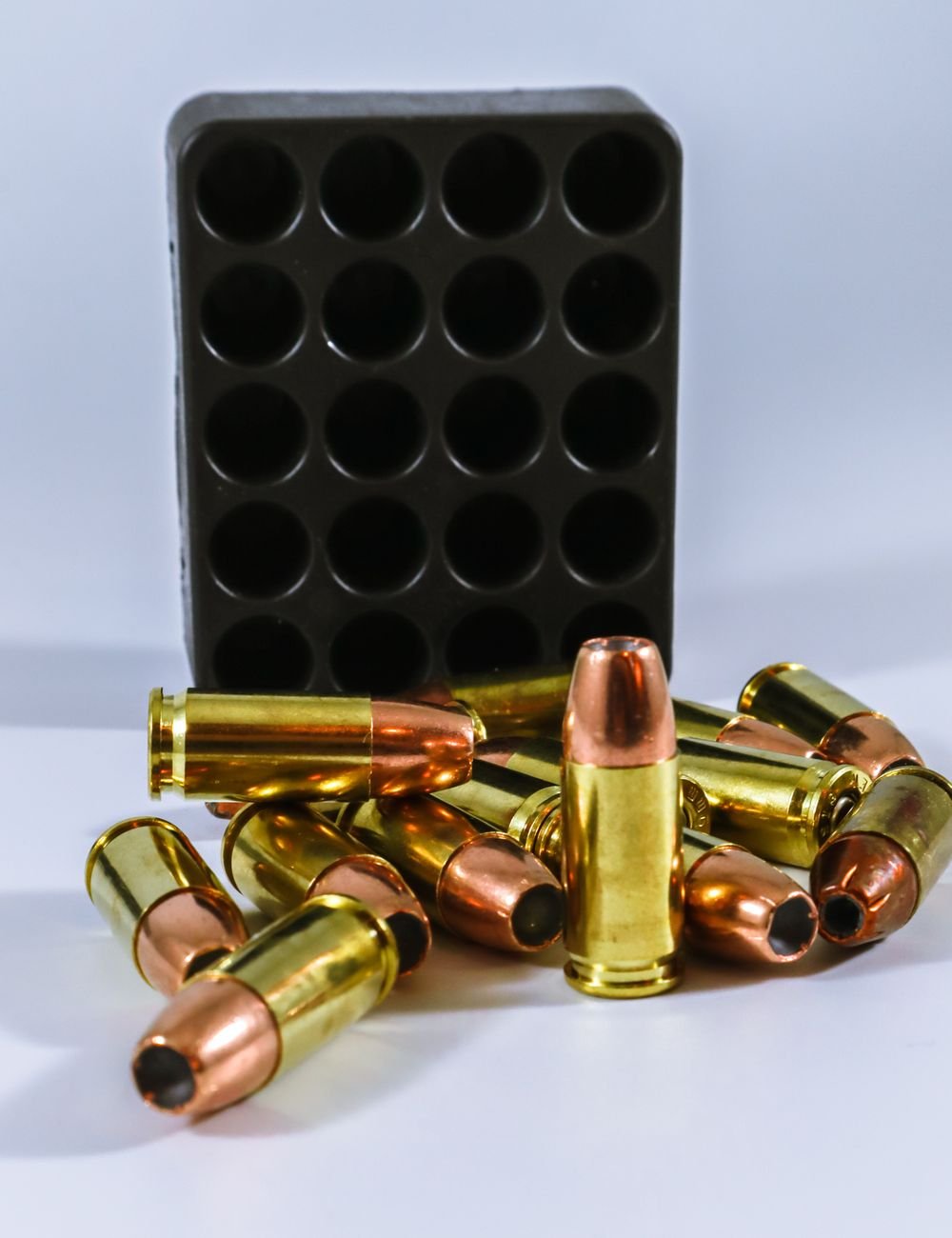
A familiar range box and a defensive-load box may feed the same pistol, yet they are built to solve very different problems.
At the counter, FMJ can look like the uncomplicated choice: widely available, generally economical, and ideal for confirming that a handgun cycles consistently. Its rounded or tapered bullet profile is designed chiefly for dependable feeding and penetration, not controlled expansion in tissue. That distinction becomes consequential when a firearm is kept for defense rather than practice.
Hollow-point ammunition is engineered to expand under suitable conditions, increasing its frontal area and usually limiting how far it travels compared with a similar FMJ load. But the label alone settles little. Performance varies with velocity, barrel length, intervening materials, bullet design, and the particular firearm’s feed geometry. A compact pistol can produce markedly different results from a duty-size model using the same cartridge. Indoor walls, nearby occupants, and local restrictions on ammunition type also shape the practical trade-off. Reliable function in the actual firearm and the load’s behavior in its intended environment matter more than shorthand claims about either bullet style.
- FMJ commonly prioritizes feeding reliability and penetration; defensive hollow points are designed for controlled expansion.
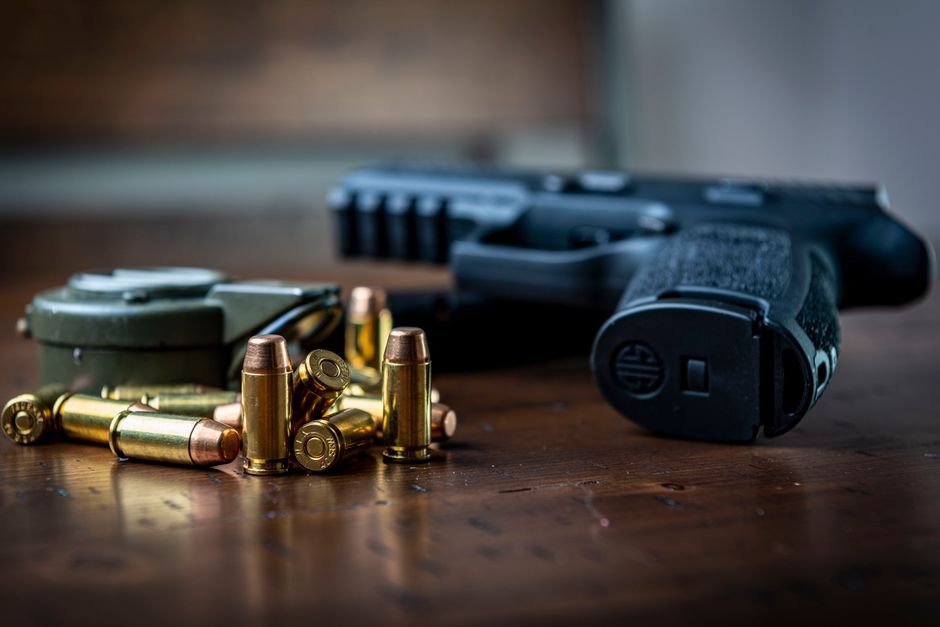
What the bullet names actually describe
FMJ (full metal jacket)
A lead or lead-alloy core enclosed mostly by a harder metal jacket, commonly copper or gilding metal. The nose is typically rounded or pointed and remains covered rather than intentionally opening on impact.
Jacketed hollow point (JHP)
A jacketed bullet with a cavity formed in its nose. On impact in a suitable medium, that cavity may allow the nose to peel back and the projectile to widen; it is not simply an “empty” bullet.
Jacket
The outer metal layer that helps a bullet retain its shape during firing, limits bore fouling, and can control how the projectile deforms. Jacket thickness, cuts, bonding, and core material vary substantially among loads.
Expansion
An increase in a bullet’s frontal diameter after impact. JHP designs commonly prioritize controlled expansion, while conventional FMJ designs generally prioritize reliable feeding, penetration, and structural integrity.
Load performance
“Hollow point” identifies a broad construction family, not a guaranteed result. Expansion and penetration can change with caliber, impact velocity, barrel length, clothing or other barriers, and the specific bullet design.
Two JHP loads in the same caliber can behave very differently. A modern bonded design may retain its jacket and core through barriers, while another design may expand only within a narrower velocity range.
The label describes the nose geometry; the complete load determines the result.
Penetration is the central trade-off
A defensive projectile must penetrate deeply enough to reach critical anatomy after encountering less-than-ideal angles, intervening limbs, heavy clothing, or other soft tissue. A shallow stop in bare gel can look reassuring, yet it may leave too little depth once real-world variables consume momentum. Conversely, a projectile that remains intact and travels far beyond the intended depth raises the possibility of exiting the body and continuing through nearby materials.
Why the target is a range, not a guarantee
The commonly cited 12-to-18-inch window in calibrated 10% ordnance gelatin is associated with FBI test protocols. For context on what FBI penetration standards mean, the number is best understood as a screening benchmark: it seeks enough reserve penetration for difficult paths without treating unlimited depth as a virtue. It is not a measurement of lethality, a promise of terminal effect, or a forecast of a particular incident.
Gelatin also makes comparison more useful when it is calibrated and tests are conducted consistently. Bare-gel results reveal one aspect of performance; tests through heavy clothing, wallboard, plywood, steel, and auto glass reveal whether expansion is retained or whether a bullet’s behavior changes sharply after a barrier. Hollow points may expand broadly and reduce depth in some conditions, while other designs can plug with fabric, expand minimally, or penetrate more after barrier contact.
FMJ generally offers more predictable straight-line depth because it does not rely on cavity expansion, but that same characteristic can increase pass-through concerns. A well-designed defensive hollow point attempts to balance expansion, retained mass, and adequate depth; no bullet design removes uncertainty. Test results can therefore help compare loads and barrel-length performance, while still leaving angle, distance, barrier sequence, and the surrounding environment unresolved.
Why FMJ remains the training default
FMJ is not an inferior cartridge in every role. It is a practical training load because it is commonly produced in large quantities, widely stocked, and often less costly than comparable defensive ammunition. That makes regular practice, drills, and function testing more attainable without consuming a reserve of premium loads.
Its smooth, rounded profile also tends to feed dependably in many semi-automatic pistols, particularly designs developed around military-style ball ammunition. Reliability still belongs to the complete system: a particular pistol, magazine, cartridge overall length, and maintenance condition can change the result.
Where the design priorities diverge
FMJ bullets are generally built to retain shape and penetrate rather than to expand. In personal-defense contexts, that can mean more pass-through potential and a narrower permanent wound path than a well-performing expanding load. Neither outcome is guaranteed; velocity, impact angle, intermediate barriers, and the bullet’s specific construction matter.
FMJ therefore remains useful for building handling skill and confirming basic firearm function. Its limitation is simply that economical, durable, deep-penetrating construction usually serves a different purpose from ammunition engineered to expand consistently in soft tissue.
Expansion is engineered, not guaranteed
Modern jacketed hollow points use a preformed cavity, scored jacket petals, and often a bonded core to make expansion more repeatable. The aim is not maximum diameter at any cost: a useful design opens while retaining enough mass and momentum to continue penetrating. Some loads use mechanical core-jacket locking rather than bonding, but the same balance applies.
Laboratory results are conditional. Heavy denim can clog a cavity and delay or prevent opening; plywood, sheet metal, and automotive glass can deform the nose or separate components. Barrier-capable loads are engineered to limit those effects, yet no bullet can produce identical results after every intermediate material, angle, and impact velocity.
Velocity changes the result
A cartridge’s published performance may come from a longer test barrel than a compact carry pistol provides. Lower velocity can reduce expansion, particularly in designs with a higher opening threshold. At the other extreme, rapid expansion can consume energy early and reduce penetration. Bullet weight, cavity geometry, jacket thickness, and retained mass all interact; caliber alone does not predict the outcome.
For comparison, meaningful testing identifies the exact load, bullet weight, and barrel length, then notes bare-gel and barrier results rather than treating a recovered expanded bullet as proof of universal performance.
Expansion is probability-based, not guaranteed.
Clothing, barriers, velocity, and impact angle can change cavity function.
Expansion and penetration must remain balanced.
A bullet that opens too quickly may not reach adequate depth.
Performance belongs to a specific load.
Bullet weight, generation, and barrel length can produce different results.
A home-defense loading decision is not settled by “FMJ penetrates” or “hollow points stop.” Drywall and hollow-core doors offer little resistance, while masonry, plumbing, appliances, and framing can slow or redirect a projectile. Occupied rooms—not walls alone—define the risk picture.
Neither projectile type makes a miss harmless. A round that misses can cross rooms or leave the dwelling; one that strikes an intermediate surface may take an unpredictable path. Every fired round remains an accountability question, regardless of bullet design.
Multi-unit buildings add occupied spaces above, below, and beside the immediate room. In that setting, apartment defense ammunition choices are inseparable from the floor plan, likely angles, and what lies beyond each wall, ceiling, and floor. Relevant evaluation includes the actual layout and the possibility of misses, not a promise of “safe” ammunition.
Bullet design can change behavior after impact; it cannot remove responsibility for where a round travels.
The pistol is part of the ammunition test
A hollow point that expands well from a duty-size pistol is not automatically a proven performer from a compact carry gun. Shorter barrels can reduce muzzle velocity enough to alter cavity opening, expansion diameter, penetration depth, or all three. Published test results are useful only when the barrel length, test protocol, and barrier conditions are comparable.
Reliable function is equally platform-specific. Bullet profile, overall cartridge length, magazine geometry, recoil-spring rate, extractor condition, and shooter grip can all affect feeding and ejection. A load that runs flawlessly in one example of a pistol may behave differently in another.
For a compact 9mm, relevant evidence combines documented terminal testing with function checks in the actual firearm—not a full-size substitute. Reviews of defensive 9mm loads for the Glock 19 illustrate the useful questions: which barrel was used, what barriers were tested, and whether the ammunition cycled consistently. Model name alone is not a complete test condition.
Compare loads by evidence, not reputation
- Comparable test protocols
Prioritize results from calibrated 10% ordnance gelatin, with stated barrel length, velocity, and barrier protocol. A single recovered bullet or bare-gel photo cannot establish consistent performance.
Look forRepeatable data across bare gel and relevant barriers.AvoidMarketing claims without test conditions or multiple trials. - Reliable function in the exact pistol
A load’s terminal design is irrelevant if it fails to feed, fire, extract, or lock back in the particular pistol and magazines. Short barrels deserve special attention because lower velocity can alter both cycling and expansion.
Look forDocumented, trouble-free operation in the actual setup.AvoidAssuming a load works because it ran in another gun. - Separate training from carry
FMJ can make high-volume practice practical, while a defensive load merits enough confirmation to establish function and point-of-impact behavior. Similar recoil and handling can make practice more representative, but identical bullet construction is not required.
Look forA practice load that supports realistic handling drills.AvoidTreating inexpensive practice ammunition as terminal-performance evidence. - Local restrictions and range rules
Ammunition classifications, permitted uses, and transport rules vary by jurisdiction; indoor ranges may also limit projectile types. Current official sources are more dependable than forum summaries when sorting out self-defense ammunition choices.
Look forCurrent, local rules and facility policies.AvoidAssuming rules transfer across state or municipal lines.
Gelatin testing can reveal whether a load repeatedly reaches a useful penetration range and how barriers change its behavior. It cannot reproduce every angle, clothing combination, intermediate object, or firearm condition.
The strongest comparison pairs published protocol data with function testing in the intended pistol. That approach is more informative than choosing by bullet weight, box label, or a single dramatic expansion image.
Frequently Asked Questions
Is FMJ or hollow-point ammunition better for home defense?
Hollow points are generally preferred for defense because they’re engineered for controlled expansion, while FMJ is built mainly for reliable feeding and penetration rather than expanding in tissue.
Why do defensive loads target 12 to 18 inches of penetration?
That range comes from FBI test protocols using calibrated 10% ordnance gelatin. It’s a screening benchmark meant to ensure enough reserve penetration through barriers like clothing or limbs, not a guarantee of a specific outcome.
Does barrel length affect hollow-point performance?
Yes. A compact carry pistol produces lower velocity than a longer duty-size barrel, which can reduce expansion, change penetration depth, or both. Test results are only meaningful when barrel length and protocol match the intended gun.
Is FMJ still useful if I own defensive hollow points?
Yes. FMJ remains a practical training load because it’s widely available and generally less costly, which makes regular practice and function testing more attainable without using up premium defensive ammunition.
Can a hollow point fail to expand?
Yes. Heavy clothing can clog the cavity, and barriers like plywood or auto glass can deform the nose or separate components, so expansion is probability-based rather than guaranteed on every hit.
Purpose Drives the Choice
FMJ remains the practical workhorse for high-volume practice: affordable enough to build skill, generally easy to source, and often dependable across pistols. Its tendency not to expand, however, makes it a poor substitute for ammunition engineered around defensive terminal performance.
Modern defensive hollow points are designed to expand while reaching a suitable depth, but no label overrides testing in the actual pistol. Reliable cycling, lawful possession and use, and accountability for every miss remain essential—whether a round expands, exits, or never strikes its intended target.


8 Comments
I understand using FMJ for the bulk of range practice, but I’m still not fully sold on the usual “just run a box of your carry load” advice. A pistol can behave perfectly for 30 rounds and then have an issue with a particular magazine much later.
For someone who can’t afford to shoot hundreds of defensive rounds every month, what is a sensible way to test reliability without pretending a tiny sample proves anything? And would you rotate magazines through the test instead of only using the one that happened to work?
That skepticism is fair: no round count can guarantee future reliability. A practical approach is to test the intended carry load across every magazine you may rely on, including loading, chambering, and firing under normal range conditions. Keep notes on any stoppage and distinguish ammunition issues from magazine or pistol issues. Then continue to verify periodically as magazines, springs, and carry conditions change rather than treating one initial test as permanent proof.
Yep, rotate the magazines. I found one older mag that was totally fine with cheap practice ammo but got intermittent feed problems with my defensive load. Annoying, but better to learn that at the range.
The multi-unit housing angle deserves more emphasis. “Use hollow points” gets repeated like it solves every wall/neighbor problem, when misses are still misses and construction is wildly different from one building to the next. Not glamorous advice, but training and knowing what’s behind a target seem like the part people want to skip.
The short-barrel point is the one I wish more articles covered. If a JHP is advertised with tests from a 4-inch barrel, how much should someone with a compact 3-inch pistol assume those results still apply? Is chrono testing enough, or do you really need to verify expansion data for that exact barrel length?
Chronograph data is a useful first check because it tells you whether your pistol is producing velocity close to the test conditions. But velocity alone cannot prove terminal performance; bullet design, clothing layers, and the particular test protocol still matter. Ideally, look for independent testing of the same load from a similar barrel length, then confirm that it cycles reliably in your own pistol.
This was my takeaway too. A “compact” label on the ammo box doesn’t magically make every short barrel identical. I’d rather see real test data than just trust the marketing.
Good reminder that 12–18 inches is a comparison benchmark, not a promise about what happens in somebody’s living room. People tend to talk about gel blocks like they’re fortune tellers 🙃