
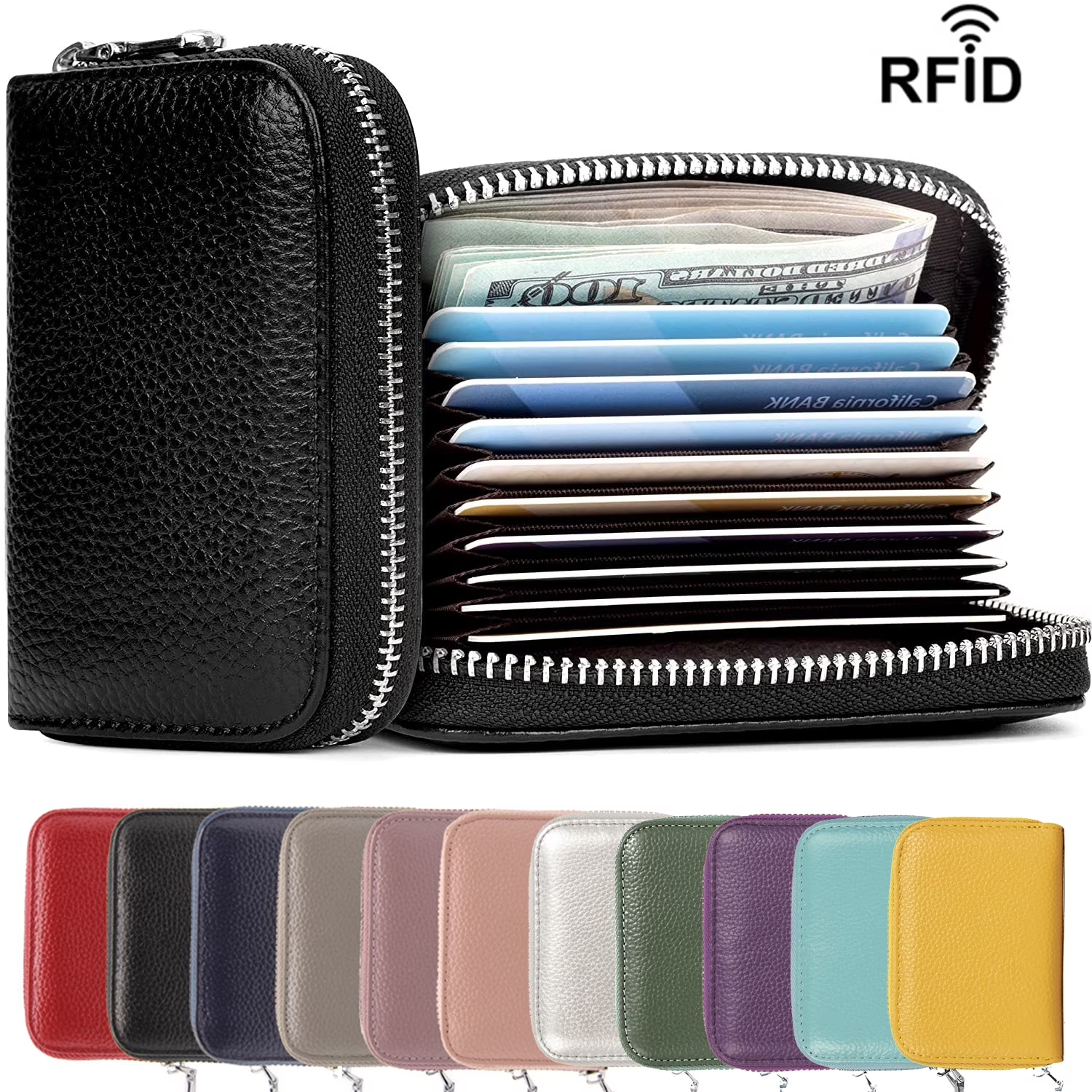
Small metal layer, big anxiety.
At the checkout, a card suddenly won’t swipe or the contactless tap fails; hands fumble around a freshly bought RFID wallet or sleeve. That instant of panic—did the protective lining erase the magnetic stripe or corrupt the chip?—is common.
RFID linings act as a Faraday cage, blocking radio signals (NFC at ~13.56 MHz) but they don’t generate the intense, localized magnetic fields needed to demagnetize a stripe. Magnetic stripes are usually only erased by strong, direct magnets or physical abrasion; EMV chips are solid-state and not damaged by passive shielding. More often, dirt, wear, or terminal faults explain read failures.

How payment technologies store and transmit data
Magnetic stripe
A magnetic stripe encodes card data as static patterns on three tracks. When the card is swiped, a read head senses changes in magnetic polarity. Because the data remains the same across transactions, it is susceptible to cloning (skimming). Additionally, it can be corrupted by strong magnetic fields. This vulnerability also affects RFID wallet magnetic stripe data.
EMV chip
An EMV chip is a tiny microprocessor that stores payment credentials and performs cryptographic operations. During a contact transaction the terminal powers the chip through the card’s metal contacts; the chip generates a transaction-specific cryptogram, so the data presented to the terminal changes each time. This dynamic authentication reduces cloning risk, though it does not make the card immune to all attack classes (for example, sophisticated relay or side‑channel attacks).
Contactless / RFID / NFC
Contactless payments use near‑field radio (NFC/RFID) to exchange data over a short distance. Cards or phones contain a secure element that responds to a reader with a cryptographic message; many implementations use transaction-specific tokens or dynamic codes. Radio-based transmission creates different threats (skimming at close range, relay attacks that extend range) and different mitigations (signal shielding, short read ranges, cryptographic tokens).
Key differences at a glance:
- Static vs dynamic data: magnetic stripe = static; EMV/contactless = dynamic.
- Interface: swipe (magnetic), contact (chip), radio (NFC).
- Typical mitigations: physical protection for magnetic stripes; cryptography and tokenization for EMV/contactless.
How RFID‑blocking wallets work
How shielding works
RFID‑blocking wallets use conductive materials to interrupt the radio-frequency coupling that powers and reads contactless cards. At the core is the Faraday‑cage concept: a continuous conductive enclosure redistributes incoming electromagnetic fields so a nearby reader cannot induce the tiny currents an NFC/RFID chip needs to communicate.
Common constructions and their effects:
- Metal foil or laminated films (aluminum/copper): thin, flexible, moderate shielding for 13.56 MHz NFC.
- Metal meshes or woven stainless/copper threads: better mechanical durability and more consistent attenuation.
- Solid metal plates or multilayer laminates: highest attenuation but add bulk and weight.
Limits and practical considerations
Shielding effectiveness depends on conductivity and continuity.
Additionally, it also depends on how the card sits inside the sleeve.
Partial covers, seams, or small stacks of cards can create leakage paths for RFID wallet magnetic stripe.
A weak or poorly fitted shield may attenuate a reader rather than block it.
Very close or high-power readers can still couple energy through imperfect shields.
Importantly, RFID wallet magnetic stripe patterns are static magnetization and are not erased by RF shielding.
Additionally, demagnetization requires a strong, varying DC magnetic field.
Moreover, different device frequencies, such as car fobs at ~315/433 MHz, affect signal blocking.
Thus, a solution optimized for NFC may be less effective elsewhere.
In short: good conductive enclosures block NFC/RFID coupling, but real‑world fit, materials, and reader power limit performance.
Do RFID wallets erase magnetic stripes?
False — RFID shielding does not generate the low‑frequency magnetic fields needed to alter magnetic domains.
RFID/NFC blocking uses passive conductive layers that block or redirect radio‑frequency energy; they do not produce sustained DC magnetic fields. Magnetic stripes store data as tiny magnetized regions; changing them requires a strong, targeted magnetic field (a degausser or rare‑earth magnet) or prolonged exposure to such a field.
False — normal contact, compression, or nonabrasive metal layers do not demagnetize stripes.
Mechanical pressure and sliding can cause physical wear, scratching, or delamination of the stripe coating, which looks like failure but is not magnetic erasure. Demagnetization is a magnetic process; abrasion is a physical one, so the culprit in many wallet failures is friction or poor card manufacture, not RFID shielding.
Partial — strong external magnets or degaussing equipment can alter stripes if present.
High‑strength neodymium magnets, industrial degaussers, or prolonged exposure to strong DC fields can disturb high‑coercivity domains on older or lower‑quality cards. Such scenarios are uncommon in everyday wallets but matter near magnetic tools, certain accessories, or specialized equipment.
Common real causes:
Strong magnets or degaussers placed close to cards Heat, chemical exposure, or prolonged UV Physical abrasion, bending, or card delaminationNot a cause: passive RFID‑blocking layers — they block RF, they do not emit demagnetizing fields.
Where magnetic demagnetization really comes from
Common sources of magnetic fields
Magnetic-stripe erasure requires a concentrated, persistent magnetic field. Typical sources that can produce such fields include:
- Built-in magnets: strong magnetic clasps, wallet closures, or embedded neodymium strips. These produce localized high fields at the card surface.
- Phone mounts and accessories: some smartphone mounts and magnetic wireless charging systems (e.g., MagSafe-style arrangements) contain neodymium magnets with significant surface flux.
- Industrial and medical equipment: MRI machines, large industrial magnets, and magnetic particle inspection gear generate very large fields capable of erasing stripes at a distance.
- Speakers and motors: high-power speakers, workshop tools, or old CRT displays can produce nearby magnetic fields occasionally strong enough to interfere.
How strong must a field be?
Cards differ: older low-coercivity (LoCo) stripes erase with relatively weak fields, while modern high-coercivity (HiCo) bank and transit cards resist much stronger fields. In practical terms:
- Household fridge magnets and weak decorative magnets rarely produce enough flux to erase modern cards.
- Small neodymium magnets and some phone accessories produce much stronger localized fields and can demagnetize a stripe if in prolonged direct contact.
- Medical/industrial magnets (and MRI scanners) produce fields orders of magnitude larger and pose a clear risk.
Practical likelihood in everyday life is low for modern HiCo payment cards, but risk rises when cards sit in direct contact with strong rare‑earth magnets or are exposed to industrial/medical fields.
Strong rare‑earth magnets and MRI‑level fields can erase magnetic stripes. Weak household magnets rarely do. Modern HiCo cards are much more resistant than older LoCo cards.
Mechanical and environmental causes that mimic erasure
Cards that appear “erased” are often victims of physical or chemical damage rather than magnetic demagnetization. Common causes:
- Abrasion: repeated rubbing against other cards, coins, or rough linings wears the magnetic coating and printed characters. Polyester or rough fabric interiors accelerate wear.
- Bending and creasing: flexing stresses the stripe layer and adhesive, causing flaking or cracking that reads as lost data.
- Heat: prolonged exposure to high temperatures (for example, inside a parked car in sun) can soften card plastics and adhesives, causing warping or delamination.
- Moisture and corrosion: sweat, humidity, salt, or liquid ingress can corrode metallic layers or lift coatings, disrupting readability.
How wallet design changes risk
- Features that increase risk: tight elastic pockets that bend cards, abrasive or unfinished seams, open-top compartments that let coins and dust mix with cards.
- Features that reduce risk: rigid card slots that hold cards flat, soft smooth linings (microfiber or bonded fabric), separate coin compartments, and zip or flap closures that limit exposure to elements.
Small design choices often explain stripe failures that are mistaken for magnetic erasure.
Magnetic snaps in wallet closures are usually too weak to demagnetize stripes. Mechanical wear, heat, and moisture are far more common culprits for unreadable cards—choose designs that minimize friction and bending.
Standards, specs and testing methods
Summarizes standards and empirical methods used to test RFID‑blocking wallets for RFID attenuation and magnetic‑stripe demagnetization.
-
Relevant standards and manufacturer specs
Key references include ISO/IEC 14443 and 15693 (contactless), ISO/IEC 7810/7811 (card formats and stripe coercivity) and ISO 10373 (test methods). Manufacturers typically report shielding effectiveness in decibels and list construction materials (copper, aluminum, mu‑metal).
-
Measuring RF attenuation
Labs measure S21 insertion loss with network analyzers or calibrated reader coils and run practical reader‑range tests with reference cards to quantify dB reduction and changes in read success rate.
-
Testing for demagnetization
Demag protocols expose cards of known coercivity to controlled DC/AC fields (Helmholtz coils or calibrated magnets), then perform magnetic readback and bit‑error analysis; independent results generally find shielding materials block RF without creating fields strong enough to erase modern HiCo stripes.
Common Practical Questions
Will an RFID wallet stop contactless payments?
When closed, a properly made RFID wallet attenuates 13.56 MHz NFC fields and typically prevents a contactless reader from coupling with a card. If the wallet is open, damaged, or uses an incomplete shield, contactless transactions can still occur because shielding is an electromagnetic attenuation, not a permanent block.
Can RFID wallets damage EMV chips or magnetic stripes?
RF shielding materials do not harm EMV chips; chips use insulated silicon and cryptographic protocols unaffected by conductive sleeves. Magnetic stripes are not erased by RFID blockers — only strong external magnetic fields or mechanical wear and heat cause demagnetization or data loss.
Does stacking multiple cards in an RFID wallet cause read errors?
Stacking can make magnetic-stripe swipes harder and can confuse mechanical or contactless readers if multiple contactless cards come into range simultaneously. Good wallet designs use individual sleeves or thin separators to reduce abrasion and unintended simultaneous reads.
How can the blocking effectiveness be tested safely?
A simple functional test is attempting a contactless tap with a closed wallet against a reader; lack of a response indicates sufficient attenuation. Laboratory-grade verification uses NFC field probes and attenuation measurements, which quantify shielding in decibels rather than relying solely on transaction attempts.
Which storage habits reduce card damage risk?
Minimizing bending, avoiding overstuffing, and using pockets with smooth, nonabrasive linings reduce stripe wear and chip stress. Metal cases can offer strong RF shielding but risk scratching; periodic inspection of stripe condition and proper separation of cards helps detect early mechanical damage.
Key conclusions and quick steps
- RFID/NFC shielding blocks radio reads but does not demagnetize magnetic stripes under normal conditions.
- Magnetic-stripe erasure requires unusually strong static fields or physical damage (abrasion, bending, delamination, heat).
- Quick inspection—look for scratches, separation, creases, or faded black stripe—can distinguish mechanical damage from electronic issues.
Bottom line: RFID-blocking wallets stop radio-frequency reads but are not a practical source of magnetic-stripe erasure. Magnetic damage is usually from strong rare‑earth magnets or physical/environmental wear rather than RF shielding.
For quick mitigation and care, inspect cards visually and by swiping or inserting: check for delamination, warped edges, deep scratches, or softening from heat or moisture. If a card fails, contact the issuer for testing or replacement rather than assuming demagnetization. To reduce mechanical wear, prefer wallets and sleeves that avoid tight stacking, excessive bending, and abrasive materials; keep cards away from unusually strong magnetic sources. For deeper reading on materials, protective technologies, and long‑term care, consult the related resources below.



9 Comments
So if I carry my cards in an RFID sleeve I bought on Amazon, there’s basically zero chance it’ll erase the magnetic stripe? That’s a relief — I’ve been paranoid about those weird little card readers at gas stations.
The testing details matter a lot. When you say shields are tested for dB attenuation and coercivity exposures, do consumer-grade sleeves actually get certified by those standards, or are most manufacturers just claiming protection? I’m skeptical of vague marketing claims.
I bought a sleeve that had a ‘tested’ sticker but no details. In practice, it did block my phone’s NFC when I put it in the sleeve, so at least for contactless blocking it worked. But I agree — certification specifics are usually missing and that’s annoying.
Good question. Most consumer sleeves won’t include full lab certification details on the packaging. Reputable makers will publish test methods or attenuation figures (e.g., dB at certain frequencies). For coercivity/demag testing, that’s less common in consumer marketing because the risk is low for modern cards — labs run high-field exposures to demonstrate it. If you need assurance, look for manufacturers that publish test reports or standards (like ISO/IEC RF test methods) rather than just buzzwords.
Great write-up on Faraday cages and dB attenuation testing — nerdy but useful.
One quick nitpick: you mentioned EMV chips remain intact, but some contactless cards use NFC; do RFID wallets block those as reliably as contactless EMV? I’ve seen mixed reports.
Interesting about HiCo cards resisting demagnetization.
Does that mean old gift cards or hotel keys (low coercivity) are the ones I should worry about more than my bank cards?
Yes—exactly. Bank and credit cards today are generally HiCo (high coercivity) and much harder to demagnetize with everyday magnets. Low coercivity cards like some hotel keys, older gift cards, or transit passes are more susceptible. Also check for mechanical wear (abrasion, bending) which is often the real culprit.
Short version: don’t store cards next to a fridge magnet and you’ll be fine. 😂
Seriously though, I didn’t realize that MRI-level fields were a concern — that’s obviously not something most people encounter. Good that the article called out mechanical and environmental damage; I ruined a stripe once by shoving a bunch of receipts in the same slot and rubbing it raw.
What about carrying several cards stacked together in an RFID wallet—does stacking reduce the blocking effectiveness or increase abrasion risk? Also, can heat from a car on a hot day degrade the stripe or chip over time?