
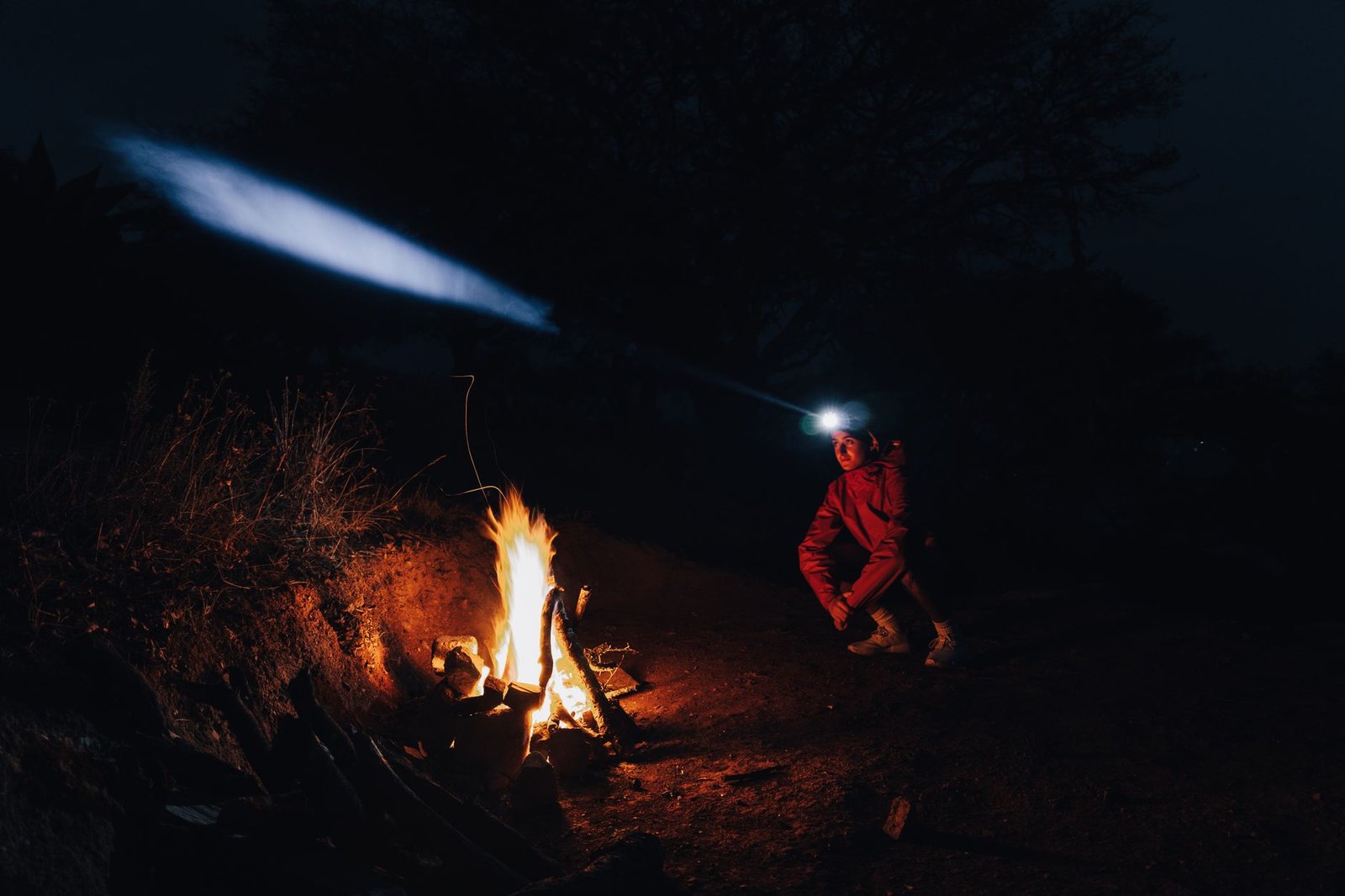
A beam that hops from trail to treetops turns an ordinary run into a constant visual correction.
On a rocky descent, even a small vertical bob can make roots seem to shift position. That distraction usually is not a verdict on headlamps for running; it is a mechanical mismatch between the lamp, its mounting system, and the runner’s motion.
Bounce commonly comes from four linked factors: a front unit whose mass sits too far forward, a strap that cannot hold tension, a band positioned on a tapered or slippery part of the head, or the repeated acceleration created at each foot strike. A lamp may feel secure while standing still yet oscillate once cadence rises. Diagnosing when it moves—upward, side to side, or after sweat builds—makes the fix far more precise than simply tightening everything.
- Up-and-down movement often points to insufficient vertical support or excess front-heavy mass.
- Side-to-side drift more often suggests poor band placement, uneven tension, or a worn elastic strap.
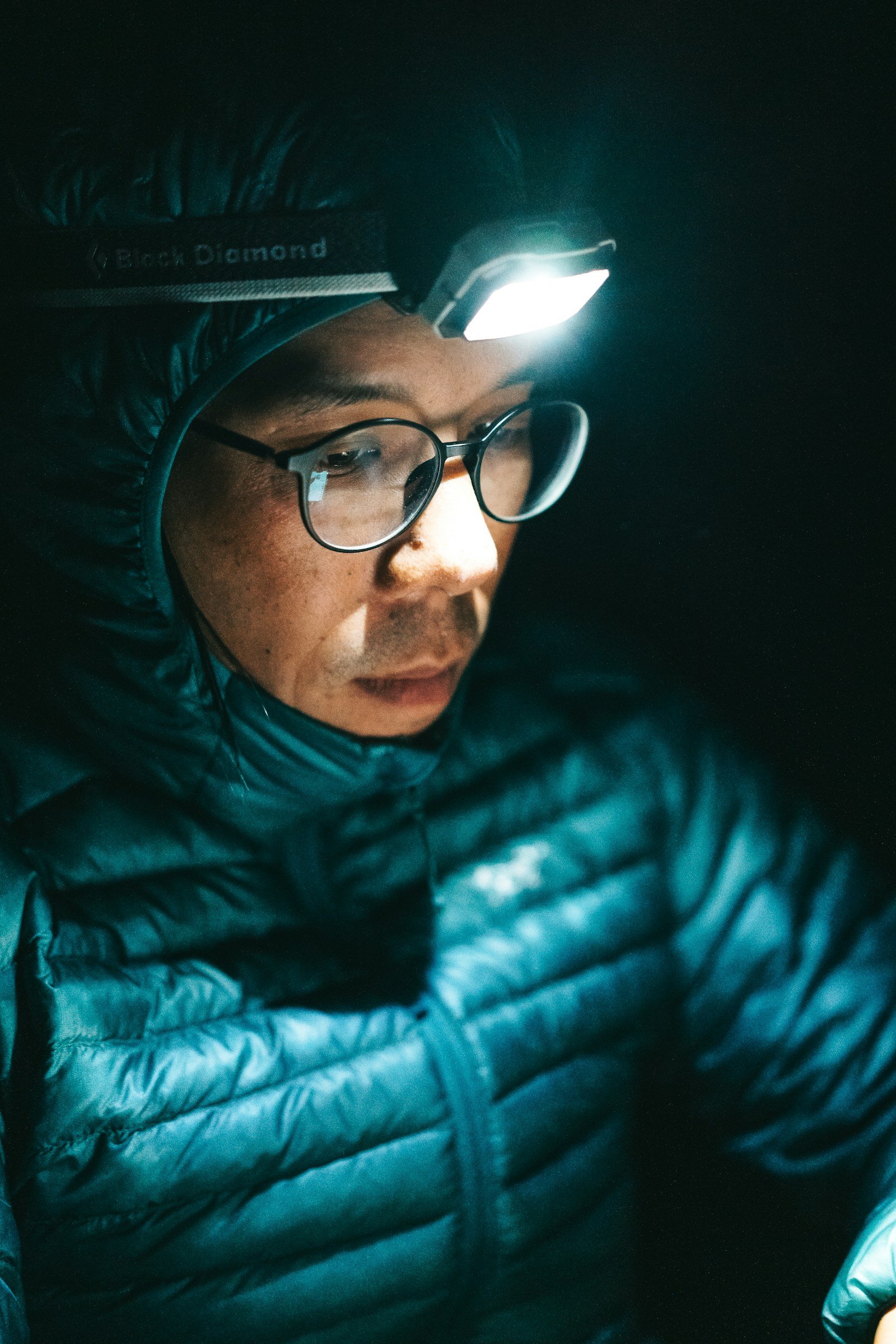
Identify the movement before tightening anything
-
Watch for vertical bobbing
The lamp rises and falls once or twice per stride, usually because the front band has slack or the head unit sits too far from the forehead.
-
Separate yaw from bounce
Yaw is side-to-side rotation. It often appears on uneven ground when strap tension is uneven or the lamp’s mass is offset from the centerline.
-
Check for progressive slipping
A band that starts secure but migrates upward or downward is losing friction to sweat, hair, a hat, or a smooth shell fabric.
-
Spot hinge droop
If the housing stays planted while the beam slowly points at the ground, the tilt hinge—not the headband—is the loose component.
-
Inspect rear-pack sag
With battery-pack models, a rear pack that drops toward the neck can lever the front lamp upward and create a misleading sense of front-end bounce.
Running adds repeated impact, heat, sweat, and head acceleration. Test fit with brisk head turns, a few hops, and running cadence—not merely in front of a mirror. The timing matters: motion that worsens gradually suggests slipping, while an immediate rhythmic shake more often points to unsupported mass or strap slack.
Re-tension the straps as a level system
- Start from a neutral reset
Loosen the top strap and rear band until the lamp can sit naturally, then center the lamp over the brow. Flatten twisted webbing and make sure the rear cradle is not caught on a hood, ponytail, or collar.
- Set the rear band first
Bring the circumferential band snug enough to resist rotation, not so tight that it compresses the forehead. Its tension should feel even from temple to temple; a band pulled harder on one side encourages yaw with each footfall.
- Level the lamp before using the top strap
Aim the housing at the intended running angle, then check that the front band is horizontal and the rear section sits at the same height. A rear band that has climbed high on the occiput often produces bounce despite excessive tightness.
- Use the top strap only to control vertical lift
Tighten it in small increments until the housing no longer nods upward or drops at landing. The top strap is a stabilizer, not the primary anchor; over-tightening it can pull the front band upward and create a pressure point.
- Account for head shape and hair
Prominent occipital bones can hold a rear band low and securely, while a flatter rear skull may need the band positioned slightly higher without tilting it. Thick hair, braids, and ponytails compress or shift during a run, so reassess tension after settling hair into its running position. Runners with unusually short adjustment range can use strap-fit guidance for smaller heads rather than cinching the top strap excessively.
Walk, jog, and make a few deliberate head turns after resetting. A stable harness stays level; it does not need to feel maximally tight.
A headlamp holds steady when the rear band resists rotation and the top strap limits vertical movement. If either strap is asked to do both jobs, the housing commonly bobs, yaws, or develops hot spots.
Hair also changes the system: a smooth cap or wet hair can reduce grip, while a thick ponytail can act like a moving wedge behind the rear band.
Set the beam without creating a lever
A headlamp bounce running is most stable when its housing sits close to the forehead and the beam is aimed only as low as needed. A steeply tilted lamp shifts its mass forward, so each footstrike can rotate the housing downward against the band. It may also cast bright spill immediately in front of the runner while leaving the useful distance dimmer.
Aim the beam toward the ground roughly 5–10 m ahead on level terrain.
However, make small adjustments for pace and surface.
The goal is to see foot placement and texture without forcing the hinge to carry the lamp.
Check the hinge before the run: it should move deliberately, not sag under the housing’s weight. However, if it droops, reset it to a shallower angle; tightening the strap alone rarely fixes a loose pivot.
Balance the mass, not just the straps
A headlamp does not just move when its straps are loose. At running cadence, the lamp’s mass keeps traveling slightly after the head changes direction. The farther that mass sits from the head, the greater the twisting force on the band. A larger front housing or battery can bob even when tension feels firm.
A rear battery pack can counter some front-heavy rotation. It only works when it sits low and centered on the occiput—the bony back of the skull. Not high on the crown or drifting toward one ear; useful checks include.
- The front unit and rear pack sit on the same horizontal band line.
- The pack cannot slide downward during several brisk head nods.
- The top strap supports the assembly without pulling the rear pack upward.
- Any cable has a short, controlled path; a loose cable can swing, tug the front lamp, or let the pack migrate.
More lumens and longer runtime often require more battery mass.
Additionally, when choosing a replacement, consider the balance between weight and long-throw performance, not beam distance alone.
A moderately powered, compact unit held close to the head feels calmer in motion.
Similarly, it is calmer than a long-throw model with a large remote pack.
Test the setup in real conditions
A headlamp that feels locked in place while standing can move differently after twenty minutes of running. Additionally, sweat wets hair and compresses it; rain can saturate webbing and add small amounts of weight. Also, both can change friction and strap tension.
Test the lamp with the exact cap, buff, ponytail, hood, or high-collar jacket intended for the run. A ponytail can push the rear band upward, while a hood or collar can lift it from below and create rear-pack sag. Runners comparing headlamps designed to stay stable on trails can use this clothing test to distinguish a poor fit from a model mismatch.
Simulate the demanding moments
Include downhill steps, quick head checks, climbing posture, and uneven ground.
Additionally, technical trails require sharper head turns and more vertical motion.
Thus, a setup that merely survives an easy jog may still bob headlamp bounce running when it matters.
Recheck tension after warming up and near the end of a run.
Fatigue can change head posture, gait, and how often the lamp is adjusted.
Run a short, controlled bounce test
-
Mark the baseline
On a flat, familiar stretch, jog for 20–30 seconds at easy cadence without touching the lamp. Note whether the beam nods on impact, the housing rebounds after each foot strike, or the band creeps upward at the back.
-
Change one variable only
Stop and make a single small change: rear-band tension, top-strap tension, hinge angle, or rear-pack position. Repeating the same easy jog makes the effect of that adjustment legible; changing several settings at once does not.
-
Add acceleration
Build smoothly to a faster running pace for 10–15 seconds. Acceleration exposes rotational looseness that an easy jog can hide, especially with heavier front housings or a rear battery pack that lags behind the head.
-
Test a descent
Run a short, safe downhill segment or a few controlled descending steps. The increased vertical impact reveals rebound and hinge droop; watch whether the beam settles immediately or continues oscillating after contact.
-
Turn the head while moving
At steady pace, scan left and right, then glance down briefly as if checking footing. This separates a loose housing or hinge from whole-band migration, which often appears during side-to-side head motion.
A practical pass is a beam that recenters within one stride, with no visible housing spring-back after impact. The rear band stays in its original position through acceleration and descent, and head turns do not create a delayed swing.
Stop the test if an early hot spot, scalp pulling, or brow pressure appears within the first few minutes. A setup can look steady briefly yet become unstable once discomfort prompts unconscious readjustment.
Know when the headlamp is the problem
A headlamp that still migrates after a controlled fit test may have a hardware problem rather than a tension problem. Flattened elastic, cracked buckles, a loose hinge, and a battery pack that shifts in its cradle all remove the repeatability needed for headlamp bounce running. Over-tightening a worn system commonly trades bounce for pressure, then allows the band to creep again once sweat reduces friction.
What can be repaired
First, replace a removable strap when its elastic no longer springs back or its adjustment tail slips through the buckle.
Next, clean dirt and oils from strap paths and hinge interfaces, then inspect for rounded teeth, webbing splits, and corrosion.
A hinge that merely needs its fastener snugged may be serviceable.
If it drifts under the lamp’s weight, has cracked detents, or cannot hold a consistent angle, replace it.
What matters in a replacement
For running, prioritize the mounting system before headline output. Additionally, useful features include:
- a wide, grippy main band with positive buckle locking;
- a lightly tensioned top strap or a low-profile, helmet-compatible harness when vertical control is needed;
- a centered, restrained rear battery pack, or a compact front-only lamp with low forward projection;
- a hinge with firm indexed positions and minimal side play;
- cable routing that cannot swing or tug at cadence.
More lumens do not compensate for a beam that oscillates.
Additionally, Weight, center of mass, hinge stiffness, and strap friction determine whether light stays on the intended line.
For trade-offs involving runtime, beam pattern, weather sealing, and battery layout, see how to choose a running headlamp.
It offers guidance on choosing a running headlamp.
Headlamp Bounce: Common Questions
What's the fastest way to check if my headlamp fits properly?
Jog 20–30 seconds at an easy pace on a flat, familiar stretch without touching the lamp. Watch whether the beam nods on impact, the housing rebounds after each foot strike, or the band creeps upward at the back — those are the signs a reset is needed.
Should I tighten the top strap or the rear band to stop bounce?
They do different jobs. The rear band should resist rotation, and the top strap should limit vertical movement. Asking either strap to do both jobs is what commonly causes bobbing, yaw, or hot spots — set the rear band snug and even first, then use the top strap only in small increments to control lift.
Does pointing the beam down more reduce bounce?
Not reliably, and it can make bounce feel worse. A sharply downward housing acts like a longer lever at each footstrike. Aim the beam roughly 5–10 m ahead on level terrain and adjust modestly from there instead of angling it steeply down.
How do I know if it's a fit problem or a hardware problem?
If the lamp still migrates after a full reset and controlled running test, look for flattened elastic that no longer springs back, a hinge that droops under the housing’s own weight, cracked buckles, or a battery pack that shifts in its cradle. Those are hardware wear signs rather than a tension issue, and over-tightening a worn system usually just trades bounce for pressure points.
A Stable Lamp Starts With the Reset
- Reset the level rear band, top strap, beam angle, and cable routing before judging the lamp.
- If migration returns during a controlled run, worn elastic, hinge play, or poorly controlled battery mass may be the limiting factor.
A headlamp that bounces is rarely fixed by simply pulling every strap tighter. A deliberate reset followed by a short running test separates an adjustment problem from a mounting or hardware problem.
Once the lamp stays planted, beam output and throw can be chosen for the route. More lumens improve visibility, not stability.





6 Comments
The point about beam angle creating a lever finally explained why my hinge kept drooping. I had the light aimed way down at my feet for rocky trails, then wondered why it slowly nodded toward the ground every few minutes.
A shallower angle and a quick shake test before leaving have made a big difference. Still not perfect, but at least I’m not readjusting it every half mile.
Good reminder that worn elastic can be the actual problem. I kept tightening an old lamp until it gave me a headache, but it would still bob once I started sweating. Replaced the strap/lamp and the difference was immediate.
This worked way better than just cranking the straps down. My lamp was doing a little side-to-side yaw on downhills, and moving the rear band slightly lower plus tightening it evenly fixed most of it. I’d been blaming the top strap the whole time 🙃
That’s a very common mix-up. The rear band is usually what stops rotation, while the top strap mainly keeps the system from rising and rebounding. Downhills make yaw especially noticeable because your head motion and the lamp’s forward mass are working against each other.
I’m mildly skeptical that a “controlled bounce test” is necessary for a headlamp, but… I tried a short loop after changing only the rear-band tension and discovered the cable was slapping against the side of the lamp. Taping/looping it closer to the strap stopped the weird rotational bounce.
So yes, apparently the tiny cable was the villain. Not my terrible running form this time 😅
Same! Mine had an external battery lead and it acted like a little pendulum. I used a small Velcro tie on the strap instead of tape so I can still swap things around in winter.