

At running pace, light must stay put, reveal depth, and avoid turning every step into a guess.
A lamp that feels perfectly adequate on a dog walk can unravel on the first rocky descent. Each foot strike makes a loose housing bob; a narrow, over-bright hotspot skips across roots; reflected light from pale stone or wet leaves erases texture. The result is not merely annoyance—it is terrain that becomes harder to read at speed.
Headline lumens are only one part of usable light. Trail runners benefit more from a secure, low-bounce fit, a broad near-field beam for immediate footing, and enough controlled reach to place the next few strides. Balanced output also matters: excessive glare can flatten shadows and reduce contrast just when uneven ground needs to look three-dimensional.
- A stable headband and compact lamp body often improve real-world visibility more than a higher maximum-lumen figure.
- Beam shape, tint, and regulated output influence how clearly roots, ruts, and wet surfaces remain defined.
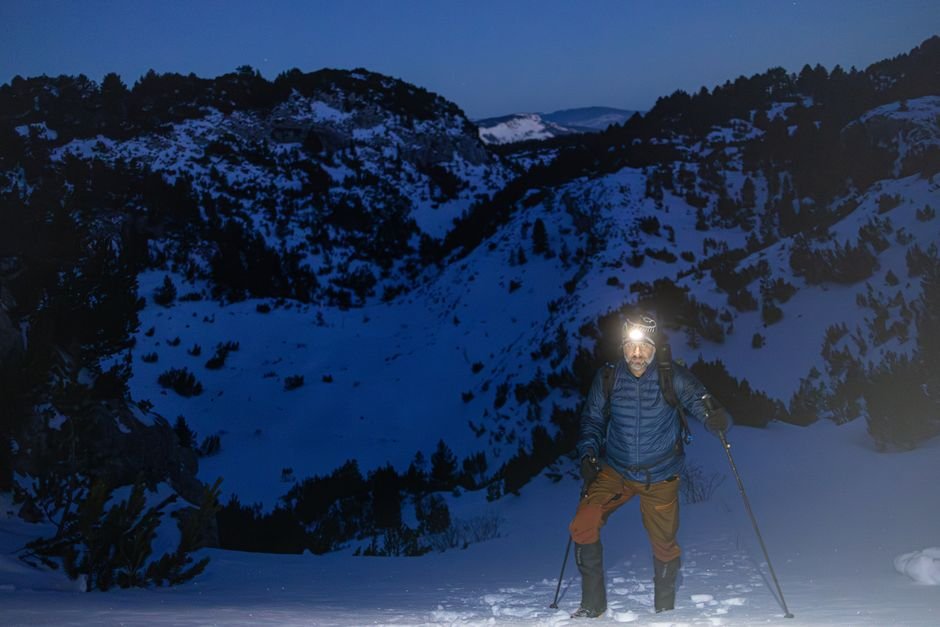
Match the lamp to the run


What separates a running lamp from a camp lamp
A credible trail-running headlamp is assessed in motion, not merely switched on against a wall. The important question is whether its light and fit remain useful when cadence, sweat, rain, and uneven ground arrive together.
Worn weight includes the lamp, bracket, strap, and any rear battery pack. Tests favor a low-profile unit that stays centered through descents and repeated head checks; a light lamp that bounces or slowly slides is not truly unobtrusive.
Output figures do not describe beam shape. A wide, even near field reveals roots and cambers, while enough controlled throw lets runners read the next turn without a harsh central hotspot. See how lumens and throw differ for night running for the distinction.
Buttons need to work with cold or wet fingers without cycling through distracting modes. Runtime is judged at a useful moving pace, including step-down behavior rather than a brief peak setting, while weather protection covers rain, sweat, and splash resistance—not necessarily immersion.
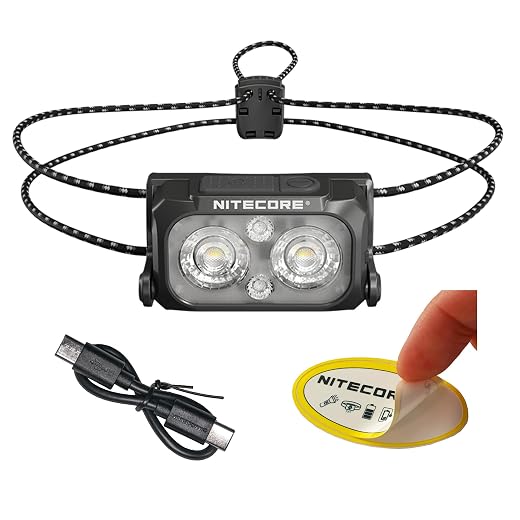
Nitecore NU25 MCT UL for low-bulk night miles
01
Best for ultralight runners needing adaptable illumination.
At 1.65 oz, the Nitecore NU25 MCT UL is built for runners who want a headlamp to disappear into a vest pocket between dusk starts and shorter night outings. Its integrated USB-C rechargeable battery keeps the package notably compact, while the three selectable white color temperatures give it more trail awareness than a typical emergency light.
Warm white can be useful in mist or rain, neutral light gives a less tinted view of the tread, and cool white can make roots and trail-edge contrast stand out. That flexibility makes this a particularly convincing fit for moderate-paced runs where portability matters as much as headline output.
- Exceptionally low carried weight
- USB-C charging suits daily use
- Warm, neutral, and cool beams
- Red auxiliary light included
- Simple, packable single-unit design
- 400-lumen mode is a short-duration tool
- Integrated battery limits cold-weather reserve
- Less reach and depth for fast descents
- No swappable battery for long outings
Quick take A remarkably small rechargeable lamp with unusually useful beam-temperature choices. It favors low bulk and adaptable close-to-midrange illumination over sustained high-output performance.
The NU25 MCT UL makes a strong case for carrying less without settling for a one-note beam. Its highest setting is best treated as a temporary boost for route finding or a difficult section, rather than an all-run cruising mode. For long, cold, or highly technical nights, a larger battery lamp—or a backup light—provides more useful reserve and forward reach.
Nitecore NU20 Classic for uncomplicated local miles
Top choice for lightweight performance at a lower price.
The NU20 Classic occupies the useful middle ground between a tiny emergency light and a more specialized running lamp. At 1.34 ounces, it disappears on the head for familiar neighborhood, park, and smooth-trail loops where the route does not demand constant beam adjustment.
Its appeal is straightforward: a rechargeable, weather-resistant lamp with a conventional button interface and enough output for planned after-dark running. It also makes sense in a vest as a charged backup, where low weight matters more than sophisticated optics. Runners who regularly move fast through roots, rock, or changing terrain may notice the limits of its simpler beam and power reserve sooner than those staying on known paths.
- Exceptionally low 1.34-ounce weight
- Straightforward white and red-light controls
- USB-C charging and battery indicator
- IP66 rating suits wet-weather use
- Useful as a vest backup
- Peak setting is not built for prolonged use
- Less beam tailoring than premium running lamps
- Single-button operation can require mode cycling
- Fixed battery cannot be swapped mid-run
Fenix HL18R-T V2.0 for faster, darker terrain
03
Best for runners wanting powerful, flexible lighting.
The HL18R-T V2.0 is the more capable step up for runners whose pace and routes expose the limits of featherweight lamps. Its 800-lumen ceiling, white and warm-white beam options, and supplied rechargeable pack place it in the conversation with longer-throw trail-running headlamps, while AAA compatibility gives it a useful contingency role on travel-heavy or cold-weather outings.
At 3.63 ounces with its Sport headband, it remains recognizably run-oriented rather than a bulky expedition light. The trade-off is that its extra capability is most convincing when output is managed deliberately, not simply left at maximum.
- 800-lumen reserve for fast descents
- White and warm-white beam choices
- Rechargeable pack or three AAA cells
- IP66 weather resistance
- Heavier than minimalist running lamps
- High mode is not a long-run setting
- AAA backup adds operating complexity
In brief A versatile high-output lamp with meaningful backup-power flexibility. It earns its place when beam definition and reserve matter more than the lowest possible headborne weight.
For rooty descents, winter darkness, and outings that may run long, the HL18R-T V2.0 brings appreciably more beam headroom than minimal lamps. Medium mode is the sensible runtime-planning baseline; maximum output works better as a temporary tool for route finding or technical features. The added mass is noticeable beside ultralight models, but the beam options and dual-fuel design make that compromise easier to justify on demanding nights.
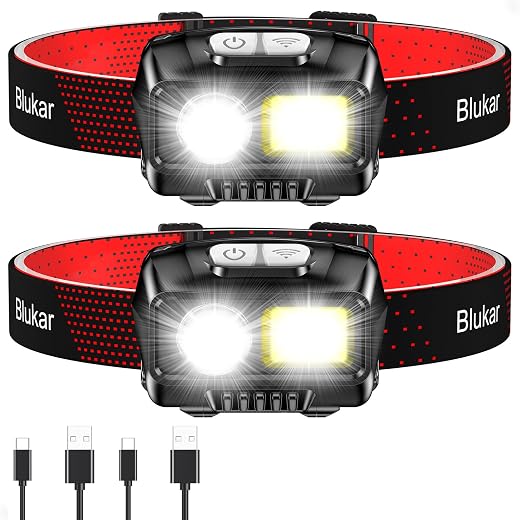
Blukar two-pack for shared use and backup coverage
A low-cost option with multiple modes and motion sensing.
The Blukar rechargeable two-pack makes more sense as redundancy than as a direct rival to dedicated running lamps. One lamp can cover a partner or occasional easy route; the second can remain charged in a vest, car, or home kit when a primary light is unavailable.
Its spotlight-and-COB flood arrangement, eight stated modes, dimming, and gesture activation offer flexibility, but they also make pre-run setup worth checking. Confirm the claimed weight with the headband, how securely that band holds during a jog, and whether the chosen beam avoids lighting nearby dust or pavement more than the trail ahead. IPX5 indicates resistance to water jets, not an invitation to immerse it. The prominently advertised output figure is less useful than a controlled, comfortable beam at the brightness it can sustain.
- Two lamps create practical shared or backup coverage
- Rechargeable design avoids disposable cells
- Flood, spot, red, and dimming modes broaden casual use
- IPX5 rating supports rain exposure
- Headband stability and real carried weight need verification
- Mode-heavy interface can slow on-the-move adjustments
- Motion sensor may be less predictable than a physical switch
- Peak-lumen claim does not establish usable running beam distance
A balanced beam often reveals moving terrain more effectively than a brighter, poorly controlled one.
Excess light near the feet can constrict attention and reduce the contrast needed to read roots, edges, and turns.
Many compact lamps reduce output as heat builds or the battery drains.
Runtime at a moderate, sustained mode is more relevant than a brief turbo figure.
Low-profile, centered lamp geometry matters as much as strap tension.
An over-tightened or front-heavy lamp can still shift, create pressure points, and become distracting over repeated impacts.
Why brighter is not always clearer
A large lumen number can be useful on open descents. A trail running headlamp doesn’t automatically create better trail vision on technical single-track.
A powerful hotspot can overlight the patch just ahead of the shoes, while farther roots stay flat and hard to read.
The eyes have to adapt between that bright near field and darker surroundings.
Additionally, a trail running headlamp with a narrow, throw-focused beam can encourage tunnel vision. The runner sees the trail center but misses branches, off-camber edges, and the next turn at the periphery.
Balance Matters More Than Peak Output
For uneven single-track, a controlled hotspot paired with broad, even spill offers a more legible view than raw output alone.
The Fenix HL18R-T V2.0 has the greater output reserve in this group. The lighter Nitecore models make more sense when modest, well-aimed light is sufficient.
Maximum mode also rarely describes the whole run.
Small headlamps may also step down from turbo output as heat accumulates or battery voltage falls.
Checking sustained-mode runtime, not merely the headline lumen figure, sets realistic expectations for cold outings.
For technical terrain, plan with a trail running headlamp.
That distinction matters most on long, cold, or technical outings where the lamp will spend hours below its rated peak.
Beam quality only pays off when the lamp stays aimed.
A low-profile housing centered on the forehead moves less under repetitive impact than a tall or front-heavy unit.
That combination of aim and stability becomes more important as pace or terrain gets more aggressive.
Test the lamp at running pace, not only while standing still. The useful setup keeps the hotspot just beyond the immediate footfall zone, with enough spill to show trail edges. If the beam wanders after a few minutes of movement, fit—not extra lumens—is often the limiting factor.
Match the lighting plan to the route, not the specification sheet
-
Start with consequence, not distance
A familiar paved loop with easy exits can favor the NU20 Classic or NU25 MCT UL’s minimal bulk. Remote singletrack, steep descents, poor markings, and delayed finish times raise the value of the Fenix HL18R-T V2.0’s stronger output and dual-fuel reserve.
-
Budget runtime in the mode that will actually be used
Manufacturer figures at the lowest setting rarely represent moving pace on technical ground. Plan around the chosen trail mode, allowing margin for high-beam checks, wrong turns, stops, and a gradual output drop as the cell drains.
-
Confirm the charge state before departure
A USB-C port is convenient, but it does not replace a known full charge. Charge indicator behavior and lockout should be checked at home; an accidental activation in a pack can consume a small lamp’s entire reserve.
-
Treat cold as a runtime penalty
Lithium-ion cells can deliver less usable energy in low temperatures, especially after hours of exposure. Keeping a spare power source close to the body can preserve more capacity than leaving it in an outer pocket.
-
Carry independent light when darkness affects navigation
For routes where losing light could turn a missed junction into a serious problem, a second functioning lamp is more useful than a cable alone. The Blukar two-pack can cover this role when both units have been tested for fit and mode access.
A backup should be separately charged and immediately usable; a depleted primary lamp and a power bank are not equivalent redundancy.
Trail Running Headlamps: Common Questions
Does a higher lumen rating always mean better trail vision?
Not necessarily. A powerful hotspot can overlight the ground right ahead of the shoes while farther roots stay flat and hard to read. A balanced beam with broad, even spill often reveals moving terrain more effectively than a brighter, poorly controlled one.
Is the headline lumen figure the setting I should plan a run's runtime around?
No. Many compact lamps step down output as heat builds or the battery drains, so the listed maximum is usually a short-duration tool. Runtime at a moderate, sustained mode is more relevant for planning than a brief turbo figure.
Does a tighter headband fix all headlamp bounce problems?
Not on its own. Low-profile, centered lamp geometry matters as much as strap tension—an over-tightened or front-heavy lamp can still shift, create pressure points, and become distracting over repeated impacts.
How does cold weather affect headlamp runtime?
Lithium-ion cells can deliver less usable energy in low temperatures, especially after hours of exposure. Keeping a spare power source close to the body can preserve more capacity than leaving it in an outer pocket.
When is a backup headlamp actually worth carrying?
On routes where losing light could turn a missed junction into a serious problem. A second functioning lamp that’s separately charged and immediately usable is more useful redundancy than a depleted primary lamp paired with a power bank.
- A brief try-on jog before an important night run can reveal bounce, pressure points, and awkward button placement better than a specification sheet.
For minimal bulk on familiar, moderate-paced routes, the Nitecore NU25 MCT UL is a particularly strong fit; its light mass and selectable beam tint help keep the setup unobtrusive. The NU20 Classic suits uncomplicated local miles or a compact spare, while the Fenix HL18R-T V2.0 brings the more substantial beam, power flexibility, and reserve useful for faster movement on darker technical ground. The Blukar two-pack is most compelling where a second lamp has real value.
Before committing, check the band-inclusive weight, runtime at the medium setting actually intended for use, and whether the beam combines enough flood with forward reach. A secure fit at running pace matters as much as output: the right lamp remains quiet on the forehead, readable on the trail, and comfortable through the final miles.
Nitecore NU 25 vs Generic Amazon Headlamp
FENIX HL18R-T V2 HEADLAMP REVIEW: COMPACT, POWERFUL, AND PERFECT FOR OUTDOOR ADVENTURES 800 LUMENS
Fenix HL18R-T V2.0 800 Lumen Trail Running Headlamp, USB-C Rechargeable, White and Warm White Lights, Red Lights, Compatible with 3X AAA Batteries, (Black)
Features
| Additional Features | Adjustable Light Modes, Durable, High Lumens, Rechargeable, Weatherproof |
| Power Source | Battery Powered |
| Light Source Type | LED |
| White Brightness | 800 lumens |
| Battery Type | Lithium Polymer |
| Number of Batteries | 1 Nonstandard Battery batteries required. (included) |
| Water Resistance Level | Waterproof |
| Battery Description | Lithium-Ion Polymer |
| Mounting Type | Head Mount |
| Battery Life | 160 hours |
| Light Source Special Features | Powerful brightness, versatile light modes, rechargeable battery |
| Runtime | 160 hours |
| Number of Light Sources | 3 |
| Light Path Distance | 126 meters |
| Item Dimensions D x W x H | 1.85"D x 2.26"W x 1.22"H |
| Item Weight | 4 ounces |
| Item Dimensions L x W x H | 1.22"L x 2.26"W x 1.85"H |
| Material Type | Polycarbonate |
| Included Components | Battery, Charging Cable, Head Band, Headlamp |
| Brand Name | Fenix |
| Manufacturer | Fenixlight Limited |
| Manufacturer Warranty Description | 5 years manufacturer warranty post the purchase date. |
| Unit Count | 1 Count |
| Model Number | HL18R-T v2.0 |
| Set Name | Fenix HL18R-T V2.0 |
| Manufacturer Part Number | HL18R-T v2.0 |
| ASIN | B0DTJK9K5V |
| Color | Black |
| Style Name | headlamp |
| Finish Types | Matte |
| Shape | Cylindrical |
| Warranty Type | Limited |
| Specification Met | ANSI FL1, IP66 waterproof |
- POWERFUL Running HEADLAMP - Designed for trail running, the Fenix HL18R-T V2.0 features white light and warm white beams, providing 800 lumens and a throw of up to 136 yards.
- VERSATILE OUTPUTS - The HL18R-T V2.0 features 4 White, 4 Warm White, and 2 Red Light modes—White for visibility, Warm White to reduce eye strain, and Red to signal or preserve night vision.
- DUAL FUEL OPTIONS - Charge the HL18R-T V2.0 via its USB-C port or use 3 x AAA batteries. The headlamp takes only 3 hours to charge fully.
- LIGHTWEIGHT - The HL18R-T V2.0 weighs only 3.63 oz with a SPORT headband for comfortable wearing.
- DURABLE - A waterproof rating of IP66 and an impact resistance of 1 meter ensure you are ready in any weather.
- CONTAINS - HL18R-T V2.0 headlamp, Fenix ARB-LP1900 battery, USB Type-C charging cable and LumenTac Organizer
Nitecore NU25 MCT UL 400 Lumens Ultra Lightweight Headlamp, USB-C Rechargeable Sticker for Back Packing, Camping and Running
Features
| Additional Features | Adjustable Light Modes, Adjustable Strap, Lightweight, Rechargeable, Weatherproof |
| Power Source | Battery Powered |
| Light Source Type | LED |
| White Brightness | 400 lumens |
| Battery Type | Lithium Polymer |
| Number of Batteries | 1 Lithium Polymer batteries required. (included) |
| Water Resistance Level | Water Resistant |
| Light Output Maximum | 400 lumens |
| Battery Description | Lithium-Ion Polymer |
| Mounting Type | Head Mount |
| Battery Life | 45 hours |
| Light Source Special Features | Adjustable Light Modes, Red Light Mode, Multiple Color Temperature (MCT) LEDs |
| Color Temperature | 4500 Kelvin |
| Runtime | 2 hours |
| Number of Light Sources | 4 |
| Light Path Distance | 144 yard |
| Item Dimensions D x W x H | 2.36"D x 1.01"W x 1.3"H |
| Item Weight | 1.6 ounces |
| Item Dimensions L x W x H | 2.36"L x 1.01"W x 1.3"H |
| Material Type | Plastic |
| Included Components | Charging Cable, Head Band, Headlamp |
| Brand Name | Nitecore |
| Recommended Uses For Product | Camping, Cycling, Emergency, Fishing, Hiking, Jogging |
| Manufacturer | Nitecore |
| Manufacturer Warranty Description | 2 year manufacturer. |
| Unit Count | 1 Count |
| Model Number | NU25-400UL |
| Manufacturer Part Number | NU25 MCT UL |
| ASIN | B0FGFQM41T |
| Color | MCT Black |
| Style Name | headlamp |
| Finish Types | Matte Black |
| Shape | Headlamp |
| Warranty Type | Limited |
| Specification Met | ANSI FL1 |
- BRIGHT ULTRALIGHT HEADLAMP- The NU25 MCT UL headlamp is capable of emitting 400 lumens with a max beam distance of 144 yards at only 1.65 oz weight total, ideal for backpacking, camping, hiking, trail running or daily tasks
- MULTI COLOR TEMPERATURE - Switch among warm, natural, and cool white lights with a push of button. Warm light is easy on the eyes and cuts through fog and rain, neutral white offers clear, natural light for daily tasks, while cool white enhances constrasts visibility outdoors.
- VERSATILE OUTPUTS - Features 4 outputs, SOS, beacon, and an auxiliary red light with three outputs for working, camping, hiking, and more.
- USB-C RECHARGEABLE - via a built-in USB-C port. A power status indicator reminds you when it’s time to recharge. Runs for up to 45 hours and takes just over 1 hour to recharge.
- STRONG AND DURABLE – Crafted from durable PC material, rated IP66 waterproof, and impact resistant up to 1 meter.
- CONTAINS - Nitecore NU25 MCT headlamp, USB-C to USB-C charging cable, Bracket, Headband, Diffusing Stuff Sack, Nitecore Sticker
Nitecore NU20 Classic Ultralight Headlamp, 360 Lumen USB-C Rechargeable Lightweight for Backpacking, Camping, Running with Auxilary White and Red Light
Features
| Additional Features | Adjustable Light Modes, Durable, Impact Resistant, Lightweight, Rechargeable |
| Power Source | Battery Powered |
| Light Source Type | LED |
| White Brightness | 360 lumens |
| Battery Type | Lithium Polymer |
| Number of Batteries | 1 Lithium Ion batteries required. (included) |
| Water Resistance Level | Waterproof |
| Light Output Maximum | 360 lumens |
| Battery Description | Lithium-Ion Polymer |
| Mounting Type | Head Mount |
| Battery Life | 97 hours |
| Light Source Special Features | Adjustable Light Modes, SOS, Beacon, Triple Output Versatility, Red Light |
| Runtime | 2 hours |
| Number of Light Sources | 3 |
| Light Path Distance | 119 yard |
| Item Dimensions D x W x H | 0.96"D x 2.05"W x 1.3"H |
| Item Weight | 1.44 ounces |
| Item Dimensions L x W x H | 2.05"L x 1.3"W x 0.96"H |
| Material Type | Polycarbonate |
| Included Components | Head Band, Headlamp, usb-c charging cable |
| Brand Name | Nitecore |
| Recommended Uses For Product | Camping, Caving, Cycling, Emergency, Fishing, Hiking, Jogging, Reading |
| Manufacturer | Sysmax Innovations Co. |
| Manufacturer Warranty Description | 2 year manufacturer post the purchase date. |
| Unit Count | 1 Count |
| Model Number | NU20 Classic |
| Set Name | 1 |
| Manufacturer Part Number | NU20 Classic |
| ASIN | B0DCQDXSS5 |
| Color | Black |
| Style Name | Compact |
| Finish Types | Matte |
| Shape | Headlamp |
| Warranty Type | Limited |
| Specification Met | ANSI FL1 |
- ULTRA-LIGHT & POWERFUL - Weighs just 1.34 oz yet delivers up to 360 lumens with a beam distance of 119 yards, perfect for all-day wear without strain.
- 3 LIGHT MODES + SAFETY FEATURES - Main white LED with 3 brightness levels, plus SOS & Beacon, a soft reading light, and an auxiliary red light for night vision — ideal for camping, hiking, running, or emergencies.
- LONG RUNTIME & FAST CHARGING - Up to 97 hours of use on low mode; recharges in just over an hour via USB-C. Battery indicator ensures you’re never caught off guard.
- DURABLE OUTDOOR-READY DESIGN – Built from rugged PC material, rated IP66 waterproof and 1m impact resistant, tough enough for rain, dust, and rough terrain.
- COMFORTABLE & RELIABLE - Lightweight construction combined with versatile lighting makes it the go-to headlamp for backpacking, jogging, or everyday adventures.
- INCLUDES - Nitecore NU20 Classic, Headband, USB-C charging cable, Nitecore Sticker
Blukar LED Headlamp Rechargeable, 2000L Super Bright Headlight Flashlight | 8 Modes & Stepless Dimming, Spotlight & Floodlight, Motion Sensor, IPX5...
Features
| Additional Features | Adjustable, Ultra-Lightweight, Motion Sensor, Rechargeable, IPX5 Waterproof Resistant, Spotlight&Floodlight, 8 Lighting Modes |
| Power Source | Battery Powered |
| White Brightness | 2000 lumens |
| Voltage | 5 volts |
| Battery Type | Lithium Polymer |
| Number of Batteries | 2 Lithium Polymer batteries required. (included) |
| Water Resistance Level | Waterproof |
| Light Output Maximum | 2000 lumens |
| Battery Description | Lithium |
| Battery Life | 20 hours |
| Light Source Special Features | Motion Sensor, Spotlight&Floodlight, 8 Lighting Modes |
| Runtime | 30 hours |
| Number of Light Sources | 2 |
| Wattage | 2 watts |
| Color | Black |
| Style Name | headlamp |
| Shape | Headlamp |
| Material Type | Abs |
| Included Components | Usb Cable |
| Brand Name | Blukar |
| Recommended Uses For Product | running, hiking, camping, cycling, car repairing, night fishing, night reading, dog walking, DIY works |
| Manufacturer | Blukar |
| Manufacturer Warranty Description | 1 year. |
| Unit Count | 2 Count |
| Item Type Name | camping-headlamps |
| Model Number | K9111 |
| Set Name | 2 |
| Manufacturer Part Number | K9111 |
| ASIN | B0BLVT2Y9N |
| Item Dimensions D x W x H | 2.48"D x 1.72"W x 1.52"H |
| Item Weight | 168 g |
| Size | 2 Pack |
- 【Super Bright and Stepless Dimming】Adopts first-class LED chips, combined with advanced COB and XPG LED technology, the beam is brighter and more stable, and can easily illuminate everything around you. Long press the button to adjust the brightness from 100% to 30%, which can meet your different lighting needs.
- 【8 Lighting Modes and Motion Sensor】5 normal modes: XPG white/COB white/XPG+COB white/COB red/COB red strobe. In this mode, you can short press the switch button to turn off the light directly. 3 sensor modes: XPG white/COB white/XPG+COB white. You can easily turn the light on or off by waving your hand, freeing your hands to focus on other things, providing you with the convenience you need for use in the dark.
- 【Rechargeable and IPX5 Waterproof】Built-in 1200mAh large-capacity battery, easily rechargeable via USB C. The powerful headlamp can support long time outdoor activities when fully charged, giving you longer lighting time and easier charging experience, (USB C cable included). This headlamp also has an IPX5 waterproof rating, making it safe to use in rainy or snowy weather, indoors or outdoors. It's an ideal choice for outdoor enthusiasts.
- 【Lightweight and Adjustable Comfort】The hand-free headlamp uses a comfortable, breathable elastic headband, which is removable, washable. The headband can be easily adjusted in length to perfectly fit your head size. Weighing only 2.96 ounces, you can always fold it up and put it in your pocket for easy carrying. At the same time, the lamp head can be adjusted up and down 45°. Just tilt it slightly downward to easily illuminate the road ahead of you in the dark.
- 【Wide Usage】The headlamp is perfect for various activities, such as jogging, cycling, camping, hiking, car repairing, emergency tools, night fishing, night reading, dog walking, DIY work and other long night activities. Perfect hands-free headlamp, no more stumbling in the dark.


16 Comments
Why no Petzl Actik Core or Iko Core? They seem to come up constantly in trail-running groups, especially for people who don’t want an external battery pack. Curious whether they lost on weight, bounce, or simply didn’t fit the four-use-case format.
Both are reasonable alternatives, and the omission wasn’t a claim that they are poor lights. This list was structured around four distinct use cases, so the NU25 and NU20 covered the low-weight end while the Fenix covered the more technical, reserve-oriented role. The Petzl models are worth comparing directly if their headband fit and battery ecosystem appeal to you.
I use an Actik Core and like it, but it sits a little less securely for me once I’m descending fast. Could totally be head-shape dependent, though.
Glad you emphasized beam shape instead of just chasing the biggest lumen number. I bought an “800 lumen” bargain lamp last year and it made wet roots look like shiny black holes because the hotspot was so harsh. For my usual 60–90 minute runs, the NU25 sounds like the sensible pick.
I’m interested in the Fenix, mostly because of the AAA fallback. Does the dual-fuel setup make it noticeably heavier or more awkward on faster runs than the NU25?
I run rocky trails at night but hate the feeling of a lamp slowly sliding down my forehead. Peak lumen numbers are not helping my annoyance level lol.
Yes, the Fenix is a more substantial setup than the NU25, and that is the tradeoff for higher output and battery flexibility. For faster technical terrain, its extra reserve can be worthwhile, but fit should be tested carefully because even a capable beam becomes frustrating if the lamp shifts. The NU25 is more comfortable for low-bulk running, while the Fenix is the better match when route difficulty and darkness raise the consequences.
Minor gripe: “rain-ready” can mean very different things between brands. Did you compare actual IP ratings, or is that based more on construction and intended use?
I’ve had a supposedly weatherproof headlamp quit after a very ordinary Pacific Northwest downpour, so I’m a little skeptical of marketing language now.
Fair criticism. “Rain-ready” should not be read as a promise that every model will survive every storm or immersion. The comparison considered the stated weather protection along with practical design factors, but shoppers should still verify the current IP rating and manufacturer guidance for the exact version they buy. For long wet runs, I also recommend protecting a backup light separately.
Same here. My rule is one lamp on my head, one tiny light in a zip bag in the vest. Cheap insurance.
The two-pack section is refreshingly cautious. So many reviews call a cheap two-pack “great value” and skip over whether either lamp stays pointed forward while running. A backup is only useful if it doesn’t turn into a forehead-mounted strobe at mile 4 😅
The line about matching the plan to route consequence is the important bit. I see folks heading into remote trails with one rechargeable lamp and a prayer because the package says 1,000 lumens. On a local loop, fine-ish. On a freezing ridge route, nope.
The warm-white option on the HL18R-T is more appealing than I expected. On foggy nights, cool white can make everything look flat and glare-y to my eyes. Nice to see that discussed instead of treating color temperature like a gimmick.
I was hoping to see the Black Diamond Sprinter included, since the rear red light is nice on mixed road/trail routes. Was it excluded because it’s heavier, or because the front beam doesn’t hold up on technical singletrack?
For a runner on about a $40 budget, would you choose the NU20 Classic over one of the better-known Black Diamond options? I mostly run paved greenways before sunrise, but there are a few unlit sections and I carry a lamp in winter as an emergency backup.
I don’t need 800 lumens; I need controls I can use with gloves and a battery that isn’t mysteriously dead after sitting in a drawer for two weeks.
At that budget and for greenways, I’d lean NU20 Classic if low carried weight and simple USB-C recharging are your priorities. For the unlit stretches, check the runtime at the mode you actually expect to use rather than the advertised maximum. If cold-weather storage is a concern, top it up before each run and consider carrying a tiny independent backup light rather than relying on one stored lamp.
That’s basically my use case. I went NU20 for dog-walk/run duty and the controls have been fine with thin gloves; bulky ski gloves might be another story.