
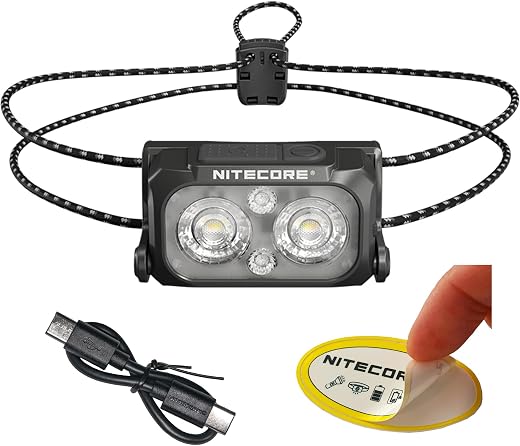
A tiny lamp can still feel oversized when its strap is doing all the work.
The familiar failure is a headlamp tightened as far as it will go: the housing still nods with every step, the elastic creeps upward, and a loop of spare webbing flicks behind the head. That is not a minor annoyance—beam aim becomes inconsistent, especially on uneven ground.
A compact body reduces front weight, but secure fit depends on more: a low-profile housing that sits close to the forehead, strap adjustment that reaches a small circumference without bunching, and enough friction in the elastic to resist bounce. A narrow, soft band often conforms better than a broad stiff one; however, an overly stretchy band may need frequent readjustment. Check where the buckle lands, too: a bulky adjuster behind the ear can create a pressure point long before the lamp’s weight does.
- Set the strap to its smallest practical setting before removing tags.
- Move the head briskly; a stable beam should not dip with each step.
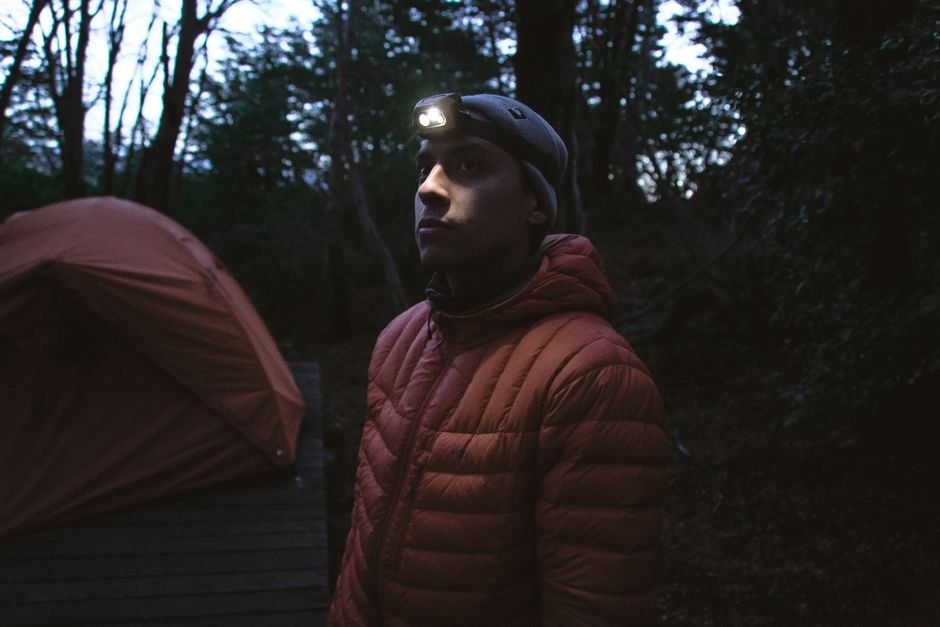
Nitecore NU25 MCT UL
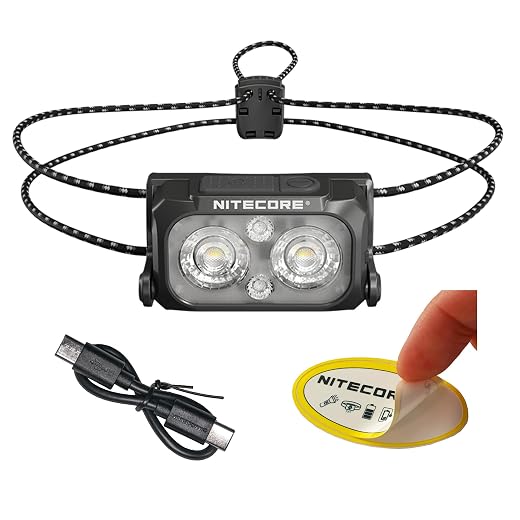
“Small head” is not a standard size
- Minimum adjustment circumference
The shortest closed-loop circumference of the band, measured with the rear buckle or slider in its tightest usable position. This matters more than a vague “one size” claim.
- Band path
A lamp can fit the same circumference differently depending on whether its strap runs flat around the forehead, rides high over the crown, or uses a top strap. Forehead contour and occipital shape can make a seemingly small band feel unstable.
- Housing leverage
A deep, heavy lamp body sits farther from the forehead and has more leverage to bounce or rotate. A low-profile housing often remains steadier even when two lamps have identical straps.
- Adult versus children’s lamps
A children’s model may close smaller, but its output pattern, controls, runtime, weather sealing, and battery format are often designed for supervised casual use rather than adult night activities.
- Worn-system circumference
The relevant measurement includes whatever sits beneath the strap: loose hair, a beanie, a climbing helmet, or a hood. Each changes both circumference and the surface available for the elastic to grip.
A repeatable fit check
-
Measure bare-head circumference
Wrap a flexible tape around the forehead, about 2–3 cm above the eyebrows, passing over the fullest point at the back of the head. Keep it level rather than following a high hairline.
-
Record the configurations that matter
Repeat with typical hair arrangement, then with the thinnest beanie, hood, or helmet likely to be used. A lamp intended for a helmet needs clearance around shell edges and vents, not merely a larger number.
-
Compare against the stated minimum, not only the range
Look for a manufacturer-published minimum circumference or a credible reviewer measurement. The target is a little adjustment remaining at the bare-head setting; a strap already bottomed out cannot compensate as elastic relaxes.
-
Inspect the rear adjustment hardware
A low-profile buckle or split rear strap can sit comfortably against the skull. Bulky battery packs, stiff tabs, and long loose tails can interfere with a hood or helmet.
-
Check return and testing conditions
Confirm whether indoor fitting is allowed before removing tags or taking the lamp outside. A short wear test with head turns, a downward glance, and a gentle shake exposes creep quickly.
An adult with a 52 cm bare-head measurement may still need a different lamp than another adult at the same measurement. Thick hair can give elastic something to bite into; very smooth hair, a satin-lined hood, or a hard helmet can let the same strap migrate upward. The decisive question is whether the band can tighten before the buckle reaches its stop while the housing stays low on the forehead.
For a wider comparison of beam, battery, and mounting trade-offs, see how to choose a headlamp when head size is a key constraint. Do not treat a children’s lamp as the automatic answer: a compact adult model with a genuinely short minimum adjustment and low-profile housing is usually the more capable fit category.
What Keeps a Compact Headlamp From Shifting
- Elastic that holds without becoming a cord
A narrower 18–20 mm band can sit neatly below a small occipital curve and clears ears more easily, but it concentrates pressure and twists sooner. A 22–25 mm band spreads load and usually resists roll-over better, provided its minimum adjustment is genuinely short.
Look forSoft, grippy elastic with a short minimum circumference and enough width to lie flat.AvoidThin, slick elastic that needs extreme tightening before it stops migrating. - Buckles and a tail that stay out of the way
Low-profile side adjusters are less likely to press behind the ear or snag hair. Once fitted, the loose tail needs a keeper, elastic loop, or tuck path to limit bouncing; a dangling end can catch collars and gradually pull the setting open.
Look forLocking or high-friction buckles, plus positive control of the excess strap.AvoidLarge rear buckles, sharp adjuster edges, or an unsecured tail. - A housing balanced close to the forehead
Stability is largely leverage: a shallow, close-set lamp exerts less downward torque than a deep battery pod of equal mass. Rear battery packs can restore balance, yet add bulk at the back and can collide with a hood, ponytail, or headrest.
Look forA compact lamp body with weight centered near the band line.AvoidA front-heavy housing that droops unless the strap is over-tightened. - A top strap only when it solves a real problem
For walking and ordinary camp use, a properly tensioned single band is often less fussy on a small head. A removable top strap becomes valuable for running, scrambling, repeated downward viewing, or heavier lamps because it prevents the front edge from rotating down; its anchor points should sit forward enough to stabilize rather than merely add pressure.
Look forA removable top strap with a centered, low-profile junction.AvoidA permanently fixed top strap on a light setup that already stays put.
Choose balance for the movement
A headlamp can feel light in hand, yet become distracting when its mass sits far forward. The overall worn weight includes the lamp, battery, bracket, strap, and any top strap, not just the bare light body.
Housing depth matters, too. This matters for the headlamp small head design: a shallow unit held close to the forehead creates less leverage than a lamp projecting outward. An equally weighted lamp projecting outward increases leverage compared with a shallow, forehead-hugging unit.
For walking and camp chores, front weight is usually tolerable if the hinge stays aimed.
Look for a tilt mechanism with distinct, firm detents.
A loose hinge slowly drops the beam toward the feet.
An overly stiff one encourages rough readjustment that can disturb a small-head fit.
A lower, close-set beam makes map reading, cooking, and tent work easier.
Motion changes the fit equation
Hiking adds repeated footfall and occasional scrambling. Running magnifies both. With every stride, forward-mounted mass has more opportunity to bounce, rotate, and tug the band upward. For these uses, low moving mass and minimal housing projection often matter more than a higher peak output.
A practical activity match:
- Camp tasks: stable hinge, broad near-field beam, easy low-mode control.
- Walking and hiking: close forehead fit, dependable tilt detents, enough reserve runtime for the planned outing.
- Running: ultralight complete setup, shallow housing, and a band that remains secure without excessive tension.
Before committing, wear the lamp at its normal beam angle and nod, look side to side, then jog in place. Any bounce, hinge drift, or pressure point is likely to become more obvious over a long outing.
Nitecore NU25 MCT UL: A Standout for High-Motion Use
A notably light option for high-motion use
At a claimed 1.65 oz total, the USB-C rechargeable NU25 MCT UL keeps carried mass unusually low for a 400-lumen lamp, which can reduce bounce during running and fast hiking. Its warm, neutral, and cool white options add useful flexibility: warm light can be pleasant for close camp work, while neutral light suits general trail and task visibility.
The fit still depends on the supplied band and how closely the housing sits against the forehead, so a movement check remains worthwhile. Red auxiliary modes, a battery indicator, and stated runtime up to 45 hours broaden its usefulness beyond short runs.
Read the Beam Chart in the Order It Matters
A genuinely low low mode, a broad flood beam, and regulated mid-level output usually matter more than a brief turbo figure.
For maps, tents, cooking, and close repairs, a low mode preserves dark adaptation and avoids harsh glare. Regulation shows whether a chosen level stays useful instead of stepping down sharply as the cell drains.
The better match has beam options suited to the task: even flood for near work, a defined spot for route finding, and a sensible transition between them.
A narrow spot can create tunnel vision around camp, while an all-flood beam can waste light on a trail. Check whether flood and spot can be blended or switched without cycling through distracting high modes.
High-CRI light can make map markings, food, cord colors, and natural surfaces easier to distinguish; electronic lockout prevents accidental activation in a pack.
A warm, high-CRI auxiliary mode is often more valuable at close range than another high-output setting. Lockout also protects runtime and reduces the chance of a hot lamp pressing against packed fabric.
Power systems change the balance
An integrated rechargeable cell often keeps a compact lamp tidy: no battery door, few moving parts, and a predictable front housing. Yet the cell still sits at the forehead, so a high-capacity model can feel more front-heavy than its small shell suggests. It suits short outings, frequent access to USB power, and users who value a simple grab-and-go routine.
AAA or AA lamps trade that simplicity for field-swappable energy. Three AAAs can add noticeable frontal mass, while a single AA may create a longer, more protruding housing; neither format is automatically better for a small head. Lithium primary cells are notably useful in cold conditions and for emergency spares, whereas rechargeable NiMH cells offer repeat use but can lose available runtime in low temperatures.
Put the battery where it helps
A removable rear pack shifts weight away from the forehead and can steady a lamp during running. This helps when the cable and pack are well retained. The trade-off is a second contact point on the back of a head with a small head, plus more strap bulk. It is often a strong fit for long night travel, winter use, or trips where a spare pack is practical.
Match the system to charging access and consequence of depletion:
- Integrated USB: daily runs, commutes, and overnight trips with reliable charging.
- AAA/AA: remote travel where common spare cells matter.
- Rear pack: extended, high-output use where balance and runtime outweigh minimalism.
Check whether charging can occur while the lamp operates; many integrated designs cannot.
Fit checks that catch expensive compromises
-
Confirm the true minimum circumference
Ignore the stated “adjustable” claim unless the seller shows the band at its shortest setting. The buckle, excess strap tail, and any fixed top strap can prevent the circumference from becoming as small as expected.
-
Inspect the rear of the system
A rear battery pack can be tolerable when it sits flat and centered, but a bulky pack raises leverage and presses against a hood, seat headrest, or pillow. For a map of compact models suited to smaller head sizes, compare worn photos rather than housing dimensions alone.
-
Check how far the lamp projects
A shallow housing with firm hinge detents generally moves less than a light body perched far ahead of the forehead. Tilt should cover close tasks and a level walking beam without forcing the face upward.
-
Look for adjustment that stays put
Thin elastic can lengthen early, while smooth buckles may creep under lamp weight. Photos of the buckle teeth, strap return path, and replaceable-band attachment reveal more than a generic comfort claim.
-
Audit everyday ownership details
A lockout prevents accidental activation in a pack. Verify the charging connector and cable, access to replacement straps, and whether the lamp can charge while its strap remains fitted.
A fixed, stiff crown strap can hold the front housing down, yet it may also create a loose loop or awkward pressure point on a smaller head. A removable top strap—or a clean two-strap design with a low-profile lamp—often offers more usable adjustment.
Small-Head Headlamp Fit: Common Questions
What does "small head" actually mean for headlamp fit?
It means the strap’s minimum adjustment still leaves slack, so the lamp sits loose, slides down, or bounces even at the tightest setting. Circumference, not lumens or weight, is the first thing to check before buying.
Is a children's headlamp the right choice for a small-headed adult?
Not usually. Children’s models are built around lower weight and smaller battery bays, and they often trade away brightness and runtime that an adult still needs. A better fix is an adult headlamp with a fully adjustable or elastic strap that closes down small, rather than switching product categories entirely.
Does adding a top strap always improve fit?
A top strap helps distribute weight and reduces forward tilt, but it only helps if the horizontal band is already snug. On a head that’s too small for the band’s minimum setting, a top strap adds stability without solving the underlying slack.
What matters more than peak lumens when choosing a compact headlamp?
Beam usability at the brightness level actually used, battery weight balance, and how securely the unit stays in place during movement matter more day to day than a high peak lumen number that’s rarely used at full output.
How should the battery system factor into fit?
A rear battery pack shifts weight off the forehead and can make a lamp feel more secure on a smaller head, while an all-in-one unit keeps the strap simpler but concentrates weight at the front, which can worsen slippage if the band is already loose.
Let the fit decide
- A lamp that stays aimed with modest strap tension is usually a stronger fit than one that needs to be cinched down.
- Test on the actual hat, hood, or hairstyle likely to be used; each changes band path and housing leverage.
At home, wear the headlamp for 20–30 minutes rather than judging it at the mirror. Walk stairs, bend to pick up objects, look side to side, and make a few quicker head turns. The housing should not bounce, rotate, or migrate upward. Aim the beam at a wall, then repeat those movements: a stable fit keeps the useful part of the beam where the eyes expect it. Cycle the hinge through its range, confirming that its detents hold both a level trail angle and a close-work downward angle.
Leave the lamp on long enough for delayed pressure at the forehead, temples, or rear buckle to emerge. The useful choice is the model with the smallest adjustment range that still grips securely and the lowest practical moving weight for its intended activity—not the smallest shell or the largest lumen figure.
Nitecore NU25 MCT UL 400 Lumens Ultra Lightweight Headlamp, USB-C Rechargeable Sticker for Back Packing, Camping and Running
Features
| Additional Features | Adjustable Light Modes, Adjustable Strap, Lightweight, Rechargeable, Weatherproof |
| Power Source | Battery Powered |
| Light Source Type | LED |
| White Brightness | 400 lumens |
| Battery Type | Lithium Polymer |
| Number of Batteries | 1 Lithium Polymer batteries required. (included) |
| Water Resistance Level | Water Resistant |
| Light Output Maximum | 400 lumens |
| Battery Description | Lithium-Ion Polymer |
| Mounting Type | Head Mount |
| Battery Life | 45 hours |
| Light Source Special Features | Adjustable Light Modes, Red Light Mode, Multiple Color Temperature (MCT) LEDs |
| Color Temperature | 4500 Kelvin |
| Runtime | 2 hours |
| Number of Light Sources | 4 |
| Light Path Distance | 144 yard |
| Item Dimensions D x W x H | 2.36"D x 1.01"W x 1.3"H |
| Item Weight | 1.6 ounces |
| Item Dimensions L x W x H | 2.36"L x 1.01"W x 1.3"H |
| Material Type | Plastic |
| Included Components | Charging Cable, Head Band, Headlamp |
| Brand Name | Nitecore |
| Recommended Uses For Product | Camping, Cycling, Emergency, Fishing, Hiking, Jogging |
| Manufacturer | Nitecore |
| Manufacturer Warranty Description | 2 year manufacturer. |
| Unit Count | 1 Count |
| Model Number | NU25-400UL |
| Manufacturer Part Number | NU25 MCT UL |
| ASIN | B0FGFQM41T |
| Color | MCT Black |
| Style Name | headlamp |
| Finish Types | Matte Black |
| Shape | Headlamp |
| Warranty Type | Limited |
| Specification Met | ANSI FL1 |
- BRIGHT ULTRALIGHT HEADLAMP- The NU25 MCT UL headlamp is capable of emitting 400 lumens with a max beam distance of 144 yards at only 1.65 oz weight total, ideal for backpacking, camping, hiking, trail running or daily tasks
- MULTI COLOR TEMPERATURE - Switch among warm, natural, and cool white lights with a push of button. Warm light is easy on the eyes and cuts through fog and rain, neutral white offers clear, natural light for daily tasks, while cool white enhances constrasts visibility outdoors.
- VERSATILE OUTPUTS - Features 4 outputs, SOS, beacon, and an auxiliary red light with three outputs for working, camping, hiking, and more.
- USB-C RECHARGEABLE - via a built-in USB-C port. A power status indicator reminds you when it’s time to recharge. Runs for up to 45 hours and takes just over 1 hour to recharge.
- STRONG AND DURABLE – Crafted from durable PC material, rated IP66 waterproof, and impact resistant up to 1 meter.
- CONTAINS - Nitecore NU25 MCT headlamp, USB-C to USB-C charging cable, Bracket, Headband, Diffusing Stuff Sack, Nitecore Sticker




8 Comments
Slightly skeptical of integrated batteries for this use. A lighter front unit sounds great, but if it dies during a cold overnight trip, charging it from a battery bank feels less convenient than swapping an AAA or 18650.
Is the balance advantage actually noticeable on a small head, or is it mostly a tradeoff people accept for lower total weight?
The bit about hinge detents is underrated. My current headlamp slowly nods toward the ground while I walk, so I end up lighting my own shoes like it’s a very important job. I assumed that was just normal with cheap lamps.
I appreciate the reminder that “small head” is not an actual standardized category. I bought a supposedly ultralight lamp for my daughter because the product photos made it look compact, but the strap bottomed out and the long adjustment tail bounced around.
Do replacement straps usually solve that problem, or can changing the band make the lamp less secure because the original buckle layout was designed around a particular elastic width?
I’m confused about the beam-chart order. For reading in a tent and finding stuff around camp, should I prioritize a very low lumen setting over high CRI? I like warm-ish light, but I also don’t want the lowest mode to be basically useless.
For camp chores, I would put a usable low mode first. High CRI is nice for sorting food, maps, or gear colors, but a good low setting is what keeps you from blasting everyone in the tent. My favorite lamp has both, although the low mode gets used way more.
This is the first article I’ve seen that explains why a tiny lamp can still feel huge on a smaller head. The housing leverage point makes so much sense now. Is there a rough minimum strap circumference you consider genuinely small, or does it vary too much by brand?
It varies enough by band material and buckle design that I would not use one circumference as a universal cutoff. As a practical shopping step, look for the maker’s stated minimum range, then check whether the lamp can sit centered with several centimeters of strap still available—not just barely closed. A short adjustment tail that stays retained is also a good sign, since loose elastic can make an otherwise small fit feel unstable.
How much does a top strap really help for hiking versus running? I hate the look/feel of them, but I also hate readjusting a lamp every 10 minutes 😅