S30V rewards the right abrasive—and punishes wasted strokes.
Twenty minutes of sharpening can leave an S30V edge reflecting light along the apex: polished shoulders, but no clean meeting point. Repeating light passes with a slow abrasive rarely fixes the underlying problem.
The practical choice is either to accept a longer session or invest in coarse diamond abrasives and repeatable angle control. A guided system reduces accidental angle changes, while a coarse starting grit removes enough steel to establish the apex before finer grits refine it. Marking the bevel with permanent marker and checking progress prevents premature grit changes.
- Raise a burr along the full edge before moving to the next grit.


Why S30V sharpens more slowly
Crucible Industries’ CPM S30V data sheet attributes the steel’s wear resistance to hard vanadium carbides. Those carbides slow abrasion compared with simpler, lower-alloy steels, especially when enough metal must be removed to change the bevel angle. S30V remains practical to sharpen; long sessions often result from starting with an abrasive that cuts too softly or too finely.
Match the abrasive to the job
Heavy reprofiling and routine maintenance require different approaches:
- Reprofiling or chip repair: Start with a coarse diamond plate or coarse CBN stone. Metallurgist Larrin Thomas identifies these abrasives as efficient choices for carbide-rich steels, reducing wasted passes before the bevels meet.
- Touching up an established edge: If the bevels already meet, begin with fine diamond, CBN, or a suitable ceramic. This restores bite without needless stock removal.
Color the bevel with marker and inspect it after a few strokes. Abrasion at the shoulder means more coarse work; abrasion at the edge indicates the apex is close.
Coarse abrasives can keep cutting after the edge is formed. Switching promptly to refinement limits burr growth and preserves steel.
What matters when choosing an S30V sharpener
- Fast-cutting, sensible grit progression
Diamond or CBN abrasives generally remove S30V efficiently, but grit selection determines whether that speed is useful. A coarse plate suits repairs or bevel changes; routine touch-ups need finer stages and a finishing abrasive.
Look forReplaceable abrasives with enough grit steps to repair, apex, and refine without large jumps.AvoidKits built around fine stones only, or numerous poorly explained grits that add passes without a clear purpose. - Repeatable angles and full-edge access
A guide should hold the selected angle consistently while allowing secure contact from heel to tip. Check fixed-angle sharpener compatibility with the blade’s length, width, thickness, plunge line, and curvature before buying.
Look forAngle settings that remain stable, plus unobstructed access to the heel, belly, and tip.AvoidSystems whose frame, clamp, or stone holder leaves part of the edge unreachable. - Secure blade retention
Clamps should resist rotation and sideways movement without damaging the finish. Narrow, tapered, flexible, or full-flat-ground blades may require dedicated jaws, supports, or manufacturer-approved adapters.
Look forA clamping method explicitly suited to the knife’s blade geometry and supported by clear setup instructions.AvoidVague compatibility claims or improvised clamping that allows the blade to shift during a stroke. - Ownership and storage practicalities
Consumable availability, replacement cost, setup time, packed size, and loose parts all affect long-term convenience. Bench systems may favor stability; compact guided tools may suit field kits or limited storage.
Look forReadily available replacement abrasives, simple calibration, a stable base, and organized storage.AvoidProprietary consumables with uncertain availability, lengthy assembly, or small components that travel unprotected.
Selections were screened against published documentation rather than anecdotal pass counts. Greater weight went to clearly identified abrasives, repeatable angle control, stated compatibility, and parts that can be replaced without buying another complete system.
Reprofiling was assessed separately, favoring coarse diamond plates that manufacturers identify by grit or micron rating. Abrasive claims were cross-checked against patterns reported in controlled sources such as CATRA testing and Knife Steel Nerds—not converted into unsupported sharpening times.
Systems received stronger consideration when their coarse-to-fine sequence was documented and their guides or clamps could hold a consistent bevel on typical folding-knife geometry.
Touch-up convenience, replacement stones, plate availability, warranty information, and manufacturer compatibility guidance were evaluated independently from raw stock-removal potential.
Published grit numbers are useful within a product line, but different grit standards are not always directly comparable.
What to look for in an S30V sharpener
S30V is not hard to sharpen so much as slow, and the reason sits in the steel rather than the technique. Its vanadium carbides are harder than the aluminum oxide in most common stones, so a conventional stone burnishes the edge instead of cutting it. Diamond and CBN cut those carbides directly, which is why the same twenty minutes produces a working apex on one setup and a polished, still-blunt bevel on another.
That single fact does most of the choosing. Beyond abrasive type, the things worth paying for in an S30V sharpener are a clamp that fits the blades actually owned, an angle that can be returned to exactly on the next session, and enough grit range to move from repair to maintenance without buying a second system.
A practical balance for folding knives
For typical folding knives that sit securely in its clamp, the Precision Adjust Elite offers a useful middle ground between rapid S30V stock removal and controlled finishing. Its 220- and 320-grit diamond plates can handle bevel correction without the prolonged work associated with finer-only kits. The 400-, 600-, and 800-grit diamonds then provide manageable refinement steps.
The guided rod and adjustable 15°–30° angle range make repeatable passes easier than freehand sharpening. Fine ceramic and leather-strop surfaces support touch-ups and deburring, while the separate small ceramic rod accommodates many serrations. Because these stages are included in one kit, fewer immediate accessory purchases are required.
It remains a value-oriented option rather than a universal solution. Clamp stability and blade shape should be checked before choosing it for a particular knife.
| Angle range | 15°–30° |
| Coarse diamonds | 220, 320, 400 |
| Fine diamonds | 600, 800 |
| Finishing stone | Fine ceramic |
| Strop surface | Leather |
| Serrations | Small ceramic rod |
| Blade control | Clamp guided |
Before sharpening, the blade should be clamped and checked for movement using light pressure. Tiny blades may leave too little edge exposed, while thin or flexible blades can deflect and alter the effective angle. Strong distal tapers, swedges, and unusual grinds may also sit unevenly. Flat diamond plates are less suitable for deep recurves because they cannot follow the inward curve consistently.
For incremental upgrades and abrasive flexibility
KME’s rotating blade clamp and spherical rod guide keep the edge accessible while maintaining a controlled angle. The included base adds useful stability, although careful blade centering and initial angle verification still matter.
Four Gold Series diamond hones—140, 300, 600, and 1,500 grit—cover S30V reprofiling through a refined working edge. KME also offers a broad ecosystem of compatible stones, films, strops, and specialty tools. That makes gradual expansion practical, but those additions increase long-term cost. The case, cleaning supplies, and base make this bundle more complete than the sharpener alone.
For stable, repeatable setup with fewer add-ons
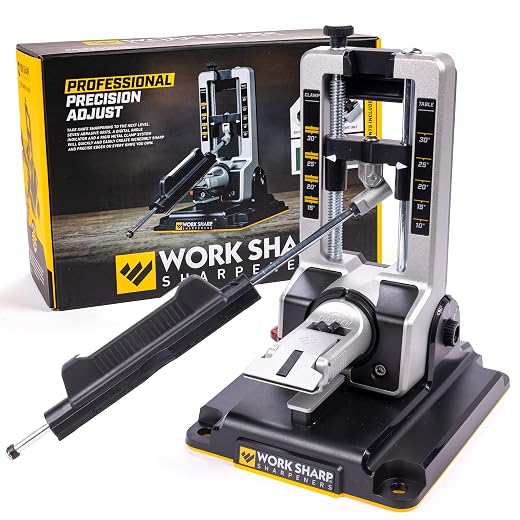
The Professional Precision Adjust uses metal construction, a rotating clamp, and a digital angle indicator. Its 15°–30° adjustment range makes returning to a documented setting straightforward, though the actual edge angle should still be checked against blade geometry.
Five diamond plates—220 through 800 grit—handle S30V stock removal and progression. Fine ceramic and a leather strop are also included, allowing deburring and finishing without an immediate accessory purchase. Compared with KME, the supplied progression is broader out of the box; KME offers more paths for specialized refinement. Work Sharp’s three-year warranty and available replacement abrasives help clarify ownership costs, while the larger bench-oriented structure favors a dedicated sharpening space over portability.
Work Sharp’s Guided Field Sharpener arrives ready to abrade S30V: the manufacturer lists coarse and fine diamond plates, a three-position ceramic rod, a leather strop, and fixed angle guides. Its diamond surfaces make it practical for restoring a tired apex away from the bench. The tradeoff is control—keeping the blade aligned still depends on steady hand pressure, and the compact plates provide less support for long blades.
The Spyderco Tri-Angle Sharpmaker takes a different approach. Its standard kit includes medium and fine alumina-ceramic rods, not diamond abrasives. Those rods suit frequent touch-ups when the existing bevel already reaches the apex. For an S30V edge that has become notably dull, Spyderco sells diamond rods and CBN rods separately; either option adds a more aggressive first stage before returning to the included ceramics. Buyers should therefore compare the configured system, not assume the stock Sharpmaker includes a coarse S30V-cutting abrasive.
Neither setup is an efficient substitute for a rigid, clamped bench sharpener when removing chips, correcting an uneven bevel, or changing the edge angle substantially. The field sharpener prioritizes portability, while the Sharpmaker prioritizes repeatable maintenance angles. Major repairs generally benefit from broader coarse stones, firmer blade support, and tighter angle control.
A routine that gets there faster
Speed on S30V comes from spending the coarse stage properly rather than rushing it. Most of the wasted time in a slow session goes into refining an edge that never apexed, which produces a handsome bevel and a blade that still will not cut paper. The sequence below front-loads the work where it counts.
A faster S30V sharpening routine
-
Mark the bevel and set the angle
Color both bevels with a permanent marker. Match the existing angle unless damage, poor cutting performance, or a planned geometry change justifies reprofiling.
-
Start only as coarse as necessary
Use coarse diamond for chips, a bevel reset, or an edge that will not apex promptly. Routine dullness can usually begin at a finer stage.
-
Form a continuous burr
Work one side until the burr runs from heel to tip, then repeat on the other. Marker left at the shoulder or edge reveals incomplete contact.
-
Reduce the burr with alternating passes
Switch sides every pass while progressively lightening pressure. Do not advance grit until the entire edge has been apexed and the burr is controlled.
-
Stop at the useful finish
A moderately toothy finish suits rope, cardboard, and general utility cutting; further refinement favors cleaner push cuts. Finish with light strokes, then clean the abrasives as their manufacturer directs.
Heavy pressure can deepen scratches, accelerate abrasive wear, and make burr removal harder. Polishing before both bevels meet only smooths an incomplete edge. Clear swarf at the recommended interval, and use only the cleaner, lubricant, or soaking method approved for that sharpener—diamond plates, ceramic rods, and bonded stones may require different care.
Choose for frequency, fit, and portability
For occasional home sharpening, an entry-level guided diamond kit can control angles without requiring a larger platform. Frequent sharpening or repeated edge settings may justify a sturdier guided system with dependable clamping and replaceable abrasives. For portable touch-ups, a compact diamond tool is often more practical—provided freehand angle control is acceptable.
Before ordering, confirm that the guide accommodates the blade’s length, thickness, grind, and edge access. Check included grits, replacement availability, and the manufacturer’s current instructions. Follow a sound pocket-knife sharpening process, then touch up the apex early; severe dullness turns routine maintenance into another slow reprofile.
S30V rewards the effort in edge retention and asks for it back in stain resistance; whether S30V rusts covers the maintenance side of the same steel.
Work Sharp Precision Adjust Elite - Adjustable Knife Sharpening System with 7 abrasives
Features
| Brand Name | WORK SHARP |
| Number of Items | 1 |
| Number of Packs | 1 |
| Unit Count | 7 Count |
| ASIN | B0CLBK94HQ |
| Material Type | Stone |
| Color | Black |
| Grit Type | Fine |
- SEVEN (7) ABRASIVE GRITS: 220, 320, 400, 600, and 800 diamond, fine ceramic, leather strop, and small ceramic rod for serrations.
- ADJUSTABLE, REPEATABLE - Sharpening Angle can be easily adjusted from 15-30 degrees.
- FAST and EASY - Quickly index between grits on each Tri-Brasive sharpening stones and easily swap one rod with another without disrupting your work.
- SHARPEN SERRATED KNIVES - use the small fine ceramic rod to sharpen serrated knives
- CREATE CUSTOM EDGES - choose between many grit options to reprofile an old blade or create a beautiful polished edge on your favorite blade.
KME Precision Knife Sharpener System with 4 Gold Series Diamond Hones - Base Included
Features
| Brand Name | KME Sharpeners |
| Number of Items | 1 |
| Manufacturer | KME Sharpeners |
| Number of Packs | 1 |
| Unit Count | 1 Count |
| UPC | 680474194476 |
| Model Number | KFD4-WB |
| Manufacturer Part Number | KF-D4 and KF-Base |
| ASIN | B010ESF0AW |
| Material Type | Wood |
| Color | Gold |
| Grit Type | Extra Fine,Extra-coarse,Coarse,Fine |
| Item Dimensions L x W x H | 7"L x 4"W x 4"H |
| Item Weight | 12 ounces |
- Newest KME Kit as of June 2015 with Base Included
- 4 Gold Series KME 1x4 diamond hones - 140 extra-coarse, 300 coarse, 600 fine and 1500 extra fine
- Spherical bearing rod guide for zero angle deviation and smooth sharpening motion
- Continuous angle adjustment from 17 to 30 degrees - marked in 1 degree increments
- Very portable - stores in included hard carry case.
Work Sharp Professional Precision Adjust Knife Sharpener Kit - Complete Sharpening System for Kitchen, Pocket & Hunting Knives - Premium Angle-Guided Sharpening
Features
| Brand Name | WORK SHARP |
| Number of Items | 1 |
| Manufacturer | Work Sharp |
| Number of Packs | 1 |
| Unit Count | 1 Count |
| Global Trade Identification Number | 00662949041546 |
| UPC | 662949041546 |
| Included Components | Ceramic, Coarse Diamond, Fine Diamond, Leather Strop, Medium DIamond |
| Item Type Name | Knife Sharpener |
| Model Number | WSBCHPAJ-PRO-ATL |
| Manufacturer Part Number | WSBCHPAJ-PRO |
| ASIN | B0BTTXVQRQ |
| Material Type | Metal |
| Color | Black |
| Grit Type | Fine |
| Item Dimensions L x W x H | 8"L x 6.6"W x 9.75"H |
| Item Weight | 3.43 kg |
- PROFESSIONAL KNIFE SHARPENING SYSTEM: A professional-level knife sharpener with metal construction that can be used for all knives at angles as low as 15 degrees and can even be used on small pen knives.
- INCLUDES 7 ABRASIVES: The seven abrasive grits: 220, 320, 400, 600, and 800 diamond, fine ceramic, and leather strop allow you to cater to what your knives or tools need and what will suit them best.
- ADJUSTABLE SHARPENING ANGLES: The included digital angle indicator allows you to adjust the sharpener's angle from 15 to 30 degrees. This allows you to provide a clean sharpen to your knife or tool.
- 3-YEAR WARRANTY: All Work Sharp sharpeners come with a comprehensive 3-year warranty. Each knife & tool sharpener is meticulously designed and quality-checked at our Oregon facility. We proudly stand behind our products.
- DESIGNED, ENGINEERED, & CALIBRATED IN OREGON: We design, engineer, and calibrate our sharpening machines all under one roof in Ashland, Oregon & ensure our products are sourced from the highest caliber manufacturers, both in the USA and globally.