

A purse brush earns its space only when it fixes the problem before the next stop.
A gusty walk can leave the crown pressed flat while shorter hairs lift around the parting—exactly when a full paddle brush is sitting at home. The useful alternative is not merely shortened: it needs enough bristle reach to catch surface flyaways, enough flex to move through a small tangle without yanking, and a form that stays clean among keys, receipts, and makeup.
Fast touch-ups are a different job from full detangling. A compact brush should restore direction at the roots and smooth the outer layer in a few passes, rather than snagging at the ends or creating static. Fold-over covers, protected bristles, and a handle that remains controllable in one hand matter as much as a slim footprint. The strongest purse-ready designs balance those details, so their small size feels deliberate rather than compromised.
- Protected bristles are less likely to collect lint or bend in a crowded bag.
- Flexible pins generally suit quick detangling; boar bristles tend to focus on surface polish.


A compact purse brush solves a specific problem: restoring hair between full styling sessions without adding bulk to an already crowded bag. The best options balance three things — a footprint that clears the tightest pocket, bristles that stay protected against keys and cosmetics, and enough working surface to smooth flyaways in a few passes. Flexible detangling pins are the safer default for anyone prone to knots, while denser natural-style bristles reward people who mainly need a polish pass on hair that’s already been brushed. Folding designs add a layer of protection at the cost of a slightly thicker closed profile, so it’s worth testing a brush against the bag’s narrowest compartment before committing to it as a permanent purse companion.
Five compact brushes, matched to the way hair needs to be refreshed


Quick smoothing
In a purse-sized brush, quick smoothing means restoring a cleaner surface: hairs lie in one direction, flyaways are gathered, and a part is re-established within a few controlled passes. It is a refresh between appointments or after wind, collars, and transit—not a replacement for a full brushing session.
Flexible detangling pins
Widely spaced, flexible pins bend around lightly crossed strands instead of dragging against them. They suit hair that has been disturbed at the crown or through the ends, and are the more forgiving choice when a compact brush must do some genuine separating.
Dense bristles
Closely packed natural or synthetic bristles create more surface contact, so they excel at collecting short flyaways and polishing the outer layer into a neater-looking sheet. Their smoothing strength is not the same as detangling capacity; dense bristles can skim over a tangle or catch at compressed lengths.
Light disruption
A few crossed strands, a softened part, static around the hairline, or wind-lifted surface hair usually responds quickly to either pins or bristles. This is the condition compact brushes handle most efficiently.
Knots and compression
Tight knots, shed-hair buildup, damp tangling, or lengths flattened under scarves and straps require slower sectioning and more detangling range than many purse brushes provide. A mini brush can start the process, but forcing repeated passes risks snagging and breakage.
Comparisons favored the brush that performs a fast refresh without becoming a snag-prone, lint-collecting object at the bottom of a bag.
Folded footprint matters, but so does the working area once deployed. A tiny head can tame a part or fringe; a broader pad covers longer lengths with fewer passes.
Flexible, spaced pins were assessed for forgiving detangling, while dense natural-style bristles were assessed for surface polish. Handle shape, hinge stiffness, and pad flex determine how precisely the brush can be guided.
Hinges, bristle retention, washable surfaces, and covers or folding shells count heavily. Protected bristles stay cleaner and are less likely to catch on keys, fabric, or cosmetics.
Retail listings can group several sizes or revisions under one product name. Check the stated closed and open dimensions, bristle material, mirror or cover inclusion, and whether the hinge locks securely. Product photos alone rarely reveal head size or bristle spacing accurately.
- Measure the usable pocket, not the brush listing
A brush’s quoted length can hide a thick hinge, bulbous back, or wide handle that catches on a zippered compartment. Compare its closed depth and widest point with the bag’s least forgiving pocket.
Look forA flat silhouette with rounded corners that can slide past a pocket opening.AvoidA compact-looking brush whose hinge or handle creates a rigid lump. - Keep the working face covered
Loose pins collect lint, snag a lining, and can become bent under keys or chargers. A folding head, fitted cap, or recessed bristle bed matters more in a densely packed purse than in a mostly empty tote.
Look forBristles that fold inward, retract, or sit below a protective rim.AvoidExposed pins sharing space with metal objects or loose cosmetics. - Match the grip to the refresh
A tiny brush can be adequate for a quick part or crown pass, but an overly short handle twists in the fingers during a longer detangling session. The Conair-style cushioned mini format favors controlled strokes; a fold-out handle offers more leverage.
Look forEnough handle clearance to guide the brush without squeezing the head.AvoidA palm-sized shape that becomes slippery or awkward once hair resistance increases. - Choose tips and bristle shape for the bag’s job
Flexible, ball-tipped pins are generally more forgiving of minor knots; densely set boar bristles excel at distributing surface oils and gathering flyaways. Rounded outer edges also enter a full bag more cleanly than square, snag-prone profiles.
Look forFlexible pins for touch-up detangling or dense natural bristles for polish, in a rounded case.AvoidStiff, exposed bristles when the brush will be pressed against hard contents.
Wet Brush Pop Go: a folding detangler for everyday refreshes
01
Best for quick purse touch-ups on wet or dry hair
The Pop Go suits a purse brush that needs to handle more than a quick pass over the crown. Its folding format closes the bristle bed for travel, then opens into a comfortably sized detangling head. Ultrasoft IntelliFlex bristles give when they meet small knots, making this model especially relevant for longer hair and strands that pick up tangles during the day. A built-in handle mirror adds a useful check for a part, fringe, or back-of-head touch-up.
- Flexible bristles work through minor tangles with relatively low pulling force
- Fold-down design keeps the bristles covered in a bag
- Usable on dry hair and for gentle post-wash detangling
- Mirror is handy for precise part and fringe checks
- Hinge and folding cavity add parts that can collect lint or hair
- Flexible pins separate well but do not create the sleekest polished finish
- Not the most compact option once opened
Quick take A capable purse brush when a refresh sometimes turns into light detangling. It prioritizes forgiving separation and protected carry over dense-bristle shine.
For regular touch-ups, the Pop Go offers a notably more useful detangling action than a tiny polishing brush. Its flexible bristles are the point: they can release small snarls without requiring the hard, repetitive strokes that often flatten or disturb a style.
The trade-off is mechanical rather than cosmetic. The fold and hinge merit occasional cleaning and gentler handling, while a dense natural-bristle-style brush remains the stronger choice for glassy surface polish. For most purse carry, though, its mix of coverage, give, and bristle protection is unusually well balanced.
Wet Brush Squirt Mini Detangling Brush: a simple grab-and-go detangler
Best budget-friendly option for gentle everyday detangling
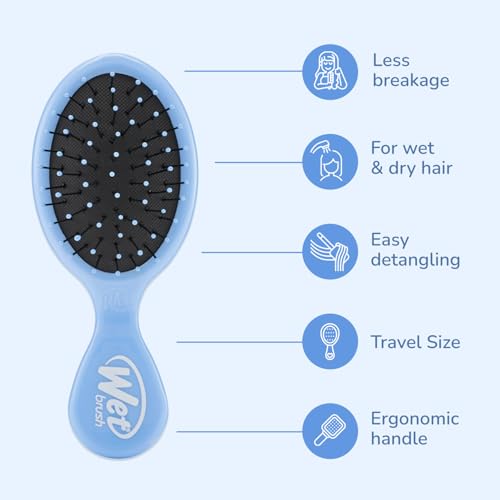
The Wet Brush Squirt Mini is the straightforward option for keeping a detangling brush in a makeup bag, generous tote, or coat pocket. It uses the familiar flexible IntelliFlex-style bristle layout in a reduced, handle-free form, so it works as a quick pass-through tool rather than a miniature styling session.
Its appeal is its lack of ceremony: take it out, work through a few sections, and put it away. The small head makes most sense for bangs, a part line, the ends around the shoulders, or a brief reset after wind and scarves. It is particularly credible as a second brush—one that stays available when the full-size brush is at home. For hair with substantial length, density, or tangling, its role is more touch-up than complete detangling.
- Flexible bristles give with light knots
- Very little bulk in a larger bag
- Easy, direct pass-through design
- Useful for ends, fringe, and part lines
- Small head covers limited hair per stroke
- Loose bristles can collect purse lint
- No cover or folding mechanism
- Less efficient on dense, long hair
Conair Totally Smooth Mini Hair Brush for familiar, controlled brushing
A comfortable, compact choice for everyday smoothing
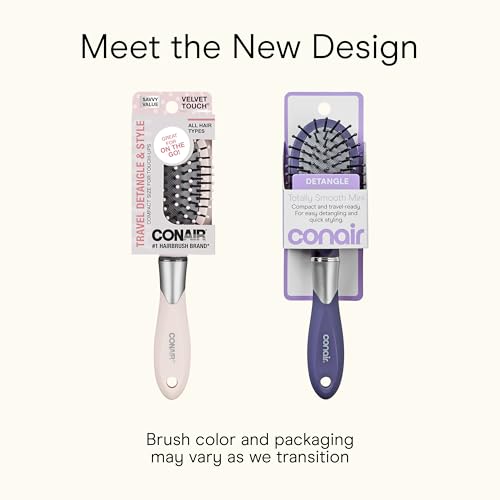
The Conair Totally Smooth Mini Hair Brush takes the conventional route: a small, non-folding cushion brush with a real handle rather than a pop-out or palm-held form. That familiar geometry gives frequent brushers more leverage for short, deliberate passes along the hairline, part, and lengths.
Its soft-touch handle and flexible cushion base suit touch-ups where scalp feel matters as much as surface neatness. Ball-tipped bristles are positioned for wet or dry detangling, making this a sensible match for someone who prefers the steadier hand position of a traditional brush—even when the bag footprint is less streamlined than a folding design.
- Soft-touch handle supports a secure, relaxed grip
- Cushion base gives bristles more forgiving contact
- Ball-tipped bristles suit wet or dry touch-ups
- Traditional handle allows controlled, directional strokes
- Non-folding shape uses more linear purse space
- Bristles are not protected by a closed cover
- Small head still needs multiple passes on dense hair
Portable Folding Boar Bristle Hair Brush for top-layer polish
A versatile compact brush for multiple hair types
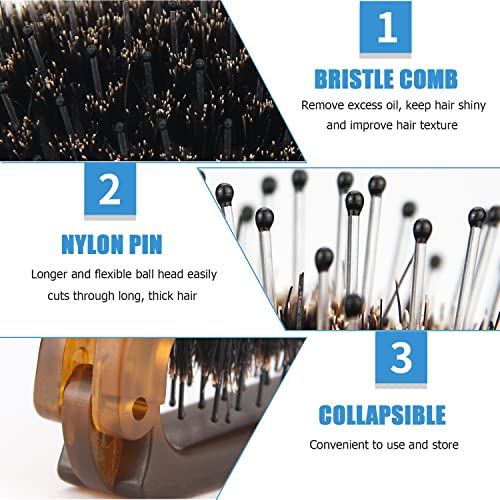
This folding brush is oriented toward the last minute of a refresh rather than the first pass through snarls. On hair that has already been detangled, its dense bristle field can gather short flyaways, refine a part, and make the crown and outer layer read sleeker with a few light strokes.
It suits purse carry for people who prioritize a polished surface—particularly for straighter styles, blowouts, buns, and ponytails—over broad detangling coverage. Fold it closed before returning it to the bag so lint and compression do not flatten the working bristles.
- Dense bristles target flyaways neatly
- Folding format protects the brush head
- Useful for refining parts and updos
- Not designed to release active tangles
- Small head covers long hair slowly
- Bristle material may need verification
Confirm the current product page and packaging before treating this as a natural-boar-bristle brush. Travel brushes may use mixed boar and nylon, synthetic bristles marketed with similar language, or different specifications across sellers.
That distinction affects feel and performance: natural bristles generally emphasize surface alignment and distribution of existing oils, while nylon pins add more reach and separation. Neither dense bristle arrangement substitutes for flexible detangling pins on thick hair, tightly textured hair, or fresh tangles.
Pocket Hairbrush With Mirror for part and fringe checks
- Mirror supports precise part and fringe checks
- Pocket-scale format keeps a touch-up tool close
- Immediate brush-and-check routine suits transit or restroom refreshes
- Small brush face needs several passes on longer or thicker hair
- Mirror adds bulk compared with a plain mini brush
- Less useful when detangling or full-head smoothing is the priority
Purse Brushes: Common Questions
What's the difference between a purse brush for detangling and one for polish?
Flexible, spaced pins bend around lightly crossed strands and are better for detangling, while densely packed natural or synthetic bristles create more surface contact and excel at collecting flyaways and polishing the outer layer—not the same as detangling capacity.
Can a compact brush handle a real tangle?
Not reliably. Tight knots, shed-hair buildup, damp tangling, or lengths flattened under scarves and straps need slower sectioning and more detangling range than most purse brushes provide; forcing repeated passes risks snagging and breakage.
Why does bristle protection matter in a bag?
Loose pins collect lint, snag the lining, and can bend under keys or chargers, so a folding head, fitted cap, or recessed bristle bed matters more in a densely packed purse than in a mostly empty tote.
Is "boar bristle" always genuine natural bristle?
Not necessarily—travel brushes may use mixed boar and nylon or synthetic bristles marketed with similar language, so it’s worth confirming the current product listing rather than assuming a natural-bristle construction.
How do I know if a brush will actually fit my bag?
Measure the usable interior width and depth of the bag’s tightest pocket—not just the exterior—and compare it with the brush’s closed depth and widest point, including the hinge or handle, which can create a lump even on a compact-looking brush.
Choose the brush that earns its purse space
- Flexible pins solve light knots; dense bristles refine the surface afterward.
- A protected brush stored in a repeatable pocket is more likely to remain useful than a smaller loose one.
For one compact tool that can handle most between-stop refreshes, the Wet Brush Pop Go Foldable Detangler is the strongest all-round pick: flexible pins address small knots, its folded format shields the brush face, and the mirror adds a practical part check. The Wet Brush Squirt Mini Detangling Brush suits a low-fuss backup where a pouch can protect its exposed pins. For sleek top layers, the Portable Folding Boar Bristle Hair Brush is the more focused polish choice; it is less suited to working through tangles. The Pocket Hairbrush With Mirror For Travel makes sense when fringe, part, or hairline checks matter more than full-head coverage.
Before choosing, measure the usable interior width and depth—not only the purse’s exterior—and allow room to grip and remove the brush. A folding model works well in a narrow organizer slot; an uncovered mini is better inside a zip pouch; a mirror brush needs a flat, easy-access pocket. That same placement test belongs in an everyday carry checklist: the brush that has a protected, repeatable home is the one likely to stay in rotation.
Wet Brush Pop Go Detangler, Blue Teal - Foldable, On-The-Go Design, Travel Brush, Ultrasoft IntelliFlex Bristles, Detangling Hairbrush, Built-In Mirror...
Mini hairbrush, pocket hairbrush with mirror, portable for purse/pocket, travel size (Black flowers and plants)
Conair Totally Smooth Mini Hair Brush, Soft-Touch Handle, Ball-Tipped Bristles for Detangling Wet or Dry Hair, Color May Vary
Wet Brush Squirt Detangling Brush, Sky, Mini Detangler, No Tangle Ultra-Soft IntelliFlex Bristles, Wet & Dry Styling Hairbrush for Women & Men, All Hair Types




17 Comments
Would you pick the Conair mini over the Wet Brush Squirt for a kid with fine hair? She hates when brushes pull, but I also don’t want to spend much since it’ll probably disappear at school within a week.
I use the little mirror brush for bangs, not my whole head, and that distinction matters. It’s great for seeing whether my fringe has decided to split into three separate political parties.
For a full refresh I’d still carry a folding detangler. The tiny brush face takes forever otherwise.
Exactly! I bought one expecting an all-purpose travel brush and it was oddly exhausting. But for bangs and a quick part check, it’s actually useful.
For under $10, which one would you buy for a small crossbody? I have shoulder-length wavy hair and mostly need to fix wind tangles after walking to work. A mirror would be nice but not if the brush barely covers anything.
For that routine, I’d start with the Wet Brush Squirt Mini if it fits your budget where you shop. Its flexible bristles are better aligned with light wind tangles than a dense polishing brush, and the smaller face is less of a drawback on shoulder-length hair if you brush in sections. Just give it a small pouch or pocket of its own since the bristles are uncovered.
The pocket-depth point is so real. I bought a “mini” brush once that was technically tiny but had a thick rounded case, and it took up more room than my sunglasses case. Mini according to whom? 😂
I’m glad you mentioned hinge quality instead of acting like every folding brush is automatically better. My last folding brush got wobbly after a few months and then pinched my finger when closing.
Do you think the Pop Go hinge holds up if it’s used daily, or is it more of an occasional-travel brush?
That’s a fair concern. The Pop Go makes the most sense for regular light refreshes, but the hinge is still a moving part worth treating gently—open it fully rather than forcing it and keep hair from collecting around the joint. For heavy daily detangling, a full-size brush at home plus a simpler mini for the bag may be the longer-lasting setup.
Why wasn’t the Tangle Teezer Compact Styler included? Mine has a proper cover and seems like the obvious comparison to the Squirt Mini. I agree that uncovered bristles are a dealbreaker in a bag that also contains receipts, crumbs, and apparently a small civilization.
I have the Pop Go and the folding part is why it actually lives in my tote instead of at the bottom of a drawer. The mirror is a little small, but for checking a crooked part before a meeting it does the job.
This clarified something I kept mixing up: I don’t need a “detangler” for my afternoon refresh, I need something that makes the top layer look less fuzzy.
The boar-bristle style sounds more suited to me, although I appreciate the warning about verifying what the bristles actually are. Listings can get pretty creative with that wording.
I appreciate that this didn’t just rank the smallest item first. A brush that protects the bristles but leaves no room to hold it is not actually purse-friendly.
I’m still curious why there wasn’t a mention of a compact vent brush. Are those just not very useful for dry, quick smoothing compared with the cushion and flexible-pin options?
Mostly, yes. Compact vent brushes can be handy when blow-drying or when airflow is part of the routine, but for a dry, on-the-go refresh they usually don’t offer the same combination of gentle separation, surface contact, and bristle protection as the options discussed. They can still work well for someone who specifically wants to reshape short hair, but they were outside the main purse-refresh focus here.
I keep a mini vent brush in my gym bag for post-dryer hair, but I wouldn’t choose it for my regular purse. The open bristles catch lint like crazy.
Could you explain why the boar-bristle option is listed as a polish brush rather than a detangling brush? I see so many social posts claiming boar bristles are the answer for everything, including knots.
My hair is thick and gets lightly tangled at the nape, but the main visible problem is flyaways around the crown. I’m trying not to buy two separate purse brushes if one can reasonably do both.
Dense boar-style bristles generally excel at gathering and smoothing the hair that is already mostly aligned, which is why they can make a crown or part look polished. They don’t have the spaced, flexible pins that are helpful for separating through tangles, especially at the nape. With your hair, a compact flexible-pin detangler is the safer one-brush choice; use a small amount of styling product or a hand-smoothing pass for flyaways if needed.
I learned this the hard way with thick hair. My boar brush makes the top look gorgeous, then hits a nape tangle and basically says “not my job.”