
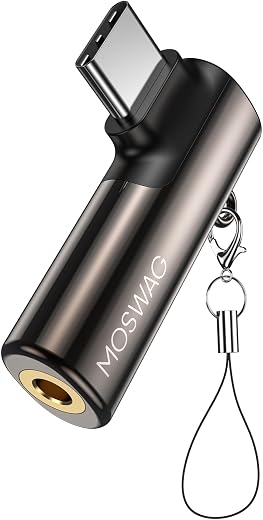
Good wired headphones become surprisingly inconvenient when the phone loses its headphone jack.
A reliable pair of wired headphones can sit unused in a bag simply because a USB-C phone offers nowhere to plug them in. The usual loose adapter is little better: it vanishes into a pocket, gets bent at the connector, or is left attached to another device when it is needed most.
A keychain dongle changes the calculation from another accessory to remember into a small piece of everyday readiness. MOSWAG’s right-angle USB-C design is especially relevant here: the cable exits sideways rather than straight out, reducing the awkward lever that a conventional plug creates in a crowded pocket. Still, keychain carry is a compromise. Keys can scratch the housing, tug the short lead, and expose the USB-C plug to lint or moisture. Its value depends less on novelty than on whether dependable wired listening is worth protecting with a compact, somewhat vulnerable spare.
A small adapter that suits mobile wired listening
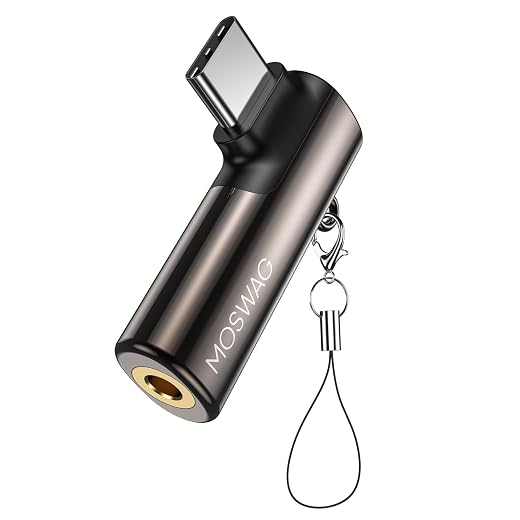
Best for comfortable gaming and everyday listening
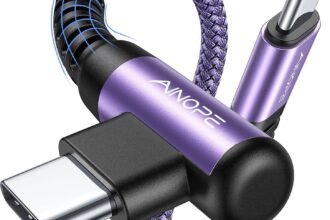
The MOSWAG USB-C-to-3.5 mm adapter is built around a 90-degree USB-C plug, a sensible shape when a phone sits in a pocket or is held horizontally for games and video. It keeps the headphone lead closer to the device edge rather than projecting straight out, which can reduce awkward cable bends.
Its integrated DAC means it is intended for USB-C devices that output digital audio. That makes it a convenient swap-in for recent phones, tablets, and laptops that have dropped the headphone jack, while the 3.5 mm socket supports conventional wired headsets and, where the host recognizes it, headset microphone audio. Sound quality will still depend on the host’s USB audio implementation and the headphones; the listing does not establish high-resolution format support or a particularly powerful amplifier.
For a keychain, compactness is only half the story. The exposed 3.5 mm socket can collect lint, and a short dongle can put leverage on a USB-C port if it catches against keys or a pocket seam. A protective cap or separate small pouch is more convincing than loose keyring carry. Thick cases, restricted USB-C ports, and inconsistent inline-control support can also limit compatibility.
- Pocket-friendly shape The right-angle plug keeps the cable along the device edge for less intrusive pocket and handheld use.
- DAC, with limits An onboard DAC is designed for digital USB-C audio; it does not imply identical output across every host.
- Controls vary Headphone audio may work broadly, but microphone and inline-button behavior can vary by device and operating system.
- Protect the ports Loose keychain carry leaves connectors exposed to lint, knocks, and strain from snagging.
Compatibility is worth confirming for the specific phone, tablet, case, and headset before treating it as an everyday carry accessory.
A USB-C audio adapter contains an audio system
- DAC
The digital-to-analog converter turns the phone’s USB-C audio data into the low-voltage analog signal that wired headphones require. Its implementation affects noise floor, output level, channel balance, and how difficult headphones are to drive.
- Digital audio output
A USB-C port may send USB Audio data, but not every USB-C device exposes it in the same way. This MOSWAG adapter depends on the host recognizing it as a USB audio device; it is not a passive pin-to-pin converter.
- 3.5 mm output
The socket delivers analog stereo through a standard TRS/TRRS-style headphone connection. Headset microphone and button support is separate from playback and can vary with the adapter’s wiring and the host operating system.
- Right-angle design
The plug exits sideways rather than straight out, reducing the lever arm in a pocket and making a keychain carry less awkward. The trade-off is that case thickness and port orientation can determine which direction the cable faces.
- Host compatibility
Before buying, verify USB-C audio support on the phone, tablet, or computer; operating-system behavior; case clearance; and whether microphone, calls, inline controls, and high-impedance headphones matter. A charging port that merely shares USB-C’s shape is not proof of audio support.
A dongle can connect physically yet still fail to provide the expected experience. Common fault lines include:
- USB-C hosts without usable USB Audio output
- Headsets whose microphone uses a different CTIA/OMTP wiring convention
- Protective cases that block a right-angle plug
- Demanding headphones that need more voltage or current than a compact adapter supplies
For ordinary efficient earbuds or portable headphones, the MOSWAG’s integrated DAC is the important distinction: it supplies an analog output where many modern phones supply only digital data.
Useful in a pocket, vulnerable on a keyring
The MOSWAG USB-C dongle’s right-angle plug makes a genuine difference when it’s connected. With a phone in a front pocket, the cable exits sideways rather than projecting straight down from the port. This reduces the lever arm created when the phone shifts against a thigh or pocket seam, and it is less likely to jab outward than a conventional straight dongle.
That is a meaningful advantage among compact cables and dongles intended for pocket carry, particularly with a short headphone lead. The design keeps the adapter close to the phone rather than creating a dangling section that can catch on a bag edge. The benefit is mechanical and practical, not cosmetic, and it highlights the MOSWAG USB-C dongle in everyday use.
Keychain storage is a different environment. A USB-C male connector rubbing against keys, coins, or zipper teeth can collect debris in its recesses and suffer scuffing on its contact tongue. More importantly, a dongle clipped directly to a crowded keyring can be repeatedly bent, twisted, and pulled by the plug or cable strain relief—loads the right-angle housing cannot eliminate.
A better setup is a small zip pouch, covered capsule, or separate organizer loop with the adapter resting inside it. If an attachment point is essential, use a short soft lanyard connected to a protective sleeve or case, not a metal split ring through or around the cable. This preserves quick access without turning the connector into a loose piece of hardware among keys.
The right-angle shape is most valuable when the dongle is plugged into a pocketed phone. For transport, keep its USB-C plug covered and avoid direct contact with loose keys, metal rings, and lint-heavy pockets.
The test that matters starts after music plays
A successful track proves only that the MOSWAG adapter has enumerated and passed audio. A useful evaluation recreates the movements, accessories, and headset functions that expose weak USB-C fit or imperfect analog compatibility.
With the phone’s everyday case installed, confirm that the USB-C shell seats fully without rocking or leaving a visible gap. Test the right-angle plug with the cable running toward both the top and bottom edges, then place the phone in a pocket and hold it during normal use; an orientation that presses the headset cable into a hand or thigh quickly becomes tiresome.
Connect and disconnect the adapter and headphone plug repeatedly, watching for a loose 3.5 mm jack, USB-C dropouts, or sound that returns only after reseating. Gentle cable movement should not trigger crackle, a channel loss, a pause, or a charging/accessory warning; abrupt connection changes can indicate marginal plug contact, case interference, or host-port wear.
Place several calls or record short voice samples to check microphone detection, speech level, and whether the phone selects the wired mic rather than its internal microphone. Test play/pause, volume, and call-answer buttons if the headset has them, then listen at low volume during silence and between tracks for hiss, digital ticks, or interference that changes when the phone transmits. Repeat the full routine after several days of carrying, since lint in the jack and strain from a keyring often reveal durability issues later than first use.
Results can vary with the phone’s USB-C implementation, case thickness, headset wiring, and headphone sensitivity.
What the tiny DAC can—and cannot—do
The MOSWAG’s built-in DAC changes the signal path from USB-C digital audio to analog, but it is not a promise of high output power or audiophile-grade conversion. With mainstream wired earphones and efficient portable headphones, the likely result is clean, convenient playback for music, video, and podcasts. The more revealing question is whether there is enough volume headroom before distortion or thin bass becomes apparent with a particular headphone.
High-impedance, low-sensitivity, or planar magnetic headphones are a poor assumption for a dongle this small. They may play, yet reach modest loudness or lose dynamic authority compared with a stronger USB-C DAC/amp. Its practical target is the 3.5 mm earphone already carried in a bag or pocket—not a desktop-style headphone setup.
Calls and controls need a quick check
The listing specifies microphone support, so a CTIA-wired headset has a reasonable basis for calls and voice notes. Still, USB-C audio negotiation, button mapping, and inline remote behavior vary by phone, tablet, operating system, and headset. A short call plus play/pause and volume-button test is more useful than assuming every three-button remote will work.
Most modern USB-C phones, tablets, and computers recognize standard USB Audio devices automatically; exceptions remain, especially on devices with restricted USB implementations or unusual power management. A device may also route audio back to its speakers after reconnecting, requiring a manual output selection.
The 90-degree plug is the everyday advantage: it keeps the cable alongside the handset rather than projecting into a palm or pocket. For a closer comparison of right-angle cables and dongles under port strain, the trade-off is clear: this adapter applies little leverage while connected, but occupies the only USB-C port and offers no pass-through charging. A slim protective case, pouch, or organizer compartment is a better home than loose keys, where grit and twisting can damage either connector.
- Right-angle form keeps the headphone lead out of the hand
- Integrated DAC supports ordinary USB-C audio use
- Tiny, light carry item with a metal housing
- No charging pass-through or second USB-C port
- Power reserve is uncertain with demanding headphones
- Mic and inline-control behavior remains device-dependent
Bottom line A compact adapter for ordinary wired listening, not a substitute for a higher-power DAC/amp or a USB-C hub.
The MOSWAG is a worthwhile wired-audio fallback for phones and tablets that deliver USB Audio through their USB-C port, especially when a right-angle plug keeps the headphone lead out of the hand. Its tiny DAC and headset support make it more capable than a passive adapter, but neither microphone controls nor case clearance can be assumed across every device and headset. Carry it in a small organizer pocket or a capped capsule rather than dangling it from keys: exposed USB-C contacts and the 3.5 mm socket are vulnerable to grit, abrasion, and leverage. Before relying on it, confirm USB-C audio output, test play/pause and calls with the intended headset, check the plug clears the case, and protect the connector between uses.
MOSWAG USB-C Dongle: Common Questions
Does the MOSWAG dongle support charging while listening to music?
No. It occupies the phone’s only USB-C port and offers no pass-through charging, so it can’t be used for audio and charging at the same time.
Will this dongle drive high-impedance or planar magnetic headphones well?
Not reliably. Its compact integrated DAC is built for ordinary wired earphones and efficient portable headphones. High-impedance, low-sensitivity, or planar magnetic headphones may play but reach only modest loudness compared with a stronger USB-C DAC/amp.
Is it safe to carry this dongle loose on a keyring?
Loose keyring carry is a real compromise. Keys can scratch the housing, tug the short lead, and let lint or moisture into the exposed USB-C plug and 3.5mm socket. A small zip pouch, covered capsule, or protective cap is a better home than a bare split ring.
Why does the right-angle plug matter for pocket use?
A 90-degree USB-C plug keeps the headphone cable running along the phone’s edge instead of projecting straight out, which reduces the awkward lever effect a straight plug creates when the phone is in a pocket or held horizontally.
Will the microphone and inline controls always work with this adapter?
Not guaranteed across every device. USB-C audio negotiation, button mapping, and inline remote behavior vary by phone, tablet, operating system, and headset, so it’s worth testing calls, play/pause, and volume buttons with the intended headset before relying on it.
MOSWAG USB C to 3.5mm Jack Type C Aux Headphone Adapter Right Angled Dongle | DAC Stereo Mic HiFi, Zinc Alloy, Compatible with iPhone 17 16 15 Pro Max/Plus,...
Features
| Compatible Devices | iPhone 15 Plus, Pro Max, Samsung Galaxy S23, S23+, S23 Ultra, S22, S22+, S22 S21, S21+, S21 S20, S20 Z Flip, S20+, S10, S9, S8 Note 20, 10, 10+, 9, 8, iPad pro, mini 6, Mac book, Pixel 4, 3, 2 XL, Huawei Mate 30, 10 Pro, P30, P20, OnePlus 6T, 7, 7Pro and more. |
| Specific Uses For Product | Headphones |
| Connector Type | USB Type C |
| Number of Ports | 1 |
| Power Plug Type | No Plug |
| Color | Brown |
| Finish | Metallic |
| Item Weight | 0.01 kg |
| Package Quantity | 1 |
| Unit Count | 1 Count |
| Number of Items | 1 |
| Brand | MOSWAG |
| Model Number | 727376257875 |
| UPC | 727376257875 |
| Manufacturer | MOSWAG |
| Mfr Part Number | MOSWAG |
| ASIN | B0C7QVPXHJ |
- 【Ergonomic 90-Degree Right-Angle Desugn】:The compact 90-degree right-angle design aims to provide a more comfortable grip during extended gaming sessions. By keeping the USB C connector aligned flush with your device edge, it helps prevent the headphone cable from crossing your palm area, allowing for a natural and unrestricted hand position. This right-angle adapter may also help reduce cable strain during other activities like watching movies or when carrying your device in a pocket
- 【Enhanced Audio Experience With Clear Sound】:Experience your audio content with enhanced clarity and depth. The built-in DAC chipset is designed to support clear sound presentation for music, podcasts, and movies, aiming to deliver a balanced audio profile that allows you to appreciate nuances in your media through your favorite headphones or earphones
- 【Durable Metal Housing and IN-Line Control】:Crafted with a durable zinc-alloy housing, this USB C to 3.5mm adapter is built for daily use. It allows you to connect your USB-C device to various audio accessories like headphones, earphones, or car audio systems, while supporting in-line microphone functions for clear voice calls and convenient media playback control
- 【Extensive Device Compatibility】:This USB C audio adapter is designed for broad compatibility with popular USB-C devices including iPhone 15/16 series, Samsung Galaxy S23/S24 series, Google Pixel 7/8 series, iPad Pro, iPad Air, iPad mini, and MacBook models. The advanced DAC chipset ensures reliable audio connectivity across these devices, providing a versatile audio solution for your digital lifestyle
- 【Compact Travel-Friendly Companion】:Its ultra-compact and lightweight design makes this adapter an ideal travel companion. Easily portable in your pocket or bag, this USB C to 3.5mm jack adapter allows you to enjoy your wired audio accessories with modern USB-C devices wherever you go, maintaining your audio experience while on the move


10 Comments
I like the right-angle idea for using wired earbuds while the phone is in a pocket, but putting any USB-C plug on my keys sounds like a good way to fill it with lint. I’d probably keep this in the little zip pocket of my bag instead. The “always have a backup” use case is real though.
The keychain marketing is kind of funny. Keys are basically tiny metal hammers that spend all day attacking everything next to them 😅 A short adapter seems more likely to get scratched, twisted, and packed with mystery pocket crumbs than conveniently “ready.”
Has anyone tried it with a Nintendo Switch? I know USB-C audio can be weirdly dependent on the host, and I only want it for a flight with wired headphones. Not expecting huge volume, just reliable sound without having to pair Bluetooth again.
The Switch supports USB-C audio devices in many situations, but we would not treat compatibility as guaranteed without testing this exact adapter and headset combination. For a flight, verify audio output, volume range, and whether the console case leaves enough clearance around the port before relying on it.
I use a similar right-angle DAC on my OLED Switch. Audio worked, but my chunky protective case blocked it completely. Definitely check the plug housing/case fit first.
I bought this mainly because the cable-style adapters keep bending near the connector. The rigid right-angle body has actually been nicer for pocket listening with my Galaxy S23 and IEMs.
Sound is clean enough for commuting, no obvious hiss with my fairly sensitive pair. But I would absolutely not put it directly on a keyring. After two weeks in a jeans coin pocket, the USB-C end already collected enough dust that I started using a small pouch.
Good reminder that “it makes sound” is not the whole test. I’ve had dongles that played music perfectly but made a faint buzz at low volume and ignored the inline controls. For basic 16–32 ohm earphones this looks like a sensible spare, just not a substitute for a proper higher-power DAC if you use demanding headphones.
Does this work with the mic and volume buttons on regular CTIA earbuds, or is it audio only? My phone has no headphone jack and I still take calls with old wired buds sometimes.
It is intended to support headset use, but the exact mic/button behavior depends on the phone’s USB Audio implementation and the wiring of the headset. Standard CTIA headsets are the most likely to work; test calls and volume controls with your specific phone during the return window.
Mine worked for mic + play/pause on a Pixel 7 with cheap Sony earbuds. Volume buttons were a little inconsistent, but calls were fine.