
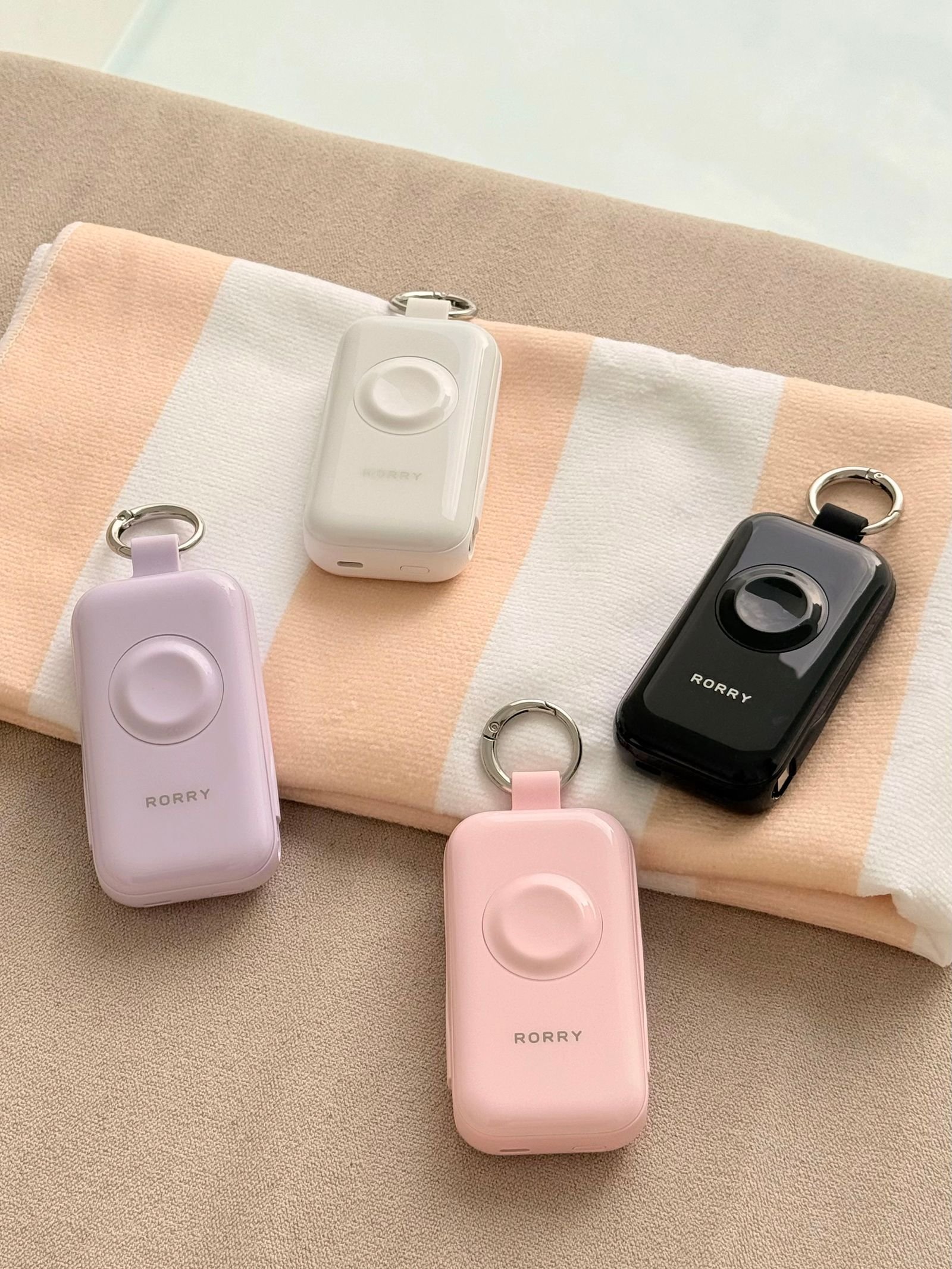
A piercing alarm may interrupt an incident; it cannot, by itself, guarantee a responder.
On a crowded platform, a keychain alarm can cut through conversation for a few seconds—then disappear into the ordinary noise of a train arriving, traffic, or someone’s music. Its value lies in creating a social signal: nearby people notice that something may be wrong and decide whether to look, approach, call emergency services, or alert staff.
That chain has weak links. Bystanders may mistake the sound for a car alarm, a prank, or a device malfunction; in enclosed venues, staff may be better placed to respond than passers-by, but may not hear it. Volume is not the same as reach, recognition, or action. An alarm is therefore most effective when its sound is distinctive, sustained long enough to attract attention, and used where potential responders are present and able to interpret it.
- A recognizable alarm pattern can prompt faster interpretation than an ambiguous continuous shriek.
- Crowded locations supply more potential witnesses, but noise and diffusion of responsibility can dilute response.
- Venues with visible staff or security create a clearer route from attention to assistance.

Four different kinds of “help”
Deterrence
A sudden, piercing alarm can interrupt an encounter by creating surprise, uncertainty, and a risk of being noticed. Its effect depends on the setting and the other person’s response.
Attention
People nearby may look, listen, or approach when they recognize the sound as distress rather than routine noise. Loudness alone does not ensure that bystanders understand what is happening.
Location
An audible alarm can help nearby people find the source, particularly in enclosed or quiet spaces. It is far less useful across distance, behind barriers, or in a noisy crowd.
Emergency response
Most standalone alarms do not contact dispatchers or transmit a location. A monitored or connected device may add that capability, but still relies on signal, power, service, and response procedures.
A personal safety alarm can draw attention, create a moment of disruption, and communicate distress. Those are meaningful benefits when someone capable of helping is close enough to hear and act.
It cannot by itself ensure that anyone hears it, interprets it correctly, finds the person, or contacts emergency services. Effectiveness therefore depends on the kind of help expected—not merely on how loud the device is.
Why a loud alarm can change the moment
A personal alarm does more than add noise.
Additionally, it can change the dynamics of coercion.
This sudden, distinctive sound signals that something may be wrong, discouraging others from assuming nobody is watching.
That change can raise the perceived cost of continuing. For example, the person causing concern may not know who has heard the alarm. They may also be unsure whether cameras or security staff are nearby, or whether someone is calling emergency services. An alarm does not control another person’s response, but it can introduce uncertainty at a moment when secrecy benefits them.
For people nearby, sound also acts as a directional cue.
Moreover, most listeners can turn toward a sharp, unfamiliar alarm faster than toward a distant spoken call.
This is especially true in busy public settings.
The clearest benefit comes when the sound is recognizable as distress.
It should not be mistaken for a vehicle, appliance, or routine building alert.
Decibel ratings are only a starting point
A sound-pressure rating is measured under defined conditions, often close to the device. It cannot reliably state how noticeable an alarm will be in a real incident. Effective notice depends on factors.
- Distance and barriers: walls, closed car windows, clothing, bags, and crowds absorb or block sound.
- Ambient noise: traffic, music, machinery, and conversations can mask an alarm.
- Tone and pattern: higher-pitched or pulsing sounds may stand out differently than a steady tone, but can also be harder to locate in reflective spaces.
- Outdoor conditions: wind can carry sound away from likely listeners; streets and buildings can create echoes.
A higher stated dB figure may extend audible reach in favorable conditions. However, it is not a guarantee that a particular person will notice, understand, or act.
An Alarm Creates a Chance to Act, Not a Guaranteed Rescue
- The device has to be activated in time
A personal alarm only enters the chain after its button, pin, or pull-cord is used successfully. Stress, a concealed device, a blocked hand, or an accidental activation can change that first link.
- Its signal has to reach a person
Sound may travel far in an open, quiet area yet be absorbed by traffic, music, closed doors, clothing, wind, or building layout. A passerby must be close enough to hear something distinctive above the surrounding noise.
- Someone has to recognize it as urgent
A siren can be mistaken for a car alarm, routine security noise, or a malfunction. Repeated false alarms in a location may make people less likely to investigate; a recognizable pattern or a shouted message can sometimes reduce ambiguity.
- Recognition must become a decision to respond
Hearing distress can create a witness without producing direct intervention. A bystander may look toward the sound, move closer, alert staff, call emergency services, or avoid involvement because the situation seems unclear or unsafe.
- A responder still needs a usable path to help
Meaningful assistance depends on locating the person, assessing what is happening, and contacting the appropriate support channel. An alarm has no built-in confirmation that a call was placed, help is en route, or anyone can safely intervene.
The most realistic benefit is often interruption and attention: those effects can matter even when they do not produce an immediate hands-on response.
Where alarms have the most practical value
An alarm is most useful where potential helpers are close enough to hear it. Moreover, they can see what is happening and act without taking on unreasonable uncertainty.
Places with people and clear sightlines
In busy transit stations, campus walkways, and shared residential buildings, an alarm can cut through ordinary social anonymity.
Staff, passengers, neighbors, or security may be nearby.
Moreover, visibility matters.
A sound from an open platform or well-lit corridor gives bystanders a direction.
One behind several closed doors may draw less useful attention.
In parking areas, environments are mixed.
However, traffic, wind, vehicle insulation, and the distance between people can weaken recognition.
In a vehicle, it may alert outside or help find the car, but closed windows and road noise limit reach.
Places where sound has fewer listeners
On trails and in isolated outdoor areas, even a very loud alarm may have no audience within effective range.
Additionally, its role can deter attention, signal a nearby companion, or help searchers orient when close.
It does not substitute for a means of communicating location over distance.
Noisy nightlife venues create the opposite problem.
Many people may be nearby, but music and crowd noise can mask an alarm.
Additionally, companion who recognizes the sound and knows where the person was seen may be valuable over a general audience.
In all settings, an alarm can also serve as a locating cue.
Moreover, groups can agree that activation means someone should move toward the sound and involve staff or emergency services.
That shared interpretation turns noise into a clearer signal.
Assess the alarm by the seconds before it sounds
- A clear, one-handed trigger
A pull pin with a large grip can be easier to find and operate under stress than a small recessed button. The important distinction is whether the activation motion is unmistakable without looking, while still resisting casual snagging in a bag or on clothing.
Look forA tactile, deliberate action that works in the carry position with one hand.Be wary ofTiny controls, ambiguous multi-press sequences, or pins that release too easily. - An alarm that stays on and signals its condition
Continuous output matters more than a brief chirp: the sound needs to persist while attention is drawn and the situation changes. Battery-status indication and a simple test function reduce uncertainty, provided they do not require an app or a menu to interpret.
Look forSustained sound, an intelligible low-battery signal, and uncomplicated checking.Be wary ofShort automatic cutoffs or battery states that are invisible until activation. - Useful light without added friction
A flashing light can help nearby people identify the source in darkness, but it does not replace an audible alarm in a noisy or obstructed setting. Among personal-alarm features worth comparing, a light is most valuable when it activates with the alarm rather than demanding a separate action.
Look forA conspicuous strobe coupled to the primary trigger.Be wary ofA light control that complicates urgent activation. - Carry hardware built for real exposure
A device that remains at the bottom of a bag is less deployable than one that can be consistently reached. Clip strength, attachment orientation, pin retention, and credible weather resistance all affect whether it remains available after rain, sweat, dust, or everyday knocks.
Look forSecure attachment, predictable orientation, and protection suited to likely conditions.Be wary ofDecorative clips, loose covers, or vague durability claims.
Carrying It Is Not the Same as Reaching It
Readiness depends on where it sits and whether it can be identified by touch.
At the bottom of a bag, an alarm competes with zips, loose objects, and panic-driven searching. A crowded keyring can twist the body or catch the pull-pin, turning a simple action into several uncertain ones.
Acute stress can narrow attention, disrupt fine finger movements, and make an unfamiliar sequence hard to recall.
Tiny buttons, safety covers, rotating caps, and pull-pins all demand different movements. Activating an alarm while stressed is more reliable when the motion is learned through ordinary handling rather than guessed in the moment.
Excessive fear of a false alarm can delay activation.
If the device seems embarrassing, difficult to silence, or likely to draw unwanted attention, a person may hesitate while deciding whether the situation is serious enough. That hesitation can matter more than a high sound rating.
Make access automatic
A personal alarm has little practical value if it disappears into the bottom of a bag. A fixed location—an outer pocket, an exposed strap clip, or a reachable keyring—makes the first movement more automatic. Moreover, it is easier to perform without looking.
The most workable position balances speed against accidental activation and loss.
Consistency matters more than novelty: the alarm needs to return to the same place after charging, cleaning, or changing bags.
Additionally, quick reach means check that coats, belts, straps, or gloves do not block the pull pin or button.
Typically, a simple carry check can confirm that the alarm is ready to use.
- reachable with either hand where feasible;
- free of tangles and covered controls;
- attached firmly enough to remain available under movement.
With the alarm in its normal position, a brief dry run can reveal whether clothing or other gear turns a one-second action into a search.
Reliability is built in routine
Keep it ready
A brief monthly inspection can catch the ordinary failures that matter most.
Confirm the battery indicator or power state.
Ensure the pull pin is fully seated.
Inspect the housing, ring, and clip for cracks or looseness.
Additionally, after rain, spills, or heavy humidity, dry the unit.
Check that moisture has not affected its controls.
Store it where keys or other objects cannot snag the pin, preventing an unintended discharge.
A simple alarm is one layer of women’s everyday-carry gear, alongside a charged phone, accessible identification, and situational planning. However, it is not a complete safety system.
Personal Safety Alarms: Common Questions
Does a personal alarm contact emergency services automatically?
No. Most standalone alarms do not contact dispatchers or transmit a location. A monitored or connected device may add that capability, but it still relies on signal, power, service, and response procedures.
Does a higher decibel rating mean the alarm will definitely be heard?
Not necessarily. A sound-pressure rating is measured under defined conditions, often close to the device. Distance, barriers, ambient noise, and outdoor conditions like wind can all reduce how far a sound actually carries and whether anyone notices it.
Where is a personal alarm most useful?
It works best where potential helpers are close enough to hear it, see what’s happening, and act, such as busy transit stations, campus walkways, or shared residential buildings. On isolated trails or in loud nightlife venues, its practical role shifts toward deterrence or signaling a companion rather than reaching a wider audience.
Is a familiar alarm always easy to activate under stress?
Not automatically. Acute stress can narrow attention and disrupt fine finger movements, making an unfamiliar sequence hard to recall. A device is more reliable when its activation motion is learned through ordinary handling rather than guessed in the moment.
A Signal That Brings Others In
- Match the device to the setting: its strongest role is often alerting people already close enough to notice and respond.
- Treat rapid, practiced activation as part of the alarm’s capability, not an afterthought.
A personal alarm is most credible where people are within earshot and able to see, approach, call for assistance, or otherwise respond. It can convert an isolated incident into a public one—often its central value.
Its limits matter just as much. The sound does not contact emergency services, identify a location, or ensure that anyone acts. Used alongside accessible emergency-contact options and nearby support, a quickly activated alarm can add a valuable, immediate layer of attention.
Frequently Asked Questions
When are personal safety alarms most effective?
Personal alarms work best in populated areas with nearby help—parks, parking lots, or urban streets where others can hear the noise and respond. Their effectiveness drops significantly in remote locations or areas where bystanders are unlikely to intervene.
How loud is a personal safety alarm?
Most effective alarms produce 120–130 decibels, similar to a jet engine at a distance. This volume can disrupt an attacker’s focus and alert nearby people, but distance and ambient noise can reduce how far the sound carries.
Do I need training to use a personal alarm?
Personal alarms require little training to activate, but understanding your escape route and how to respond after activating it matters more than the device itself. The alarm draws attention; your safety depends on leaving the area quickly.







17 Comments
What about someone who freezes? Advice often says “pull the pin and run,” but hesitation is real, especially for teens or older relatives who have never used one before. Would practicing with it occasionally actually reduce that, or does practice create a false sense of confidence?
Practice cannot guarantee a response, but it can remove uncertainty about where the alarm is, which motion starts it, and what it sounds like. Short, low-stakes familiarization is more useful than assuming a person will figure it out under pressure. It should be framed as one option in a broader plan, not as proof that someone will react perfectly.
My mom keeps hers by the front door and tests it on the first of each month. It sounds almost silly, but she no longer has to remember which end has the pin.
The distinction between “making noise” and actually getting help is really useful. I think people sometimes buy an alarm assuming it somehow alerts police, when it mostly just changes what people nearby notice.
For someone walking from a parking garage to an apartment at night, would you prioritize an alarm over location sharing, or treat the alarm as strictly the immediate attention-getter?
I’d treat them as different layers. An alarm can create attention in the immediate moment, while location sharing can help a trusted person know where to look or what information to pass along if you do not arrive. Neither is a substitute for the other, especially where there are few nearby people.
This is how I think about it too. My sister and I share location when one of us is coming home late, but an alarm is still useful for the 30 seconds when you need someone in the area to look up.
I’m a little skeptical about the emphasis on decibels because shoppers have almost no other number to compare. If two alarms are rated 120 dB and 140 dB, isn’t the second one still generally preferable?
I understand walls, traffic, and people wearing headphones change everything. But surely there has to be some practical baseline where an alarm is simply too quiet to bother with?
A minimum useful loudness is reasonable to consider, and a stronger signal can help in comparable conditions. The caution is that the rating alone does not tell you how the device performs once it is covered by clothing, blocked by a bag, competing with traffic, or used around corners and barriers. It is best used as one comparison point alongside activation speed, sustained output, and how you will carry it.
Also, dB labels are not always apples-to-apples. I tested two cheap ones at home and the “louder” one had a shrill tone that carried farther down the hall, while the other just sounded big right next to it.
I appreciate that this doesn’t sell the “someone will definitely come save you” fantasy. In my building, people hear car alarms and random noises all day, so recognition matters a lot.
Maybe a companion plan could include a specific call or phrase too? If my roommate hears an alarm outside, she may not know whether it’s mine versus a car nearby.
One scenario I didn’t see much about: public transit. On a crowded train, an alarm might get plenty of attention, but the sound could also make it hard to explain what is happening or identify the person causing trouble.
Would the best use there be to move toward the driver/conductor or other passengers while it is sounding, rather than expecting everyone to understand immediately?
How much does a built-in flashing light realistically help? In a busy street it seems useful for pointing people toward the sound, but in a dark lot I could also imagine it making the person easier for an attacker to see. Is that a meaningful tradeoff or mostly overthinking it?
The “carrying it isn’t the same as reaching it” section hit home. I had one clipped inside my tote for months, which was basically the same as not carrying it at all when the tote was zipped and full of stuff.
I moved it to an outside strap, then accidentally set it off while getting out of the car. Embarrassing? Yep. But at least now I know I can pull the pin without doing a tiny purse excavation 😅
That is a very practical example. A carry position should be accessible under stress but also stable enough to avoid frequent accidental activation, so it often takes some trial and adjustment. Practicing the motion occasionally helps make the tradeoff visible before a real emergency.
The monthly check recommendation makes sense, although I can already hear myself forgetting it by month two. A calendar reminder seems obvious, but do alarms tend to lose battery just sitting there, or is the bigger risk damage/moisture and the pin getting loose?
It depends on the design and battery type, but all of those are worth checking. A monthly routine can confirm the battery still produces a sustained sound, the pin or switch moves as expected, the case has not cracked, and the attachment point is intact. Pairing the check with another recurring task can make it easier to remember.
This seems right, but the phrase “capable nearby helpers” is doing a lot of work. In a remote trailhead or an empty office floor, there may be nobody within earshot no matter how good the alarm is. That’s not a criticism of alarms exactly—just a reminder that marketing photos always show a helpful crowd magically appearing.
For those settings, a check-in time and location-sharing plan seem much more important than buying the highest-numbered dB gadget.