

Tiny chargers save space; their thermal margin deserves equal attention.
A charger wedged beside a passport may feel noticeably warm after fast-charging a tablet. That is not automatically a fault: conversion losses rise under load, and a very small enclosure has little surface area to shed heat. Persistent overheating, a hot plug or cable end, discoloration, odor, or intermittent charging is different and can indicate a compromised charger, cable, or outlet.
Wattage is a compatibility choice as much as a speed rating. A 30W single-port model suits phones, tablets, and some light laptops; 65W or 100W gives a USB-C laptop more headroom, but demands a properly rated cable. GaN helps shrink the package, not eliminate heat. Published temperature monitoring is a more meaningful safety signal than size alone.
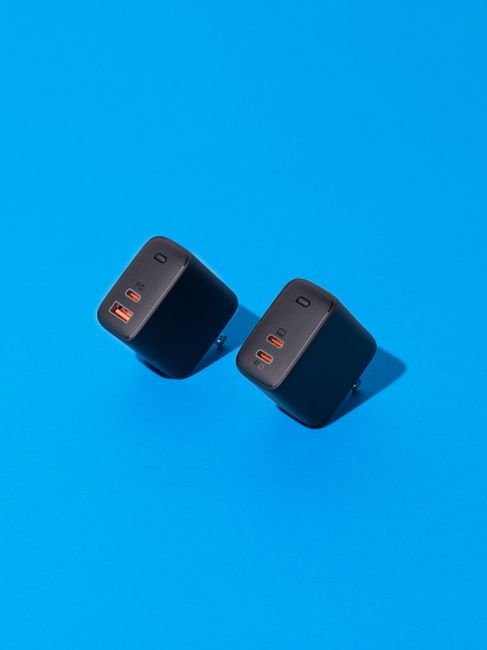

Thermal protection is a control system, not a badge
Temperature sensing
A credible charger monitors a meaningful internal location—typically near the primary switch, transformer, or output stage—not merely the plastic shell.
Derating
As temperature rises, the controller reduces available output or alters operating conditions to limit further heating. A brief wattage drop under sustained load can be intentional protection, not necessarily a fault.
Thermal shutdown
If derating cannot contain the rise, output should stop until the unit cools. The useful evidence is defined behavior in documentation, not an unexplained “over-temperature protection” claim.
Independent evidence
Safety certification markings traceable to the relevant testing body, a model-specific datasheet, and stated operating limits carry more weight than marketplace badges. This is especially relevant for thermal protection in GaN pocket chargers.
Look for a manual or technical sheet that identifies the exact model, input range, output profiles, ambient-temperature limit, and protection functions. A listing that only says “smart chip” or “multi-protection” does not establish where temperature is sensed, whether output derates, or whether shutdown occurs.
Certification evidence is strongest when the mark, issuer, and model can be matched—not when a logo appears only in product images.
Buy for the device’s real charging profile
A phone rarely gains anything from a 65 W charger if it accepts only 18–27 W. Many tablets sit around 30–45 W; USB-C laptops commonly need 45–100 W or more.
USB Power Delivery is a negotiation: charger and device select a shared voltage/current profile. A 100 W label matters less than whether its PDO list includes the voltage and current the laptop requests.
Maximum output can be available only briefly or on one port. With two devices attached, many compact chargers redistribute power, sometimes leaving the laptop below its normal operating requirement.
PPS allows fine voltage adjustment and can support faster, cooler charging on compatible phones. It is not a universal safety upgrade and usually does not determine laptop charging capability.
An oversized charger can run lightly loaded, but its safety value still depends on the same internal sensing, derating, and shutdown design. For a single phone, a well-documented 30 W–45 W PD model may be a more proportionate fit than a poorly specified high-wattage brick.
Read the label before trusting the wattage
-
Confirm the input range
Look for a mains input such as 100–240 V, 50/60 Hz and a credible current rating. This identifies broad-voltage travel compatibility; it does not prove safety on its own.
-
Decode each USB-C output
A credible label lists USB Power Delivery voltage/current pairs—for example 5 V, 9 V, 15 V, and 20 V—or explicitly states PPS ranges. “USB-C 65 W” without profiles leaves too much unknown.
-
Find the combined-port table
For multiport units, check the split-output diagram or manual. A charger may supply its headline total only with one port occupied, then divide power sharply when a second device connects.
-
Match the maker and model exactly
Record the manufacturer’s legal name, full model number, and support address. Search documentation using that model, not a retailer’s shortened listing title; similar-looking revisions can have different ratings.
-
Treat marks as traceable evidence
Look for applicable safety marks and an identification file, listing number, or certifier database entry where available. A printed CE-style symbol alone is a declaration, not independent proof of testing.
Label data establishes what to investigate; it cannot reveal build quality or thermal behavior by itself.
Avoid treating “PD compatible,” “smart chip,” or a large wattage figure as substitutes for electrical ratings. Missing output profiles, no shared-power specification, an unsearchable model number, or a manufacturer that cannot supply a manual makes thermal and certification claims difficult to verify.
A legitimate charger can still have a compact label, but the missing details should be available in its model-specific documentation.
Small chargers have less room for heat
A pocket charger must move heat from switching components to its outer shell and then into surrounding air. A smaller enclosure has less surface area and less internal spacing, so watt density—watts delivered per unit of volume—matters more than the headline output alone.
Two chargers rated for the same power can vary in performance, so a safe pocket USB-C charger helps avoid surprises.
GaN transistors can switch more efficiently than conventional silicon, reducing some conversion losses and enabling compact designs. This is an efficiency advantage, not proof of cooler operation or robust protection. A GaN charger used as a safe pocket USB-C charger can still get hot when supplying sustained power.
Details that change thermal behavior
- Port count: Each active port adds conversion and control losses; shared-output use can create a harder sustained thermal load than one-device testing suggests.
- AC prongs: Foldable prongs save pocket space but consume internal volume and can constrain component layout. Firm prongs and a solid hinge also reduce mechanical wear at the wall outlet.
- Housing and assembly: Flame-retardant materials, secure port mounting, adequate internal insulation, and well-designed heat paths matter more than a glossy finish. Noticeable seam gaps, loose ports, rattling parts, or a charger that rocks in the outlet are practical warning signs.
Compactness is a trade-off, not a defect. For repeated high-power or multi-device sessions, a slightly larger model often has more thermal headroom.
A thermal cutoff is only one layer
Temperature sensing is valuable, but it needs over-current, over-voltage, short-circuit, and input-surge protection around it.
A failing switch transistor, capacitor, cable, or connected device can create an electrical fault before internal temperature reaches a shutdown threshold.
PD negotiates voltage and current; it does not verify transformer insulation, PCB clearances, component ratings, or solder quality.
A charger can advertise legitimate 5 V, 9 V, or 20 V PDOs yet have weak isolation or poorly engineered protection circuitry.
Protection must detect faults quickly and fail predictably; credible safety testing and a traceable maker provide stronger evidence than feature lists.
Robust designs coordinate sensing, control firmware, fuse behavior, isolation, and adequate spacing between high-voltage circuits.
USB-C PD is a communications standard, not a construction standard. It can request a lower power level after a fault response, but it cannot repair inadequate insulation, undersized magnetic components, or a missing input fuse.
A credible compact charger combines protocol control with physical safeguards: reinforced isolation, suitable creepage and clearance distances, correctly rated capacitors, and independent fault protection.
A pocket charger can operate normally while the cable or connector becomes the limiting part. A USB-C cable rated for 3 A may cap a 20 V connection near 60 W. Higher-power use generally needs a 5 A, e-marked cable. The charger may then negotiate a lower profile, so slower charging is not automatically a thermal fault.
Connector condition matters as much as the printed rating. Bent shells, looseness, contamination, or a cable that runs hot near either plug add resistance. That resistance turns power into heat at a very small contact area. Additionally, a connector that is distinctly hotter than the charger smells unusual. If it causes repeated connect/disconnect behavior, take that cable out of service.
When a second device changes the result
On a multiport model, the labeled total output is a shared budget with a port-priority rule. Additionally, adding a phone can make a laptop briefly pause, renegotiate to lower wattage, or charge more slowly. Check the port-sharing table, then test with the same cable and device load using a safe pocket USB-C charger.
- Expected: a one-time renegotiation and stable, reduced speed.
- Concerning: cycling, intermittent charging, or concentrated plug heat.
Additionally, warmth after adding a device is meaningful only alongside stable charging and the charger’s documented sharing limits.
Anker Nano 30W: A Modest Single-Port Phone Charger
Anker Nano 30W: ActiveShield 2.0 in Practice
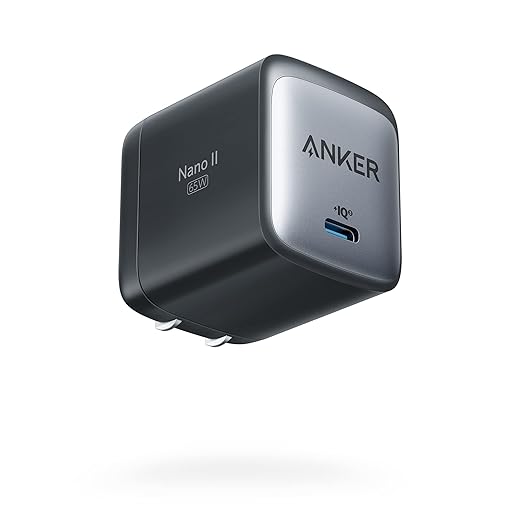
Anker Nano II 65W: Compact Headroom for One Device
Travel light, charge one device at a time
At 65W, the foldable Nano II 715 has useful headroom for a phone, tablet, or many USB-C notebooks, without packing a separate brick for each. Its GaN II stacked construction and small format make it a plausible carry-on companion—but it remains one USB-C port, not a simultaneous phone-and-tablet solution.
That compact enclosure is the trade-off. Sustained laptop charging can make a 65W single-port charger noticeably warm, particularly in a crowded outlet or poorly ventilated bedside setup. The supplied product details describe GaN II and PPS support, but do not specifically document a temperature-monitoring system for this model; the model label and current manufacturer documentation merit checking before purchase.
Anker 317: Full-Power Charging in a Pocketable Body
For occasional full-power laptop sessions
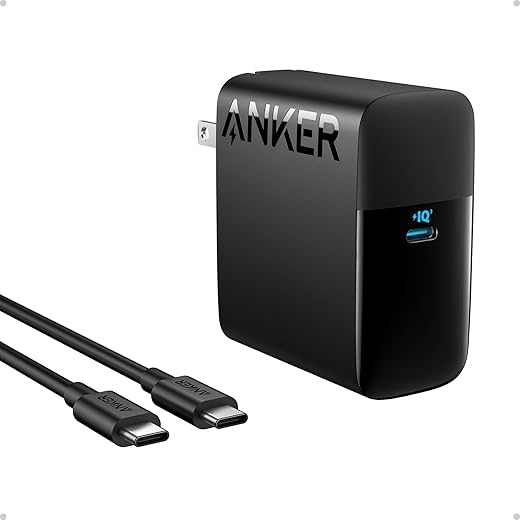
The Anker 317 is the higher-output choice when a laptop occasionally needs close to its full USB-C PD allowance. Its single port can deliver up to 100W, and the included 5-foot USB-C cable is a practical advantage—provided that cable is used only where its rating suits the laptop’s negotiated load.
More power in a pocketable body means less thermal margin during long, heavy charging sessions. Anker describes ActiveShield as providing 24/7 temperature monitoring, which is more meaningful than a generic safety claim, but it does not eliminate heat: free air around the charger, a firm outlet connection, and avoiding strain on the cable still matter. For phones and tablets alone, this capacity is usually unnecessary.
Choose documented models, not a universal winner
A credible shortlist may contain only a few models—and that is more useful than filling it with unverified alternatives.

-
Give the charger open air
Use a hard, uncovered surface where heat can dissipate. Bedding, clothing, sofa cushions, bags, and tightly packed power strips trap heat around an already compact enclosure.
-
Keep the cable and plug ends in good condition
Use a cable rated for the intended current, with clean, firm-fitting USB-C ends. Retire cables with split jackets, bent connectors, looseness, discoloration, or a plug that becomes unusually hot.
-
Check the wall connection
The AC plug should sit securely in a sound outlet. A loose outlet, crackling, intermittent power, scorch marks, or a warming receptacle points to a connection problem beyond the charger itself.
-
Treat repeatable heat as evidence
Some warmth at high output is expected; compare behavior at the same device load and ambient temperature. Repeated shutdowns, sharp output drops, or excessive case heat during ordinary charging merit investigation rather than explanation.
-
Stop using a suspect unit
Disconnect a charger that smells of hot plastic, buzzes, swells, changes color, sparks, or remains excessively hot after the load is removed. Inspect the cable and outlet before attributing the fault to one part.
Safe Pocket USB-C Chargers: Common Questions
Is it normal for a small USB-C charger to feel warm during use?
Yes, to a point. Conversion losses rise under load, and a small enclosure has little surface area to shed heat. Persistent overheating, a hot plug or cable end, discoloration, odor, or intermittent charging is different and can indicate a compromised charger, cable, or outlet.
Does GaN make a charger run cooler than a traditional silicon charger?
GaN transistors switch more efficiently, which reduces some conversion losses and enables a smaller size, but that’s an efficiency advantage, not proof of cooler operation. A tightly packed GaN charger can still run hot under sustained power, especially with multiple ports active.
What does thermal protection in a charger actually do?
A credible design senses temperature at a meaningful internal location, reduces output as heat rises (derating), and stops output entirely if the temperature keeps climbing (thermal shutdown). A vague “smart chip” or “multi-protection” label without documented behavior says very little on its own.
Does USB-C Power Delivery certification guarantee a charger is electrically safe?
No. PD is a negotiation protocol for voltage and current between charger and device; it doesn’t verify transformer insulation, PCB clearances, component ratings, or solder quality. Electrical safety depends on separate certification evidence and build quality.
Why might a laptop charge more slowly when a phone is also plugged into the same charger?
On a multiport charger, the labeled total output is a shared budget. Adding a second device can make the first one renegotiate to a lower wattage, which is expected behavior, not necessarily a fault, as long as charging stays stable rather than cycling on and off.
Safe Use Is Part of the Purchase
- A charger’s thermal behavior must be judged with its cable, outlet, load, and surroundings—not in isolation.
- Repeatable protective shutdowns are a warning pattern, even when no visible damage is present.
A well-documented pocket charger can still be undermined by a damaged cable, a loose outlet, or heat trapped under soft materials. Adding these checks to an everyday carry technology accessories checklist helps keep ordinary charging predictable.
Protective shutdown is preferable to continued overheating, but it is not a reason to accept a recurring fault. At normal loads, repeated cutoffs or pronounced heat call for stopping use and isolating the cause.
Anker Nano Phone Charger, 30W Portble and Foldable USB C GaN Charger | For iPhone 17/17 Plus/17 Pro Max/16/16 Plus/16 Pro Max/15 Pro Max, Galaxy, iPad, and...
Features
| Connector Type | USB Type C |
| Compatible Devices | MacBook Air 2020 / ThinkPad X1 / X390 / E490/ Google Pixelbook / Dell XPS 13 9360 / 9380 / iPad Air 5 / 4 / iPad Pro 2021 / 2020 / 2018 |
| Compatible Phone Models | iPhone16 / 16 Pro / 16 Pro Max / 16 Plus / 15 / 15 Plus / 15 Pro / 15 Pro Max / 14 / 14 Pro / 14 Pro Max / 13 mini / 13 / 13 Pro / 13 Pro Max / SE (2nd Gen) / 12/ 12 Pro / 12 Pro Max / Samsung S22 / S21 / S20/ Samsung Note 20 / 20 Ultra / 10+ / 10 / AirPods Pro / 3 /Nintendo Switch / MacBook Air 2020 / ThinkPad X1 / X390 / E490/ Google Pixelbook / Dell XPS 13 9360 / 9380 / iPad Air 5 / 4 / iPad Pro 2021 / 2020 / 2018 |
| Special Features | Fast Charging |
| Input Voltage | 240 volts |
| Amperage | 3 A |
| Total Usb Ports | 1 |
| Wattage | 30 watts |
| Output Current | 3 A |
| Output Voltage | 5 volts |
| Power Source | Corded Electric |
| Main Power Connector Type | 2 Pin |
| Number of Power Levels | 1 |
| Power Plug | Type A - 2 pin (North American) |
| Compatible Cellular Phone Models | Apple iPhone 16 |
| Connectivity Technology | USB |
| Color | Phantom Black |
| Enclosure Material | Plastic |
| Brand | Anker |
| Built-In Media | Anker 511 Charger,welcome guide, Warranty Card |
| Model Number | A2147 |
| Customer Package Type | FFP |
| Mfr Part Number | A2147 |
| Manufacturer | Anker |
| UPC | 194644102838 |
| Warranty Description | 18-month |
| ASIN | B0B2MLRF93 |
| Number of Items | 1 |
| Item Weight | 1.6 ounces |
| Unit Count | 1 Count |
- Small Yet Powerful: By swapping out silicon for Gallium Nitride (GaN) we've been able to fit 30W of power into a charger that's just 1.12 inches thick, and 70% smaller than an original 30W charger.
- Nano Now Charges Everything: Upgraded with a 30W output so now you can charge your earbuds, phone, tablet, and even your MacBook Air with a tiny charger.
- High-Speed Charging: Deliver full-speed 30W charging for iPhone 15 Pro and Pro Max, or power up your iPad Air (5th Generation) to 50% in just 45 minutes. Also supports Samsung Super Fast Charging (25W).
- Upgraded Protection with ActiveShield 2.0: Anker's proprietary technology safeguards your devices by intelligently monitoring temperature over 3 million times per day—that's twice as often as ActiveShield 1.0.
- What You Get: Anker 511 Charger (Nano 3, 30W), welcome guide, our worry-free 24-month warranty, and friendly customer service (cable not included).
Anker Nano USB C Charger,65W GaN II PPS Fast Compact Foldable Charger for MacBook Pro, Galaxy, Dell, iPhone 17/16, iPad Pro, and More | For iPhone 17/17...
Features
| Connector Type | USB Type C |
| Compatible Devices | iPhone 15 / 15 Pro / 14 / 14 Plus / 14 Pro / 14 Pro Max / 13 mini / 13 / 13 Pro / 13 Pro Max / 12 mini / 12 / 12 Pro / 12 Pro Max / SE (2nd Gen) |
| Compatible Phone Models | Galaxy S8 and later, IPad / iPad mini / AirPods / Apple Watch, iPhone 13 / 13 Mini / 13 Pro / 13 Pro Max / 12 / 12 mini / 12 Pro / 12 Pro Max / iPhone SE (2nd generation) /11 / 11 Pro / 11 Pro Max / XS / XS Max / XR / X / 8 Plus / 8; Magsafe Wireless Charger |
| Special Features | Fast Charging |
| Input Voltage | 240 volts |
| Amperage | 16 A |
| Total Usb Ports | 1 |
| Wattage | 65 watts |
| Output Current | 3 A |
| Output Voltage | 5 volts |
| Power Source | Corded Electric |
| Current Rating | 3.25 A |
| Frequency Range | 50-60 Hz |
| Main Power Connector Type | 2 Pin |
| Number of Power Levels | 1 |
| Power Plug | Type A - 2 pin (North American) |
| Compatible Cellular Phone Models | Apple iPhone 15 |
| Voltage | 12 volts |
| Current | DC |
| Compatible Power Plug Type | Type A - 2 pin (North American) |
| Wired Charging Connector Type | USB Type C |
| Connectivity Technology | USB |
| Mounting Type | Wall Mount |
| Brand | Anker |
| Built-In Media | Cable |
| Model Number | A2663 |
| Customer Package Type | FFP |
| Mfr Part Number | A2663 |
| Manufacturer | Anker |
| UPC | 194644065263 194644068523 |
| External Testing Certification | Não Aplicável |
| Warranty Description | 18-month |
| ASIN | B08T5QN2TR |
| Number of Items | 1 |
| Unit Count | 1 Count |
| Color | black |
| Enclosure Material | Plastic |
| Form Factor | Compact foldable USB-C charger |
| Specification Met | USB Power Delivery, Anker brand reputation |
- The Only Charger You Need: Say goodbye to your old power bricks. Anker 715 Charger (Nano II 65W) has the power you need to fast charge your phone, tablet, and USB-C notebook from a single tiny charger.
- High-Speed Charging: Charge a 2020 MacBook Air in less than 2 hours, a MacBook Pro 13ʺ at full speed, an iPhone 13 up to 3× faster than with an original 5W charger, and charge the latest Samsung phones at full speed with Samsung Super Fast Charging.
- Downsized Design: At 58% smaller than an original 61W USB-C charger, and with a foldable plug, Anker Nano II takes up less space while giving you just as much power.
- Powered by GaN II Technology: With a 100% increase in operating frequency, an innovative stacked design, and an upgraded circuit board structure, GaN II technology makes our latest charger smaller without sacrificing a drop of power.
- What You Get: Anker 715 Charger (Nano II 65W) / Anker Nano II 65W, welcome guide, our worry-free 18-month warranty, and friendly customer service (cable not included).
Anker Laptop Charger, Compact Foldable 100W USB C Charger with 5FT Cable | High-Speed for MacBook Pro/Air, Samsung Galaxy, iPhone 17/16, iPad Pro, and More
Features
| Connector Type | USB Type C |
| Compatible Devices | Laptops: MacBook Air; MacBook Pro; MacBook; HP Spectre x360 (2019) / Spectre Folio / Chromebook 14; ThinkPad X1 / X390 / E490; Samsung NoteBook 9 / Chromebook 4; Dell XPS 13 9360 / XPS 13 9380; Huawei MateBook 13 / X / X Pro / 14 (2021); Lenovo Chromebook Duet 10.1" / Microsoft Surface Book 2 / Google Pixelbook / ASUS Chromebook Detachable CM3 and more USB C devices;, Others: DJI Mavic 3 / Steam Deck / Nintendo Switch Lite / Nintendo Switch OLED / AirPods / AirPods Pro / AirPods (3rd Gen) / Apple Watch Ultra / Apple Watch S7 / Samsung Watch5 Pro / ASUS ROG Ally;, Phones: Samsung Galaxy S22 / S22 Ultra / S21 Ultra / S20 / Z Flip4 / Z Fold4 / Note 20 Ultra Google Pixel 6 / 6 Pro / 7 / 7 Pro Sony Xperia 1 lV / OPPO Find X5 Pro / vivo X80 Pro / Huawei P40 / Mi 11 iPhone 14 Pro Max / 14 Pro / 14 Plus / 14 / 13 Pro Max / 13 Pro / 13 / 13 mini / 12 mini / 12 / SE (2nd Gen) / SE (3rd Gen) - USB-C to Lightning cable not included., Tablets: Samsung Galaxy Tab S7 FE / S8 Ultra; iPad Pro 12.9" (M2, 2022) / 12.9" (2021) / 12.9" (2020) |
| Compatible Phone Models | Samsung Galaxy S22 / S22 Ultra / S21 Ultra / S20 / Z Flip4 / Z Fold4 / Note 20 Ultra; Google Pixel 6 / 6 Pro / 7 / 7 Pro; Sony Xperia 1 lV / OPPO Find X5 Pro / vivo X80 Pro / Huawei P40 / Mi 11; iPhone 16 / 16 Pro / 15 / 15 Pro / 14 Pro Max / 14 Pro / 14 Plus / 14 / 13 Pro Max / 13 Pro / 13 / 13 mini / 12 mini / 12 / SE (2nd Gen) / SE (3rd Gen) and more USB C devices |
| Special Features | Fast Charging |
| Input Voltage | 240 volts |
| Amperage | 5 A |
| Total Usb Ports | 1 |
| Wattage | 100 watts |
| Output Current | 5 A |
| Output Voltage | 20 volts |
| Power Source | Corded Electric |
| Main Power Connector Type | 2 Pin |
| Number of Power Levels | 1 |
| Power Plug | Type A - 2 pin (North American) |
| Compatible Cellular Phone Models | Apple iPhone 14 |
| Current | DC |
| Compatible Power Plug Type | Type A - 2 pin (North American) |
| Wired Charging Connector Type | USB Type C |
| Connectivity Technology | USB |
| Mounting Type | Wall Mount |
| Specification Met | UL |
| Brand | Anker |
| Built-In Media | Anker 317 Charger (100W), 5ft / 1.5 m USB C to USB C cable, welcome guide, our worry-free 18-month warranty, and friendly customer service. |
| Model Number | A2672 |
| Customer Package Type | Standard Packaging |
| Mfr Part Number | A2672 |
| Manufacturer | Anker |
| UPC | 194644133009 |
| Warranty Description | 18-month |
| ASIN | B0C1FZWT8M |
| Number of Items | 1 |
| Item Weight | 10.56 ounces |
| Unit Count | 1 Count |
| Color | Black |
| Enclosure Material | Plastic |
| Form Factor | compact and portable with a foldable plug |
- High-Speed Charging: The 100W USB C port pumps out enough power to charge a wide range of devices in record time. Charge your MacBook Pro 16" (M1 Max, 2021) to 100% in 1 hour and 20 minutes, so you can stay productive all day.
- Wide Compatibility: From phones to laptops and more, our proprietary PowerIQ 3.0 technology provides flawless compatibility with virtually any mobile device.
- Foldable and Portable: The charger's compact size and foldable plug make it easy to take wherever you go, while saving valuable space in your bag or pocket.
- Safer Charging Experience: Our exclusive ActiveShield safety technology provides 24/7 temperature monitoring to ensure safety for you and your connected devices.
- What You Get: Anker 317 Charger (100W), 5ft / 1.5m USB C to USB C cable (placed behind the plastic tray compartment), welcome guide, our worry-free 18-month warranty, and friendly customer service.

9 Comments
Can you clarify the shared-port issue? I have a dual USB-C charger marked 65W, but when I charge my laptop and phone together the laptop sometimes says “slow charger.” Does that mean the charger is faulty, or just that the 65W is a total budget split across both ports?
The included 5-foot cable with the 100W option is nice, but what should the cable label actually say? I see 100W, 240W, 5A, and e-marked thrown around, and product pages are spectacularly bad at explaining whether the cable is included in the certification or merely has vibes. 😅
For USB-C PD above 60W, look for a 5A e-marked cable from an identifiable maker; a 100W-rated cable is appropriate for a 100W charger and device combination. A 240W cable is also fine, but it does not make a device charge faster unless both the charger and device support the relevant higher-power profile. The cable should have its own stated rating—do not assume the charger’s safety documentation automatically covers an included cable.
For PPS: if my Android phone supports it, should I prioritize a charger with PPS even if the plain PD charger has the same 30W rating? I’m trying to avoid buying features I won’t notice, but battery heat is the part that worries me most.
Really useful distinction between a charger feeling warm and it actually being unsafe. For a 30W phone charger, is it normal for the plug end to get warmer than the phone itself?
My little 45W charger gets quite hot when it’s behind the couch, but only mildly warm on a table. I assumed it was dying, though maybe it just has no airflow back there.
Still, I wish manufacturers published actual derating temperatures instead of making us play charger roulette. “Over-temperature protection” without details is basically a motivational poster.
I keep seeing “GaN = safer/cooler” in listings, which always sounded a little too convenient. Glad you called out that it’s not a safety certification.
If a listing has a UL-looking logo but no actual model number or certificate reference, would you just skip it?
Yes—I would treat that as a reason to move on, especially when the seller cannot tie the mark to the exact charger model. A legitimate mark should be traceable through the certifier’s database or supported by clear, model-specific documentation. GaN can help efficiency, but the protection design and verified construction are what matter.
Same rule I use now. I got burned by a marketplace “65W GaN” brick that had a very official-looking pile of icons and zero identifiable manufacturer info. It charged, but it also got alarmingly hot.