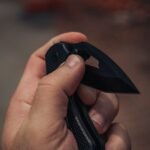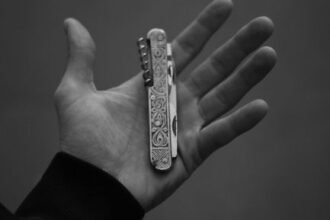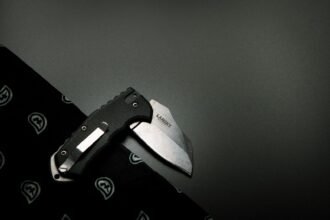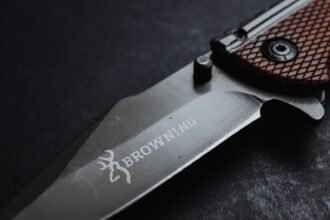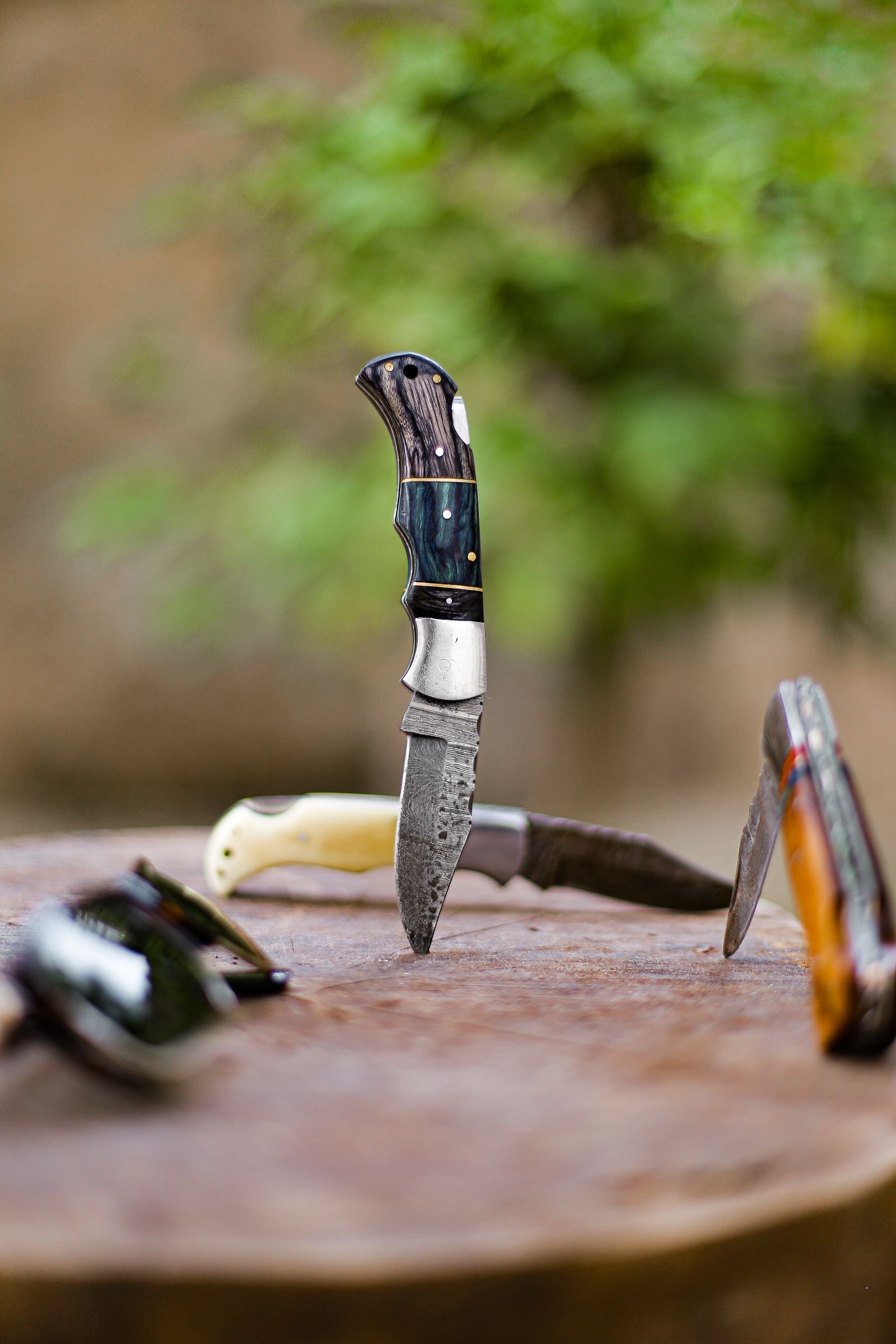
A familiar one-handed opener can feel completely different through insulated fingers.
On a cold jobsite, a thumb that normally catches the stud may slide past it, press weakly, or push the handle toward an exposed edge. That sudden loss of control matters: protective gloves reduce tactile feedback while adding bulk between the hand and a small opening control.
Thin work gloves may preserve enough dexterity for a conventional thumb stud. Heavy winter, welding, or cut-resistant gloves often demand a larger target, more clearance around it, and a motion that does not rely on fingernails or a precise fingertip angle. The practical tradeoff is straightforward: greater hand protection can mean less reliable knife access. Opener choice should therefore match the gloves actually worn—not bare-hand familiarity at a display counter.
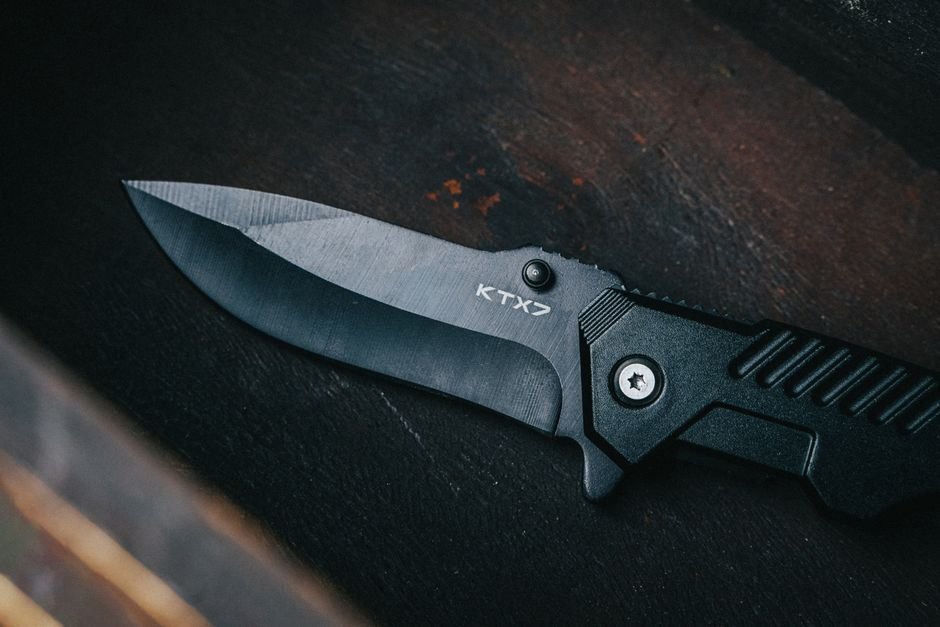
The glove matters as much as the opener
A knife labeled “easy to open” may still be awkward with a particular glove. Finger length, dominant hand, grip strength, and reduced tactile feedback all affect whether the control can be reached without shifting into an unstable hold.
Compare common glove types
Thin mechanic gloves usually preserve more dexterity, making thumb studs and larger nail-free controls plausible. Reinforced fingertips can still slide over a small stud or prevent the thumb from getting behind it.
Insulated winter gloves add thickness and often resist bending at the knuckles. A broad opening hole, pronounced flipper tab, or other large control may be easier to locate than low-profile hardware.
Bulky work gloves can combine stiff leather, seams, padding, and wide fingertips. Wetness may further reduce traction or make fabric cling, complicating both opening and one-handed multitool access.
Test the real combination
Before relying on a knife, check it with the exact glove pair:
- Confirm the closed knife can be held securely.
- Reach the opener without placing fingers in the blade path.
- Open it with both dominant and non-dominant hands.
- Repeat after the gloves become damp, if that condition is expected.
If opening requires grip changes, excessive force, or fingertip probing, a larger control—or two-handed opening—may be the safer choice.
Check Access and Control Before Opener Type
- Enough contact area and clearance
A gloved thumb or finger should reach the control without precise fingertip placement. Check that studs, holes, or flippers remain exposed above the handle and provide room for thick material.
Look forA broad, unobstructed contact surface with space for the glove to engage.AvoidRecessed controls, narrow studs, or openings that only accept a bare fingertip. - Traction and handle purchase
Opening force matters less if the handle twists or slips. Texture, contour, and sufficient handle exposure should support a stable grip before the blade starts moving.
Look forPositive traction and enough handle area to brace the knife securely.AvoidSlick scales, sharp pressure points, or a grip that shifts during opening. - Access from either side
Pocket position, clip orientation, and glove bulk can obstruct both the draw and the opener. Confirm clearance around the pocket hem and practical access with either hand when ambidextrous use matters.
Look forA reachable control and clean draw from the intended carry position.AvoidClip or seam interference that forces grip changes near the opening blade. - Safe lock operation and closing
Evaluate lock control after one-handed opening, not just deployment. The handle should stay secure while the lock is released, with fingers kept outside the blade’s closing path.
Look forA lock that remains accessible through gloves and permits controlled closure.AvoidClosing motions that place fingertips beneath the blade or require an unstable grip.
Ratings compare control size, required fingertip precision, and dependence on tactile feedback. They are qualitative, not results from one standardized glove test.
-
Source basis
Mechanism details follow manufacturer documentation from Spyderco, Kershaw, Benchmade, and Emerson.
-
Rating context
Thin gloves mean fitted work gloves; bulky gloves mean insulated winter or heavy-duty models.
Handle shape, lock access, hand size, and glove material can change the result.
How common openers compare
| Opener | Thin gloves | Bulky gloves | Practical limitation |
|---|---|---|---|
| Thumb hole | Strong | Strong | A large opening offers a broad target, though thick fingertips may not enter smaller holes. Spyderco describes its Round Hole as usable for one-handed opening. |
| Flipper tab | Strong | Fair–strong | Easy to sweep with an index finger, but a short or flush tab can disappear under thick insulation. |
| Thumb stud or disc | Strong | Fair | Raised controls help, but small studs demand accurate thumb placement. Broad discs are usually easier to locate. |
| Front flipper | Fair | Poor–fair | Relies on friction and precise thumb or index-finger movement along the knife’s front edge. |
| Nail nick | Poor | Poor | Designed for fingernail purchase and generally unsuitable when gloves block that access. |
| Assisted opening | Strong | Fair | Kershaw’s SpeedSafe system assists only after the blade is started; the initial stud or flipper still has to be engaged. |
| Automatic button | Strong | Fair–strong | Benchmade documentation shows push-button deployment, but recessed buttons may be hard to feel. Check local law and prevent unintended activation. |
| Opening hook | Strong | Strong | Emerson’s Wave feature is designed to catch the pocket edge during the draw. It is fast but depends on pocket geometry and deliberate technique. |
For bulky gloves, a large thumb hole, prominent flipper, or pocket-opening hook is generally the safer shortlist. Controls should still be tested slowly with an unloaded pocket area and the blade directed away from the body.
Why a large thumb hole can be forgiving
A generously sized thumb hole gives a gloved hand a broad target rather than requiring a fingertip to land on a small stud or narrow tab. The thumb can press against the rim or enter the opening, and the same interface is generally available from either side. That does not automatically make the entire knife ambidextrous; the lock, clip, and handle shape may still favor one hand.
Several details can cancel that advantage:
- Partial obstruction: Handle scales or liners may cover enough of the hole to prevent thick gloves from engaging it.
- Sharp or thin edges: An abrupt rim can catch glove material or concentrate pressure instead of providing secure purchase.
- A stiff detent: Extra breakaway force may cause the thumb to slip before the blade starts moving.
- Poor handle traction: Opening leverage matters little if the other fingers cannot stabilize the closed knife.
Product examples should be named only when manufacturer documentation or clear closed-knife images confirm the hole’s size, exposure, and access from both sides. Detent effort and traction are rarely conveyed by dimensions alone, so credible independent evaluations—or a careful check with the intended gloves—remain important.
What Actually Makes a Flipper Glove-Friendly
A prominent rear tab with space behind it usually requires less fingertip precision than a low-profile tab or front flipper. The distinction matters when comparing flippers and thumb studs for gloved use.
A raised rear tab gives the glove a larger target and allows a sweeping press. Front flippers often depend on accurate fingertip placement and controlled traction along the knife’s spine.
Bearings may reduce pivot friction, but they cannot compensate for an overly strong detent or poor leverage.
The blade must first break free from the closed position. A stiff detent can demand more pressure than an insulated finger can apply securely, even when the blade moves smoothly afterward.
Clearance around the guard and reliable handle traction are equally important.
A glove must reach the tab without catching on nearby scales or guards, while the remaining fingers maintain a stable grip. Smooth handles, wet gloves, or cramped geometry can undermine an otherwise generous tab.
Studs, discs, and powered opening
Oversized thumb studs and opening discs can remain workable through thin gloves, especially when deeply textured and positioned clear of the handle scale. Small, smooth, or handle-hugging controls require precise fingertip placement; insulation reduces both reach and feedback, increasing the chance of a slip.
Assisted versus button deployment
An assisted-opening knife still requires deliberate blade movement—usually through a stud or flipper—before its spring mechanism takes over. A glove must therefore engage the initial control reliably. Lint, grit, and thick lubricant can affect movement, so maintenance should follow the manufacturer’s instructions.
A button-deployed blade may require less thumb travel, but the button’s design matters:
- Raised buttons are easier to locate but may be more vulnerable to unintended pressure.
- Recessed or guarded buttons reduce exposure, though thick gloves can make them difficult to press fully.
- A safety or secondary lock can help prevent accidental activation, provided it remains operable while gloved.
Closing deserves equal attention. Assisted blades generally must be folded against spring pressure, while button locks require the release to be held as the blade begins closing. Fingers should remain outside the blade path throughout.
Finally, check which hand can reach the stud, button, lock, and safety. A reversible pocket clip changes carry orientation—not control placement. Those needing opposite-side access should consider left-handed knives with suitably positioned openers, rather than relying on clip reversibility alone.
Precision controls and specialized openers
Nail nicks, subtle front flippers, recessed buttons, and small thumb studs are not inherently poor designs. They are precision-dependent: thick insulation, wet fabric, or reduced fingertip feedback can turn a manageable control into an unreliable one. If one is preferred, it should be evaluated while wearing the exact gloves used in the field.
Opening hooks use a different approach. A hook catches the pocket seam and rotates the blade open as the knife is drawn. This can bypass fine fingertip work, but success depends on pocket position, draw angle, clip orientation, and an unobstructed blade path. A poorly controlled draw may cause incomplete opening or unintended contact with nearby objects.
Assisted-opening and automatic knives also require a legal check. Definitions and carry restrictions vary by jurisdiction; the American Knife & Tool Institute’s state law resources provide a useful starting point, but local rules should be confirmed before purchase or carry.
Begin with slow, deliberate repetitions in a clear area, ideally using a compatible trainer. Keep fingers and clothing outside the blade path. After every opening, visually and physically confirm full lock engagement rather than relying only on an audible click.
Run a Safe, Repeatable Opening Test
-
Use the actual gloves
Test each candidate with the gloves normally worn, not a thinner substitute. Apply the same check to options from a budget pocket knife buying guide.
-
Establish a dry baseline
With permission in a store—or within the return policy—open and close the knife five times. Keep the blade path clear and use the intended hand.
-
Repeat with damp gloves
Lightly dampen the glove, not the knife, then repeat over a stable surface. Stop if the handle shifts or the opening control becomes unreliable.
-
Check the complete cycle
Confirm safe pocket access, opening, lock release, and closing. Test the non-dominant hand only if ambidextrous operation matters.
-
Reject inconsistent controls
Pass on a knife if the control is missed repeatedly, fingers enter the blade path, the grip slips, or the lock cannot be released predictably.
Follow retailer handling rules and keep moisture away from the pivot and blade.
- Record failures by glove type rather than assuming practice will solve them.
- Confirm local carry and automatic-knife restrictions before purchase.
Large thumb holes and prominent rear flippers are strong starting points, especially with bulky gloves. Studs, discs, powered systems, and precision controls depend more heavily on glove construction, handedness, local law, and practiced technique. A knife is a poor match if repeated damp-glove operation is not controlled from draw through closing.
Glove use narrows the field considerably, which is easier to weigh alongside the other criteria in how to choose an EDC knife — opener size rarely survives contact with the rest of the requirements.