

A carry belt earns its place in the hours when the body and the waistband refuse to stay still.
At a desk, in a vehicle, after a meal, or under an added outer layer, the waistband can gain or lose just enough circumference to turn a stable holster into a pressure point. A belt that closes only at fixed one-inch holes may force a compromise: comfortable while standing, but loose when seated—or secure when seated, but overly tight later.
All-day concealed carry depends on two separate qualities. Precise adjustment keeps tension matched to changing clothing and posture; ratchet tracks excel here, often moving in small increments without unthreading the belt. Structural support resists the holster’s outward roll and downward sag, especially with a loaded firearm, spare magazine, or light. Leather can provide a quiet, traditional stiffness when properly reinforced, while nylon systems may offer greater rigidity and faster adjustment. Neither quality substitutes for the other: micro-adjustability without stiffness can let the rig tilt, while a very stiff belt with coarse sizing can create persistent hot spots.
- Holster stability is influenced by belt stiffness, buckle bulk, attachment geometry, and the weight carried—not material alone.
Choose by adjustment and load

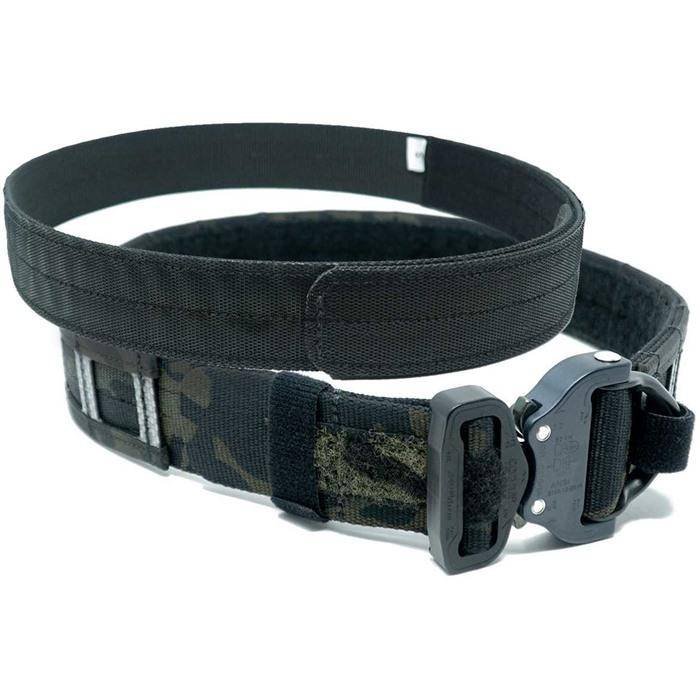

The listed belts are nylon/tactical examples: stiffness comes from layered webbing, reinforced structure, and purpose-built buckles. That makes them especially relevant when frequent adjustment or externally mounted equipment matters.
Leather is assessed here as a construction category, not as one interchangeable product. A quality leather gun belt can offer excellent vertical support and a conventional appearance, but its hole spacing, break-in behavior, edge finish, and reinforcement method determine how it compares with a ratchet system.
Ratchet and leather are not opposing belt types
Ratchet closure
A ratchet belt uses a toothed track and locking buckle, usually allowing changes in very small increments. Its practical advantage is precise tension control as seated and standing posture changes.
Leather construction
Leather identifies the strap material, not the adjustment system. A purpose-built carry belt uses a thick, dense hide or layered construction, often with an internal stiffener to resist sag and holster roll.
Fixed-hole adjustment
A conventional buckle changes fit only at spaced holes. When the ideal carry tension falls between holes, the belt may be slightly loose—allowing movement—or overly tight when seated.
The useful comparison
The meaningful choice is micro-adjustable closure versus fixed adjustment points, then the strap’s reinforcement and stiffness. A ratchet mechanism can be fitted to leather, nylon, or synthetic webbing; leather can use holes or a ratchet track.
What the belt holds in place
A loaded holster creates a levering force.
The belt’s job is to keep the holster mouth at a consistent height.
It resists the grip pulling outward and spreads the force across the waist.
This prevents concentrating force at one clip.
When this support is lacking, the holster can sag.
It can rotate, or gradually change cant as the wearer walks.
When you compare ratchet vs leather gun belt options, distribution matters.
Vertical stiffness resists the belt folding downward under the holster. It is what keeps a pistol from drooping below the surrounding waistband. Torsional resistance resists twisting along the belt’s length; it helps prevent a holster from rolling away from the body or its clips from tilting. These are related but separate qualities, and belt stiffness that remains comfortable depends on balancing both.
The useful middle ground
An overly soft leather strap or thin web belt can collapse at the holster, allowing cant migration and a shifting draw position. At the other extreme, a belt that is exceptionally rigid around its full circumference can feel like a hoop while seated, press at the abdomen when bending, and resist conforming to normal body movement.
The most effective carry belts support the loaded section while still flexing enough around the hips.
In the ratchet vs leather gun belt comparison, ratchet systems let you release or tighten a small increment after sitting.
Reinforced leather relies more on its construction and hole spacing.
Either approach works best when the belt lies flat.
The holster clips should be fully engaged, and the load must not curl the strap.
A belt can look substantial yet fail torsionally. If the holster body rolls outward or the grip angle changes through the day, strap stiffness alone is not the whole answer; clip engagement and resistance to twist matter too.
Why reinforced leather still earns a place
A well-made leather gun belt can disappear in an office setting more effectively than tactical webbing. Its smooth face, conventional buckle, and muted edges read as ordinary business-casual equipment, while a properly reinforced core keeps a holster from pulling the waistband outward. That visual restraint matters when the belt must work with tucked shirts, chinos, or dressier footwear.
It breaks in differently
Leather gradually conforms at the hips and through the belt loops. The desirable result is not a floppy strap, but a belt that retains vertical support while losing the sharp, board-like feel of new leather. This is one reason quality leather often feels more natural over long days than its initial stiffness suggests.
The trade-offs are real
Traditional holes impose coarse adjustment steps. A setting that is comfortable while standing may be slightly loose when seated, and a full stomach or changing layers can expose that gap. Leather also absorbs sweat and rain more readily than nylon; repeated moisture exposure can darken it, distort the edges, and accelerate softening.
Not every thick leather belt solves those problems. Fashion leather is often a single, pliable hide chosen for appearance, sometimes with a thin liner that adds little structural value. A true gun-belt build commonly uses:
- multiple bonded leather layers or a stiffened internal reinforcement;
- edge finishing that resists layer separation and stretching;
- a buckle attachment and hole area designed to resist elongation; and
- enough width to spread holster pressure without becoming conspicuously bulky.
That construction brings a cost in bulk: very heavy leather can print at the waistband or crowd narrow loops. The strongest office-friendly choice is therefore not simply “thick leather,” but reinforced leather with controlled stiffness and restrained dimensions.
A leather belt that becomes dramatically softer in a few weeks may also be losing the support that kept the holster stable. Gradual body conformity is desirable; rapid stretching around holes and holster positions is not.
Where ratchet belts earn their place
A ratchet belt’s chief advantage is repeatable, small tension changes. Instead of moving between widely spaced holes, the wearer can ease the belt a notch after sitting, snug it before walking, or accommodate a cover garment without resetting the entire fit. This is particularly useful when an appendix holster, spare magazine, or changing waistband thickness makes one “ideal” hole unreliable.
Adjustment is only half the system
The track must survive repeated engagement under load. A shallow, soft, or poorly bonded track can round off, skip, or develop a permanent weak area near the usual setting. On nylon ratchet designs such as the IDOGEAR Quick-Adjust Nylon Ratchet Belt, the webbing’s longitudinal stiffness and the integrity of the track insert deserve as much scrutiny as the claimed increment size.
Buckle geometry also changes concealed-carry comfort. A long or thick buckle occupies valuable front-waist real estate and can crowd an appendix holster; a release lever positioned against the body may press into the abdomen or release awkwardly when seated. A compact buckle with a deliberate, protected release is generally easier to live with than a large mechanism with finer adjustment.
Finally, inspect the body-facing edge of the webbing. Abrasive cut edges, stiff track channels, and exposed hardware can create hot spots even when the belt holds the holster securely. The best ratchet setup combines fine adjustment with a durable track, low-profile buckle, and smoothly finished inner surface.
IDOGEAR: fine tension control for utility-minded carry
Best for precise adjustments and extended wear
The IDOGEAR Quick-Adjust Nylon Ratchet Belt is the lineup’s clearest example of a carry belt built around in-use adjustment. Its nylon strap, broad 38 mm profile, and quick-release ratchet hardware target the practical problem of changing waistband tension as sitting, standing, layering, or holster load changes through the day.
This is a natural fit with jeans, cargos, workwear, range clothing, and other casual utility wardrobes. The visual language is unapologetically tactical, however: the textured nylon and prominent buckle read less at home with tucked shirts, dress trousers, or tailored jackets.
- Quarter-inch adjustment steps make tension changes unusually precise
- Stiff double-layer nylon gives substantial holster support
- Ratchet avoids the compromise of fixed hole spacing
- Utility styling pairs easily with casual and work clothing
- Buckle is bulkier and more conspicuous than a conventional leather buckle
- Hardware needs clear space beside the holster rather than directly under it
- Nylon texture and tactical buckle can conflict with tailored clothing
- Broad, rigid webbing may feel overbuilt for a light compact setup
The IDOGEAR’s ratchet track makes the adjustment advantage tangible: tension can be eased or added in small increments rather than by moving a full hole. That helps keep a holster stable without forcing one fixed setting to serve every posture.
Its buckle should be positioned away from the holster’s mounting area, since the hardware adds thickness and needs a clean section of belt to operate. For casual and utility clothing, it is a persuasive carry-focused choice; for polished office or formal wear, reinforced leather remains the quieter match.
2ND AMEN: rigid nylon support for everyday carry
Top choice for rigid everyday carry support
A conventional nylon benchmark for load-focused carry. The 2ND AMEN pairs a rigid 900D ballistic-nylon webbing with a straightforward buckle, prioritizing a stable foundation for a holster and spare-magazine load. It belongs beside ratchet belts as a simpler, heavy-duty webbing option—not as a substitute for the discreet look or gradual break-in of reinforced leather.
- Rigid 900D webbing
- Broad fit range
- Simple buckle layout
- Supports larger loads
- Less precise than ratchets
- Tactical visual profile
- May feel bulky seated
- No leather-like conformity
The 2ND AMEN is the practical reference point for conventional heavy-duty nylon: set the buckle, then let rigid webbing resist sag and holster rotation through movement. Its adjustment range accommodates day-to-day changes, though it cannot match a ratchet track’s small tension increments. Choose it for consistent support with a familiar buckle, not for leather styling or precision fit tuning.
Assaulter Belt System V3: built for a full loadout
Best for demanding operational environments
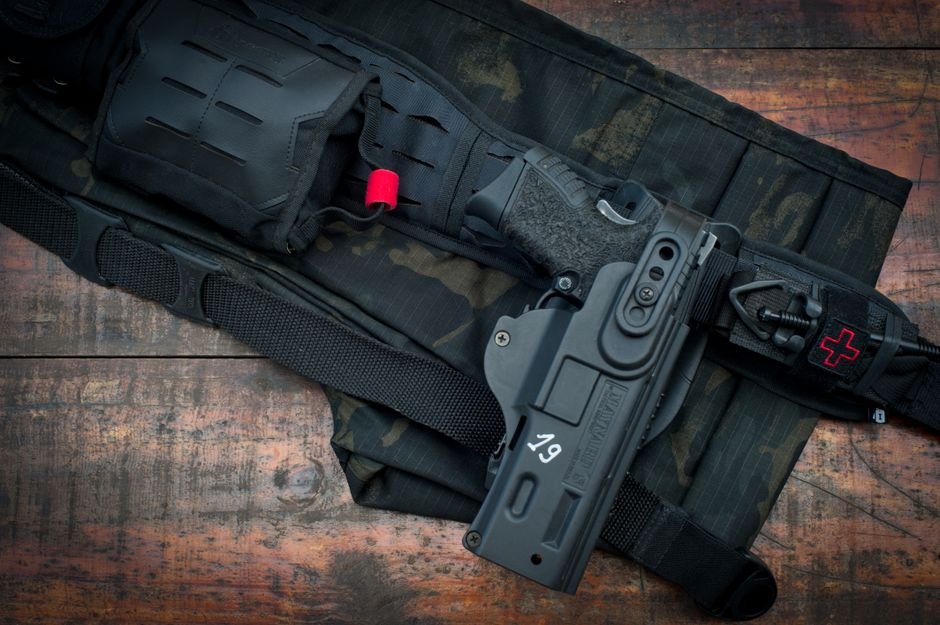
The Assaulter Belt System V3 is built around the priorities of a range or duty-style setup: a more structured platform for a holster plus spare magazines, medical pouch, or other equipment. Its tactical format suits an X-Large wearer who needs the belt to behave as equipment support rather than resemble an ordinary leather belt. “System” language also leaves room for a layered or modular setup, though any attachment compatibility should be confirmed against the specific pouch and holster hardware.
- Structured support for loaded gear
- Tactical platform suits duty-style layouts
- Potential for modular configuration
- Professional-grade orientation
- More bulk under light clothing
- Tactical appearance is conspicuous
- Can exceed everyday carry needs
- Fit and attachment details matter
Quick take This is the choice when equipment stability outweighs concealment discretion. Its advantages become less persuasive once the load falls back to a pistol and one spare magazine under everyday clothing.
For a heavier, equipment-oriented configuration, the Assaulter’s structured tactical approach can keep a loaded layout more coherent than a softer everyday belt. That same structure is the dividing line: under a cover garment, the added layers, hardware, and visual profile can be excessive for ordinary concealed carry. It makes most sense when the belt is expected to carry a system, not merely a handgun.
| Fine-tuning, active carry IDOGEAR Quick-Adjust Nylon Ratchet Belt | VS | Discreet daily wear 2ND AMEN Heavy-Duty Nylon Gun Belt |
|---|---|---|
Quarter-inch changes | Adjustment precision |
Usually hole-spaced |
High, especially rigid webbing | Support under load |
High when properly reinforced |
Easy to relax after sitting | Seated comfort |
Breaks in; holes limit relief |
Often larger, placement matters | Buckle bulk |
Usually flatter, conventional |
Best under casual layers | Concealment and wardrobe |
Best with tucked, tailored clothes |
| Compare | Compare |
For appendix carry, a ratchet’s small tension changes can be especially useful: the belt can be eased after sitting without accepting a full hole’s worth of slack. Its buckle still needs to sit clear of the holster and beltline pressure point. A large buckle can erase that advantage.
For strong-side carry, a reinforced leather belt often makes sense when the holster, cover garment, and setting call for a conventional appearance. Its gradual conformity can feel less abrupt against the body, provided the belt has enough vertical and torsional structure to prevent cant drift.
Load changes the answer. A compact handgun and slim holster leave more room to prioritize wardrobe fit. A full-size handgun, spare magazine, or additional equipment exposes weak leather, stretched holes, and flexible webbing quickly. Rigid nylon generally tolerates rain, sweat, and repeated tension changes better; leather needs drying, cleaning, and occasional conditioning to preserve its shape.
Neither style conceals automatically. Belt width, holster clips, buckle location, garment drape, and the chosen carry position can matter more than whether the strap is nylon or leather.
Carry position changes the belt priority
Appendix carry
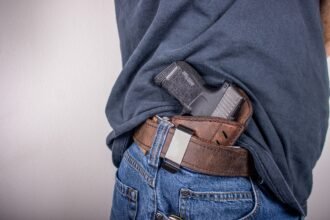
Appendix carry makes buckle geometry unusually important. A tall, thick buckle can create a concentrated pressure point when sitting, so a low-profile ratchet buckle or a buckle positioned off-center can be preferable. Immediate adjustment is valuable here: a small release after sitting can reduce belt compression without changing holster placement.
Strong-side hip
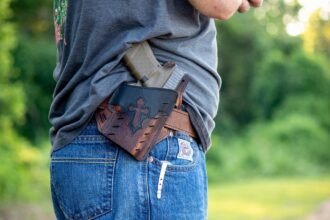
At roughly 3–4 o’clock, the central issue is often holster roll. The belt must resist twisting where the holster clips pull outward, or the grip can tip away from the body and print. A stiff nylon ratchet belt generally holds tension more consistently through the day; a well-reinforced leather belt can do the same with less tactical visual weight.
Behind the hip
Behind-the-hip carry places greater demand on belt-edge stability. The holster’s leverage can make a soft lower edge curl or let clips migrate, especially during repeated sitting and standing. A firm, smoothly finished edge helps the holster stay vertical without becoming abrasive.
Check belt, holster, and buckle clearance only with unloaded, safely handled equipment, following the applicable product instructions.
The best tension is not simply the tightest setting. It is the setting that keeps the holster from shifting while preserving workable movement in the chosen carry position.
Match the belt to the trousers
The trousers set the limit
A belt’s mechanical strength matters only if it suits the trousers worn most often. Jeans usually accept a 1.5-inch strap, larger buckle, and visible webbing; dense denim and generous loops make nylon hardware less conspicuous. That context often determines the better belt choice for jeans as much as adjustment type.
Work trousers commonly have narrower loops, lighter fabric, and more drape. A very rigid nylon strap can pull or tent the waistband, while a broad tactical buckle may look out of place. Reinforced leather with a restrained buckle generally integrates more cleanly.
Uniform trousers vary widely: duty-cut garments may accommodate tactical belts, while office-style uniforms may not. Checking actual loop width, waistband structure, and holster-clip clearance prevents a capable belt from becoming an impractical daily one.
When chinos and dress pants set the limit
Chinos
Chinos often accept a 1.25–1.5-inch belt, but their softer waistband can reveal a thick ratchet buckle or rigid webbing. A reinforced leather belt with a modest buckle generally preserves the trouser’s drape while supplying enough structure for a compact holster. Check loop clearance with the belt’s thickest section, not only the strap.
Dress pants
Dress-pant loops are commonly narrower, and close-fitting waistbands leave little room for a holster, spare magazine, and bulky closure. For many wardrobes, reinforced leather is the better match for dress pants because its restrained finish attracts less attention. Before committing, thread the belt through each trouser style, sit, and check whether the buckle lies flat without crowding the waistband.
Test the belt against an ordinary day
-
Confirm loop and buckle clearance
Thread the belt through every trouser style in regular rotation. Check whether the buckle passes the loops and can sit clear of the holster; the IDOGEAR’s ratchet buckle and the Assaulter V3’s hardware need more front-waist real estate than a restrained leather buckle.
-
Set the holster, then move
With the normal carry setup installed, sit, drive, climb stairs, bend to pick up an object, and reach overhead. Watch for belt-edge collapse, holster roll, cant drift, and pressure points rather than judging stiffness in the hand.
-
Check concealment under usual layers
Assess printing with the shirts, overshirts, jackets, and untucked knits actually worn. A rigid tactical belt can stabilize a load yet create a visible waistband ridge; reinforced leather often disappears more naturally under tailored layers.
-
Repeat the test after a meal and while seated
A ratchet’s small tension changes can relieve seated compression without leaving the holster loose. With leather holes, verify that the usable setting remains stable through normal daily waist variation.
-
Choose for the wardrobe, not a single outfit
The 2ND AMEN and Assaulter V3 suit rugged trousers and utility-oriented clothing; a slim reinforced leather belt may better cover office and social wear. A belt that works across the weekly rotation is less likely to become a drawer-only carry option.
Frequently Asked Questions
What is the main advantage of a ratchet belt for concealed carry?
A ratchet belt allows repeatable, small tension changes instead of moving between widely spaced holes. The wearer can ease the belt a notch after sitting, snug it before walking, or accommodate a cover garment without resetting the entire fit—useful when an appendix holster, spare magazine, or changing waistband thickness makes one “ideal” hole unreliable.
Why would someone still choose a reinforced leather belt over a ratchet belt?
A well-made leather gun belt can disappear in an office setting more effectively than tactical webbing. Its smooth face, conventional buckle, and muted edges read as ordinary business-casual equipment, and a properly reinforced core still keeps a holster from pulling the waistband outward—useful with tucked shirts, chinos, or dressier clothing.
Does a thick leather belt automatically mean better holster support?
No. Fashion leather is often a single, pliable hide chosen for appearance, sometimes with a thin liner that adds little structural value. A true gun-belt build needs multiple bonded leather layers or a stiffened internal reinforcement, edge finishing that resists layer separation, and a buckle attachment designed to resist elongation.
How does carry position change what a belt needs to do?
Appendix carry makes buckle geometry especially important, favoring a low-profile buckle and quick small adjustments. Strong-side hip carry is mostly about resisting holster roll, where a stiff belt holds tension consistently. Behind-the-hip carry depends more on belt-edge stability, since a soft lower edge can curl or let clips migrate during sitting and standing.
Which belt works better with chinos or dress pants?
Reinforced leather with a modest buckle generally works better here, since chino and dress-pant loops are narrower and their softer waistband can reveal a thick ratchet buckle or rigid webbing. Leather’s restrained finish preserves the trouser’s drape while still supplying enough structure for a compact holster.
What is the best way to test whether a carry belt actually fits?
Thread the belt through every trouser style in regular rotation, set up the normal carry setup, then sit, drive, climb stairs, bend, and reach overhead while watching for belt-edge collapse, holster roll, or pressure points. Check concealment under the shirts and layers actually worn, and repeat the test after a meal and while seated, since seated compression and tension needs can change through the day.
Choose the Belt That Disappears Into the Day
A reinforced leather belt remains the quiet choice for stable, discreet carry: it holds its shape, works with ordinary clothing, and asks little once fitted. A ratchet belt is stronger where daily tension changes matter, letting the wearer release or add small increments without moving to the next hole.
Heavier nylon and tactical systems have a legitimate role when holsters, spare equipment, or modular pouches create a demanding load. Their stiffness and bulk are worthwhile only when that support is actually needed; otherwise, the best belt is the one that keeps the holster steady without announcing itself or becoming the most noticeable part of the outfit.
2ND AMEN Tactical Belt for Men - Military Hiking Nylon Gun Belt, Perfect Battle Belt, 1.5" EDC Belt for Everyday Use
- TACTICAL GUN BELT: Our black gun belts for men are endorsed by firearm professionals, instructors, and law enforcement officers, making them ideal for use at the range and in the line of duty. The stiff, rigid ballistic 900D nylon black belt strap ensures that your tactical belt can securely carry any size gun and extra magazine pouches without folding over or sagging.
- HIGH-GRADE MATERIAL: The crafted heavy-duty 5-ply rugged rip-resistant ballistic nylon is more solid than regular nylon belt. We made the stiffness of the belt stop at 900 denier with ballistic nylon providing the best balance. Moreover, the gun belt is exceptionally durable and flexible, providing both comfort and a secure fit around your waist, even during extensive movement. Our conceal carry belt is highly beneficial for anyone engaged in physical activities for extended periods.
- PRECISION-FIT RATCHET SYSTEM: Our tactical gun belts are the perfect gun belts for men & women featuring meta...
IDOGEAR SPORTS Quick-Adjust Tactical Ratchet Belt | Heavy-Duty 1000D Nylon for EDC, CCW & Duty Use
- Military-grade double-layer fabric resistant to pressure and deformation: Double-layer 1000D military nylon woven strap, tested to withstand 3,000 bends, with zero elongation and zero curling under extreme loads. Rigid support for full-size handguns and 3 magazines + medical kit, AIWB concealed carry for 12 hours without waist or back fatigue.
- Tactical-grade quick-adjust ratchet system: Patented one-handed quick-adjust buckle (0.25 inches per notch), 40 notches for precise adaptation to tactical clothing layering. Dynamic anti-slip design ensures zero equipment displacement during climbing and obstacle crossing, with a 300% improvement in response speed compared to traditional belts.
- Bionic mechanical waist support structure: 38mm wide spinal support zone distributes pressure, while 3D honeycomb breathable layers eliminate moisture and heat buildup. Internal reinforced rubber plates provide high-elasticity support, evenly distributing 8 pounds of gear weight. ...


12 Comments
Really appreciated the reminder to test with the actual pants you wear. My favorite “gun belt” fits my jeans perfectly but is too wide for half my work pants, so it has become a weekend-only belt whether I like it or not.
The Assaulter V3 sounds like the right answer for a range day or a real modular loadout, not necessarily grocery-store carry. I made the “more rigid must be better” mistake once and spent all day feeling like I had a hula hoop around my waist 😅
Still, for a full-size pistol, two mags, light, and maybe medical gear, I can see why normal leather starts to complain.
Exactly—the Assaulter system’s structure is useful when the equipment load genuinely calls for it. The tradeoff is bulk, stiffness, and a more overt tactical appearance. For an ordinary concealed-carry day, enough support without excessive rigidity usually produces the better result.
Same experience here. My heavier belt is fantastic when I have pouches on it, but for just pistol + phone + keys it feels like bringing a pickup truck to pick up milk.
The distinction between a ratchet closure and a leather strap needed to be said more often. I kept seeing people compare “ratchet vs leather” as if those were mutually exclusive categories.
For office days, I still lean reinforced leather because it disappears with chinos and a normal shirt. On weekends with a light, jacket, flashlight, and extra mag, the Assaulter Belt System V3 makes more sense—but calling that an everyday discreet belt would be optimistic lol.
For light workwear and a compact carry piece, I’d pick reinforced leather every time—assuming it’s actually reinforced and not just thick-looking leather. The 2ND AMEN seems more appropriate when the load gets heavier, while the IDOGEAR makes sense for people whose waistband changes throughout the day.
There is no universal winner here, which is mildly annoying because I wanted one belt to solve everything. Naturally, my closet has other plans.
I tried a cheap ratchet belt before and the track eventually started skipping teeth, so I’m a little skeptical of “micro-adjustment” being automatically better. The concept is awesome, but track strength and that inner edge rubbing my side are the real questions. Has anyone compared the IDOGEAR to the 2ND AMEN for a compact pistol plus spare mag?
I have the 2ND AMEN with a G19 and a mag carrier. It is definitely more stable than the ratchet belt I had, especially on the hip, but it is not subtle under a tucked shirt. Great with jeans, less great with chinos.
That is a fair concern. A ratchet is only as durable as its track and buckle engagement, while the 2ND AMEN’s conventional buckle and rigid nylon prioritize stable support. For your compact-plus-mag setup, the 2ND AMEN is likely the steadier choice if holster roll is your main issue; the IDOGEAR is more attractive when frequent small tension changes matter most.
I use a reinforced leather belt with a small appendix setup and like that it softened up over a few weeks without becoming floppy. Rain is the one thing that makes me nervous; after getting caught in a downpour, it felt different until it dried.
Would nylon be the better default for someone who walks outside all day, or is that overstating the moisture issue?
For regular rain, sweat, or humid outdoor work, nylon is generally the lower-maintenance choice because its support changes less with moisture. Leather can still work well if it is properly constructed and cared for, but repeated wet/dry cycles are a real factor. Your experience is why weather belongs in the belt decision rather than being treated as an afterthought.
Not sold on quarter-inch adjustment by itself. If the buckle is too thick or the strap edge is sharp, being able to dial in the perfect tension just means you can precisely adjust an uncomfortable belt. The article was right to call out buckle geometry instead of treating ratchets like magic.