
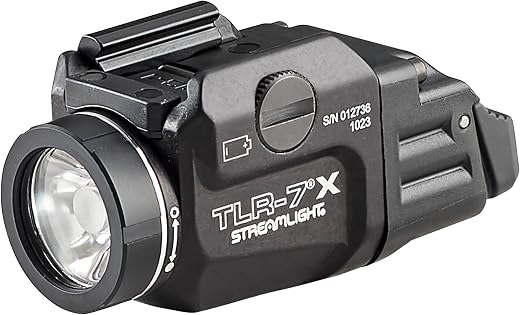
For a bedside pistol, useful light is about certainty at room distance—not a spec-sheet arms race.
At 2 a.m., a dark hallway can turn a laundry pile, pet, or family member into an indistinct shape. A Glock 19 light needs to reveal what is there without making the pistol nose-heavy or difficult to access from its storage position.
Indoor walls return plenty of spill, so extreme output can create harsh near-field glare and bounce-back. Beam shape, controlled spill, and a switch that activates naturally with the support hand matter more than the largest claimed lumen figure. A compact unit that sits close to the trigger guard also preserves the Glock 19’s manageable balance while reducing snag-prone bulk.
- A defined central hotspot helps distinguish details across a typical room; spill fills the surrounding space.
- Ambidextrous paddle switches are generally faster to find under stress than tiny recessed controls.
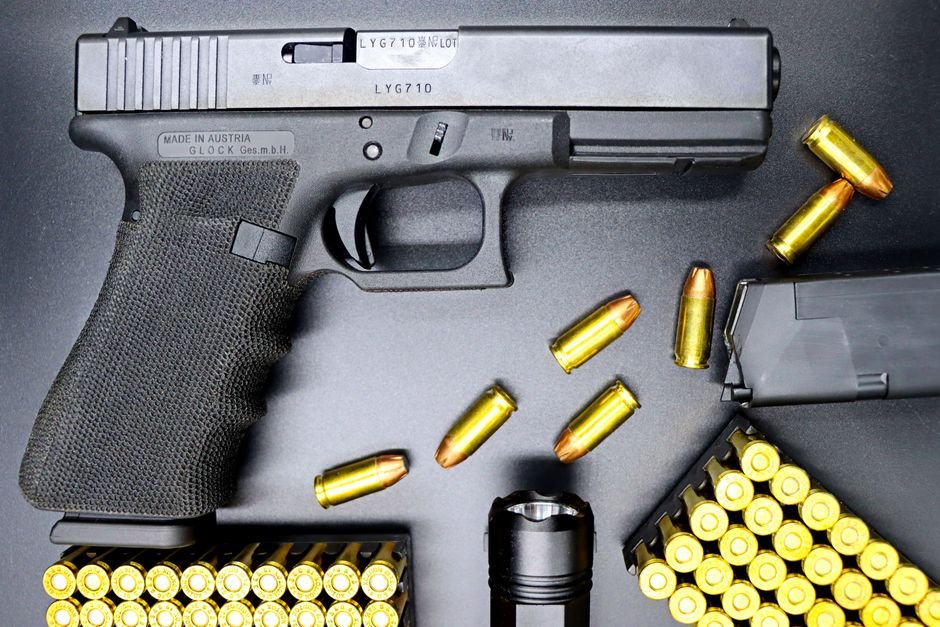
How a Bedside Glock 19 Light Gets Evaluated
- Rail fit and switch reach
A light should lock squarely to the Glock 19 rail without shifting, while its paddles remain reachable from a normal firing grip. Compact bodies usually preserve more support-hand room.
Look forSecure fit with ambidextrous, no-shift activationAvoidA switch that demands a grip change - Beam shape for rooms and halls
Lumens measure total emitted light; candela measures peak beam intensity and therefore throw. Bedrooms favor usable spill and a defined center, while hallways benefit from enough candela to identify detail at distance.
Look forBalanced spill with controlled central intensityAvoidA narrow hotspot or washed-out flood - Runtime and power logistics
Published runtime matters most at the output actually used. Replaceable cells simplify long-term readiness; magnetic or USB charging reduces battery handling but adds a charging routine.
Look forKnown runtime and dependable power sourceAvoidUnverified cells or vague output claims - Durability and muzzle overhang
Hard-anodized aluminum, sealed controls, and proven recoil resistance matter on a bedside gun. A short light is less likely to extend beyond the muzzle, reducing impact exposure and keeping the package compact.
Look forSealed construction with minimal muzzle projectionAvoidExcessive overhang or fragile charging ports
High lumens can brighten a room yet still lack reach if candela is low. High candela concentrates light farther down a hallway, but an overly tight beam can make nearby spaces feel less evenly illuminated. The useful choice balances both rather than chasing the largest lumen number.
The right trade-off depends on footprint




A Glock 19 fit is more than a light sliding onto the rail. The correct locating key determines where the body sits, how securely it locks, and whether the rear paddles land naturally under the support-hand thumb. A high-output light with an awkward switch is rarely the better bedside choice.
Streamlight TLR-7 X: the balanced Glock 19 bedside light
01
Top choice for compact Glock 19 bedside setups
The TLR-7 X keeps a Glock 19 close to its original handling while supplying the kind of controlled white light that makes sense across bedrooms, stairwells, and adjoining rooms. Its 500-lumen, 5,000-candela optic favors usable peripheral spill rather than a narrowly concentrated hotspot.
Its multi-fuel design is especially practical for a staged firearm: it can run on a familiar single CR123A or Streamlight’s optional SL-B9 rechargeable pack. Interchangeable high and low rear paddles also let the activation surface better match the shooter’s grip and hand size.
- Compact enough to preserve Glock 19 balance
- Rear paddles are reachable from a firing grip
- CR123A or optional rechargeable battery support
- Useful room-scale spill with a defined hotspot
- Tool-free rail clamp simplifies fitting
- Less candela than full-size weapon lights
- 140-meter rating does not equal long-range identification
- Paddle choice requires initial setup
The short version A compact, well-sorted light with a sensible beam and flexible power options. It sacrifices some distance performance to avoid turning the Glock 19 into a front-heavy package.
For a Glock 19 kept near the bed, the TLR-7 X is the most complete compromise between size, switch access, beam utility, and battery management. The 5,000-candela beam has enough center intensity for interior distance while retaining spill that is useful in close spaces.
A full-size light can extend reach down a long, dark hallway, but adds length and muzzle weight. For most room-to-room layouts, the TLR-7 X remains the more natural fit.
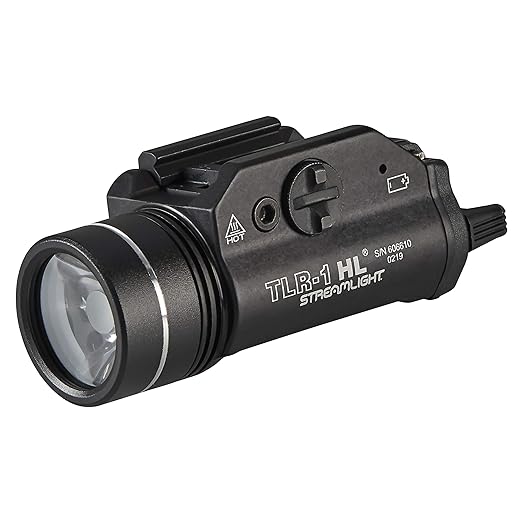
Streamlight TLR-1 HL: reach and control over a flush fit
Best for maximum brightness and extended beam reach
The TLR-1 HL puts a full-size weapon light on the compact Glock 19: a sensible pairing when the pistol is primarily staged rather than carried. Its 1,000-lumen, 20,000-candela beam combines usable spill with enough central intensity to reach beyond a typical room, and its 1.5-hour regulated runtime supports a simple CR123A maintenance routine.
The larger ambidextrous rocker is notably easier to find under stress than many compact-light paddles. It is not the only route to a harder-reaching beam—dedicated high-candela models can offer more throw or different switching geometry—but the Streamlight’s mature mounting-key, holster, battery, and accessory ecosystem remains a practical advantage. For a closer look at that trade, see the X300 Turbo and TLR-1 HL comparison.
- Large, positive ambidextrous rocker
- Strong 1,000-lumen / 20,000-candela output
- Broad parts and accessory support
- Regulated 1.5-hour runtime
- Extends beyond Glock 19 muzzle
- Adds noticeable front-end bulk
- CR123A-only power system
- Strobe shortcut can be unnecessary
TLR-7 X USB for a rechargeable bedside routine
Rechargeable compact design with broad rail compatibility
The Streamlight TLR-7 X USB keeps the short, Glock-19-friendly form of the TLR-7 family while shifting its primary power routine to Streamlight’s rechargeable battery system. Its 500-lumen, 5,000-candela beam remains aimed at room-scale identification rather than long-range throw, and the included rail-key architecture is intended to support a secure fit on compatible compact pistol rails.
It suits households that already maintain rechargeable equipment and can make a quick battery-status check part of the same routine. The interchangeable high and low rear switches also make it possible to match activation geometry to the shooter’s grip without adding the length of a full-size light.
- Compact 500-lumen package
- USB rechargeable power system
- Interchangeable rear switches
- IPX7-rated construction
- Rechargeable cells require routine checks
- Charging package can vary by listing
- Less reach than full-size lights
“TLR-7 X USB” identifies the rechargeable version, but retailer bundles and inventory descriptions can be incomplete or mixed. Confirm the exact battery type, charging cable or charger included, and rail key before purchase.
A light left on a bedside firearm benefits from a simple status habit: inspect charge indication, test activation briefly, and keep the charging method accessible. Rechargeability reduces disposable-cell rotation; it does not remove the need to verify power.
OLIGHT PL X for flood-or-spot flexibility
Best for switching between floodlight and spotlight modes
The OLIGHT PL X takes a different route from a conventional single-beam pistol light: it provides separate wide-flood and concentrated-spot beams. The 1,200-lumen flood is the more natural fit for filling a nearby room, while the 22,500-candela spot offers a tighter, longer-reaching pattern when distance or visual separation matters more than peripheral spill.
That flexibility has real appeal only when its operation becomes automatic. Buyers considering the PL X can confirm which beam is recalled after shutdown, how mode changes are made from the ambidextrous rear switches, and whether those actions remain distinct by touch in a dark room. A feature-rich light is less compelling if its selected beam cannot be predicted without looking.
Its adjustable, reversible rail lugs and anti-loosening mount are designed for both Glock-pattern and 1913 rails, so fit on a Glock 19 can be set without accepting visible wobble. The built-in battery charges by USB-C, which simplifies a bedside charging routine, but also makes charge-state awareness part of that routine: unlike a CR123A-powered light, the power source is not swapped in seconds. The PL X suits the owner who values two genuinely different beam shapes and is willing to keep the controls and charging habit uncomplicated.
- Independent flood and spotlight beams
- Broad 1,200-lumen area illumination
- 22,500-candela focused beam
- Adjustable lugs for GL and 1913 rails
- Built-in USB-C rechargeable battery
- Beam-selection behavior merits practice
- Non-replaceable built-in battery
- Longer than compact rail lights
- More functions add control complexity
EZshoot: a low-cost entry to rechargeable rail lights
Affordable option for basic nightstand illumination
The EZshoot Compact Rechargeable Pistol Light is a compact polymer-bodied rail light listed at 800 lumens, with onboard USB charging and a stated 1.2-hour runtime. It suits an owner who wants to explore the convenience of a small rechargeable bedside light without treating it as a peer to the established duty-oriented options above.
Its value lies in making the format accessible: mount it to a Glock-compatible rail, learn whether the control layout and charging routine fit the role, then judge it by actual function rather than its spec sheet.
- Compact, light 57 g format
- Rechargeable without removing it
- 800-lumen listed output
- Strobe mode included
- No stated water resistance
- Long-term support is less established
- Mount and switch consistency need scrutiny
- Charging port needs careful protection
With the firearm unloaded and pointed in a safe direction, check that the rail clamp stays tight after repeated activation and handling, and that each switch press gives the expected constant or strobe response.
Also inspect the bottom charging-port cover after charging. A loose cover, intermittent cable connection, shifting mount, or ambiguous mode behavior matters more on a bedside light than the headline lumen figure. Keep the charging setup to the stated 5V requirement; the listing says fast-charge cables and adapters are unsupported.
Size the light to the room
A Glock 19 with a compact light such as the TLR-7 X stays easier to place in a shallow bedside safe, drawer, or holster. Its lower-output, lower-candela beam is often enough for a bedroom, while limiting splashback from white walls, mirrors, framed glass, and pale bedding.
A full-size light such as the TLR-1 HL earns its added length in long halls, open-plan rooms, or darker exterior-facing spaces. Its tighter, higher-candela hotspot carries farther, but nearby reflective surfaces can make the center of the beam feel harsher than its lumen rating suggests.
For indoor identification, consider the nearest likely distance and the brightest surfaces in the room—not just output. A light that is easy to activate and store consistently can be more useful than a larger model with impressive specifications.
Output numbers need context
Beam shape and candela often matter more.
A broad beam can illuminate a room evenly; a concentrated hotspot reaches down a hallway.
It can suit deeper storage and longer sightlines.
The trade-off is extra muzzle length and weight in compact bedside storage.
Keep the light ready, not merely mounted
A light’s rail clamp and key deserve a check after installation. With the Glock 19 unloaded and verified clear, confirm the unit sits squarely in the correct rail slot, follows the maker’s tightening guidance, and does not shift under firm hand pressure. Recheck fit after cleaning, battery changes, or a hard knock.
Activation familiarity matters as much as output. Safe, unloaded handling can confirm that either switch is reachable without changing the firing grip excessively and that momentary versus constant-on behavior is understood. This practical check also helps settle whether a weapon-mounted light is actually needed for home defense.
Keep a simple power routine: inspect battery status or charge level on a recurring calendar date, and replace depleted primary cells with matched, reputable cells. For rechargeable models, verify the port cover closes fully after charging. A mounted light remains equipment for identification; it does not replace secure storage, clear household access rules, or a separate handheld light for ordinary searches and power outages.
A handheld light can handle routine noises, outages, and lost-item searches without bringing a firearm into the task.
Go deeper before choosing
The compact-light recommendation remains the practical default for most bedside Glock 19 setups. For a closer look at the details behind that choice, the guides below cover two variables worth confirming: the rail interface and usable output. They supplement the comparisons here rather than replace hands-on fit and unloaded control checks.
Frequently Asked Questions
What is the best overall light for a Glock 19 kept by the bed?
The Streamlight TLR-7 X is the top overall pick. It delivers a 500-lumen, 5,000-candela beam in a compact package that keeps the Glock 19’s balance while offering ambidextrous, configurable paddle switches.
When does a full-size light like the TLR-1 HL make more sense than a compact light?
The TLR-1 HL suits a dedicated bedside pistol that can accept extra length in exchange for substantially greater reach. Its 1,000-lumen, 20,000-candela beam and large ambidextrous rocker are strong in long hallways or open-plan rooms, though it extends beyond the Glock 19’s muzzle and adds front-end bulk.
Is a higher lumen rating always better for indoor use?
No. Beam shape and candela (peak beam intensity) often matter more indoors than a high lumen figure. A broad beam illuminates a room evenly, while a concentrated hotspot reaches farther down a hallway, so the ideal light balances both rather than chasing the largest lumen number.
What is the trade-off with rechargeable lights like the TLR-7 X USB or OLIGHT PL X?
Rechargeable lights such as the TLR-7 X USB and PL X trade the instant swap of a CR123A cell for a charging routine. Owners need to check battery status and confirm the charging cable or port cover before relying on the light overnight.
Is the EZshoot a good choice for a bedside Glock 19?
The EZshoot is a low-cost, compact, rechargeable option listed at 800 lumens, but its polymer construction and less established durability record make it best suited to budget experimentation rather than a primary duty-oriented bedside light.
Does a weapon-mounted light replace a handheld flashlight?
No. A mounted light remains equipment for identification; it does not replace secure storage, clear household access rules, or a separate handheld light for routine noises, power outages, and searches that don’t require a firearm.
- Confirm the light locks securely to the Glock rail and its controls can be reached without altering the firing grip.
- Favor a beam that reveals a room without overwhelming nearby walls, mirrors, or light-colored surfaces.
- Maintain a defined battery or charging schedule; a mounted light is only useful when it powers on.
The TLR-7 X is the compact default: balanced output, clean Glock 19 proportions, and adaptable controls. Choose the TLR-1 HL when a bedside-dedicated pistol can accept more length for substantially greater reach and spill. The TLR-7 X USB makes the same compact format easier to sustain with rechargeable power; the PL X suits those who value deliberate flood-or-spot selection. The EZshoot is the strict-budget entry, provided its fit and retention pass careful checks.
The final requirements do not change: secure rail fit, reachable switching, useful indoor beam behavior, and maintained power.
Streamlight 69424 TLR-7 X 500-Lumen Compact Tactical Weapon Light, Includes High, Low Paddle Switches and Key Kit, Black
Features
| Additional Features | Durable |
| Power Source | Battery Powered |
| Light Source Type | LED |
| White Brightness | 500 Lumens |
| Voltage | 3 Volts |
| Battery Type | Lithium |
| Number of Batteries | 1 CR123A batteries required. (included) |
| Water Resistance Level | Not Water Resistant |
| Light Output Maximum | 500 Lumens |
| Battery Description | Lithium |
| Mounting Type | Weapon Mount |
| Battery Life | 5 Hours |
| Wattage | 4.6 Watt-hours |
| Number of Light Sources | 1 |
| Batteries are Included | Yes |
| Light Source Special Features | Safe off feature to prevent accidental activation |
| Light Path Distance | 140 Meters |
| Runtime | 1 hour |
| Item Dimensions D x W x H | 2.58"D x 1.18"W x 1.27"H |
| Item Weight | 2.48 ounces |
| Size | One Size |
| Item Dimensions L x W x H | 2.58"L x 1.18"W x 1.27"H |
| Material Type | Aluminum |
| Included Components | Battery, High Switch (Mounted), Key Kit, Light, User Guide, Low Switch |
| Brand Name | Streamlight |
| Recommended Uses For Product | EDC, Every Day Carry, Hunting, Law Enforcement, Tactical |
| Global Trade Identification Number | 00080926694248 |
| Manufacturer | Streamlight |
| UPC | 080926694248 |
| Manufacturer Warranty Description | Limited lifetime warranty. |
| Manufacturer Part Number | 69424 |
| Set Name | Tactical Equipment Set |
| Model Number | 69424 |
| Item Type Name | Weapon Flashlight |
| Unit Count | 1.0 Count |
| Item Length | 4.15 Inches |
| ASIN | B084SWJQG6 |
| Color | Black |
| Style Name | With Non-Rechargeable Battery |
| Finish Types | Black |
| Shape | Rectangular |
| Warranty Type | Lifetime |
| Specification Met | IPX7 |
- 500-Lumens; 140 Meter beam; Runs 1.5 Hours
- Engineered optic produces a concentrated beam with optimum peripheral illumination
- Durable, anodized machined aluminum construction; IPX7; Waterproof to 1 Meter for 30 Minutes
- Includes high switch (mounted), low switch, 1 CR123A lithium battery and key kit
- Safe off feature prevents accidental activation; Saves batteries
Streamlight 69456 TLR-7 X USB 500-Lumen 5000-Candela Compact Tactical Weapon Light with Interchangeable High & Low Switches and Key Kit, Flat Dark Earth
Features
| Additional Features | High Power, Lightweight, Long Range, Mountable, Rechargeable |
| Power Source | Battery Powered |
| Light Source Type | LED |
| White Brightness | 500 Lumens |
| Voltage | 3 Volts |
| Battery Type | Lithium Ion |
| Number of Batteries | 1 Lithium Ion batteries required. (included) |
| Water Resistance Level | Waterproof |
| Light Output Maximum | 500 Lumens |
| Battery Description | Lithium-Ion |
| Mounting Type | Gun Mount |
| Wattage | 3.06 Watt-hours |
| Number of Light Sources | 1 |
| Batteries are Included | Yes |
| Light Source Special Features | Strobe Function, Safe-off Feature |
| Light Path Distance | 140 Meters |
| Runtime | 1 hour |
| Item Dimensions D x W x H | 2.58"D x 1.18"W x 1.27"H |
| Item Weight | 2.64 ounces |
| Size | One Size |
| Item Dimensions L x W x H | 2.58"L x 1.18"W x 1.27"H |
| Material Type | Anodized Aluminum |
| Included Components | Battery, Mounting Kit and Keys, TLR-7 X, USB-C Cord, User Guide |
| Brand Name | Streamlight |
| Recommended Uses For Product | Home Protection, Hunting, Law Enforcement, Security and Safety, Tactical |
| Manufacturer | Streamlight |
| UPC | 080926694569 |
| Manufacturer Warranty Description | Limited lifetime warranty. |
| Manufacturer Part Number | 69456 |
| Set Name | TLR-7 X Set |
| Model Number | 69456 |
| Item Type Name | Weapon Mounted Light |
| Unit Count | 1.0 Count |
| ASIN | B0CTGQ8ZK7 |
| Color | Flat Dark Earth |
| Style Name | Securely fits a broad range of weapons and Picatinny MIL-STD-1913 rails |
| Finish Types | Brushed |
| Shape | Rectangular |
| Warranty Type | Lifetime |
| Specification Met | ANSI FL1, CE, IPX7 |
- Versatile Compatibility: Securely fits a broad range of weapons and Picatinny MIL-STD-1913 rails using included key kit; refer to Streamlight's fit guide before purchase
- Bright Performance: 500 Lumens; 5000 Candela intensity with a 140 Meter beam distance and a run time of 1 Hour on high mode
- Designed for Both left-handed and right-handed Users: Ambidextrous rear paddle switches with high and low options
- Safety by Streamlight: Rail-grip clamp securely attaches/detaches without putting your hands in front of the muzzle
- Built Streamlight Tough: Durable 6000 series machined aircraft aluminum construction; 1PX7 waterproof to 1 Meter for up to 30 Minutes
Streamlight 69260 TLR-1 HL 1000-Lumen 20000 Candela Rail-Mounted Tactical Weapon Light with Specific Compatibility Rail Locating Keys, Black
Features
| Additional Features | Portable |
| Power Source | Battery Powered |
| Light Source Type | LED |
| White Brightness | 1000 Lumens |
| Voltage | 3 Volts (DC) |
| Battery Type | Lithium Metal |
| Number of Batteries | 2 CR123A batteries required. (included) |
| Water Resistance Level | Waterproof |
| Light Output Maximum | 1000 Lumens |
| Battery Description | Lithium |
| Mounting Type | Weapon Mount |
| Battery Life | 5 Hours |
| Wattage | 4.6 Watt-hours |
| Number of Light Sources | 1 |
| Amperage | 12.5 Amps |
| Batteries are Included | Yes |
| Light Source Special Features | High Intensity, Durable, Water Resistant |
| Light Path Distance | 283 Meters |
| Runtime | 1 hour |
| Item Dimensions D x W x H | 3.39"D x 1.47"W x 1.44"H |
| Item Weight | 4.16 ounces |
| Size | 3.4 Inch |
| Item Dimensions L x W x H | 3.39"L x 1.47"W x 1.44"H |
| Included Components | Battery, Rail Locating Keys, Tactical Weapon Mount Light With Rail Locating Keys & Lithium Batteries, User Guide |
| Brand Name | Streamlight |
| Recommended Uses For Product | Emergency, Hunting, Personal and Home Protection, Security and Law Enforcement, Tactical |
| Global Trade Identification Number | 00080926692602 |
| Manufacturer | Streamlight |
| UPC | 080926692602 |
| Manufacturer Warranty Description | Limited lifetime warranty. |
| Manufacturer Part Number | 69260 |
| Model Number | 69260 |
| Item Type Name | Weapon Mount Light |
| Unit Count | 1.0 Count |
| Item Length | 6.4 Inches |
| ASIN | B00B8Q31UQ |
| Color | Black |
| Style Name | Non-Rechargeable |
| Finish Types | Black |
| Shape | Round |
| Warranty Type | Manufacturer |
| Material Type | Aluminum |
- Bright Performance: 1,000 lumens, 20,000 candela, maximum throw of 283 meters, and a run time of 1.5 hours on high
- Specific Compatibility: Mounts directly to handguns with Glock-style rails and Picatinny rails only; Includes keys for Glock-style rails, MIL-STD-1913 (Picatinny) rails, Beretta 90two, Smith & Wesson SW99, Smith & Wesson TSW, and Sig Sauer P320 rails
- Easy to Install with Safety in Mind: Rail clamp system securely attaches/detaches quickly and safely with no tools and without putting your hands in front of the muzzle
- Designed for Both Left-handed and Right-handed Users: Ambidextrous momentary/steady on/off switch which allows for effortless lighting for any situation
- Built Streamlight Tough: IPX7 waterproof to 1 meter for 30 minutes; durable machined aluminum construction
OLIGHT PL X Tactical Flashlight Rechargeable USB-C Dual Beams Strobe Combo 22,500 Candelas Spotlight and 1,200 Lumens Floodlight Adjustable & Reversible...
Features
| Additional Features | Adjustable Light Modes, High Lumens, Long Range, Rechargeable, Waterproof |
| Power Source | Battery Powered (USB-C Rechargeable) |
| Light Source Type | LED |
| White Brightness | 1200 Lumens |
| Voltage | 3.7 Volts |
| Battery Type | Lithium Polymer |
| Number of Batteries | 1 D batteries required. (included) |
| Water Resistance Level | Waterproof |
| Light Output Maximum | 1200 Lumens |
| Battery Description | Built-in non-replaceable |
| Mounting Type | GL Rail(Installed)and 1913 Rail(included) |
| Wattage | 960 milliamp_hours |
| Color Temperature | 6500 Kelvin |
| Number of Light Sources | 2 |
| Batteries are Included | Yes |
| Light Source Special Features | Rail Mount Compatibility |
| Runtime | 2 hours and 25 minutes |
| Item Dimensions D x W x H | 2.48"D x 1.18"W x 1.24"H |
| Item Dimensions L x W x H | 2.48"L x 1.18"W x 1.24"H |
| Included Components | Belt Clip, KM2.5×5 Screw x 1, Multi Tool x 1, OLIGHT PL X x 1, USB-C Charging Cable x 1 |
| Brand Name | OLIGHT |
| Recommended Uses For Product | Home,Hunting,Security and Safety,Tactical,Outdoor |
| Manufacturer | OLIGHT |
| Manufacturer Warranty Description | Lifetime warranty (product purchased after january 1st, 2023). |
| Manufacturer Part Number | O-PLX-300000 |
| Model Number | O-PLX-300000 |
| Unit Count | 1.0 Count |
| ASIN | B0FJFR82VQ |
| Color | Matte Black |
| Style Name | tactical |
| Finish Types | Matte |
| Shape | Cylindrical with Rectangular Head |
| Warranty Type | Lifetime |
| Material Type | 6061 Aluminum |
- [𝐈𝐧𝐧𝐨𝐯𝐚𝐭𝐢𝐯𝐞 𝐅𝐥𝐨𝐨𝐝𝐥𝐢𝐠𝐡𝐭 𝐚𝐧𝐝 𝐒𝐩𝐨𝐭𝐥𝐢𝐠𝐡𝐭]:Switch seamlessly between two exclusive, independent beams, a powerful 1,200 lumens wide floodlight for area illumination, and a focused 22,500 candela spotlight that throws up to 300 meters
- [𝐁𝐫𝐨𝐚𝐝 𝐔𝐧𝐢𝐯𝐞𝐫𝐬𝐚𝐥 𝐑𝐚𝐢𝐥 𝐂𝐨𝐦𝐩𝐚𝐭𝐢𝐛𝐢𝐥𝐢𝐭𝐲]:Features adjustable, reversible lugs paired with a patented anti-loosening ratchet mounting system—delivering a rock-solid, wobble-free fit across a wide range of rails, including 1913 Picatinny and GL rails
- [𝐃𝐮𝐫𝐚𝐛𝐥𝐞 𝐌𝐞𝐭𝐚𝐥 𝐂𝐨𝐧𝐬𝐭𝐫𝐮𝐜𝐭𝐢𝐨𝐧]:Crafted from high-strength 6061 aluminum with a Type III hard anodized finish and IPX7 waterproof rating. Rigorously tested to withstand 1.5m drop impacts, built for tough tactical conditions
- [𝐇𝐨𝐥𝐬𝐭𝐞𝐫 𝐂𝐨𝐦𝐩𝐚𝐭𝐢𝐛𝐢𝐥𝐢𝐭𝐲]:Backed by support from major holster manufacturers. Users can easily find matching holsters, ensuring secure retention, quick access, and seamless integration with your complete carry system
- [𝐔𝐒𝐁-𝐂 𝐑𝐞𝐜𝐡𝐚𝐫𝐠𝐞𝐚𝐛𝐥𝐞]:Built-in rechargeable battery fully charges in just 2 hours with a standard 5V/1A USB-C charger. No disposable battery replacements required, helping reduce long-term battery costs while minimizing waste. The universal USB-C port supports charging from car chargers, power banks, laptops, and wall adapters, making it easy to recharge at home or on the go. A red LED indicates charging, while a green LED confirms a full charge.
- [𝐍𝐨𝐭𝐢𝐜𝐞]:1913 insert pre-installed. Built-in Battery does not support replacement with other battery types
EZshoot 800 Lumens Compact Pistol Light with Strobe Mode for Home Defense | Rechargeable Gun Light Compatible with Glock and 1913 Picatinny Rail for Range...
Features
| Additional Features | Adjustable Light Modes, Lightweight, Long Range, Rechargeable |
| Power Source | Battery Powered |
| Light Source Type | LED |
| White Brightness | 800 Lumens |
| Battery Type | Lithium Ion |
| Number of Batteries | 1 Lithium Polymer batteries required. (included) |
| Water Resistance Level | Not Water Resistant |
| Light Output Maximum | 800 Lumens |
| Battery Description | Lithium-Ion Polymer |
| Mounting Type | Gun Mount |
| Battery Life | 1.2 Hours |
| Number of Light Sources | 1 |
| Batteries are Included | Yes |
| Light Source Special Features | Adjustable Light Modes, Strobe Mode |
| Light Path Distance | 160 Meters |
| Runtime | 1 hour |
| Bulb Shape Size | B17 |
| Item Dimensions D x W x H | 1.2"D x 1.2"W x 2"H |
| Item Weight | 2.01 Ounces |
| Size | Compact |
| Item Dimensions L x W x H | 2"L x 1.2"W x 1.2"H |
| Included Components | Battery |
| Brand Name | EZshoot |
| Recommended Uses For Product | Home defense, hunting, outdoor lighting, day and night use |
| Manufacturer | EZshoot |
| Manufacturer Warranty Description | 2. |
| Manufacturer Part Number | A00ZM371 |
| Set Name | Single |
| Model Number | A00ZM371 |
| Item Type Name | Tactical flashlight |
| Unit Count | 1.0 Count |
| ASIN | B0D3HNKZT4 |
| Color | Black |
| Style Name | Utilitarian |
| Finish Types | Matte |
| Shape | Tactical |
| Material Type | Aluminum, Polymer |
- Stable Light - EZshoot rechargeable pistol light has a 800 lumens light with 160 meters beam distance,which is suitable for home defense, range training, hunting, every day carry and night use, etc.
- Lightweight And Compact - EZshoot picatinny light has a compact design and weighs only 57g. You won't feel any weight or fatigue when using it for a long time.
- USB Rechargeable - This gun light can work about 1.2 hour and adopts USB charging. The charging port is located at the bottom of flashlight for convenient charging without remove it from the rail. Please NOTE: It does NOT support fast charging cable and adapter, please use the 5V power adapter.
- Sturdy for Range Training - Built from high-strength polymer, this gun light stays securely mounted on your rail even after multiple rounds. Ideal for range toys and target practice.
- Status Indicator - The battery indicator light will inform you the charging status of handgun light in different colors : Red-Charging, Green-Full.
- Super Compatibility - This mini pistol light is compatible with Glock rail with slot and picatinny rail. Sliding rails design allow the flashlight to be freely positioned in the best position, fit for most compact and full-size guns. (Not fit devices without slot and rail)
- Versatile Usage:Whether you need a bright light for your nightstand gun, range training, or a tactical upgrade for your airsoft or BB gun, this compact design is also suitable for concealed carry. The powerful 800-lumen beam can illuminate an entire room instantly—perfect for those unexpected bumps in the night.


7 Comments
I appreciate that you didn’t automatically crown the highest-candela option. My hallway is short and the bedroom is pretty reflective, so a huge hotspot seems more likely to make me grumpy at 3 a.m. than solve anything.
Still, why not include the Nightstick TCM-10? It’s usually priced competitively with the Streamlight compact models and seems like an obvious alternative for someone who wants a smaller rail light.
Can you do a true under-$100 pick next? The EZshoot looks tempting, but “verify retention, switches, port cover, and support” sounds like a polite way of saying don’t trust it yet 😅 I’d rather buy once than discover the light is dead or loose when it matters.
I have a TLR-1 HL on my bedside 19 and agree it is noticeably more front-heavy. But the larger paddles are much easier for me to hit consistently than the small compact switches, particularly when I’m half awake.
Would have liked a little more discussion of the TLR-7A versus the newer X, since plenty of us already own the A. Is the battery flexibility really the main reason to upgrade, or is there a meaningful switch/fit advantage?
I’m in the same boat. My 7A has been boringly reliable, which is basically the highest compliment for bedside gear. Unless you specifically want the rechargeable battery option, I wouldn’t rush to replace it.
The reminder about a separate handheld is probably the most useful part here. A weapon light is not a magic “what was that noise?” scanner, especially in a bedroom with mirrors and white walls. People get way too focused on lumen numbers.
Why no SureFire XC-1B or X300 mention? I get that the X300 is a lot of light for a Glock 19 by the bed, but the XC-1B seems like it belongs in the compact comparison. Curious if it was left out because of output, switch feel, or simply price.
Fair question. The list focused on lights with a stronger current balance of beam performance, activation options, and power routines for this specific bedside role. The XC-1B is nicely compact, but its output and overall value proposition are harder to justify beside the TLR-7 X; the X300 is excellent but extends well beyond a G19 and was outside the compact-versus-full-size set we were narrowing down.