

A key organizer works only while its pivot stays tight enough to hold position—and loose enough to move.
The frustration usually returns at the worst moment: keys that sat neatly flush yesterday now droop from the stack, click against one another, or leave a tiny screw in a pocket or bag. That change is not merely cosmetic. It means the pivot has lost the clamping force that creates friction between the keys and the organizer’s spacers.
A usable setup lives in a narrow middle ground. Too little tension produces play, sag, and screw back-out; too much makes each key difficult to fan out and can bind softer washers. The right fix therefore is rarely “tighten it as hard as possible.” It is restoring controlled pivot friction while making the threaded joint resistant to vibration, repeated swinging, and the gradual compression of leather or polymer components.
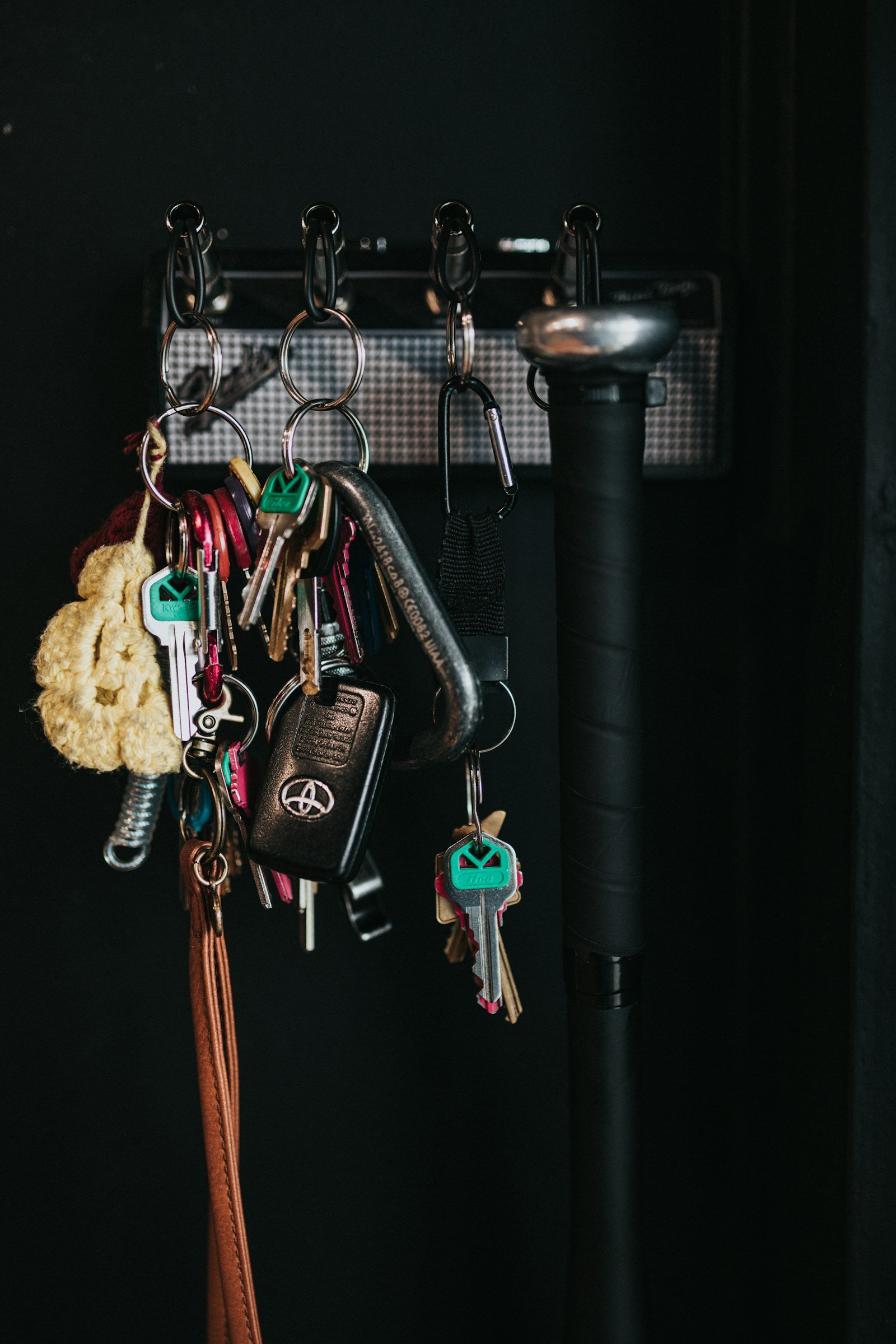
The pivot is a preload system
First, a key organizer pivot works as a compressed stack, not as one screw acting alone.
Additionally, tightening the screw creates preload through the scales, keys, washers or spacers, and often a barrel or threaded post.
The result is friction that keeps keys from swinging freely when the key organizer pivot screw loose.
A pivot can feel loose even when the screw has not moved. Keys and fibre washers may bed in after initial assembly, soft polymer spacers can cold-flow, and worn washers lose thickness. In each case, stack compression reduces preload; the screw remains seated, but the assembly develops side play or an overly easy swing.
Separate back-out from stack loss
| What is observed | More likely cause |
|---|---|
| Screw head sits visibly proud or turns easily counter-clockwise | True thread back-out |
| Screw appears fully seated, but keys wobble or swing loosely | Compression set, washer wear, or a missing spacer |
| Pivot binds before the stack feels secure | Incorrect washer order, a misaligned key, or a bottomed-out screw |
A bottomed-out screw is a common false fix. It reaches the end of the post’s threads before clamping the stack. The head feels tight, yet the keys remain loose. Compare both sides of the organizer, confirm every washer is present and flat, then tighten only until side play disappears and each key still moves with controlled resistance. If tension quickly fades again, inspect the washers and threaded post rather than repeatedly adding torque. key organizer pivot screw loose
Inspect the pivot before tightening
A screw that backs out after a few uses may be losing preload, but the reason is not always the threads. Open the organizer and inspect the pivot from both sides before adding threadlocker or increasing torque.
Read the symptom
- One scale sits proud or tilted: the screw may be entering at an angle, a washer may be displaced, or a spacer may be pinched. Tightening against a skewed stack can deform soft scales and still leave uneven clamping.
- The screw turns but never firms up: hold the opposite side and watch for a spinning barrel, nut, or threaded insert. If that component rotates with the screw, threadlocker on the screw alone will not restore clamping.
- It tightens abruptly, then loosens again: lint, pocket grit, adhesive residue, or a damaged thread may be giving a false “tight” reading. Disassemble the pivot and clean the screw, barrel, washers, and recesses with a suitable solvent; let every part dry fully.
- The screw stops before the stack is snug: it may be bottoming out in the barrel. A missing washer, worn scale, or incorrect replacement screw can create this gap.
Check that washers are flat, centered, and installed in their original order. Compare the exposed screw length on both sides where the design permits. Only after the stack seats squarely and the fastener develops real resistance does controlled tightening—and, if appropriate, a removable threadlocker—make sense.
Forcing a cross-threaded or debris-packed pivot can strip fine threads, crack scales, or permanently bind the key swing. If resistance feels gritty or asymmetric, stop and inspect rather than tightening harder.
Rebalance the key stack
A pivot can be correctly tightened yet work loose when the keys pull sideways on it. An overloaded stack—especially one carrying bulky car fobs, thick access tags, or several keys on one side—acts as a small lever each time the organizer is opened, pocketed, or dropped. That repeated side-load can make the screw and barrel shift microscopically, reducing preload over time.
Position matters as much as count. Put the heaviest or thickest items near the center of the stack, then distribute thinner keys on both sides. Avoid placing every key, spacer, and accessory under one screw head; the stack should close with its side plates parallel, not visibly splayed or tilted.
Check whether capacity is the real fault
Remove nonessential items and test the organizer with a balanced, smaller stack. If it remains tight, but loosens again after fobs or extra keys return, the issue is capacity rather than thread retention. This is a useful way to separate pivot-screw faults from capacity problems.
Signs that the stack is beyond a comfortable working load include:
- keys binding or snapping open unevenly;
- side plates no longer sitting parallel;
- a pivot that needs repeated retightening after normal carry;
- an accessory that hangs outside the plates and twists the assembly.
A slimmer daily set, with occasional keys kept separately, reduces leverage and lets the pivot maintain stable clamping force.
Know what can still be saved
A pivot holds only when its entire clamping stack is intact: screw head, washer(s), outer scale, keys or spacers, opposite scale, barrel/nut, and the threads joining screw to barrel. Some designs also use a sleeve or bushing that sets the compressed width. If that sleeve is absent, crushed, or the wrong length, tightening the screw may merely bend the scales rather than load the key stack.
Contamination is often recoverable
Pocket grit, oxidized metal dust, old threadlocker flakes, and oily residue can prevent washers from sitting flat or can make a screw feel tight before it has developed preload. Disassemble only as far as the maker permits, then clean mating faces and female threads with an appropriate residue-free cleaner and let everything dry completely. A washer that is dirty but flat and smooth is commonly reusable; a washer that is cupped, gouged, split, or polished through its coating is not.
Wear changes the geometry
Replacement is generally warranted when threads skip. Additionally, the barrel spins in its seat, or the screw head recess is rounded. Moreover, if the key organizer pivot screw loose, the barrel’s shoulder may wear and the stack cannot be compressed. Elongated holes in keys or scales are replacement faults. Threadlocker cannot restore missing material or a distorted bearing surface.
Visually similar pivot kits are not necessarily interchangeable. Thread diameter, pitch, barrel length, head profile, drive size, washer thickness, and scale counterbore depth all vary—even between revisions of one organizer. Before attempting to tighten or replace the pivot screw, identify the exact model and production version, then use the manufacturer’s specified hardware or a verified model-specific kit. Mixed parts can bottom out, bind, or leave too little thread engagement.
Reassemble for even, durable friction
-
Lay out the stack in its exact order
Place the screw, outer plate, keys or tools, any washers or spacers, barrel, and opposite plate in sequence. A thin washer on the wrong side can change friction dramatically; omit no part simply because the assembly seems to close without it.
-
Clean and dry the mating surfaces
Wipe pivot holes, washers, barrel faces, and screw threads until free of grit and old adhesive. Let solvent evaporate fully: threadlocker bonds to clean, dry metal, not to oil or residue.
-
Seat the barrel and plates squarely
Hold the plates parallel while the screw engages by hand. The barrel must sit flush rather than turning with the screw; cross-threading or a cocked stack produces false resistance and uneven clamp load.
-
Set friction in small increments
Tighten only until the keys no longer rattle, then open and close the stack several times. Add tiny adjustments until movement is controlled but not stiff; binding at one point often indicates a misaligned washer or side-loaded stack, not a need for more torque.
-
Use threadlocker only after the fit is correct
If vibration repeatedly relaxes an otherwise sound pivot, apply a very small amount of removable, medium-strength threadlocker to the clean screw threads, then reassemble and set friction again. Keep it off washers and pivot faces, where it can gum up movement.
-
Allow the joint to settle before checking
After the threadlocker cures according to its label, cycle the organizer and recheck for side play. If it loosens quickly despite correct assembly, the threads or barrel may be worn rather than merely under-secured.
A locking compound resists vibration; it does not restore stripped threads, a screw that bottoms out, a spinning barrel, or a missing washer. Forcing more adhesive into a faulty pivot can make later service difficult while leaving the underlying loss of clamp force unchanged.
When persistent loosening points to replacement
A screw that repeatedly loses preload after correct cleaning and reassembly usually signals a part that can no longer hold the joint reliably. Adding more threadlocker may hide the symptom briefly, but it cannot restore material that has worn away.
Match the symptom to the failed part
- Compromised threads: A screw that turns with little resistance, skips, or will not tighten at a repeatable point may have worn threads; the barrel’s internal threads can be damaged as well. Replace the mating hardware as a set when possible.
- Flattened friction hardware: Polished, cupped, torn, or permanently compressed washers no longer maintain spring-like pressure. Fresh, correctly sized washers often restore stable tension more effectively than overtightening.
- Excess accessory load: Large key fobs, car remotes, pocket tools, and many thick keys create leverage that works against a light-duty pivot. A smaller stack may stay secure, while the full carry does not.
If load is the recurring cause, a model built with a larger pivot, sturdier barrel, and more generous spacing is the durable fix. Compare organizers designed to carry multitools without undue strain rather than forcing a compact organizer past its intended capacity.
-
Clear debris
Monthly, open the pivot, brush out lint, and confirm each washer lies flat.
-
Feel for change
Swing each key; uneven drag, wobble, or a turning barrel calls for inspection.
-
Use the decision rule
Clean contamination; replace worn threads or flattened washers; reduce a load that still side-loads the pivot.
-
Set the preload
Reassemble squarely, use a small amount of removable threadlocker when appropriate, then check again after cure.
Key Organizer Pivots: Common Questions
How do I know if my pivot screw actually backed out or just lost clamping force?
If the screw head sits visibly proud or turns easily counter-clockwise, that’s true thread back-out. If the screw appears fully seated but the keys still wobble or swing loosely, the more likely cause is compression set, washer wear, or a missing spacer, not the screw itself.
Why does my pivot screw tighten but the keys stay loose?
This is often a bottomed-out screw, a common false fix where the screw reaches the end of the post’s threads before actually clamping the stack. The head feels tight, yet the keys remain loose. Check that every washer is present and flat before assuming the fastener itself is at fault.
Can too many keys or a heavy fob cause the pivot to loosen?
Yes. An overloaded stack, especially one carrying bulky car fobs or several keys on one side, acts as a small lever each time the organizer is opened or pocketed. That repeated side-load can make the screw and barrel shift microscopically, reducing preload over time even on a correctly tightened pivot.
Will threadlocker fix a pivot that keeps loosening?
Only if the hardware itself is sound. Threadlocker resists vibration, but it does not restore stripped threads, a screw that bottoms out, a barrel that spins in its seat, or a missing washer. If a pivot keeps loosening after correct cleaning and reassembly, worn or damaged parts likely need replacing.
A quiet carry stays simple
Routine beats repeated tightening. A clean, balanced stack with sound pivot parts tends to hold its setting; recurring movement signals a need for replacement hardware or a lighter carry.






12 Comments
My screw looked like it was backing out, but it was actually bottoming out in the barrel before it could squeeze the stack. There was a missing thin spacer after I cleaned it last month. Put the spacer back in, tightened in small turns, and now every key swings about the same.
Honestly, these things are tiny sandwiches of parts pretending to be simple 😅
Exactly—bottoming-out is easy to mistake for a loose pivot because the screw can feel fully tightened while the stack still has no preload. The even swing after restoring the spacer is a strong sign that the stack height and seating are now correct.
Same thing happened with mine after a roadside key swap. I assumed I had stripped threads and nearly tossed it. One missing washer caused all the drama.
I tried adding more tension to stop the rattle and ended up with one key that needed two hands to pull out while the others were loose. Reassembled it on a flat table, seated the barrels squarely, then tightened a little at a time. Much better than brute force.
I appreciate the “clean-replace-reduce” approach. Mine had pocket lint packed around the washers, and cleaning it fixed the uneven feel, but a visibly chewed-up screw thread did not improve with cleaning. New hardware was the right call.
I kept cranking down the screw on mine and it would feel tight for a day, then the keys were floppy again. Turned out the little washer had flattened and one of the barrels was spinning with the screw. Replaced both and it finally holds friction without having to overtighten it.
Good reminder that recurring loosening can mean the organizer is just undersized. My work keys plus a chunky RFID fob were too much leverage for the little pivot. Switched to a larger one and the annoying click-clack is gone.
The smaller balanced-stack test was the useful bit for me. I had a fat car fob, a bottle opener, and six keys all hanging on one side, so of course the pivot was getting pushed sideways. With just four keys centered it stayed put; I may need a larger organizer rather than trying to make this one do everything.
That comparison is a good diagnosis. If the reduced stack stays stable, the original setup is likely creating side-load rather than simply needing more tightening. Try keeping the fob outside the pivot if possible, or move to a design with a longer/larger pivot for that accessory load.
Does anyone else find monthly maintenance a little optimistic? Mine lives in a jeans pocket with coins and receipts, so I check it whenever it starts squeaking instead. Still, cleaning the pivot before applying removable threadlocker made a bigger difference than I expected.
Monthly is a preventative guideline, not a requirement. For a dusty or pocket-heavy carry, checking when you notice squeak, uneven swing, or a new rattle is perfectly reasonable. The important part is not sealing dirt into the threads or between the friction surfaces.
Worth mentioning that threadlocker is not magic. I used way too much blue stuff once, and it wicked into the washers; the pivot went from loose to basically welded shut. A tiny amount on clean threads is plenty.