A 50m marking usually does allow swimming — it just does not mean fifty metres of water.
The number on the dial is a pressure classification, established under controlled laboratory testing and commonly written as 5 bar or 5 ATM; ISO 22810 sets the test framework. It certifies that a new, undamaged case held a static pressure equivalent to that depth. It does not recreate an hour in a chlorinated pool, a summer of sea water, a crown that was not quite screwed home, or the temperature swing between a cold lake and a hot shower.
That gap is where the real answer lives. For calm surface swimming, most 50m watches are working inside their rating, and the makers say so: Apple describes its 50m models under ISO 22810 as suitable for shallow-water activities such as pool or ocean swimming while excluding scuba, water skiing and high-velocity water, and Garmin lists 5 ATM for swimming with the same instruction to check the individual model. What decides the outcome is rarely depth. It is the condition of the seals, whether the crown was secured, what the strap is made of, and what happens in the ten minutes after the swim.
- Check the manual for the exact model — permission differs between watches carrying the same 50m mark.
- Secure the crown and any pushers fully, and do not operate them in the water unless the maker expressly allows it.
- Treat the rating as unverified after a battery change, a case opening, or a hard knock.
Is 50m enough to swim in?
- Usually yes, for surface swimming A 50m (5 ATM) watch is normally within its rating for pool or calm open-water swimming — provided the maker’s own guidance for that specific model says so.
- The number is a pressure test, not a depth Fifty metres describes a static laboratory pressure under ISO 22810. It is not fifty metres of water the watch is cleared to descend into.
- Where you swim matters more than how deep Salt, chlorine residue and heat cycling do more damage across a season than the pressure of a swimming pool ever will.
- The crown and strap decide the outcome Most swimming failures trace back to a crown left unsecured, a gasket past its life, or a leather strap — not to the case being out of its depth.
- Diving is a separate standard Purpose-built diver’s watches are certified under ISO 6425. A 50m mark is not a diving qualification, whatever the number suggests.
Showering is a different question with a different answer — heat, steam and soap are harder on seals than a swim.
What a 50m rating actually allows
Does 50m water resistance mean a watch can be taken 50 meters underwater?
Usually not. ISO 22810 defines laboratory test methods and requirements for water-resistant watches, but the depth figure represents controlled pressure rather than permission to descend to that depth.
Is every 50m watch individually pressure-tested?
Not necessarily. Compliance can involve type testing, sampling, or other manufacturer quality controls; ISO 22810 does not by itself promise that every retail unit received an identical individual test.
Is 50m water resistance generally enough for swimming?
It can be adequate for gentle surface swimming when the manufacturer expressly permits it and the seals, crown, and case are undamaged. Buyers wanting more margin may also compare compact dive watches suited to swimming and water use.
What do major manufacturers allow?
Apple describes its 50m-rated models under ISO 22810 as suitable for shallow-water activities such as pool or ocean swimming, while excluding scuba diving, water skiing, and high-velocity water. Garmin’s published water-rating guidance similarly lists 5 ATM for swimming but advises checking the specific model’s manual.
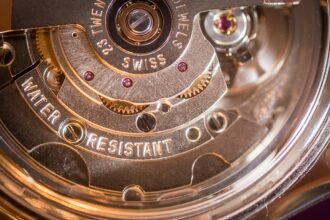
What 50m water resistance actually promises
The figure stamped on a caseback is a laboratory result rather than a depth limit, and the gap between those two readings is where most ruined watches begin. 50m water resistance for swimming means the case held a static pressure equivalent to fifty metres of water while new, sealed and undisturbed. It says nothing about a crown left half-open, a gasket four summers old, or the temperature swing between a cold pool and a hot shower. The claims below are the ones that come up most often, and only one of them survives contact with how watches actually fail.
Three things swimmers believe about 50m watches
Ordinary swimming does not come close to 50 metres of static pressure. Moving an arm through water adds a small fraction of the load the rating describes.
This myth pushes people towards dive watches they do not need, while distracting from the failures that actually happen: an unsecured crown, a perished gasket, or a hard entry.
The figure comes from a controlled static pressure test under ISO 22810. It describes laboratory conditions, not a depth the watch is cleared to reach.
Treating the number as a depth is how people take a dress watch snorkelling. Surface swimming is the realistic ceiling for 50m, and only when the maker says so.
Gaskets are consumables. Chlorine, salt, heat cycling and simple age all harden them, and a case that sealed last summer may not seal this one.
Water resistance is a condition, not a permanent property. Regular swimmers need a periodic pressure check; a single successful swim proves nothing about the next.
Where the swimming happens changes the risk
When a 50m watch should stay out of the water
Can a 50m watch be used for diving?
A basic 50m rating should not be treated as a diving qualification. Scuba and deeper freediving call for equipment specifically approved by its manufacturer for those activities; ISO 6425 covers purpose-built diver’s watches.
Are forceful pool entries safe?
Cannonballs, high diving-board entries, and repeated hard impacts add sudden water pressure and physical shock. Entering gently is the more conservative choice, especially with an older watch.
What about water skiing, surfing, or fast personal watercraft?
Fast water sports can drive water against seals more forcefully than ordinary lap swimming. Apple explicitly excludes water skiing and other high-velocity water exposure for relevant 50m-rated models, and model-specific guidance should control.
Can shower or spa jets damage the watch?
Pressurized jets should be avoided because they concentrate force around buttons, the crown, and case openings. Hot water, steam, soap, and chemicals can also affect seals over time, so rinsing gently with fresh water is preferable after permitted swimming.
How Water Resistance Fails in Practice
Can the crown or pushers be used in water?
An open or partly secured crown can bypass the case seals. Unless the manufacturer explicitly permits underwater operation, pushers should remain untouched and screw-down controls should be fully secured before swimming.
Why can an older 50m watch start leaking?
Gaskets deteriorate, while impacts can deform sealing surfaces. Opening the case for a battery change or service also compromises protection if seals are reused, fitted poorly, or not pressure-tested afterward.
Does a water-resistant case make the whole watch swim-ready?
No. Check whether the watch’s leather strap can get wet, because leather may stain, stiffen, or deteriorate even when the case remains sealed. A secure clasp and sound spring bars also matter: water resistance does not prevent loss.
Treat the stated rating as unverified after the case has been opened. Before swimming, arrange gasket inspection and pressure testing according to the manufacturer’s service guidance. Stop wearing the watch in water if condensation appears beneath the crystal.
How should a 50m watch be checked before swimming?
- Confirm the exact model’s instructions
Check the manufacturer’s manual, support page, or water-activity chart—not a generic depth-rating table. Permission can differ between models carrying the same 50m mark.
- Inspect the watch and strap
Look for a cracked crystal, loose caseback, damaged crown, corrosion, or condensation beneath the glass. Check that the strap, spring bars, and clasp are secure and suitable for water.
- Secure every control
Push or screw the crown fully into its normal position and close any locking covers. Unless the model’s instructions expressly allow it, avoid operating the crown, pushers, or rotating controls in water.
- Review its recent history
Treat the seal condition as uncertain after battery replacement, case opening, servicing, a significant impact, or long periods without inspection. Age alone does not reveal whether gaskets still seal correctly.
- Arrange pressure testing when needed
A watchmaker or authorized service center can perform appropriate water-resistance testing and replace seals if required. Testing is prudent after the case has been opened, after impact, or whenever maintenance records are unclear.
If moisture appears under the crystal, leave the watch out of water and seek service promptly.
An everyday 50m watch may be approved for limited surface swimming, yet still have controls, straps, or service requirements poorly suited to frequent sessions. Watches designed for repeated water use generally emphasize more secure controls, robust retention, and clearer maintenance guidance—part of the daily-wear differences between field and dive watches.
Should the watch go into the water?
-
Confirm explicit permission
Check the manual or manufacturer’s current instructions for the exact model. A 50m marking without clear approval for swimming is not enough.
-
Consider its present condition
Keep the watch dry if the service history is unknown or there are signs of impact, corrosion, crystal damage, or control problems.
-
Match it to the activity
Calm surface swimming presents a different risk from diving, water sports, forceful entries, fast-moving water, or concentrated jets. Follow the manufacturer’s activity restrictions.
-
Check retention
Inspect the strap, spring bars, clasp, and fit. This matters for watches worn as everyday carry, since a secure daily fit may still loosen during vigorous swimming.
-
Resolve uncertainty before swimming
If the instructions, condition, or seal integrity remain unclear, keep the watch out of the water or obtain a pressure test from a qualified watchmaker or authorized service center.
A passed pressure test reflects condition at the time of testing; later damage or seal deterioration can change water resistance.
What happens after the swim decides the next one
Almost none of the damage a swimming watch takes happens in the water. Chlorine and salt do their work as residue, drying into the gaps around the crown, between the lugs and inside a clasp, where they sit against the gaskets until the next immersion. Heat does the rest: a hot shower or a spa straight after a cold pool expands the case and its seals, then contracts them, and that cycle draws moisture past a seal that had held perfectly well at a steady temperature. The routine below takes about a minute, and it is the difference between a watch that swims for years and one that fogs in a season.
What to do when the watch comes out of the water
- Rinse before anything dries
Chlorine and sea salt do most of their damage as residue rather than in the water. Rinse the case, the lug gaps, the clasp and the seam around the crown under cool fresh water while the watch is still wet.
- Dry the places water hides
Blot the caseback, between the lugs and inside the clasp. Water trapped under a bracelet or against a caseback is what starts corrosion on spring bars and caseback screws, long after the outside looks dry.
- Leave the crown alone until it is dry
Winding or setting the time with a wet crown draws moisture past the seal that has just kept it out. Wait until the case is fully dry before touching any control.
- Skip the hot tub or hot shower straight afterwards
Going from cool water into heat expands the case and its gaskets, then contracts them as everything cools. That cycle can pull water in through a seal that was holding perfectly well at constant temperature.
- Watch for fogging over the next day
Condensation under the crystal means the seal is no longer keeping water out. Keep the watch out of the water and have it pressure tested before swimming with it again.
Rinsing matters most after salt water — salt left in the crevices keeps working on steel long after the watch feels dry.
Buying for regular swimming, not occasional splashes
A watch that goes in the pool twice a year and one that swims every week are not asking the same thing of their seals. Weekly immersion works through gaskets faster, finds every weakness in a strap, and punishes a crown that was only ever push-fit. If 50m water resistance and swimming are going to be a standing arrangement rather than a holiday one, the specifications worth paying for are narrow and specific.
If the watch swims every week, buy for these
The crown is the largest opening in the case, and it is where most swimming failures start. A screw-down crown clamps its gasket shut instead of relying on a push-fit seal; a button-only digital has no crown to leave open at all.
A perfectly sealed case still ends badly if the strap fails. Repeated immersion is far harder on strap materials than on the watch itself, and a wet wrist is where watches get lost.
Fifty metres is the entry point for surface swimming, not a safety margin. A higher rating does not let the watch go deeper in practice — it buys tolerance for a gasket that is a few years old or a service that slipped.
Water resistance says nothing about retention. Wet skin and repeated arm movement work at a clasp far harder than a day at a desk does.
Gaskets are consumable parts. Regular swimming works through them faster than occasional splashes, and no rating survives a seal that has gone hard.

Treat 50m as a starting point, not permission
- Use another watch when confirmation is unavailable.
- Recheck suitability after impacts, repairs, or unexplained moisture.
A 50m rating alone does not establish swimming suitability. The decision depends on model-specific manufacturer guidance, current seal condition, secure fit, and the planned activity.
When any of those factors is uncertain, the practical choice is to keep the watch dry until its documentation is confirmed or its water resistance is professionally tested.