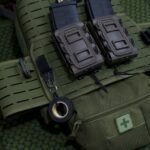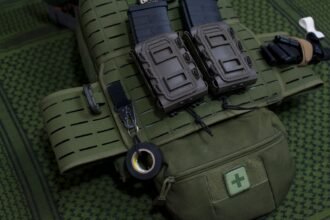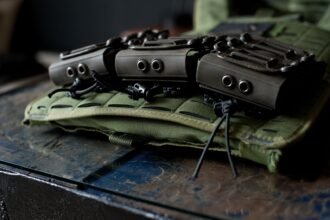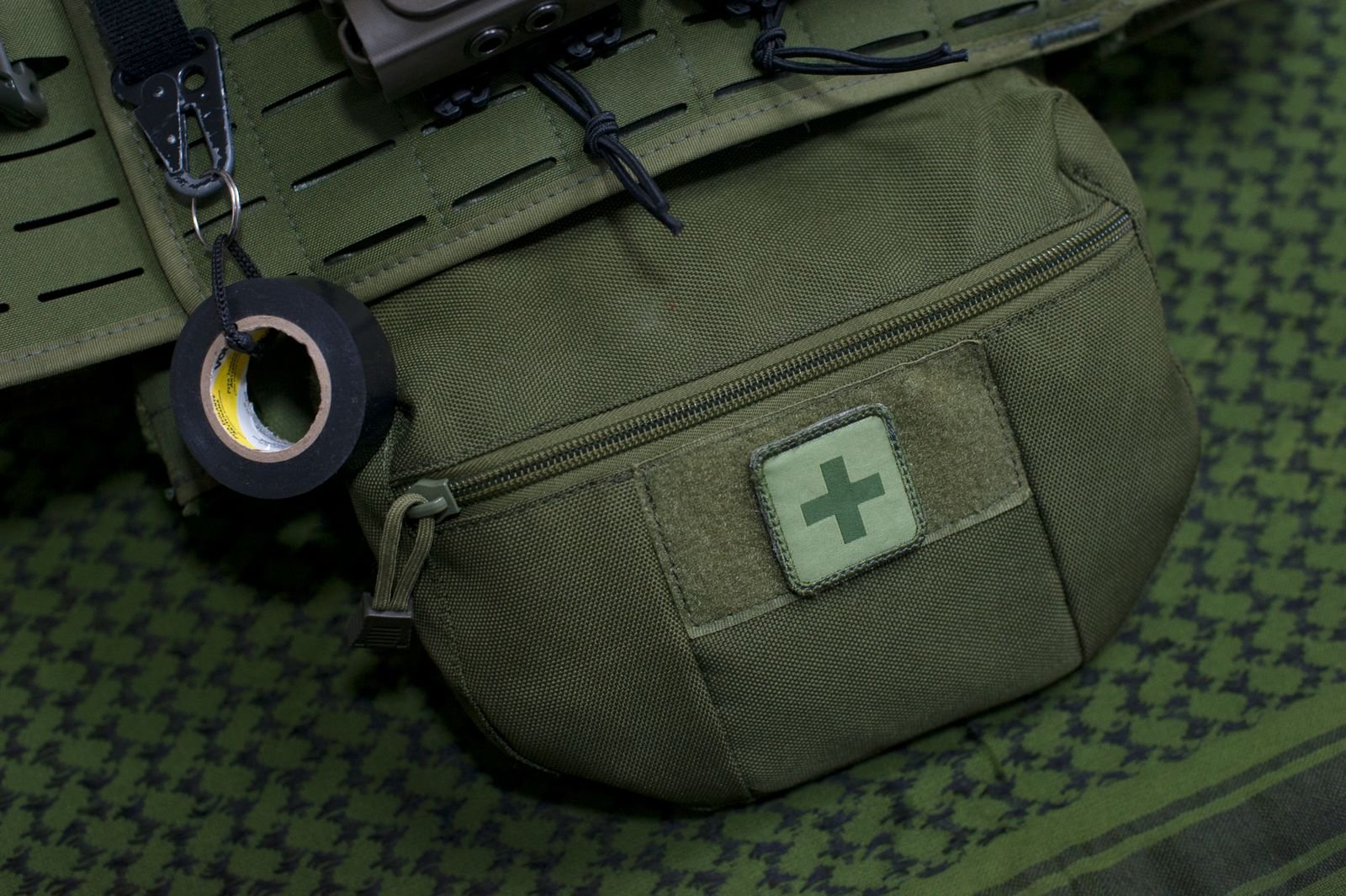
Extra toughness has a cost when every pouch adds it to the load.
A single stiff pouch may feel reassuring; six spread across a belt can create noticeable bulk, resist bending, and make movement less comfortable. 1000D fabric is often justified where abrasion is sustained, loads are dense, or the pouch regularly contacts rock, concrete, or vehicle interiors.
For general field gear, admin kits, and lightly loaded utility pouches, 500D can offer adequate durability while conforming more easily to the body or pack. Denier describes yarn weight—not the finished pouch’s total strength—so stitching, reinforcement, lining, coating, and hardware also matter. Choose 1000D for concentrated wear; favor 500D when lower weight and easier handling matter across the whole setup.
What denier does—and does not—describe
Denier (D)
Denier is yarn linear density: under 16 CFR §303.7, it is the mass in grams of 9,000 meters of yarn. A 1000D yarn is heavier per equal length than a 500D yarn, but the number alone does not rate durability or quality.
Fiber
The polymer—commonly nylon or polyester—affects abrasion behavior, moisture response, strength, and dye performance. Two fabrics carrying the same denier label may use different fibers or yarn structures.
Weave and fabric construction
Thread count, weave pattern, yarn spacing, and whether yarns are textured or filament-based influence stiffness, snagging, and tear propagation. Denier does not reveal any of these details.
Coating and backing
Polyurethane, PVC, laminates, and other finishes can add water resistance, body, and substantial mass. They may also change flexibility, aging behavior, and how easily the fabric can be sewn or repaired.
Finished weight and tested performance
Finished fabric weight includes yarns, coatings, and treatments; it is distinct from yarn denier. Abrasion, tear, and breaking-strength results describe performance only under the stated test method and conditions.
Build a controlled comparison
A useful 500D-versus-1000D comparison holds as many variables constant as possible. Marketing labels become meaningful only when supported by construction details and comparable test data.
- 1. Match the material specification
Compare fabrics from the same manufacturer or obtain technical sheets listing fiber, weave, coating, backing, and finished mass per area. If those fields differ or remain undisclosed, denier cannot isolate the reason for a weight or stiffness difference.
- 2. Check the test protocol
Compare results produced under the same standard, specimen preparation, endpoint, and units. ASTM D3884 abrasion data, ASTM D2261 tear data, and ASTM D5034 breaking-strength data should not be treated as interchangeable measures—or compared across altered procedures.
- 3. Evaluate the complete pouch
Fabric test results apply to fabric specimens, not automatically to a finished pouch. Seam layout, stitch density, thread, binding, zipper attachment, reinforcement, hardware, and load concentration may determine where the product wears or fails.
A heavier denier can support a durability goal, but it is evidence about yarn size, not a complete verdict on service life.
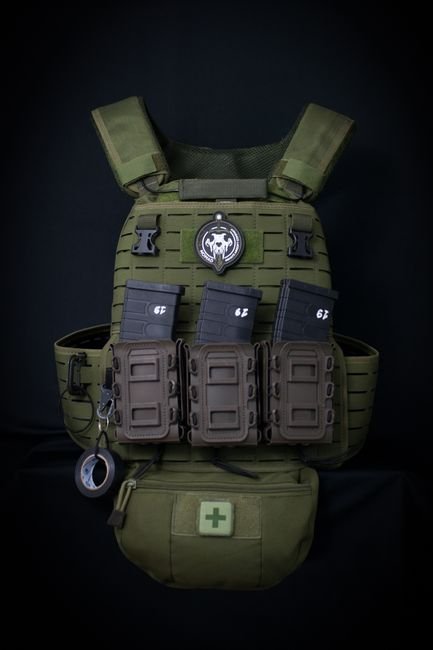
Small savings multiply
Denier alone cannot calculate finished weight, but published areal weight can. Rockywoods lists representative coated CORDURA nylon at about 7.1 oz/yd² for 500D and 9.9 oz/yd² for 1000D. Those figures apply to those specific fabrics—not every textile carrying the same denier label—but they provide a transparent comparison.
The difference is 2.8 oz/yd². If six pouches collectively use 1.08 yd² of shell fabric—0.18 yd² each—the arithmetic is straightforward:
- 1.08 yd² × 2.8 oz/yd² = roughly 3 oz saved
- 1.5 yd² across a travel organizer and nested pouches = roughly 4.2 oz saved
- 2 yd² across a larger body-worn setup = roughly 5.6 oz saved
These are fabric-only calculations. Thread, binding, zippers, webbing, stiffeners, and hardware may narrow or overwhelm the difference, so finished products should be compared on a scale whenever possible.
The savings matter most when fabric outweighs the contents: medical organizers, admin pouches, cable kits, empty nested bags, and body-worn systems carried for hours. A heavily loaded tool pouch gains less proportional benefit, while a broad, lightly filled organizer may show the difference more clearly.
When considering how to select an EDC pouch, total fabric area and pouch count deserve as much attention as denier. A practical comparison records empty pouch weight, capacity, hardware, and reinforcement—not merely the shell specification.
Where stiffness earns its weight
A pouch that stays open is easier to search and reload with one hand. Stiff sidewalls also preserve internal space when neighboring gear presses inward, while a reinforced back panel can reduce sag when the pouch carries radios, magazines, medical supplies, or bulky tools.
That structure does not come from denier alone. Coatings, laminates, foam, polymer stiffeners, edge binding, and folded construction can make a 500D pouch more rigid than a minimally reinforced 1000D model. External attachment also matters: a stable mounting interface and well-spaced bar tacks often control bounce better than simply choosing heavier fabric.
Stiffness becomes a liability when the pouch must conform to the body or squeeze into a tightly packed bag. Rigid corners can create pressure points, catch on adjacent equipment, and leave unusable gaps. For small-tool carry, fabric and construction choices should therefore reflect placement as much as load.
Match construction to the likely failure
Before choosing by denier, identify what is most likely to fail:
- Abrasion: Look for reinforcement where the pouch contacts belts, vehicle interiors, or the ground.
- Seam loading: Heavy contents need sound load paths, adequate stitching, and reinforced attachment points.
- Zipper stress: Overfilled pouches place tension on zipper tape, sliders, and curved openings regardless of shell fabric.
- Puncture or cutting: Awls, bits, blades, and other sharp tools require fitted sleeves, caps, or rigid internal protection; thicker woven fabric alone is not dependable edge protection.
- Weather exposure: Water resistance depends heavily on coatings, seams, openings, and zipper design—not denier by itself.
A useful compromise is localized structure: a stiffened opening or back panel paired with lighter, flexible sidewalls. This retains access and mounting stability without making the entire pouch bulky.
Durability is more than heavier yarn
Service life depends on the failure mode and the complete construction.
Seams, zipper tape, attachment webbing, coatings, and exposed corners may fail before the main fabric.
Structure helps only when the opening, closure, and internal layout remain accessible.
An overpacked rigid pouch can bind its zipper or crowd contents just as readily as a soft pouch can collapse.
Concentrated loads need reinforcement and controlled movement.
A reinforced base, secure mounting, internal dividers, and tool guards address sag, impact, and puncture more directly.
Denier is not a water rating
A 1000D fabric is not automatically more water-protective than 500D. Denier describes yarn mass; coatings and laminates determine how readily water passes through the textile. Even a strongly water-resistant panel cannot compensate for openings elsewhere in the pouch.
Finished-pouch performance depends on:
- Seams: Needle holes can leak unless taped, welded, or otherwise sealed.
- Zippers: Standard coil zippers, coated zippers, and waterproof closures provide different protection.
- Closure geometry: Storm flaps, roll tops, and overlapping lids reduce direct water entry.
- Construction details: Drain holes may be intentional in pouches designed to shed water rather than exclude it.
Compare only ratings with the same scope and test method. A hydrostatic-head result for raw fabric is not equivalent to an ingress-protection rating for an assembled product. If a maker publishes no finished-product test, treat terms such as water-resistant as limited claims and use a liner or dry bag for moisture-sensitive contents.
Match construction to the job
- Exposure and abrasion
Frequent contact with rock, concrete, vehicle interiors, or dense brush can justify 1000D at wear zones. For routine carry with limited scraping, 500D may reduce cumulative weight without sacrificing needed function.
Look forReinforced bottoms, protected corners, covered zipper tracks, and drainage where water or debris can collect.AvoidChoosing a heavier shell while leaving the base, zipper, or exposed edges unprotected. - Load and concentration
Dense tools, magazines, batteries, and other hard items create concentrated stress that shell denier alone cannot resolve. Internal organization and reinforcement can spread loads and limit abrasion from within.
Look forLined pockets, shaped dividers, stiffener inserts, and reinforced seams beneath heavy objects.AvoidUnsupported pockets that sag, collapse, or allow hard contents to grind against the shell. - Carry position
Belt- and chest-mounted pouches benefit from lower bulk and reliable shape retention. Vehicle, pack-side, or ground-contact positions may place greater value on abrasion panels and protected hardware.
Look forBar-tacked mounting points, stable attachment geometry, reachable pulls, and clearance from straps or body armor.AvoidExtra stiffness that impedes movement, access, or comfortable positioning. - Access and structure
A pouch that must stay open may need a rim stiffener or removable insert more than a uniformly heavier fabric. Zipper garages and reinforced pull ends can also protect common stress points.
Look forTargeted structure that preserves the opening while allowing the body to flex where useful.AvoidTreating high denier as a substitute for thoughtful shaping, reinforcement, and hardware protection.
Firearm retention and trigger protection require a rigid holster shell molded for the specific firearm model and configuration, with the trigger guard fully covered. A general-purpose pouch—even a stiff 1000D design—can deform, admit objects near the trigger, or release the firearm unpredictably.
Use pouches for compatible accessories or protected transport only when their design supports that purpose; do not rely on shell denier as a retention or trigger-safety feature.
Choose the fabric around the failure mode
-
Inventory the contents
Flag sharp corners, exposed blades, hot items, and dense tools. Add a liner or rigid insert where an edge could cut either fabric.
-
Rate the abrasion
Consider crawling, vehicle contact, masonry, and repeated dragging—not merely occasional brush against clothing.
-
Set the structure requirement
An empty pouch may need to stay open for rapid access. Prefer targeted stiffeners when only the mouth or divider needs support.
-
Compare finished weight
Use manufacturer-listed weight for the complete pouch. Fabric savings can be erased by extra webbing, hardware, liners, or reinforcement.
-
Predict the first failure
Inspect zipper paths, seams, corners, attachment points, and tool tips. Choose 1000D when documented abrasion, concentrated load, or stiffness needs implicate the shell.
A utility pouch is not a holster. Firearms require a rigid, firearm-specific shell that fully covers the trigger guard.
For routine carriage, 500D is the practical starting point when flexibility and cumulative system weight matter. Move to 1000D only when the use case shows that heavier fabric addresses the likely failure; otherwise, improve the vulnerable seam, edge, closure, or attachment directly.
Fabric weight is a proxy for how hard the bag works. The same calculation runs through range backpack versus duffel, where stiffness buys structure and costs carry comfort.