

Routine cleaning need not leave a basement bench smelling like a paint shop.
After a short range session, the usual residue is not mysterious: loose carbon around the bolt face, oily powder grime in the action, and fresh fouling in the bore. For that work, water-based and low-odor cleaners can be remarkably capable. SLIP 2000 725, Hoppe’s M-Pro 7, and Riptide Armory Advanced All-Surface are aimed at lifting carbon, old lubricant, and general shop dirt without the aggressive vapor profile associated with many traditional petroleum solvents.
“Non-toxic” is a useful direction, not a safety exemption. Formulas vary, and even an odorless product can irritate skin or eyes, damage an incompatible finish, or become a problem when sprayed into a poorly ventilated room. Product labels and safety data sheets remain the authority on contact, ventilation, storage, and disposal. These gentler cleaners are strongest as routine-maintenance tools: let them dwell on carbon, agitate with a nylon brush or patch, then wipe away the suspended residue. Stubborn copper fouling, heavy leading, or baked-on deposits may still call for a purpose-built treatment rather than repeated soaking.
- Odor is not a reliable measure of chemical hazard; “odorless” mainly improves the working environment.
- A finish-friendly cleaner still merits a small compatibility check on unusual coatings, painted markings, wood, or optics-adjacent surfaces.
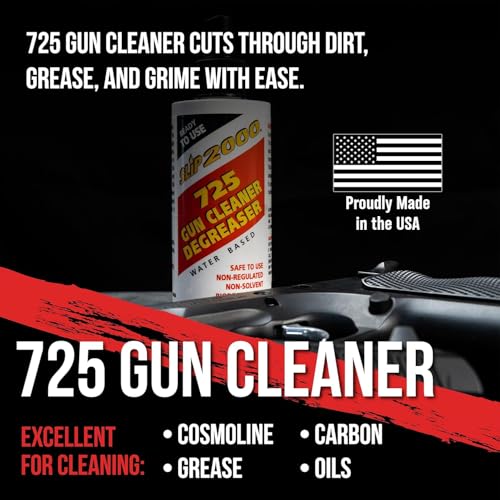


Choosing a non-toxic gun cleaner mostly comes down to what’s actually on the bench that day — loose carbon around the bolt face, oily powder grime in the action, and fresh bore fouling all respond well to water-based, low-odor chemistry with a bit of dwell time and some brushing. The three picks below cover a broad routine cleaner, the lowest-odor option for indoor work, and a finish-conscious formula for mixed-material firearms, so the choice can match the job rather than the label.
- Water-based cleaner
A cleaner using water as a primary carrier, often with surfactants and corrosion-control additives. It commonly excels at carbon and grime but should not be left to dry on bare steel.
- Surfactant
A compound that loosens oily residue and helps carry it into a wipe or patch. Its action is mechanical and chemical, rather than simply dissolving everything on contact.
- Dwell time
The brief period a cleaner remains on fouling before brushing or wiping. Allowing dwell time often improves carbon removal without harsher chemistry.
- Copper fouling
Bullet-jacket material deposited in a bore. It usually requires a dedicated copper remover when routine cleaning no longer restores normal bore condition.
- Corrosion protection
The protective film or inhibitor needed after cleaning removes oils and contaminants. Cleaning and lubricating are separate jobs, even when a product offers some protection.
Three cleaners, three practical strengths


| Best fit | Odor claim | Stated targets | Container | ||
|---|---|---|---|---|---|
|
SLIP 2000 725 All-Purpose Gun Cleaner All-purpose pick | Routine degreasing | Not stated | Carbon, grease, grime | 16 oz trigger | View |
|
HOPPE'S M-Pro 7 Odorless Gun Cleaner Lowest odor | Low-odor cleaning | Odorless | Carbon, lead, copper | 8 oz spray | View |
|
Riptide Armory Advanced All-Surface Gun Cleaner Finish versatility | Mixed finishes | Not stated | Carbon, metals, residue | 16 oz bottle | View |
The useful question is not whether a cleaner removes some dirt, but what it removes without prolonged soaking, harsh odor, or a film that complicates the next step. Results can change sharply once carbon has been heat-cured or metal fouling has plated into the bore.
Fresh powder soot, oil, and loose carbon reveal how well a formula wets and lifts routine grime. Baked-on bolt-tail carbon, piston deposits, and fouling at the chamber mouth expose whether it needs meaningful dwell time, brushing, or repeat applications.
A cleaner was judged by wipe-off cleanliness, lingering odor, and whether its spray, stream, or liquid format reaches rails, locking recesses, and bore surfaces without flooding the action. Compatibility matters across blued steel, stainless, aluminum, polymer, anodizing, wood finishes, and common optic or grip materials; a discreet spot test remains sensible for an unfamiliar finish.
Routine all-purpose cleaners are built chiefly for carbon and old lubricant. Dedicated copper or lead removers address tenacious bore deposits, while a corrosion protectant or lubricant is applied afterward because an effective cleaner is not automatically a long-term protective film.
Dwell time is part of the chemistry: more time can reduce scrubbing, but it does not turn a routine cleaner into a dedicated copper or lead solvent.
One bottle for routine carbon and grime
01
Top choice for broad carbon, grease, and grime removal.
SLIP 2000 725 is the sensible bench cleaner when a collection includes pistols, rifles, and shotguns and the task is ordinary upkeep rather than a one-off rescue job. Its broad-use formula is aimed at the mixed residue left by firing and handling: carbon around actions and muzzle areas, old lubricant in recesses, and greasy exterior grime.
It works best as part of a mechanical cleaning pass. Let the cleaner sit briefly on stubborn deposits, then use nylon brushes, patches, and swabs to lift what the liquid has softened. That makes it particularly useful for regular intervals, when deposits have not yet become a hard, layered problem.
- Cuts routine carbon, grease, and handling grime in one pass
- Useful across common action types and exterior surfaces
- Trigger spray supports targeted application and controlled wetting
- Effective with brushes, patches, and short dwell time
- Not a substitute for a dedicated copper remover
- Heavy bore deposits may need stronger, purpose-built chemistry
- Mechanical agitation remains important on baked-on residue
Quick take A capable general cleaner that earns its place by covering most routine messes without requiring a separate product for every firearm type.
For normal maintenance, SLIP 2000 725 covers an unusually large share of the cleaning job: loose carbon, migrated oil, dried grease, and the grime that builds up on frequently handled firearms. Its advantage is practicality, not miracle chemistry. A short dwell time and deliberate brushing let it do its best work in actions, chambers, and hard-to-reach exterior details.
When the issue is deeply baked carbon in a bore or substantial copper fouling, a dedicated bore or copper product remains the more efficient tool. As the everyday first bottle on the bench, however, 725 is a strong, uncomplicated choice.
M-Pro 7 for indoor-friendly maintenance without solvent fumes
Best for non-toxic cleaning with bore-conditioning benefits.
M-Pro 7 is built for the cleaning sessions that happen often: clearing carbon, old lubricant, powder residue, and handling grime without turning a workbench or indoor space into a cloud of conventional-solvent odor. Its odorless, non-toxic formula makes it especially appealing where the familiar sharp smell of gun cleaner is the reason maintenance gets postponed.
The spray format helps wet a bore, bolt face, chamber, and small carbon-catching recesses evenly. For ordinary range fouling, it is a practical cleaner rather than a shortcut: give deposits time to soften, work stubborn areas with an appropriate brush, then wipe or patch until residue stops transferring. The cleaner’s bore-conditioning claim may help reduce later buildup, but it does not replace a dedicated protective lubricant on moving, load-bearing, or corrosion-prone surfaces.
- Odorless formula suits indoor bench work
- Non-toxic positioning without harsh solvent character
- Spray reaches chambers and tight action areas
- Handles routine carbon, lead, and most copper residue
- Bore-conditioning benefit for recurring maintenance
- Heavy baked-on fouling still needs dwell time and brushing
- Not a substitute for specialized aggressive copper removal
- Cleaner leaves no complete lubrication regimen behind
- Spray application can over-wet confined assemblies
M-Pro 7 is the standout when conventional cleaner fumes are the main deterrent to frequent maintenance. It can handle the ordinary carbon-and-grime workload well, provided the surface is properly saturated, brushed where needed, and wiped clean rather than merely sprayed and left.
Odorless does not make cleaning frictionless: stubborn deposits still respond to contact time and mechanical action. Finish the job with suitable protective lubrication; cleaning and long-term protection remain separate tasks.
Riptide Armory for mixed-material firearms
A versatile formula designed for carbon, metals, and residue.
Riptide Armory Advanced All-Surface Gun Cleaner is the practical middle ground for firearms that combine coated metal, polymer furniture, rubberized controls, and accessory mounts. Its stated all-surface, carbon-and-residue focus makes it particularly relevant when a maintenance session involves more than a bare steel action.
That breadth matters on modern rifles, pistols, and shotguns with layered finishes and add-ons. The cleaner is best treated as a general cleaning step—followed by a separate lubricant or protectant where the firearm’s maintenance guidance calls for one.
- Broad cleaner for carbon, metal residue, and old grime
- Designed for use across surfaces and finishes
- Useful for accessory-heavy modern firearms
- Not a substitute for dedicated copper-removal chemistry
- “All-surface” claims do not override component instructions
- Cleaner does not replace lubrication or corrosion protection
Riptide Armory is the finish-confidence pick for routine cleaning across a firearm’s varied exterior and mechanical materials. It earns that role through versatility rather than extreme bore-solvent aggression; heavily copper-fouled bores may still call for a purpose-built product. Treat optics, bonded parts, and sensitive accessories as separate systems, not merely more firearm surface area.
Keep cleaner away from optic lenses, turret seals, electronic compartments, and exposed battery contacts unless the relevant manufacturer explicitly permits it. Avoid soaking wood, leather, painted markings, or glued-on accessories; finishes, sealants, and adhesives vary widely.
Apply sparingly to a cloth or swab near those areas, rather than flooding joints or cavities. Manufacturer instructions for a firearm, optic, suppressor accessory, or aftermarket coating take precedence over a general cleaner’s compatibility claim.
Mild cleaner, hard fouling: separating the myths
It can remove routine carbon, powder ash, old oil, and handling grime very effectively.
Surfactants and water-based cleaning chemistry can lift this residue when given dwell time, followed by nylon brushing and wiping. Fresh deposits release far more readily than carbon baked into a gas system.
Copper, lead, and plastic-wad fouling are different deposits with different removal methods.
Copper often leaves blue-green staining with a copper-specific product; lead may need a dedicated remover or careful mechanical treatment; shotgun plastic can respond best to a bore solvent and brush. A general cleaner may loosen surface grime without stripping these layers.
Mechanical action remains essential for tenacious fouling.
For routine deposits, use the cleaner to lift carbon buildup, then let a correctly sized nylon or bronze brush reach corners, ports, and bore lands. If patches stop improving, the remaining deposit may require purpose-specific chemistry rather than a longer soak.
Treat compatibility as a process
A cleaner’s compatibility claim is a starting point, not permission to flood every part. Firearms often combine anodized aluminum, coated steel, polymer, rubberized grips, painted markings, adhesives, and aging finishes—materials that can react differently to prolonged wet contact.
Start with a hidden, non-critical spot: the underside of a grip, an interior polymer edge, or a small section of finish. Apply a small amount, allow only the intended dwell time, then wipe dry and inspect for softening, haze, color transfer, tackiness, or altered sheen. This matters even with products marketed as compatible with polymer frames and finishes.
Keep exposure controlled on older bluing, case colors, shellac-like wood finishes, and aftermarket coatings. Avoid soaking grips or wood; cleaner can wick beneath panels and into bedding or adhesive joints. On optic-mounted assemblies, apply solvent to a patch or brush rather than spraying near lens coatings, seals, turret gaps, electronics, or mounting compounds.
Prompt wiping limits both residue and unnecessary contact time. A clean, dry cloth also reveals whether the cleaner has lifted finish—not merely fouling.
For rails, optic mounts, and grip interfaces, a damp patch gives more control than an aerosol blast. Reapply in small amounts as fouling releases.
Let time and technique do the work
-
Clear the firearm and set up a ventilated work surface
Confirm the firearm is unloaded, remove ammunition from the area, and follow the maker’s disassembly guidance. Even low-odor, water-based cleaners deserve gloves, eye protection, airflow, and a tray or mat that keeps runoff off finishes and benches.
-
Apply cleaner only where fouling is visible
Wet carbon-stained bolt faces, chambers, gas-system parts, and exterior grime rather than flooding every cavity. Keep liquid away from optics, wood seams, electronics, and areas where it can be trapped.
-
Give the formula a real dwell period
Allow the cleaner to soften residue before brushing. A nylon brush, patch, or purpose-made pick can then lift loosened carbon with far less force than repeated dry scrubbing; use bore tools sized for the caliber and avoid abrasive shortcuts.
-
Wipe, inspect, and stop when the part is clean
Remove dissolved residue with clean patches or cloths, then inspect under strong light. The goal is functional cleanliness—not bare metal polished indefinitely; persistent copper, lead, or plastic fouling is evidence for a dedicated remover, not more force.
-
Dry, lubricate, and protect as separate operations
Cleaner removes contamination but is not automatically a lubricant or rust preventive. After surfaces are dry, apply the firearm maker’s specified lubricant sparingly at friction points and a compatible corrosion protectant to exposed metal, then wipe away excess.
Avoid mixing cleaners or leaving any product to dry on a surface unless its label specifically permits it.
Frequently Asked Questions
Is a non-toxic gun cleaner strong enough for routine carbon and grime?
Yes. Water-based, low-odor cleaners like SLIP 2000 725, M-Pro 7, and Riptide Armory are aimed at lifting carbon, old lubricant, and general shop dirt without the aggressive vapor profile of many traditional petroleum solvents.
Does odorless mean a cleaner is completely safe?
No. Odor is not a reliable measure of chemical hazard. Even an odorless product can irritate skin or eyes, damage an incompatible finish, or become a problem in a poorly ventilated room, so product labels and safety data sheets remain the authority on contact, ventilation, and storage.
Can a non-toxic cleaner remove copper or lead fouling?
Not reliably. These cleaners excel at fresh carbon, powder residue, and grime, but stubborn copper fouling, heavy leading, or baked-on deposits usually still call for a dedicated, purpose-built remover.
Which cleaner is best for indoor, low-odor maintenance?
HOPPES M-Pro 7 is positioned as the lowest-odor option, with an odorless, non-toxic formula suited to carbon, lead, and most copper fouling during indoor bench work.
Should I test a cleaner before using it on wood, polymer, or coated finishes?
Yes. Apply a small amount to a hidden, non-critical spot first, allow only the intended dwell time, then wipe dry and inspect for softening, haze, color transfer, or altered sheen before treating the whole firearm.
- A cleaner removes contamination; a light, correctly placed lubricant restores the operating film afterward.
- No all-purpose non-toxic formula replaces a dedicated copper, lead, or plastic-fouling remover when deposits are substantial.
For the broadest routine role, SLIP 2000 725 is the strongest single-bottle pick: it cuts carbon, old oil, and handling grime across a typical home collection. HOPPE’S M-Pro 7 fits frequent indoor bench work where minimizing solvent odor matters most, provided dwell time and brushing are not skipped. For firearms with varied coatings, polymers, and mixed materials, Riptide Armory Advanced All-Surface offers the most finish-conscious starting point.
Build the cleaning station around the chosen cleaner with caliber-correct brushes, patches, a bore guide where applicable, and dedicated lubricant. After all cleaner residue is wiped away and the parts are dry, apply a thin lubricant film only to specified friction and wear points; excess oil collects debris and can migrate where it is unwanted.
SLIP 2000 725 Gun Cleaner and Degreaser, Removes Deposits of Carbon, Grease, Grime, All Purpose Gun Cleaner, Trigger Spray Bottle, 16 fl oz
HOPPE'S M-Pro 7 Gun Cleaner - 8 Ounce Spray Bottle
Features
| Brand Name | M-Pro 7 |
| Included Components | Bottle |
| Set Name | M-Pro 7 Gun Cleaner |
| Manufacturer | Green Supply |
| UPC | 763705100085 015568917714 |
| Global Trade Identification Number | 00763705100085 |
| Manufacturer Part Number | 070-1005 |
| Model Number | 070-1005 |
| Item Weight | 0.01 Ounces |
| Unit Count | 1.0 Count |
| Item Type Name | Gun Cleaner |
| ASIN | B00162PQTG |
| Liquid Volume | 8 Fluid Ounces |
- Removes carbon, lead, and most copper fouling: M-Pro 7 Gun Cleaner Spray effectively removes embedded carbon and most copper issues for weapon maintenance
- Odorless and non-toxic: M-Pro 7 Gun Cleaner Spray is odorless and non-toxic, ensuring safe use
- Conditions to reduce future issues: M-Pro 7 Gun Cleaner Spray conditions the bore to help prevent future build-up
- Improves accuracy and reliability: Regular use of M-Pro 7 Gun Cleaner Spray helps improve accuracy and reliability of weapons



10 Comments
Why no Break-Free CLP in the lineup? It’s what my dad has used forever, and it seems like the obvious budget “one bottle” option. Is it mainly excluded because it’s more of a cleaner/lube/protectant compromise than a dedicated cleaner?
That’s essentially it. CLP products are convenient and can work well for ordinary maintenance, but this article was comparing non-toxic or lower-odor cleaners specifically and keeping the cleaning step separate from lubrication/protection. A traditional CLP can be a sensible budget choice if its odor, ventilation needs, and residue are acceptable to you.
Would love a true shoestring-budget recommendation next time. The three choices here sound useful, but an occasional shooter may not want separate cleaner, bore product, lubricant, and protectant right away.
Also, thanks for not pretending copper fouling disappears because a bottle says “all purpose.” That marketing gets old fast.
Appreciate the “odorless does not mean risk-free” reminder. Somehow people hear odorless and translate it to “drinkable.” Gloves, airflow, and reading the label are still not optional, folks 😅
For someone cleaning one range pistol twice a month at the kitchen table, would you pick M-Pro 7 over the SLIP 2000? The no-fume aspect sounds great, but I don’t want to spend forever scrubbing routine carbon either.
For that use, M-Pro 7 is a very reasonable pick, especially if indoor odor is the deciding factor. Give it a little dwell time, use a nylon brush on stubborn areas, then wipe thoroughly; routine pistol carbon should be manageable. SLIP 2000 gets the edge when you want a more broadly aggressive routine degreaser, but neither replaces a dedicated copper or lead treatment when that is actually the problem.
I use M-Pro 7 in an apartment and it’s been fine for exactly that. The trick is not expecting one wet patch to do all the work—let it sit for a minute and brush the breech face.
The dwell-time advice is spot on. I used to scrub immediately because I thought waiting was wasted time, then wondered why cleaning felt like punishment lol. Spray, let it work, brush only the spots that need it, inspect, then lubricate.
I’m a little skeptical of the claim that mild cleaners handle baked-on carbon well. Maybe with a lot of brushing and patience, sure, but some of that stuff is basically geological material by the time I get to it.
Did you leave out carbon-specific products on purpose, or are you saying these three genuinely replace them?
Riptide being positioned for mixed finishes makes sense, but I wish the article had been more direct about optics. “Use caution” can mean anything from keep it off the lens to don’t let it wick under a turret cap. I just remove/cover optics before cleaning now because I learned that lesson the annoying way.