
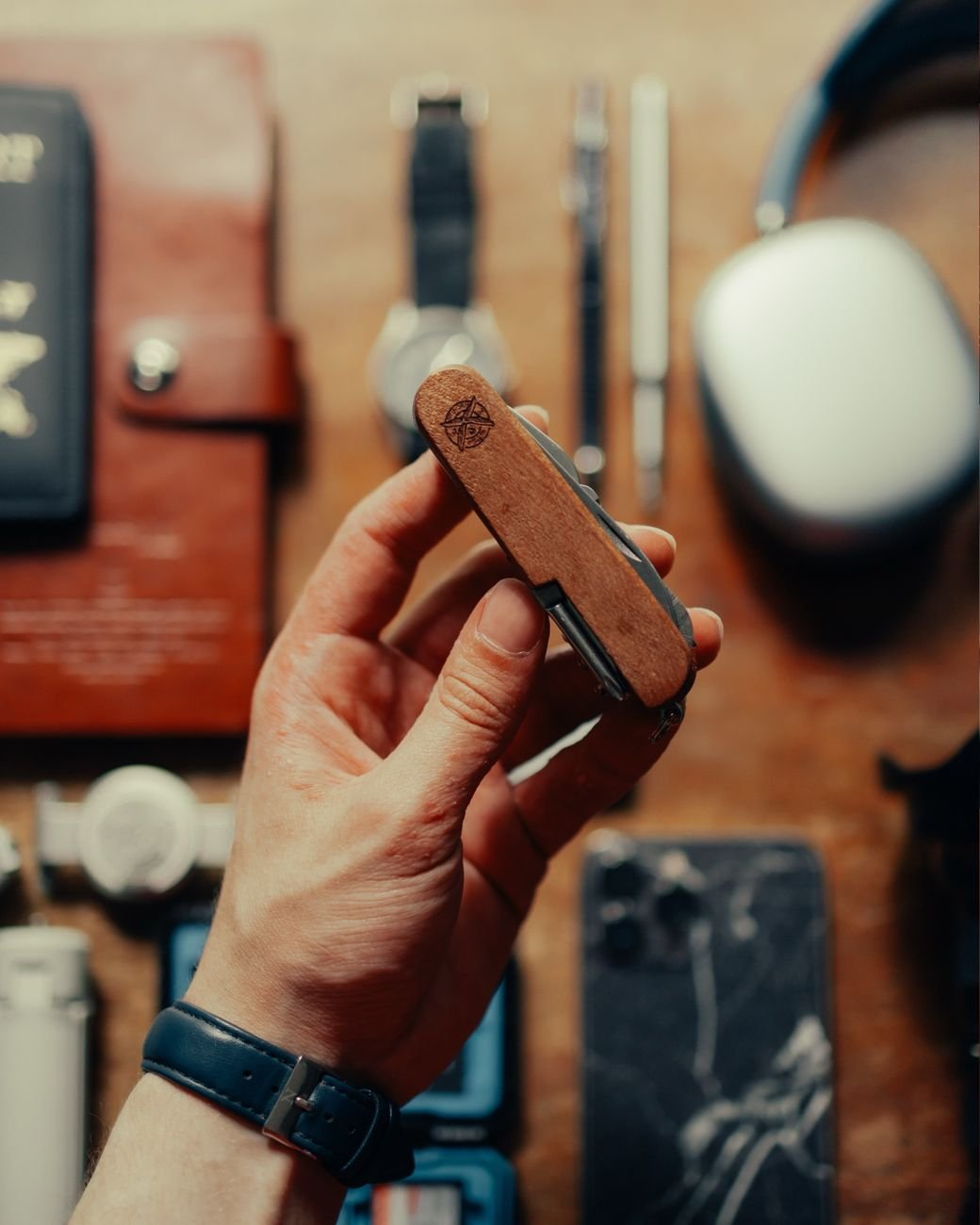
“Compact” on a spec sheet can still feel like too much tool in a small hand.
A tool may be only a few inches long yet still force the thumb to stretch past the pivot, leave the fingers unable to wrap the handle, or bury the nail nick under the palm. In that position, opening a blade or driver becomes a grip shuffle rather than a deliberate action—especially when the tool is held one-handed.
Fit is therefore a control issue, not a luxury. A narrower closed profile keeps the handle from rotating in the palm; reachable access points let an implement be selected without repeated repositioning; and a shorter handle can make the pivot’s resistance easier to read. Predictable handling comes from secure contact and clear visibility of the working end, not simply from a lower weight or a “mini” label. A well-sized multitool also reduces the temptation to pinch an awkwardly exposed implement or apply torque from an unstable grip.
- Compare closed length and handle width: thickness often decides whether fingers can fully close around the tool.
- Check where the nail nick, lock release, and pivot sit when the tool is actually gripped.
Dimensions that reveal a better fit
Handle span
The usable distance from one end of the closed tool to the other, excluding protruding lanyard rings or pocket clips. It indicates how much handle remains under the palm during a firm squeeze.
Cross-section
The handle’s width and thickness together. A short tool can still feel oversized when its body is thick, while a narrow, flat profile lets smaller fingers wrap farther around it.
Grip index
The relationship between handle width and finger reach. On a well-matched tool, the fingertips meet the palm-side handle rather than stretching, stacking, or leaving a weak gap.
Control reach
The distance and angle from a normal grip to a nail nick, thumb stud, release, lock, or spring. A compact tool loses much of its advantage when opening requires a grip shift or two hands.
Pinch clearance
Space around the pivot and moving handles where thumb and fingertips work. Rounded edges and exposed control surfaces reduce interference; crowded hardware can make a slim tool feel awkward.
A shorter multitool may fit a pocket yet remain difficult to control if its handles are chunky or its pivots sit beyond thumb reach. Width, thickness, and access geometry determine the working fit.
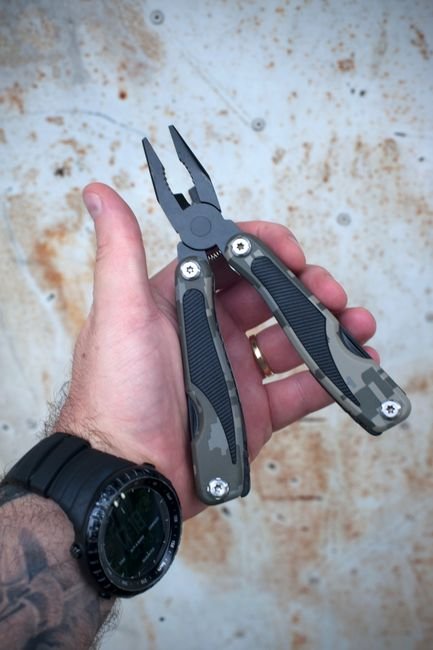
For plier-based designs, handle separation matters as much as body size: wide-open handles can exceed a small hand’s comfortable closing range even when the folded tool is very short.
Match the tool to the work that repeats
-
Start with a short task log
A week of repeated jobs reveals more than a feature chart: loose screws, packages, cord, tape, bike adjustments, or splinters of wire. The useful baseline is everyday-carry multitool fundamentals, then the tool can be judged by its most frequent demands.
-
Trace the access sequence
Note whether the needed implement opens from the outside, requires unfolding the handles, or is blocked by another tool. A capable bit driver has little everyday value when reaching it takes two hands and several motions.
-
Match force to the handle
Pliers, cutters, and drivers transfer load through the grip. Short handles can suit light control work, but hard cutting or seized fasteners demand enough leverage and a shape that does not rotate in the palm.
-
Separate precision from capability
Fine screws, shallow recesses, and small pull tabs reward narrow tips, clear sightlines, and low pivot resistance. Large-capacity tools can feel clumsy when the job requires millimetres of placement rather than maximum force.
-
Account for gloves and dirty hands
Gloves reduce feel and enlarge the effective hand size; wet or oily conditions reduce traction. Raised opening tabs, distinct tool profiles, and non-slip handle edges can matter more than an extra blade or file.
The best everyday tool is often the one whose two or three regularly used functions are reachable, controllable, and easy to put away. Rarely used implements add value only when their bulk, weight, and access penalty do not compromise those repeat tasks.
Shape beats shortness
Fit and feel of small hand multitools
A multitool can be compact. It may feel insecure if its handle is broad, boxy, or too slick for the fingers to close around. A shorter tool with a thicker grip can be hard to control in tight spaces. For small hand multitools, a slightly longer tool with a narrow, gently rounded cross-section often offers better purchase. This balance helps you grip quickly and apply force without slipping.
Closed length is only one dimension of fit. A tool that feels comfortable in your hand also depends on its cross-section and edge rounding. That setup gives you confident handling during everyday tasks. Choose a grip with subtle texture to prevent slipping in wet conditions.
Finger wrap is the key difference. When the fingertips can reach far enough around the handle to oppose the thumb, the hand needs less squeezing force to steady a driver, saw, or blade. That reduces the tendency to shift grip halfway through a cut or twist. A modestly longer handle can also place the heel of the palm farther from the working end, improving leverage without requiring an oversized grip.
Edges deserve close attention. Light chamfers and rounded spine edges guide the hand into a repeatable position; sharp corners concentrate pressure and can make a tool feel larger than its measurements. Texture helps, but aggressive knurling is not a substitute for a shape that lets the fingers wrap naturally.
A pocket clip changes the closed-tool experience, too. A wide or proud clip can occupy the exact surface where the ring and little fingers want to rest. Reversible clips, flush-mounted designs, or clip-free handles often feel cleaner in small hands.
Finally, opening resistance should match the task. A stiff nail nick or heavy detent can force an awkward pinch; a tool that opens with controlled, deliberate resistance is less likely to snap open or demand a grip change.
With the tool closed, check whether the fingertips can wrap past the midpoint without resting on a clip or a hard corner. Then open the most-used implement: the hand should not need to slide forward to overcome its opening force.
Choose the opening architecture
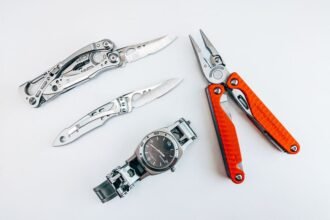
A compact folding multitool keeps its handles together and usually carries like a thick pocketknife. Its knife, driver, and scissors can be reached without opening pliers, which suits frequent light cuts and adjustments. The trade-off is that folded pliers handles are often narrow and short: adequate for controlled pinching, less convincing when a stubborn fastener or wire demands torque.
Butterfly-opening tools create full-size pliers handles from a short closed package. That gives the best leverage-to-length ratio, but opening requires two moving handles and a larger clear area. For smaller hands, the fully spread grip can exceed a comfortable span; the wrist then compensates, especially during repeated squeezing. External implements improve access, yet add thickness and may introduce more edges against the palm.
A keychain tool wins decisively on carry bulk, not capability. The small-hand-friendly keychain format works well for a parcel tape cut, tiny screw, nail-file touch-up, or bottle cap. Its short driver reach, shallow purchase, and minimal leverage make it a companion to a proper tool—not a shrunken substitute for pliers.
Small hand multitools overview
Modular systems separate the carry decision from the task decision. A slim handle or base can accept a driver, bit holder, or purpose-built attachment.
They can keep grip span manageable and reduce redundant implements, but connections add play, setup time, and pieces that must be tracked.
A module is most worthwhile when the same interface supports repeat work; for occasional jobs, a simple folding tool is usually faster.
| Format | Strongest advantage | Real compromise |
|---|---|---|
| Folding | Quick single-tool access | Limited plier leverage |
| Butterfly | Strong pliers in short storage | Wide open grip span |
| Keychain | Almost no carry burden | Strictly light-duty use |
| Modular | Task-specific configuration | Setup and connection play |
Prioritize the tools that do real work
Small hand multitools: balance of form and function
A compact multitool earns its place through four implements. A blade or scissors are reachable without opening the pliers. Drivers stay engaged, pliers close cleanly at the tip, and cutters match the material.
Moreover, ten rarely used attachments cannot compensate for weakness in these basics.
Cutting and driving without fighting the tool
Performance notes for small hand multitools
For routine package, cord, tape, and light trimming work, outside-accessible scissors or a blade reduce the awkward two-handed deployment. This keeps small hand multitools more compact and easier to handle in tight spaces. The result is less bulk during everyday use without sacrificing cutting capability.
Drivers deserve equal scrutiny. Because dependable bit interfaces improve torque transfer and engagement. A rigid, appropriately sized bit interface is more useful than a broad collection of thin, flex-prone flat drivers. Additionally, short handles naturally limit torque, so positive engagement matters.
Read the cutter geometry
Wire notches and cutting edges in pliers heads
Many pliers heads, including small hand multitools, have a wire notch near the pivot. It is commonly intended for soft, light-gauge wire and is not equivalent to dedicated cutters.
Harder wire and thicker stock demand sharper, more robust cutting edges and sufficient leverage. Also, a head should not twist in the hand.
For jobs involving fine cable ties, electronics leads, or craft wire, compare small-hand models with more capable cutters for delicate work. Jaw tips also matter: narrow, well-aligned tips can grip a tiny fastener or pull a splinter-sized object, while broad, poorly meeting jaws merely pinch. The best choice is the one whose blade, drivers, jaws, and cutters remain controllable at the tasks that recur.
Small does not automatically mean safer
Compact size reduces some leverage and carry bulk, but it can also crowd the hand near sharp implements and closing handles.
Safety depends on whether fingers have a clear place to rest and remain outside the blade, cutter, and plier-closing paths.
A firm detent can suit light, controlled cuts; a positive lock adds protection when cutting resistance could fold the blade toward the fingers.
Detent strength should be judged in actual material, not by the reassuring feel of opening the tool empty.
A slim profile helps reach controls, but modest texture, rounded edges, and a non-twisting grip often matter more under pressure.
A handle that rotates or slides forces grip corrections precisely when the implement is loaded.
Before an implement is folded away, the hand needs a clear finger path around its edge and the handles’ travel. Small tools can concentrate several moving parts into very little space.
A secure lock or detent, visible contact points, and grip texture help make movement predictable. They reduce surprises; they do not make distracted operation safe.
Choose leverage or driver access
A medium pliers-based tool earns its extra thickness when the job involves holding, bending, pulling, or cutting material that resists a fingertip-sized grip. Longer handles give the hand more mechanical advantage, while full-size pliers jaws keep the work farther from knuckles and improve visual control. For mechanics use that still fit small hands, this format is often the more capable compromise.
It is especially useful for:
- gripping a rounded nut or small fitting while a separate wrench turns it;
- bending light wire, pulling staples, or cutting ties and soft wire;
- holding a part steady during assembly, where jaw alignment matters more than speed.
A thin, driver-first tool is better suited to frequent, low-torque adjustments: tightening cabinet hardware, opening battery compartments, trimming tape, or turning common screws. Its advantage is not force but access: it slips into a pocket, presents a driver quickly, and is less fatiguing during repetitive light tasks. A centered bit holder and a handle broad enough to resist twisting matter more than an oversized tool count.
Neither class replaces dedicated equipment for seized fasteners, high-torque bolts, thick or hardened wire, plumbing fittings, or sustained prying. Small pivots, short driver arms, and compact jaws can flex, cam out, or lose bite before the task is safely controlled. When force rises, a dedicated wrench, pliers, cutter, or screwdriver provides a larger margin.
Let repeated work decide
-
Rehearse the job that recurs
Open the tools needed most and mimic the usual cut, turn, or grip; awkward transitions are a meaningful warning.
-
Load the grip lightly
A secure hold keeps the palm centered, fingers clear of closing handles, and wrist close to neutral without a white-knuckle squeeze.
-
Test primary-tool reach
The blade, driver, or pliers should be accessible without shifting the hand into a precarious pinch grip.
-
Treat unused features as bulk
Extra implements earn their space only when they solve a recurring task without making the body harder to control.
Frequently Asked Questions
Does a shorter closed length always mean a multitool is easier for a small hand to use?
Not necessarily. Closed length is only a packing measurement — handle width, cross-section, and control reach (how easily the fingers reach the nail nick, thumb stud, lock, or driver) are what actually determine whether the tool is controllable.
What is "finger wrap" and why does it matter?
Finger wrap describes whether the fingertips can reach far enough around the handle to oppose the thumb. When they can, the hand needs less squeezing force to steady a driver, saw, or blade, and is less likely to shift grip mid-task.
Which multitool format gives the best pliers leverage for a small hand?
Butterfly-opening tools create full-size plier handles from a short closed package, giving the best leverage-to-length ratio. The trade-off is that the fully spread grip can exceed a comfortable span for smaller hands.
Are folding multitools a good choice for small hands?
They can be: a folding multitool keeps its handles together and lets the knife, driver, and scissors be reached without opening the pliers, which suits frequent light cuts. Its folded plier handles are often narrow and short, though, so they’re less convincing for a stubborn fastener or wire that needs torque.
Is a smaller multitool automatically safer?
No. Compact size reduces some leverage and carry bulk, but it can also crowd the hand near sharp implements and closing handles. Safety depends more on whether the fingers have a clear place to rest and stay outside the blade, cutter, and plier-closing paths.
What is the small wire notch near the pivot actually good for?
It’s generally intended for soft, light-gauge wire and is not equivalent to dedicated cutters. Harder wire, thicker stock, and flush or repeatable cuts need sharper, more robust cutting edges with sufficient leverage and a head that doesn’t twist in the hand.
The best fit is rarely the tool with the longest feature list. It is the smallest multitool that reliably covers recurring work while maintaining a natural, secure grip in the positions that work demands.



8 Comments
I do light electrical work around the house, mostly stripping small wire and tightening terminal screws. Would you generally lean toward the thin driver-style tool for that, even if it means giving up better pliers?
Are rounded handles always better? I get the comfort argument, but a little flat surface seems like it would stop the tool from rotating when I’m twisting a driver.
The “shape beats shortness” point is spot on. My supposedly pocket-sized tool is short but so chunky that it feels like trying to turn a screwdriver with a potato.
How does glove use change the recommendation? My hands aren’t huge, but with thin work gloves on, nail nicks and outside-access tools can become surprisingly annoying.
I’m wondering whether a slightly wider tool with easier implement access is actually the better small-hand choice once gloves are involved, or whether that just creates more grip-span problems.
I’ve found that easier access wins with gloves, especially if you’re opening the blade or driver a lot. A narrow tool is nice until you can’t get a fingernail under anything. Look for raised tabs or a slot you can catch with a thumb, not just a nail nick.
I bought a slim driver multitool for eyeglasses and computer stuff, then tried using it on a stuck cabinet screw. Bad decision, very little leverage, lots of regret.
This article makes the tradeoff clearer: fast access and low torque versus actual gripping power. I probably need to stop expecting one tiny gadget to be my whole toolbox.
One thing I wish more guides discussed is pivot tension changing over time. A tool may have nice controlled opening resistance out of the box, then loosen after a few months in a pocket.
For someone with smaller hands, is a slightly stiff pivot preferable because it reduces accidental movement, or does that create too much of a two-hand-opening struggle?
I appreciate the warning that compact doesn’t automatically equal safer. A tiny handle can make a blade feel *less* controlled, not more. “Small” is not a safety feature, apparently—who knew?