Rhino USA Survival Hiking Stick Multi-Tool

Rhino USA Survival Hiking Stick Multi-Tool Review: Walking Staff with Compass & Built-In Fire Starter for Camping & Backpacking
Introduction
The Rhino USA Survival Hiking Stick Multi-Tool is a multifunction walking staff designed for
outdoor enthusiasts who want a practical tool that stays with them on the trail. Manufactured by Rhino USA,
this product falls into the category of survival and hiking multi-tools—specifically a hiking
cane/staff with added emergency and navigation features.
Intended for camping, backpacking, and general hiking, the concept is straightforward:
replace (or reduce the need for) a few separate items—such as a compass and fire-starting capability—by
integrating them into a single, carry-friendly hiking stick.
Overview & What It Is
This is essentially a walking staff that doubles as a survival-oriented multi-tool. The staff
includes a compass for navigation and a built-in fire starter for
emergency or campfire use. The idea is that when you’re already carrying a hiking pole, you can gain
added utility without needing a separate dedicated tool.
Appearance, Materials & Design Aesthetic
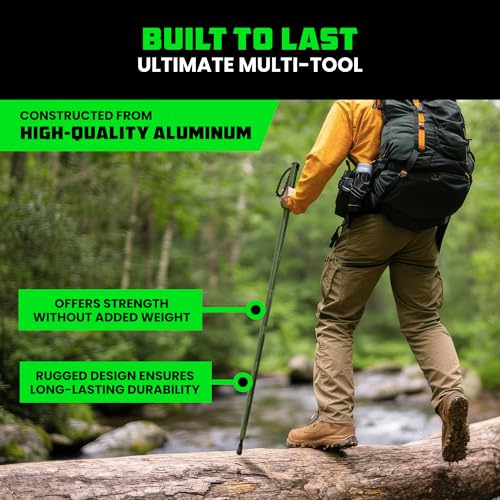
Visually, the Rhino USA staff presents as a robust, trail-ready hiking cane rather than a flashy gadget.
The overall aesthetic is utilitarian: it looks built for functional outdoor use, not showroom display.
In terms of design, the key “standout” elements are the embedded navigation (compass) and the
emergency-focused component (fire starter). The integration of these features into a
walking-stick form factor is the defining design choice.
Design note: Because this is a hiking staff first, the controls and additions are typically
designed to be accessible when needed, while still allowing comfortable use as a walking aid.
Buyers should expect the staff to feel like a practical hiking tool with minor “survival tech” complexity
rather than a full survival kit in stick form.
Key Features & Specifications
- Product type: Survival hiking stick / walking staff multi-tool
- Brand: Rhino USA
- Intended use: Camping, backpacking, hiking, and emergency preparedness
- Built-in compass: For basic navigation and route awareness
- Built-in fire starter: Designed to help initiate fire in camp or emergency situations
- Form factor: Walking staff/pole designed to be carried on hikes
- Multi-function concept: Combines a walking aid with two common “field needs” (navigation + fire)
Note: Exact dimensional specifications (length, weight, materials, and adjustment ranges) are not fully
provided in the source data supplied here. If you need those details to judge packability or sturdiness,
check the product page listing for the latest specs.
Experience on the Trail
1) Daily Hiking & Uneven Terrain
On the trail, the staff’s value depends on how naturally it fits your stride and how stable it feels under
load. As a walking stick, it aims to provide the expected benefits: improved balance, reduced strain on
knees, and more controlled movement on uneven ground.
Because the compass and fire-starting components are integrated, the overall feel tends to be “tool-like,”
meaning it may not be as minimalist as a standard lightweight hiking pole. However, for travelers who
prefer to carry fewer separate items, that tradeoff can be worthwhile.
2) Navigation & Orientation
The included compass is the key navigation feature. In practical terms, it’s best suited
for basic orientation—confirming direction, checking bearings, and re-grounding yourself
if you lose track of the route.
For serious navigation (multi-leg route planning, detailed topographic reading, or complex map work),
hikers typically rely on a map and compass workflow or a GPS device. This stick compass is better treated
as a helpful backup or quick-reference tool rather than a replacement for full navigation equipment.
3) Camping Use & Fire Starting
The built-in fire starter addresses one of the most critical “survival and comfort” needs:
getting a fire going. In camping scenarios, the expectation is that you can use it to ignite tinder or
help start a workable flame for warmth and cooking.
As with most integrated fire-starting solutions, performance depends on technique and conditions (wind,
moisture, tinder quality). The staff design makes the fire-starting capability convenient to have on-hand,
particularly for emergency readiness or when you’d rather not carry an additional dedicated fire tool.
Buyer expectation setting: If you already carry a proven fire-starting kit (e.g., multiple
ignition methods), this stick likely serves as a supplementary backup. If you don’t, the integrated system
may be a welcome convenience—but still be prepared with appropriate tinder and wind protection.
4) Emergency Preparedness
In an unexpected situation—injury, disorientation, or being delayed—this product’s integrated features
can reduce reliance on digging through a pack. Having a compass and a fire-starting option built into
what you already carry (your walking stick) is a meaningful advantage.
That said, survival outcomes depend on much more than tools alone: water, insulation, signaling, and
sound judgment matter. Treat the Rhino USA stick as one part of an overall plan, not the
complete solution to safety.
Pros
- Multi-purpose convenience: Combines walking support with navigation and fire-starting tools.
- Useful redundancy: Provides emergency-capable features while keeping your carry load simpler.
- Practical, utilitarian design: Looks and feels suited to real outdoor use.
- Trail-first functionality: Designed primarily as a hiking staff, so it doesn’t require a separate carry habit.
- Quick-reference navigation: The compass can help you regain direction or confirm bearings.
Cons
- Integrated tool tradeoffs: Compared to a dedicated lightweight hiking pole, added components may increase weight/bulk.
- Compass limitations: Likely best for basic orientation rather than detailed navigation tasks.
- Fire-starting performance varies: Success depends on technique, tinder quality, and environmental conditions.
- Spec details not provided in source: Without clear material/length/weight information, it’s harder to judge suitability for every user.
Conclusion
The Rhino USA Survival Hiking Stick Multi-Tool is a smart idea for hikers and campers who want
a single carry item that supports daily trekking while adding survival-oriented utility. Its major strengths
are the integrated compass for quick orientation and a built-in fire starter
that adds meaningful value in camping and emergency contexts.
The main compromises are the typical ones for multifunction gear: potential added weight/bulk versus a
minimalist hiking pole, and the reality that integrated tools often perform best as backups or quick aids
rather than full replacements for dedicated navigation and fire kit systems.
Overall, this is a strong option for backpackers who like redundancy and convenience and for anyone
seeking an all-in-one staff-style tool for camping readiness. If you want a compact, trail-friendly way
to carry navigation and ignition support, the Rhino USA survival hiking stick is worth considering.


Rhino USA Survival Hiking Stick: Common Questions
Does the built-in compass replace a dedicated navigation setup?
No. It’s best suited for basic orientation like confirming direction or checking bearings; for multi-leg route planning or detailed map work, hikers should still rely on a proper map-and-compass workflow or a GPS device.
Will the built-in fire starter work in any weather?
Performance depends on technique and conditions such as wind, moisture, and tinder quality, just like any integrated fire-starting solution—it should be paired with appropriate tinder and wind protection rather than relied on alone.
Is this stick a full survival kit by itself?
No. Survival outcomes depend on much more than tools alone—water, insulation, signaling, and sound judgment matter—so the stick is best treated as one part of an overall plan, not the complete solution.
Who is this hiking stick best suited for?
Backpackers who like redundancy and convenience, and anyone who wants a single carry item that supports daily trekking while adding backup navigation and fire-starting capability.
Does adding a compass and fire starter make the stick heavier than a standard hiking pole?
Likely yes to some degree—the integrated components can add weight and bulk compared to a dedicated lightweight hiking pole, which is a typical tradeoff for multifunction gear.
Unboxing and first thoughts on the Rhino USA Tactical Hiking Stick with Integrated Survival Kit