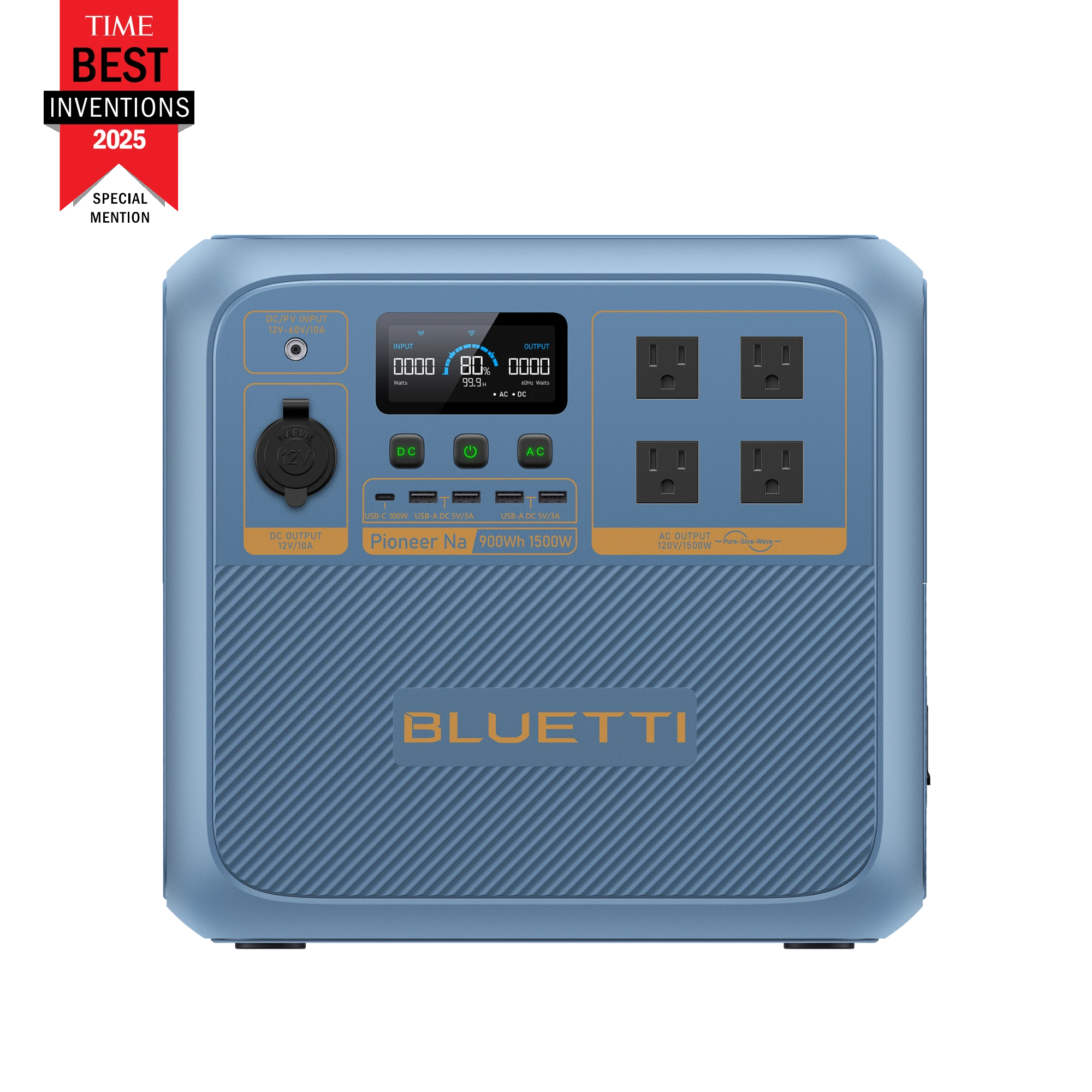
BLUETTI 1500W Sodium Portable Power Station
Introduction
The BLUETTI Pioneer Na (marketed as the BLUETTI 1500W Sodium Portable Power Station) is a new entrant in the consumer portable power station market that uses sodium‑ion battery chemistry. BLUETTI positions it as a rugged, all‑weather solution for home backup, outdoor use, and mobile power needs. This review examines the key claims — 1,500W continuous output, 900Wh capacity, 1,900W fast charging, -25°C operation, and a long battery life rated at 4,000+ cycles — and evaluates how those translate into real‑world usefulness.
Overview
- Manufacturer: BLUETTI
- Product category: Portable power station / battery generator
- Model: BLUETTI 1500W Sodium Portable Power Station (Pioneer Na)
- Primary intended uses: home backup for short power outages, camping and RV/van life, jobsite or remote power for tools and electronics, and cold‑weather applications
- Manufacturer claims (high level): World’s first sodium‑ion portable power station with 1,500W output, 1,900W fast charging capability, operation down to -25°C, 4,000+ cycles, and an expected 10‑year battery life
Appearance, Materials & Design
The Pioneer Na follows the familiar portable power station form factor: a compact rectangular housing intended for tabletop or trunk placement. BLUETTI’s industrial design language is evident — functional, utilitarian, and focused on rugged everyday use rather than style for its own sake.
BLUETTI commonly uses durable plastics for external panels and metal reinforcements around critical components; the Pioneer Na continues that trend with a look and feel that prioritizes toughness and portability. A practical carrying handle (integrated or foldable on similar BLUETTI models) and straightforward front‑panel controls make it easy to move and operate. The product is clearly aimed at buyers who want reliable functionality rather than a premium boutique finish.
Notable design elements tied to this model’s marketing are the sodium‑ion branding and emphasis on low‑temperature operation — features BLUETTI highlights to set the Pioneer Na apart from many lithium‑based rivals.
Key Features & Specifications
- Battery capacity: 900Wh (sodium‑ion chemistry)
- Continuous AC output: 1,500W
- Fast charging input capability: 1,900W (very high‑power input for rapid recharge)
- Cold‑temperature operation: Rated down to -25°C
- Cycle life & longevity: 4,000+ cycles; BLUETTI advertises a 10‑year battery life
- Claim to fame: Marketed as the world’s first sodium‑ion portable power station
Hands‑On Experience & Real‑World Use
First impressions and setup
Unboxing and basic setup are straightforward. The unit’s controls and indicators are intuitive, and powering the unit up is quick. The weight and footprint are typical for a 900Wh class station — portable for one person, but not pocketable.
Powering appliances and electronics
The Pioneer Na’s 1,500W continuous inverter is capable of running most common household devices and small appliances simultaneously — for example, laptops, lights, small refrigerators, CPAP machines, and power tools with moderate draw. As a rule of thumb, you can estimate runtime by dividing the 900Wh capacity by the device draw:
- 60W laptop → ≈ 15 hours
- 50W mini fridge (average) → ≈ 18 hours
- 1500W microwave or heater at full output → ≈ 0.6 hours (~36 minutes)
- Typical smartphone full charges (~15Wh) → multiple dozen charges
These are theoretical maximums; real runtime will be lower after accounting for inverter losses, efficiency, and accessory draws. The key benefit here is that the inverter rating (1,500W) lets you run heavier loads than many smaller stations while keeping the unit size and price relatively compact.
Charging performance
The Pioneer Na touts a 1,900W fast‑charging capability. In practice, an input rating that high means the unit can be recharged extremely quickly from a compatible high‑power AC source or generator. Expect substantially shorter recharge times than conventional small power stations — BLUETTI’s spec implies the unit is designed to minimize downtime between uses. Actual charge time will depend on charge curve design and environmental factors, but the high input ceiling is a genuine advantage when you can access an appropriate power source.
Cold‑weather operation
One of the headline differentiators is the -25°C operating rating. If you frequently use portable power in subzero climates (winter camping, cold‑weather job sites, high altitude), the Pioneer Na’s thermal tolerance is a practical benefit. Many lithium chemistries struggle or require warming at low temperatures; BLUETTI’s sodium‑ion approach appears aimed at eliminating the need for elaborate battery thermal management for cold‑weather users.
Longevity and cycle life
With a claimed 4,000+ cycles and a 10‑year lifespan, the Pioneer Na targets buyers who want a long‑term energy asset rather than a short‑lived gadget. If these cycle figures hold up in independent testing, the total cost of ownership could be favorable over time — especially for frequent users of portable storage.
Pros & Cons
Pros
- High inverter output (1,500W): Can run a wider range of appliances than lower‑powered rivals.
- Very fast recharge capability (1,900W input): Minimizes downtime when a high‑power source is available.
- Cold‑temperature operation (-25°C): Built for reliable use in extreme cold where many batteries falter.
- Long cycle life: 4,000+ cycles and a 10‑year battery life projection improve long‑term value.
- Sodium‑ion chemistry: A novel option in the consumer space — promising different tradeoffs than typical lithium variants.
- Competitive price for specs: The feature-to-price ratio is attractive for this performance class.
Cons
- Capacity tradeoff: 900Wh is a moderate capacity — generous for short trips or partial home backup, but you’ll need multiple units or a larger station for extended outages.
- Sodium‑ion is new for consumers: While BLUETTI’s claims are compelling, sodium‑ion chemistry is less battle‑tested in portable consumer stations than some lithium chemistries; independent long‑term data is still accumulating.
- Details on ports & features: Specific port counts, expansion options, and solar integration details are important for buyers but are not covered by the headline specs alone — check BLUETTI’s full spec sheet for port types and counts before purchase.
- Real‑world charge times vary: The 1,900W input is excellent on paper, but to take advantage of it you need a matching high‑power AC source or generator, which is not always available in every situation.
Conclusion
The BLUETTI Pioneer Na is an intriguing and capable portable power station that brings sodium‑ion chemistry into a mainstream product with practical benefits: a strong 1,500W inverter, a rapid 1,900W charging ceiling, operation in very cold temperatures, and a long rated cycle life. For users who need reliable power in cold climates, those who value rapid recharge, or those who want a high‑output unit at a competitive price point, the Pioneer Na is a compelling option.
However, buyers should balance the 900Wh capacity against their intended use — it is excellent for short outages, overnight support for essential loads, and extended off‑grid use for small devices, but not a substitute for larger home backup systems when multi‑day coverage for whole‑home loads is required. Also, because sodium‑ion technology is relatively new in this product category, prospective buyers who prioritize long‑term, widely‑documented chemistry performance may want to follow independent long‑term test results as they become available.
Overall impression: the BLUETTI Pioneer Na delivers strong, practical performance for a wide range of users and stands out for cold‑weather reliability and rapid recharge capability. If those features match your needs and you accept a moderate 900Wh capacity, it’s a compelling, well-priced choice in the portable power station market.

Testing the BLUETTI Pioneer Na means putting a sodium power station through real charging, runtime, and cold-weather scenarios instead of taking the spec sheet at face value.
Frequently Asked Questions
What makes the BLUETTI Pioneer Na different from other power stations?
It uses sodium-ion battery chemistry rather than lithium, and BLUETTI markets it as the world’s first sodium-ion portable power station, with claimed cold-weather advantages and long cycle life.
How cold can the BLUETTI Pioneer Na operate?
It’s rated to operate down to -25 C, a practical benefit for winter camping, cold-weather job sites, or high-altitude use where many lithium batteries struggle without warming.
How fast does the Pioneer Na recharge?
It supports up to 1,900W fast-charging input, which can significantly cut recharge time when a compatible high-power AC source or generator is available.
How long will the BLUETTI Pioneer Na run common devices?
Its 900Wh capacity gives roughly 15 hours for a 60W laptop or about 18 hours for a 50W mini fridge, though a 1,500W device at full draw would drain it in about 36 minutes.
How long does the Pioneer Na's battery last?
It’s rated for 4,000+ cycles with an advertised 10-year battery life, though independent long-term data on sodium-ion consumer stations is still accumulating.