

The real test starts when alertness disappears.
At 2:17 a.m., the room is black, pulse spikes, and fine motor control shrinks. A bedside safe is not judged by lab speed alone; it is judged by what happens half-awake, off-angle, and with damp fingers.
Failure is broader than a lock that never opens. Biometric models can pause, misread, or lock out after bad scans; mechanical ones can invite fumbling through a stiff button sequence or tiny keyway. The worse flaw may be opening too easily under prying or simple bypass. The better design is the one that stays predictable after idle months, not merely fast on day one.
Biometric and mechanical each make a legitimate handgun safe, but they fail in different places: one trades battery and sensor risk for speed, the other trades a touch of speed for a lock that never needs power. The right handgun safe for a bedside table is the one whose most likely failure mode you can live with at 2 a.m.
Three fast fits


Three ways a safe can fail
A handgun safe is not reliable in one universal way. Fast access, physical resistance, and day-to-day upkeep often move in different directions.
This covers false rejects, keypad fumbles, wake delay, and one-hand use in the dark. Biometric locks can be fastest until sensor condition or battery state interferes.
This covers pry resistance, latch strength, hinge exposure, and cable vulnerability. A thicker mechanical box may resist attack better even if it is slower to open.
This tracks batteries, fingerprint enrollment, app pairing, override-key storage, and maintenance drift. Low daily friction matters because neglected safes often fail long before the lock breaks.
A bedside safe can feel effortless for the owner yet fold under simple attack. The reverse also happens: a stout mechanical box may be reassuringly tough, but awkward fingers, darkness, and stress can turn toughness into delay.
What actually goes wrong with biometric and mechanical safes
Most misses come from bad finger placement, dry or dirty skin, rushed scans, or sleepy one-handed use—not the mere presence of a fingerprint reader.
Biometrics are usually fastest in ideal conditions, but bedside access punishes narrow scan windows and weak sensors.
A Simplex-style mechanical lock is often slower on its best run, yet more repeatable when batteries are dead, hands are cold, or electronics need waking.
Mechanical delay is usually human: recalling the code, hitting the sequence cleanly, and lifting the lid under stress.
Mechanical safes avoid charging and low-voltage lockouts, but they still fail through forgotten codes, mis-presses, worn controls, or weak anchoring.
Access reliability and break-in resistance are separate; a dependable lock on a lightly secured box is still a compromise.
Apps, logs, and multiple entry methods mainly improve convenience and management; they do not automatically improve steel strength or pry resistance.
If the feared failure is unauthorized entry, lock type matters less than door thickness, boltwork, hinge protection, and mounting.
| Cold-start access | Works without battery | Typical access failure | Steel/tamper bias | Upkeep burden | ||
|---|---|---|---|---|---|---|
|
BILLCONCH Smart Biometric Pistol Safe with App Smart access | Fast, variable | False reject | Charge/manage | View | ||
| Slower, steady | Code fumble | Near-zero | View | |||
| Slower, steady | Code fumble | Near-zero | View |
Smart biometric access with layered entry
Fast fingerprint and app access
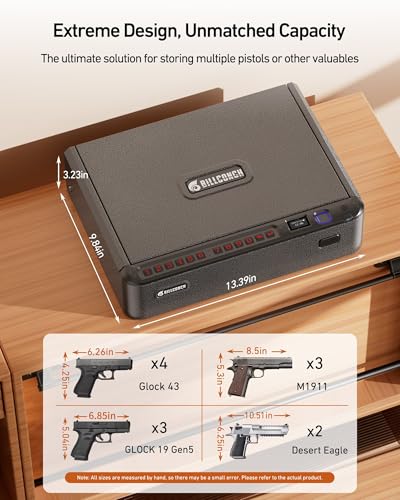
BILLCONCH is the clearest argument for choosing a biometric handgun safe for convenience first. Its appeal is not that fingerprint entry becomes magically infallible; it is that the safe stacks several alternate paths—fingerprint, keypad, physical key, and app unlock—so one bad read does not automatically become a hard stop. That makes it a strong fit for buyers who want fast bedside-style access but are willing to accept a more electronic, feature-heavy system.
- Four access methods reduce single-point lockout
- App can manage fingerprints, battery status, and access records
- Stores many fingerprints for multi-user setups
- Voice/LCD setup lowers configuration friction
- Battery state becomes part of reliability
- More electronics means more upkeep variables
- App features add another dependency layer
- Not the cleanest pick for pure mechanical simplicity
BILLCONCH makes the strongest case for biometric speed because it treats fingerprint unlock as the first lane, not the only lane. Its keypad, key, and app fallback paths soften the usual false-reject problem, but that convenience comes with the normal costs of batteries, electronics, and software dependence. For shoppers comparing biometric against mechanical, this is the model that best shows how layered access can narrow the reliability gap without erasing it.
Viking VS-12LSX for long-term mechanical trust
Purely mechanical, pry-resistant construction
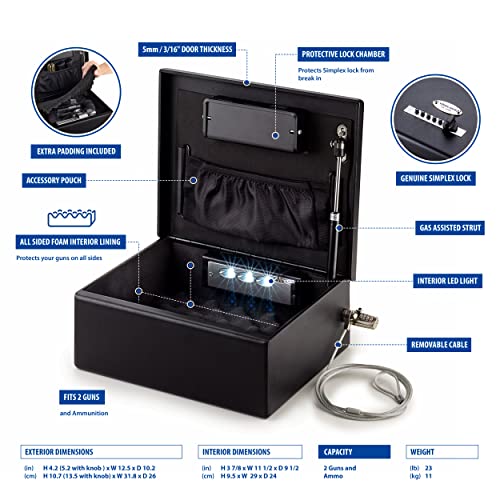
Built around a fully mechanical Simplex lock, the Viking is the clearest case for long-horizon dependability. No batteries, fingerprint reader, or app layer means fewer parts to drift with age, storage, or neglect. For readers comparing a Simplex bedside safe, this is the reference point.
It fits buyers who value predictable operation years from now more than the fastest possible opening in a rushed moment.
- No batteries or electronics to age out
- Simplex lock stays credible after long storage
- Pry-resistant steel build matches the lock philosophy
- Entry is more deliberate than biometric tap-open
- Fatigue or darkness can slow button input
- Limited code complexity versus electronic systems
This is the model that best illustrates why mechanical safes still matter. Its trust comes from simplicity: a proven pushbutton lock, no power chain, and fewer failure modes that creep in over time.
The compromise is equally clear. Access is usually consistent, but not effortless; in the dark, half-awake, or rushed, a mechanical sequence can be slower than a good biometric system.
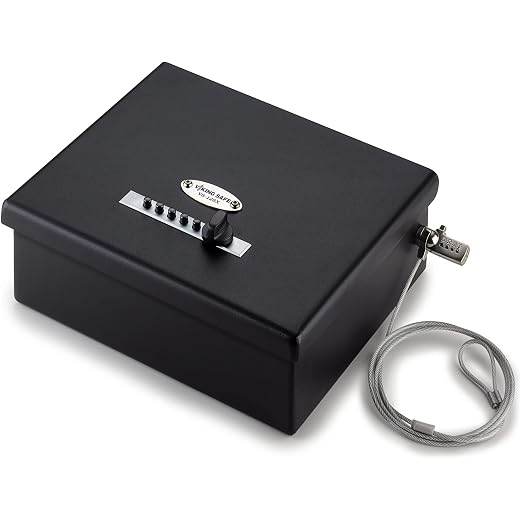
Battery-free access in a lighter portable safe
- Simplex lock needs no batteries
- Predictable entry after long storage
- Easy to stash for travel
- Lower pry resistance than bolted safes
- Cable anchor can become the weak link
- Tight fit for larger pistols
Battery-free access is the main advantage. In compact travel safes, failure often moves away from the lock and toward the box itself: thinner steel, shorter overlap, and cable-based anchoring can leave the container vulnerable even when the push-button mechanism is the most trustworthy part.
-
Start with the failure most likely to matter
For pure lock reliability, mechanical usually fails less because it does not depend on batteries, sensors, or electronics. That makes the Viking VS-12LSX and the portable mechanical safe the steadier bets.
-
Test access in darkness and under a timer
If a fingerprint opens cleanly, repeatedly, and faster than a button sequence when hands are cold, damp, or shaky, biometric can be the lower real-world failure path for that owner. If not, its theoretical speed does not count.
-
Check the fallback path
Any electronic safe needs a backup that is reachable and memorable in the dark. Layered entry matters more than app features once the primary method misses.
-
Match the safe to usage frequency and threat level
Frequent bedside access can favor the BILLCONCH if enrollment and backup methods are well-practiced. Higher forced-entry risk favors heavier mechanical construction; light travel safes trade attack resistance for portability.
Frequently Asked Questions
Do biometric handgun safes fail because fingerprint readers are unreliable?
Most misses come from bad finger placement, dry or dirty skin, rushed scans, or sleepy one-handed use rather than the fingerprint reader itself. Biometrics are usually fastest in ideal conditions, but bedside access punishes narrow scan windows and weak sensors.
Are mechanical locks too slow for defensive access?
Not necessarily. A Simplex-style mechanical lock is often slower on its best run, yet more repeatable when batteries are dead, hands are cold, or electronics need waking. Mechanical delay is usually human: recalling the code and hitting the sequence cleanly under stress.
Does going battery-free mean a safe cannot fail?
No. Mechanical safes avoid charging and low-voltage lockouts, but they still fail through forgotten codes, mis-presses, worn controls, or weak anchoring. Access reliability and break-in resistance are separate concerns.
Do smart features like apps and fingerprint enrollment make a safe more secure against attack?
Not directly. Apps, logs, and multiple entry methods mainly improve convenience and management; they do not automatically improve steel strength or pry resistance. Door thickness, boltwork, hinge protection, and mounting matter more for physical security.
The safer choice is the one that misses least in its actual job
- Mechanical usually wins on independence.
- Biometric can win on access speed if it is repeatably faster for that specific user.
- Dark-room testing matters more than spec-sheet claims.
Mechanical generally fails less often overall because fewer systems have to cooperate. That is the cleaner answer on reliability alone.
Biometric becomes the better match only when repeated testing proves faster, cleaner access under stress, with a dependable backup if the sensor or battery does not cooperate. The right comparison is not smart versus simple; it is which failure mode is less likely in the conditions the safe will actually face.
BILLCONCH Smart Gun Safe with Security Cable - Biometric Pistol Safe for Handgun 4 Ways Quick Access with Fingerprint/Keypad/Key/APP Lock, for Nightstand...
Features
| Lock Type | Electronic/Key/Fingerprint/APP |
| Additional Features | Portable |
| Mounting Type | Freestanding, Tabletop |
| Alarm | anti-theft |
| Water Resistance Level | Not Water Resistant |
| Smart Home Compatibility | Smart Home Compatible |
| Control Type | Key Control |
| Item Dimensions D x W x H | 9.84"D x 13.39"W x 3.23"H |
| Capacity | 417.08 cubic inches |
| Item Weight | 8.4 Pounds |
| Chamber Height | 2.99 Inches |
| Chamber Width | 12.8 Inches |
| Chamber Depth | 7.6 Inches |
| Brand Name | BILLCONCH |
| Included Components | Key, Steel Cable |
| Model Number | BG-J11 |
| UPC | 738629377462 |
| Manufacturer Part Number | BG-J11 |
| Manufacturer | BILLCONCH |
| Unit Count | 1.00 Count |
| ASIN | B08TTZVN21 |
| Color | Black |
| Material Type | Alloy Steel, Carbon Steel |
- Convenient App Operation: Simply connect with your phone APP and slide the screen to quickly unlock the gun safe with one click. You can check the remaining battery power in real-time, and you can also easily manage fingerprints, add/delete at will, and set up to 40 fingerprints. View the unlocking record of the user ID at any time to keep track of the unlocking situation. Administrator, unlocking, and connection passwords can also be easily changed to keep the pistol safe under your control
- Intelligent Design, Convenient Life: The handgun safe has a smart LCD with Ul that simplifies the setup process with intuitive voice navigation so you can easily set up and operate without the need for annoying manuals. It also has a mute function humanized design, you can also switch to mute mode according to your preference. Gun safe with a 2200mAh large capacity rechargeable battery and low power consumption chip, with USB charging and low battery reminder, you can have worry-free power
- 4 Quick Unlock Methods: Gun safe can be quickly accessed by fingerprint、PIN、APP、key. With high-resolution fingerprint scanning and fingerprint self-learning technology, quickly unlock with one hand in 1s. Numeric key 0-9 diversify passwords and enhance security. In addition to the key, the APP connects to the pistol safe for remote unlocking in a variety of scenarios. 4 unlocking options provide flexible and quick access to the handgun safe, saving time and ensuring safety in times of danger
- Portable & Spacious Capacity: This biometric gun safe can easily store 4 small handguns or 3 small to medium-sized handguns, plus other valuables like jewelry. Handgun safe adopting a compact size design makes the exterior size, only: 13.39"*9.84"*3.23", and the interior size, as high as: 12.8"*7.6"*2.99", small gun safe which is also perfect to put in your car, drawer, nightstand, etc., easy to carry. Keep your guns away from children and protect your family and yourself anytime, anywhere
- Premium Materials & Excellent Design: This gun safe features a sturdy hard carbon steel core and 4-layer coating for corrosion, and oxidation resistance, and a high gloss surface. The unique hinge design opens quickly, avoiding slow opening with a hydraulic lever defect. Double U-lock design with a security cable to prevent prying and stealing. LED lighting, easy to access items in the dark. Pistol safe built-in ESD-Safe Sponge can take good care of your favorite gun and valuables
- 5-Star After-Sales Service: We are committed to providing top-notch intelligent gun safes to Protect your home! If you are not satisfied with the quality of the pistol safe product, or the results do not meet your expectations, please contact us through Amazon within the 365-day warranty period and we will provide you with exceptional service and support, including refunds or replacements and more. Rest assured that BILLCONCH's team of handgun safe professionals is always willing to help
Viking Security Safe VS-12LSX Heavy Duty Mechanical Simplex Lock Two Gun Safe 2 Handgun Capacity Pistol with Security Cable Lock
Features
| Lock Type | Mechanical Code Lock |
| Additional Features | Purely Mechanical, Security Cable Lock, Simplex Lock, Top Opening |
| Mounting Type | Freestanding, Tabletop |
| Alarm | No |
| Water Resistance Level | Not Water Resistant |
| Control Type | Push Button Control |
| Item Dimensions D x W x H | 10.2"D x 12.5"W x 4.2"H |
| Capacity | 426 cubic inches |
| Item Weight | 23 Pounds |
| Chamber Width | 12.5 Inches |
| Chamber Depth | 10.2 Inches |
| Color | Black |
| Material Type | Alloy Steel |
| Brand Name | Viking Security Safe |
| Included Components | 2 AA Batteries, 4 Mounting Bolts, Removable Cable Lock, Safe Box, User Manual |
| Model Number | VS-12LSX |
| UPC | 855113006292 |
| Global Trade Identification Number | 00855113006292 |
| Manufacturer Part Number | VS-12LSX |
| Item Type Name | Mechanical Gun Safe |
| Manufacturer | Viking Security Safe |
| Unit Count | 1.0 Count |
| ASIN | B09J8H8JTN |
- NO Keys. NO Electronics. NO Batteries. NO Worries! This gun safe is equipped with (USA Patented) Original Dormakaba Fully Mechanical Pushbutton Simplex Lock. Made of metal with no batteries required, Simplex pushbutton lock has proven maximum security over several decades. It opens with 1 PIN combo among 1000 combinations. Purely Mechanical & Highly Secure. FOREVER HANDGUN SAFE.
- SAFETY FEATURES: Made of Steel. Tightly Sealed Laser Cut, Two Guns Safe with a massive 5 mm door; Sledgehammer-protected hinges; Solid Steel 40 mm Deadbolt; Protective Lock Chamber " solid steal casing prevents Simplex Lock on the inside from forceful break-in. PRY-RESISTANT BY DESIGN.
- CONVENIENCE: All-Sided Foam Interior, LED Light, Gas Assisted Strut Lifts the top easily, Accessory Pouch, Removable cable lock, and extra padding to keep protected your guns, handguns, ammo, Jewelry, Cash, Electronics, Important Documents, and more; EASY TO SET UP & SIMPLE TO USE FOREVER.
- External Dimensions: H 4.2" (107 mm) x W 12.5" (318 mm) x D 10.2" (260mm); Weight: 23 lbs. (11 kg).
- DEFENSE for the people: 100 % Service & Solution Warranted by VIKING SECURITY SAFE. Designed in San Francisco and Made in China.
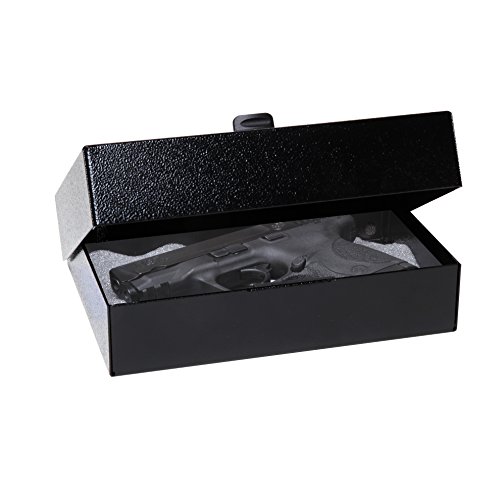
Compact Keyless Gun Safe, CA DOJ Certified Portable Quick Access Pistol Safe for a Handgun and Ammo. Mechanical Lock. Great for Single Handgun When Traveling.
Features
| Lock Type | Mechanical Lock |
| Additional Features | Made in the USA |
| Mounting Type | Floor Mount |
| Alarm | anti theft |
| Water Resistance Level | Not Water Resistant |
| Smart Home Compatibility | Not Smart Home Compatible |
| Control Type | Push Button Control |
| Item Dimensions D x W x H | 7.25"D x 9.5"W x 2"H |
| Item Weight | 5 Pounds |
| Chamber Depth | 7 Inches |
| Color | Black |
| Material Type | Metallic-Fiber |
| Brand Name | V-Line |
| Included Components | Instruction manual (English language not guaranteed). Steel Cable |
| Model Number | 279-S |
| UPC | 689076090063 689076090261 851476006023 |
| Global Trade Identification Number | 00851476006023 |
| Manufacturer Warranty Description | 1 Year Limited Warranty |
| Manufacturer Part Number | 279-S-BLK |
| Item Type Name | V-Line Compact Security Case |
| Manufacturer | V-Line Ind. |
| Unit Count | 1.0 Count |
| ASIN | B001H3QGJS |
- CA DOJ Approved.
- Travel Friendly Design: Compact and portable construction makes it convenient for transporting firearms and valuables on the go.
- TSA Compliant: Meets Transportation Security Administration requirements for secure firearm transportation during air travel.
- Simplex Mechanical Lock: Features a five push button mechanical lock that is easily programmable and requires no batteries for reliable access.
- Durable Finish: Textured semi-gloss black powder coating with silver V-Line logo and brushed stainless steel lock faceplate for lasting protection.
- Protective Interior: Foam-lined interior safeguards your firearm and valuables from scratches and damage during transit.
- Security Cable Compatible: Elongated hole on the left side corner accepts V-Line's Optional Custom Security Cable for additional security options.
- Single Firearm Storage: Designed to securely store a single handgun or small valuables with space-efficient dimensions for easy transport.



17 Comments
The portable mechanical one seems like the classic “good at one job, bad at another” product. Battery-free access sounds great for travel or a car, but if the resistance to prying/crushing/cable theft is meaningfully lower, I wouldn’t want to fool myself into thinking it’s equivalent to the Viking.
That distinction gets lost a lot in product roundups.
One thing I wish more people discussed is upkeep. You touched on it, but it’s huge.
A biometric safe can be very fast when everything is maintained, charged, enrolled properly, and used often enough that the owner remembers every backup option. A mechanical safe asks less from you, but maybe more in terms of deliberate motion and practice. Those are two very different lifestyles, honestly.
App management on a handgun safe is one of those things that sounds cool until I imagine myself debugging Bluetooth at 2:13 a.m. 😂
Not saying smart access is bad, just that “more features” and “fails less” are definitely not the same sentence.
This article basically convinced me there isn’t a universal winner, which is annoying but probably true lol. The BILLCONCH seems best if someone genuinely tests faster with fingerprint + fallback methods, the Viking seems best for long-term nightstand trust, and the portable mechanical one seems best when battery-free access matters more than brute security.
So… which one did I *want* to win? The fancy biometric, obviously. Which one do I probably trust more after reading? Not the one with an app.
The part about “three ways a safe can fail” was honestly the most useful thing here. A lot of reviews act like speed is the only metric, but if the box opens fast and then gets peeled open with a screwdriver… cool, I guess 🙃
For a nightstand setup, I still lean mechanical unless somebody has actually tested the biometric one a bunch in the dark while half asleep. Did you end up personally favoring the Viking, or just saying it depends?
For my own priorities, I lean toward the Viking-style mechanical route for a dedicated nightstand safe because it reduces power and sensor-related failure points.
That said, the article’s main point is that “best” depends on the actual job. If someone consistently opens a biometric safe faster under realistic low-light, high-stress conditions and the safe has solid fallback entry, that can be the better fit for them.
Same. I realized I was overvaluing quick demo videos and undervaluing the “what if it says no” problem. In the dark, half your brain is still offline lol.
Which one did you end up choosing for your own house? If it was strictly nightstand use and not travel, I’d assume the Viking VS-12LSX, but curious if you still think the biometric one wins for households that open it more often.
If the role is strictly home nightstand use, I’d personally choose the Viking over the portable option and over most biometrics unless I had already proven the biometric was faster and dependable for me.
For higher-frequency access, the biometric case gets stronger, but only if the user has tested it under realistic conditions and is comfortable with charging and fallback management.
I had a cheap fingerprint safe before and the false rejects were maddening. Clean hands? Fine. Dry winter skin? Suddenly I’m apparently a criminal trying to break into my own stuff.
So reading your point that biometric failures are situational while mechanical failures are slower/steadier really rang true. If someone wants the BILLCONCH mainly for convenience, do you think the layered entry methods are enough to make up for the battery dependence?
That’s basically the trade-off. The BILLCONCH’s layered entry options help because a fingerprint miss does not automatically mean total lockout if you have another method ready.
But those fallbacks do not erase battery dependence or the possibility of hesitation under stress. They improve the reliability profile; they do not turn it into a purely mechanical system.
This was my experience too. Biometrics feel amazing right up until your hands are cold, sweaty, or weirdly dry. Then suddenly the backup method is the real method.
I’m shopping for a bedside safe for my dad, and simplicity matters more than raw speed because he is NOT going to mess with apps. Based on this, the Viking seems like the obvious answer, but the weight/size is the only thing making me hesitate.
Did anyone here actually compare the Viking to a smaller mechanical box and regret going too small? That’s my worry.
If app-free simplicity is the priority, the Viking-style approach usually makes more sense than a smart biometric model.
The main question is whether you need true bedside permanence and better attack resistance, or just basic secure storage with portability. Going too small can be regrettable if the safe ends up being easier to move, pry, or cable away than you expected.
I went too small once and yep, regretted it. It was “convenient” until I realized convenient for me also meant convenient for a thief to carry off.
I appreciate that you didn’t pretend mechanical means perfect. A lot of people swing too far and act like no batteries = no problems ever.
Slower deliberate access is still a real downside, especially if somebody’s fine motor skills go out the window under stress. But I agree with your overall conclusion that dependency failures matter more than people admit.
For me the Viking sounds like the best “leave it there for years and trust it” choice, while the BILLCONCH sounds more like a convenience-first tool with decent fallback planning.
Exactly. Mechanical designs can still be slower, can still wear over time, and can still be less forgiving if the user has not practiced the sequence.
The reason they often earn trust is not perfection, but fewer dependency layers. That makes them attractive for long-term stationary use where consistency matters more than gadget features.