
At bedside, the most dependable opening sequence matters more than the fastest claimed one.
At 2 a.m., a glossy biometric reader, a tiny keypad, and an unfamiliar latch can all feel like different mechanisms than they did in daylight. Predictability is the real quick-access feature. A bedside safe needs an opening routine that remains understandable with sleepy hands, low light, and elevated stress—not merely a short advertised unlock time.
That is where a simplex-style mechanical lock earns its reputation. Its fixed push-button sequence provides tactile reference points, avoids battery dependence, and does not ask a sensor to recognize a finger that may be damp, cold, or poorly positioned. A biometric vault can still be useful when enrolled prints are consistently recognized, but its practical advantage depends on repeated real-world reliability. Equally important, the safe must resist casual handling by children, guests, or anyone who encounters it unattended. A solid mounting arrangement and a code known only to authorized users turn fast access into controlled access.
- Mechanical simplex locks retain their normal feel without power or screen illumination.
- Biometric access is only as fast as the reader’s recognition under imperfect conditions.



So which handgun safe actually works when it matters — in the dark, half-asleep, under stress? A mechanical Simplex-style handgun safe wins on repeatability: no battery, no fingerprint read to fail, just a tactile button sequence the hand can find blind. The sections below compare that mechanical approach against biometric and keypad options, then walk through fit, mounting, and a five-minute test to run before trusting any of them.
True Simplex-style pushbutton lock
A mechanical lock whose code is entered by pressing physical buttons in a sequence; some codes can include two buttons pressed together. The mechanism releases a latch directly, with no battery, sensor, or electronic controller between the fingers and the door.
Mechanical combination lock
This broader label also covers dial, wheel, and button locks that require a fixed series of single inputs. It does not automatically mean the lock has the simultaneous-press capability, tactile layout, or rapid reset action associated with a true Simplex design.
Electronic keypad
An electronic keypad only feels mechanical at the surface. Button presses are read by a circuit board, which powers a solenoid or motorized lock; dead batteries, sleep modes, and electronics can affect access even when the code is correct.
What to inspect
Product listings often use “mechanical” loosely. Examine close photos and manuals for an all-mechanical latch, the number and arrangement of buttons, whether paired presses are supported, reset requirements, backup-key access, and whether the door must be relocked before another attempt.
The bedside test is repeatability
A biometric vault can post an impressive unlock time—when the enrolled finger lands cleanly on a powered, cooperative sensor. Bedside conditions are less controlled: a finger may be cold, damp, slightly misaligned, or presented before the sleeper is fully awake. A failed read creates a retry loop: reposition, wait for feedback, scan again. That delay is often less predictable than the headline speed suggests.
Electronic keypads avoid fingerprint matching, but introduce their own variables. Backlit buttons aid orientation, while dead batteries, dim indicators, missed presses, and lockout behavior can interrupt the sequence. Quality units normally include an override method, yet an override key is not equivalent to immediate bedside access if it is stored elsewhere.
A direct mechanical push button lock such as the STOPBOX Mechanical Handgun Safe has a narrower but valuable advantage: its inputs are tactile and its operation does not depend on sensor recognition, firmware, or battery state. The user still must remember and enter the combination accurately, but each press has a distinct physical reference.
What matters after the first attempt
The useful comparison is not “Which opens fastest once?” but “Which opens consistently after imperfect attempts?” A practical bedside routine favors:
- a code or scan practiced in darkness;
- a mounting position that keeps the lock face oriented the same way;
- periodic checks of biometric recognition and battery condition, where applicable;
- a backup-access plan that does not depend on searching during an interruption.
Biometrics remain convenient for authorized access, and keypads can offer flexible codes. For bedside duty, however, repeatable tactile input is often the more meaningful performance measure.
The lock is only one layer
A compact handgun container is primarily an access-control device: it can keep the firearm out of casual hands, add delay, and provide a defined bedside location. It is not, by size alone, a burglary-rated safe.
The meaningful barrier comes from the whole enclosure, not merely a reliable lock. Thin steel can flex around a latch; a plastic shell can resist ordinary handling yet yield at seams or hinge points; and a rigid lid is far harder to pry than one that twists under load. This is why less expensive lockboxes are often defeated sooner: weak geometry can bypass an otherwise adequate locking mechanism.
What changes the real-world barrier
- Construction: thicker metal and reinforced latch areas resist flexing better than light-gauge shells.
- Seams and hinges: concealed or protected hinge designs leave fewer leverage points.
- Attachment: a properly routed security cable or a bolted-down unit prevents easy removal for later attack.
- Portability: travel-friendly boxes are easier to carry away, a trade-off for their convenience.
A Simplex model can be excellent for fast bedside access while still needing realistic expectations about forced-entry resistance.
A cable can deter grab-and-go removal, but its anchor point, cable routing, and the container’s cable attachment all set the practical limit. Permanent mounting generally creates a more meaningful delay than a loose box on a nightstand.
Choose the lock behavior, not the feature list


A bedside safe earns its place through the complete access cycle, not an impressive specification sheet. The comparison favored actions that remain predictable in darkness, with imperfect hand placement, and when household power is unavailable.
Each vault’s sequence—wake, identify, unlock, and lift or retrieve—was judged as one motion rather than isolated lock speed. Button spacing, directional cues, lid travel, and clearance matter when touch replaces sight.
The safe must fit the intended handgun without forcing an awkward retrieval or allowing excessive movement. Interior geometry, shell rigidity, hinge protection, seams, and anchor points show how well it resists casual removal and prying.
Backup entry was weighed alongside primary access, including dead batteries and failed sensors. Audible beeps, alerts, and latches matter too: fast access that announces itself across a quiet room loses bedside value.
Fit the safe to the actual bedside setup
A fast lock cannot compensate for a poor physical setup. Before buying, confirm the safe fits the firearm as stored: optic, weapon light, extended magazine, threaded barrel, and any retained holster can change both height and draw path. The STOPBOX’s polymer shell and other compact options are especially sensitive to accessory bulk.
Check the intended location with the lid fully open, not merely the closed footprint. A drawer face, mattress rail, nightstand underside, or wall can stop lid travel or place the hinge where it binds. For broader comparisons of layouts and retention approaches, this quick-access gun-safe resource provides useful context.
- Orientation: Confirm the opening presents the grip in the dominant-hand draw direction; a reversed position can require an awkward regrip.
- Retention: Test whether the chosen holster, trigger guard cover, or foam insert permits a clean lift without snagging accessories.
- Anchoring: Route a security cable without crushing it in the lid seam or creating a sharp bend; verify its attachment point does not obstruct the firearm.
- Reach: A bedside unit that must be pulled from a drawer, detached from a cable, or turned around before opening adds steps when speed matters.
STOPBOX: battery-free access in a two-safe setup
01
Top choice for battery-free bedside access
The STOPBOX two-pack centers its bedside appeal on a tactile mechanical code: no fingerprint scan, app, key cylinder, or charging routine sits between the stored handgun and the opening sequence. Its user-set system offers 81 combinations, making consistent practice with a short button pattern more relevant than managing electronics.
Two cases make the package more adaptable than a single bedside box. One can serve the primary sleep area while the other covers a second room, vehicle transfer, or separate storage location. The Full-size model provides a 9.25 × 7.15 × 1.75-inch interior plus a small built-in compartment; actual fit still depends on the handgun’s dimensions and any mounted accessories.
- Mechanical entry needs no battery, sensor, or key
- Two cases support separate access locations
- 81 programmable tactile combinations
- Compact, low-profile freestanding format
- Portable build is less inherently resistant to removal
- No wall-mount provision
- Cable and padlock accessories are separate
- Full-size interior may limit larger accessory setups
The short version STOPBOX prioritizes a repeatable mechanical opening sequence over electronic convenience. The two-pack adds meaningful placement flexibility, provided each case is treated as a portable lock box rather than a fixed vault.
STOPBOX is the strongest bedside pick for households that value battery-independent, tactile access and benefit from two matching cases. It follows the practical objective associated with Simplex-style bedside storage—reliable button-driven entry without electronics—while using its own mechanical code system. Its 28-ounce, freestanding construction is convenient to place and move, but that portability makes deliberate positioning and compatible supplemental securing especially important.
Bulldog Magnum Biometric Steel Pistol Vault: a compact steel option
Best for buyers wanting fingerprint entry
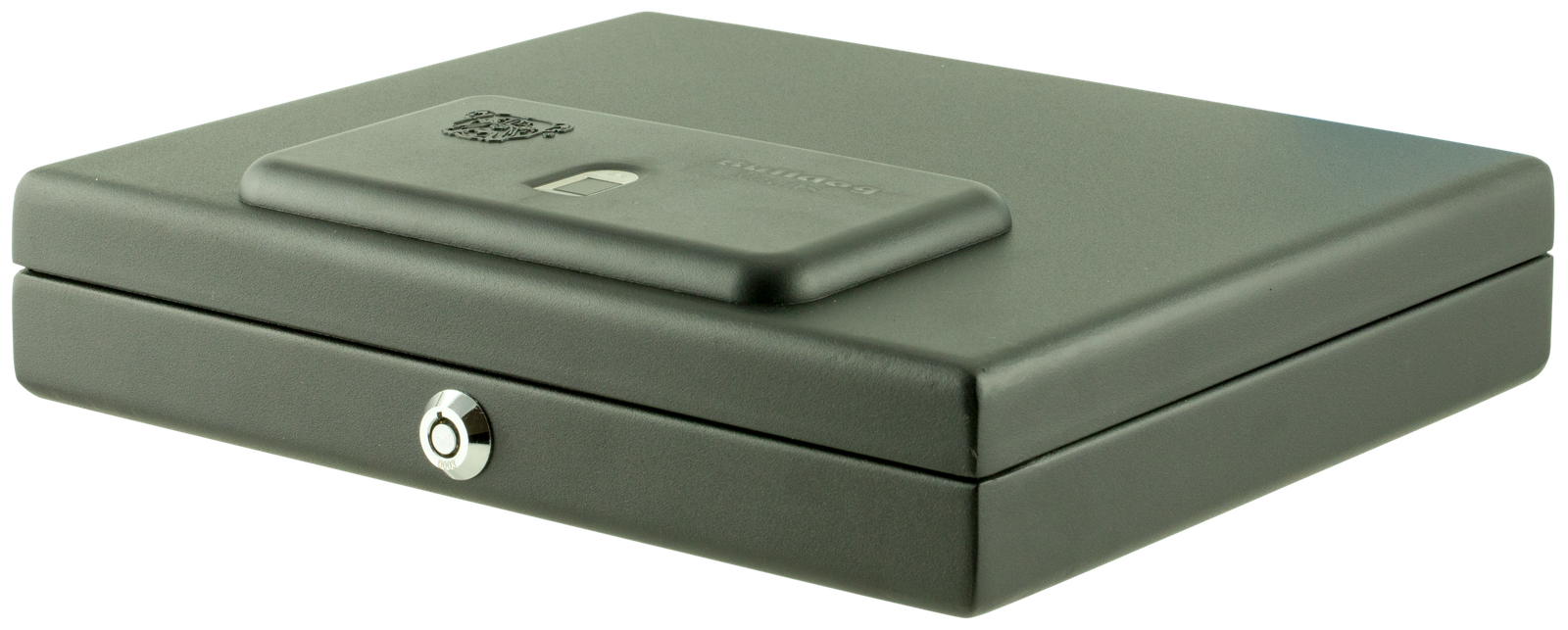
The Bulldog Magnum Biometric Steel Pistol Vault takes a different bedside route from a Simplex case: a compact, powder-coated steel vault built around fingerprint entry. It suits households that value a familiar vault format and want authorized access to begin with a touch rather than a memorized button sequence. Its shallow 11.5 × 9.75 × 2.5-inch footprint also makes placement easier where drawer or nightstand clearance is limited.
- Steel vault form factor
- Compact bedside footprint
- Fingerprint-led access
- No code sequence required
- Requires dependable battery power
- Enrollment quality is critical
- Sensors can vary with skin conditions
- Backup-entry method needs confirmation
This is the biometric alternative for readers who want a small steel vault rather than a portable mechanical case. Its value depends heavily on careful fingerprint enrollment, fresh power, and a backup-opening method that has been located and tested before it is needed. In a household with several potential users, nighttime dependability is only as good as each authorized person’s successful repeat access—not the fastest demonstration scan.
Biometric Two-Pistol Quick-Access Gun Safe: budget capacity for two
Affordable electronic option for multiple handguns
Budget biometric capacity, not a Simplex substitute. This compact electronic vault targets bedside setups that need room for two handguns without moving into premium-vault territory. Its biometric reader and keypad offer an electronic access path, but they do not reproduce the direct, battery-free tactile behavior of a true Simplex lock. The advertised two-pistol layout makes sense only after a real clearance check: mounted lights, tall optics, extended magazines, holsters, and the lid’s opening arc can quickly change the usable space. It suits buyers who accept routine testing of the primary entry method and a verified secondary method.
- Advertised capacity for two standard pistols
- Fingerprint and keypad access paths
- Silent-mode option for bedside use
- Multiple fingerprint enrollment claimed
- Electronic access is not battery-independent
- Accessory-equipped pistols may not fit
- Freestanding, 4.1-pound enclosure is not a heavy vault
- Backup entry method requires hands-on verification
Biometric Drop-Slot Handgun Safe: LED-lit, flexible placement
Best for low-light access and flexible placement
This compact biometric vault is the feature-forward counterpoint to a Simplex case: it combines fingerprint, keypad, and key entry with an interior LED, a top drop slot, and room claimed for two to three handguns. The light has real bedside value: it reveals the grip, cable lock, or loose item inside without turning on a lamp. Stealth mode can also suppress confirmation sounds when discretion matters.
Its extra capacity changes the retrieval question. A wider compartment can hold more, but bedside access still depends on a clean, repeatable path from lid to grip; crowding the interior with spare magazines or valuables can make that path less certain. The drop slot is useful for temporary small-item storage, yet it does not improve ready access and can encourage a mixed-use interior.
Electronics add their own routine. Fingerprint recognition needs dependable enrollment, batteries need checking, and a mounted or cable-anchored safe needs enough slack and lid clearance to open fully. This model suits a nightstand setup that benefits from guided low-light visibility and flexible storage, provided its powered entry is tested as deliberately as its backup key access.
- LED illuminates the interior without room light
- Three advertised entry methods add fallback options
- Drop slot separates brief deposits from opening the lid
- Compact footprint can fit drawers or nightstands
- Security cable supports flexible anchoring
- Battery condition becomes part of readiness
- Biometric performance depends on enrollment and finger placement
- Audible and motorized actions may be less discreet than Simplex buttons
- Shared storage can obstruct a clean draw path
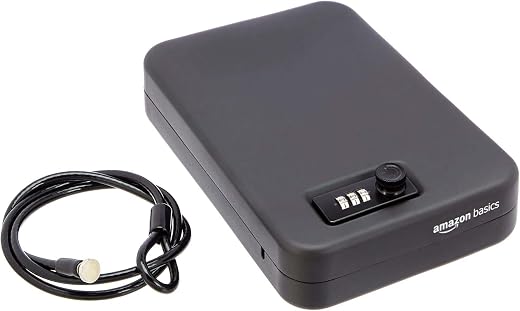
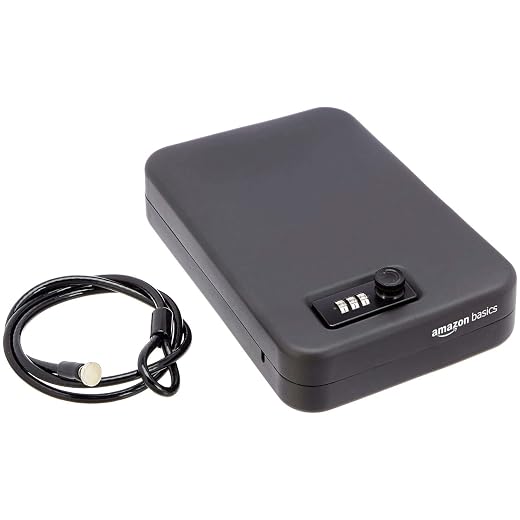
Amazon Basics Portable Combination Lock Box: basic low-cost storage
The details that decide bedside usability
- Controls that confirm the entry
Buttons should be distinguishable by touch, accept a code cleanly with one hand, and provide a definite click or stop. Code changes should not require leaving a reset control exposed.
Look forTactile sequence, protected code settingAvoidMushy keys or exposed reset access - An opening that clears the setup
Check lid swing, hinge side, interior dimensions, and clearance for the actual pistol, optic, light, and holster. A backup keyway or override should not be easily reachable, while bolts generally resist movement better than a cable.
Look forClear draw path, concealed override, solid mountAvoidBlocked lid, tight fit, cable-only security
Anchoring changes the equation
A bedside drawer conceals a safe and limits casual handling, but it does not stop removal if the safe is simply sitting inside. Drawer placement also adds a mechanical question: a lid that swings upward or a door that drops forward needs clearance from the drawer front, rails, and nearby contents.
A security cable is a middle ground. It can tether a portable case to a bed frame or furniture structure, making a grab-and-go removal less convenient while preserving the option to relocate it. Its resistance is governed by the cable, lock point, and—most importantly—the object it loops around; a thin drawer slide, removable leg, or particleboard panel is a weak anchor.
Fixed mounting generally offers the strongest resistance when the manufacturer provides purpose-designed mounting holes and compatible hardware. The furniture must carry the load: solid wood framing, substantial metal, or a structurally sound surface is meaningfully different from a thin drawer bottom or back panel. Mounting can also change the opening geometry.
Before committing, confirm three things:
- The safe can open fully without striking the drawer, wall, or mattress.
- Mounting hardware remains reachable for inspection but not exposed during normal use.
- The retrieval path stays natural: code or sensor, lid movement, grip, and removal all work from the intended bedside position.
A securely attached safe that cannot open cleanly is less useful than a modestly anchored one with a repeatable access path.
A five-minute unloaded function check
-
Confirm the real loadout fits
With the firearm unloaded and cleared, place it in the safe exactly as it will be stored, including the usual holster or light if applicable. Close the lid without forcing it, then verify that nothing presses against the latch, buttons, biometric sensor, or opening path.
-
Repeat the normal opening sequence
Run several open-close cycles using the intended bedside motion. Mechanical-button cases need deliberate, complete presses; biometric models need consistent finger placement and a lid that releases cleanly after recognition.
-
Repeat it in low light
Use the same unloaded check in darkness or with only the room’s normal nighttime lighting. This exposes missed button positions, unreadable indicators, awkward lid clearance, and objects that snag the retrieval path.
-
Inspect positive latch engagement
After each closure, gently test whether the lid is fully captured before attempting entry. Look for a partial close, rubbing foam, shifted contents, loose fasteners, or a latch that requires unusual force to release.
-
Verify the backup path and revisit changes
Confirm that the documented override method works and remains available under the household’s storage arrangement. Repeat the check after changing the firearm, holster, batteries, mounting position, furniture, or safe location.
This is a storage-function check with an unloaded firearm, not a speed drill.
Frequently Asked Questions
Why is a mechanical Simplex-style lock often better than a biometric lock for a bedside gun safe?
A true Simplex-style pushbutton lock releases the latch directly through a mechanical sequence, so it doesn’t depend on a battery, sensor, or firmware. Biometric locks can be fast when the enrolled fingerprint reads cleanly, but bedside conditions—a cold, damp, or misaligned finger—can trigger a retry loop that adds unpredictable delay.
Does a compact bedside handgun safe protect against burglary?
Not by itself. A compact handgun container is primarily an access-control device that keeps a firearm away from casual hands and adds delay, but it is not a burglary-rated safe unless the construction, seams, hinges, and attachment method also resist prying and removal.
What should I check before buying a bedside handgun safe?
Confirm the safe fits the firearm as actually stored—including any optic, weapon light, extended magazine, or holster—and test the lid’s full opening travel in the intended location to make sure a drawer face, mattress rail, or wall doesn’t block it.
Is a security cable enough to secure a bedside safe?
A security cable can deter grab-and-go removal, but its effectiveness depends on the anchor point, cable routing, and the object it loops around. Fixed mounting into solid wood framing or a structurally sound surface generally offers stronger resistance than a cable alone.
How many combinations does the STOPBOX mechanical lock offer?
The STOPBOX Mechanical Handgun Safe Two-Pack uses a user-set mechanical code with 81 possible combinations, and it does not require a battery, fingerprint scan, or charging routine.
How often should I test a bedside handgun safe?
Run a five-minute unloaded function check with the firearm as normally stored, repeat the opening sequence in low light, confirm positive latch engagement, and verify the backup access path—then repeat the check whenever the firearm, holster, batteries, mounting, or safe location changes.
Choose the Opening Process First
- A safe that opens flawlessly in its intended position is more valuable than one that merely offers more access methods.
- For a compact bedside setup, lid clearance and tether routing matter as much as the lock itself.
The STOPBOX Mechanical Handgun Safe Two-Pack is the strongest bedside choice where repeatable, battery-free tactile access matters most. Its paired format suits separate rooms or a primary safe plus a staged backup, provided the firearm fits without forcing the lid and the case is placed or tethered against easy removal.
The Bulldog Magnum Biometric Steel Pistol Vault is the better fit for those wanting a more substantial steel enclosure and fingerprint convenience, but only after its sensor, batteries, and keyed backup have proven consistent. The Biometric Two-Pistol Quick-Access Gun Safe makes sense when two handguns must share one compact location; the drop-slot model suits feature-oriented placement where its opening path remains clear. The Amazon Basics lock box is best reserved for deliberate, low-cost storage rather than urgent bedside access.
The practical rule is simple: select the model that accepts the actual handgun and mounted accessories, opens correctly by touch in its final position, and can be credibly secured there. For most bedside roles, those three tests favor a true mechanical Simplex-style process over a longer specifications list.
Biometric Gun Safe for Handgun,Drop Slot Compatible for 2-3 Pistols | Fingerprint Pistol Safe, Fits 2-3 Handguns, Quick Access, LED Light, Stealth Mode,...
Features
| Lock Type | Biometric, Electronic Combination Lock, Key |
| Additional Features | Biometric Fingerprint, LED Light, Portable, Quick Access, Stealth Mode |
| Mounting Type | Floor Mount |
| Water Resistance Level | Not Water Resistant |
| Smart Home Compatibility | Not Smart Home Compatible |
| Item Dimensions D x W x H | 10.83"D x 8.66"W x 2.76"H |
| Capacity | 260 cubic inches |
| Chamber Depth | 10.24 Inches |
| Color | Black |
| Material Type | Alloy Steel, Carbon Steel, Stainless Steel |
| Brand Name | AIRMuch |
| Included Components | 1 Security Cable, 1 Usb Cable, 1 User Guide, 2 Installation screws, Key |
| Model Number | K2 |
| Global Trade Identification Number | 06976030146305 |
| Manufacturer | AIRMuch |
| Unit Count | 1.0 Count |
| ASIN | B0G48P71TH |
- Triple Unlock (Key/Digital Password/Fingerprint) & 1s Quick Access – Integrates 3 unlock methods with advanced biometric sensors for 1-second response. Combines the security of a fingerprint safe with the efficiency of a quick-access safe for emergency retrieval
- Multi-Purpose Drop Slot Safe – EVA-lined interior protects valuables/jewelry; discreet design fits closets/offices for seamless storage
- Anti-Theft Steel Cable & Secure Anchoring – Equipped with a high-strength steel cable to anchor this car safe or lock box firmly in vehicles or homes, preventing unauthorized removal
- Built-In LED Light & Nightstand Compatibility – Features a soft LED light for clear visibility in low light, fitting seamlessly as a nightstand safe in bedrooms or drawers
- Portable & Spacious Capacity – Holds up to 3 compact items (small-sized safe) with a soft sponge pad for jewelry/documents; lightweight for car/travel use (requires 4×AA batteries, not i...
Gun Safe, Biometric Gun Safe for Pistols - Quick-Access Handgun Safe with Fingerprint & Digital Keypad | Fits 2 Pistols | Silent Mode, Heavy-Duty Steel for...
Features
| Lock Type | Biometric, Key, Mechanical Code Lock |
| Mounting Type | Freestanding |
| Smart Home Compatibility | Not Smart Home Compatible |
| Control Type | Key Control |
| Item Dimensions D x W x H | 12"D x 9"W x 3"H |
| Capacity | 3 liters |
| Item Weight | 4.1 Pounds |
| Chamber Depth | 12 Inches |
| Color | Black |
| Material Type | Iron |
| Brand Name | teentan |
| Included Components | 2 emergency keys, User Manual, a Type-C cable, a steel security cable |
| Model Number | BXX250116 |
| Manufacturer Warranty Description | 1 Year Manufacturer |
| Manufacturer Part Number | BXX250116 |
| Manufacturer | teentan |
| Unit Count | 1.0 Count |
| ASIN | B0DT5QZTLL |
- 【Biometric Quick Access】This biometric gun safe for handgun is equipped with advanced biometric technology, supporting up to 99 fingerprints, making it ideal for multiple authorized users. Perfect for emergencies, it provides quick and secure access to your firearms.
- 【Durable Steel Construction】Built with thick solid Alloy Steel and an anti-pry door, this gun safe offers excellent protection against tampering and theft, ensuring your firearms remain secure. Its robust construction makes it a reliable addition to your home or vehicle security.
- 【Versatile Storage Space】Designed with ample interior space, this pistol safe accommodates two standard handguns and ammunition. It is also suitable for storing cash, jewelry, documents, and other valuables. Its compact size allows easy placement in drawers, cars, or under beds.
- 【Multiple Access Options & Advanced Features】The bedside gun safe for handgun offers multiple access methods, including a biometric ...
STOPBOX Gun Safe Alternative - Tactical Handgun Storage, Instant Access Portable Gun Case, TSA Compliant Gun Lock Box for Quick Handgun Access | Black - 2PK...
Features
| Lock Type | Mechanical Code Lock |
| Additional Features | Portable |
| Mounting Type | Freestanding |
| Alarm | anti theft |
| Water Resistance Level | Waterproof |
| Smart Home Compatibility | Not Smart Home Compatible |
| Control Type | Push Button Control |
| Item Dimensions D x W x H | 11.5"D x 8.5"W x 2.25"H |
| Capacity | 250 cubic inches |
| Item Weight | 28 Ounces |
| Chamber Depth | 12 Inches |
| Brand Name | StopBox USA |
| Included Components | Actuators |
| Model Number | SB4012-BLK |
| UPC | 850028729106 |
| Global Trade Identification Number | 00850028729106 |
| Manufacturer | StopBox USA |
| Unit Count | 2.0 Count |
| ASIN | B0CRZRY7KV |
| Color | Black | Black (2 Pack) |
| Material Type | Glass-Reinforced Polycarbonate-ABS |
- Instant Reliable Access: Portable handgun lock box alternative with mechanical design for fast, dependable entry; compact storage for home, vehicle, or travel
- No Batteries or Electronics: Mechanical lock box eliminates dead batteries, key jams, and scanner failures; patented combination system provides quick access
- Customizable Lock Access: Choose from 81 user-set mechanical combinations for personalized speed and accuracy; TSA compliant and compatible with padlocks or security cables; note that accessories are not included
- Size and Storage: Available in Full or Compact sizes for portable use; not designed for wall mounting; Full-size interior measures 9.25 x 7.15 x 1.75 in; Compact interior measures 7.5 x 5.5 x 1.75 in; includes 5 x 1.5 x 1 in built-in compartment
- Trusted by Gun Owners: Proven gun safe alternative trusted by 500,000+ firearm owners; secure storage for handguns, BB guns, airsoft, or tasers; designed for reliable instant acces...
Amazon Basics Portable Security Case Lock Box Safe with Combination Lock for Documents, Valuables, Personal Items, Dorm Room, Home, Large, Black
Features
| Lock Type | Combination |
| Additional Features | Anti-Theft, Portable |
| Mounting Type | Freestanding |
| Alarm | No Alarm |
| Water Resistance Level | Not Water Resistant |
| Item Dimensions D x W x H | 9.61"D x 6.52"W x 2.23"H |
| Capacity | 110 cubic inches |
| Item Weight | 1.44 Kilograms |
| Chamber Depth | 9.5 Inches |
| Color | Black |
| Material Type | Alloy Steel |
| Brand Name | Amazon Basics |
| Included Components | Combo Lock |
| Model Number | SW-SC01 |
| UPC | 192233012308 |
| Global Trade Identification Number | 00192233012308 |
| Manufacturer Part Number | SW-SC01 |
| Manufacturer | Amazon |
| Unit Count | 1.0 Count |
| ASIN | B077K3FJHC |
- Effectively safeguards valuables such as cash, jewelry, documents, firearms and more
- Compact design made with premium anti-pry steel and a foam-padded interior
- Easily transportable for traveling and small enough to store discreetly
- Includes a zinc alloy combo lock for additional security
- This case is California DOJ certified as a firearm safety device.



13 Comments
Good point about biometric speed being mostly theoretical at 2 a.m. I’ve had a phone fingerprint reader reject my thumb after washing dishes, so I’m not betting a bedside safe on it.
Why wasn’t a V-Line included as an alternative to the STOPBOX? It seems like the heavier steel, button-style mechanical option people always bring up, especially for someone who wants to bolt it down rather than use a cable.
That’s a fair omission to ask about. V-Line-style mechanical boxes are well regarded, particularly when fixed mounting and heavier enclosure construction are the priority. This comparison focused on the listed products and on portable/freestanding bedside use, where the STOPBOX two-pack’s size and battery-free opening process made it the closer fit. A securely mounted V-Line is absolutely worth considering if your setup has the clearance for its lid and a solid mounting surface.
I have a V-Line in a nightstand drawer. Great box, but definitely measure first—the lid swing and mounting position matter more than I expected.
The two-safe idea is interesting, but I’m a little skeptical of a portable case as the main plan. If someone can grab the whole thing, the “fast” lock has become a take-home puzzle box. Cable tethering sounds better than nothing, though—not exactly Fort Knox lol.
I appreciate that you didn’t call every “mechanical” lock a Simplex lock. That wording gets abused so much in listings it’s honestly annoying. The five-minute unloaded check should be mandatory before anybody trusts one beside the bed.
For a strict $60-ish budget, would you pick the Amazon Basics combination case or save longer for the STOPBOX? This would be for a handgun that is normally carried, with the case used only overnight or when guests are around.
I know the answer is probably “it depends,” but I’m mainly asking whether the basic case is too slow to be a responsible bedside option.
At that budget, the Amazon Basics case can be reasonable for deliberate overnight storage, travel, or keeping a firearm secured from casual access. I would not present it as equivalent to a tactile quick-access bedside safe: finding and operating a conventional combination in darkness takes more attention and repetition. If rapid defensive access is your primary goal, saving for a proven mechanical quick-access design is the better match; if your priority is economical secured storage while guests are present, the combination case fits that role.
Why no Vaultek in the biometric discussion? I realize this wasn’t a giant roundup, but they’re one of the first names people see when shopping for a bedside vault.
Also, the article’s warning about backup keys is spot on. A biometric safe with the override key sitting in the same drawer is a pretty funny security system 🙃
Vaultek is a sensible brand to compare, and its omission here is scope rather than a judgment that those products are unsuitable. For any biometric vault, we would apply the same test: enroll multiple prints, try it repeatedly in low light and with normal dry hands, verify battery alerts, and confirm the override method is protected but reachable. The brand name matters less than whether that specific model passes those checks in the owner’s actual bedside setup.
Yep. I keep the backup key elsewhere and test the fingerprint every few weeks. Mine works well, but it’s not a “set it and forget it” gadget.
Glad you mentioned open-lid clearance. My first safe technically fit in the drawer, right up until the lid hit the drawer above it and opened about three inches. Excellent planning on my part 😅
People also underestimate draw orientation. A box can open quickly and still force an awkward, unsafe grab if it’s turned the wrong way.
Would the Bulldog Magnum be your budget pick if someone wants a steel enclosure but only needs room for one compact pistol? I’m not interested in app features, LEDs, or a drop slot; I just want something that can be tethered in a drawer and doesn’t need a perfect fingerprint scan every single time.
The article leans STOPBOX for the opening process, but I’m trying to balance that against a more rigid box.
That is exactly the trade-off. The Bulldog Magnum makes more sense when enclosure rigidity and a compact steel format are higher priorities, provided you personally verify the biometric entry and backup process before relying on it. If you do not want to depend on fingerprint performance, a mechanical option remains the cleaner choice for the opening process. For either type, check the actual tether point, cable routing, drawer clearance, and whether the lid can open fully after it is anchored.