
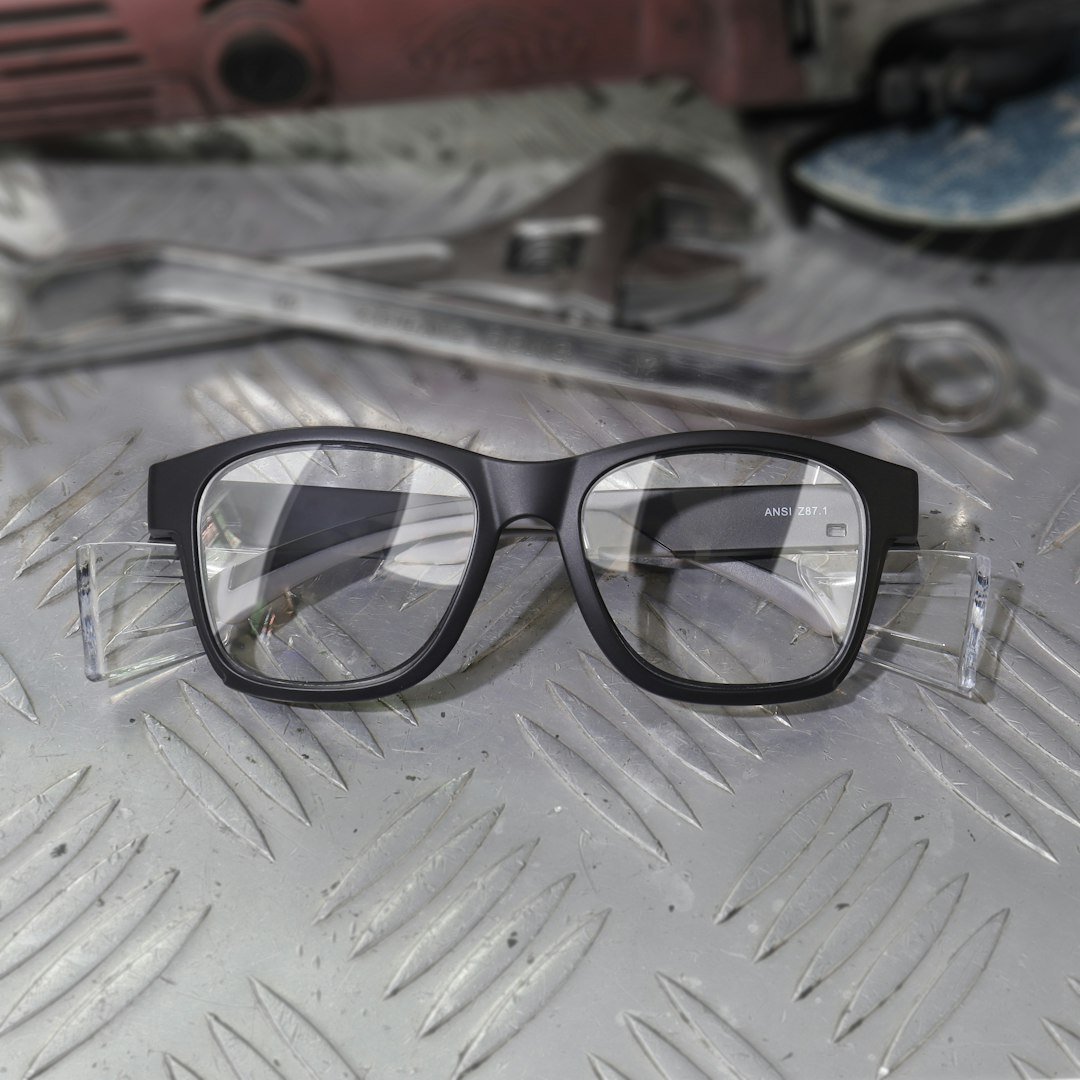
That plus sign is not decoration when a fragment is closing the distance fast.
Two pairs can share the same wraparound shape, clear lens, and “Z87” marking, yet respond to a fast-moving chip under very different test conditions. ANSI/ISEA Z87.1 Z87+ eyewear has passed the standard’s high-impact tests; basic Z87 marking indicates coverage for the lower-impact test category.
The distinction matters most around powered cutting, grinding, drilling, nail guns, or other work that can launch hard particles unpredictably. High-impact-rated spectacles are assessed as a complete protector—lens, frame, and side protection—not simply as a tougher-looking lens. A “+” on the frame and lenses helps indicate that the assembled eyewear is intended for those higher-energy hazards. It does not make glasses invulnerable, nor does it replace hazard-specific protection such as a compatible face shield where conditions call for one.
- Look for Z87+ on both the frame and each removable lens; mixed components can change the rated configuration.
What the ANSI marking actually covers
ANSI/ISEA Z87.1 is a voluntary consensus standard in the United States for eye protection performance and markings. Meanwhile, ANSI accredits the standards-development process, while ISEA develops the document. Manufacturers use the standard’s tests and marking rules to support a conformity claim for Z87 vs Z87+ safety glasses.
That marking matters, but it has a narrow meaning.
It indicates that the marked component or assembled protector meets requirements, such as impact resistance and coverage.
It also reflects optical quality and, where marked, special-purpose protection for Z87 vs Z87+ safety glasses.
This does not mean ANSI has individually certified every pair, nor that the eyewear is suitable for worksite hazard.
Hazards outside an impact rating
A Z87 or Z87+ designation alone does not establish protection.
Additionally, it does not establish protection against every hazard.
- chemical splash, unless the eyewear design and applicable markings address it;
- welding radiation, lasers, intense light, or infrared exposure without the appropriate filter marking;
- fine dust, vapors, molten metal, or infectious material;
- a severe strike that exceeds the standard’s test conditions.
Protection for Z87 vs Z87+ safety glasses also depends on the complete configuration.
A high-impact lens placed in an unmarked frame can reduce coverage.
A damaged shield, or eyewear worn with large gaps, changes practical protection.
Additionally, hazard assessments and task needs may call for goggles or face shields beyond marked glasses.
Basic versus high-impact protection
A plain Z87 marking indicates basic-impact performance under the standard’s applicable lens test.
Z87+ identifies eyewear that has also passed high-impact testing.
That extra designation is not a claim that the lens is harder to scratch. Those are separate properties.
The practical difference emerges when an object arrives with meaningful speed. Additionally, a dropped hand tool or debris released by compressed air can carry far more impact energy. Moreover, a chip thrown from a grinder, a broken drill bit, or similar projectiles can also injure. High-impact-rated protectors are intended for these fragment-and-projectile scenarios, provided the complete marked assembly is worn as configured.
Match the marking to the exposure
Basic Z87 eyewear is appropriate when the concern is low-energy contact or general eye coverage. For higher-risk tasks, use the Z87 vs Z87+ safety glasses comparison to decide. When choosing eyewear, consider the typical exposure and environment. Additionally, opt for models that fit well and stay comfortable during use.
In operations that create flying particles, the Z87+ mark is the more relevant starting point. Common examples include tasks such as grinding or cutting where face shields may be used. This guidance helps compare protection levels. It also clarifies when Z87+ certification matters more.
- grinding, cutting, drilling, and machining;
- nail-gun, fastening, or demolition work;
- handling brittle materials that may chip or shatter;
- tasks involving pressurized air or ejected debris.
Additionally, The rating does not make gaps around the frame disappear. Additionally, Fine dust, splash, and hazards approaching from the side may call for a different protector design or additional equipment. Moreover, Fit, side coverage, and condition still influence real-world protection.
A lens can remain relatively free of scratches yet lack a high-impact marking. Conversely, a marked Z87+ protector still needs replacement if it is cracked, deeply gouged, or its frame is damaged; the tested configuration may no longer be intact.
Protection depends on the complete spectacle
A safety spectacle is not simply a marked lens placed in front of the eyes.
Additionally, under ANSI/ISEA Z87.1, the protective article is a tested assembly.
Lens material and geometry, the frame or carrier, and how the lens is retained all contribute to its performance.
With interchangeable-lens eyewear, this is especially important.
A high-impact lens installed in an unmarked or incompatible carrier does not automatically create a high-impact spectacle.
The frame and lens markings identify components intended to work in the certified configuration.
Additionally, substitutions can change retention behavior or leave protection outside the tested design.
Impact resistance is not coverage.
The Z87 vs Z87+ safety glasses mark addresses resistance to specified high-velocity impact tests.
However, it does not describe how readily dust, chips, splash, or windblown debris can enter around the lens.
Additionally, that is a separate matter of coverage and fit.
Side shields, wraparound temples, and close-fitting lens contours can reduce open paths at the sides. However, their value depends on the spectacle’s actual geometry.
A broad front lens may still leave substantial gaps at the brow, cheeks, or temples. Moreover, a more enclosed design can improve peripheral shielding without changing its impact designation.
When comparing models, it helps to read the markings.
Additionally, inspect the physical design as two distinct checks.
- Impact: Are the relevant lens and frame/carrier marked for the intended Z87 or Z87+ configuration?
- Retention: Does the lens seat fully and securely in the designated frame?
- Coverage: Where are the remaining gaps around the face, and are side shields integral, removable, or absent?
- Condition: Cracks, warped frames, loose shields, and damaged retention features can undermine the assembly’s intended performance.
However, a Z87+ spectacle can be highly impact-capable.
Additionally, it may offer limited protection from fine airborne debris if its open areas are large.
How to verify the glasses in hand
Permanent mark
Look for molded, engraved, or laser-applied characters—not a removable sticker—on the lens, frame front, bridge, or temple. Placement varies by manufacturer and spectacle design.
The plus sign
On eyewear marked under the familiar ANSI convention, “Z87+” identifies high-impact performance for the marked component. A plus on a lens does not automatically establish the rating of every frame configuration.
Manufacturer identifier
A maker’s mark beside the ANSI designation helps connect the component to its certification documentation. An isolated “Z87+” with no identifiable source warrants closer scrutiny.
Legacy markings
Older editions of ANSI/ISEA Z87.1 used different marking conventions, particularly for prescription and specialty products. A legacy mark may be legitimate, but it should not be casually equated with a current catalog claim.
Replacement compatibility
Interchangeable lenses, temples, side shields, and inserts can be configuration-specific. A marked replacement part may not preserve the original assembly’s tested status unless the manufacturer lists that combination.
Phrases such as “ANSI rated,” “impact resistant,” or “meets Z87 standards” can omit the decisive details: the exact edition, whether high-impact testing applies, and which lens-frame combination was evaluated.
Product photos can also conceal marks behind temple artwork or show a different lens option. The more reliable evidence is the permanent marking on the actual components, interpreted alongside the manufacturer’s configuration documentation.
Choose for the debris, not the job title
- Energy and source
A slow chip falling from overhead is unlike a high-speed fragment thrown by an abrasive wheel, pressurized line, or powered cutting tool. The latter can make high-impact spectacle protection relevant, but the source may also create hazards spectacles cannot fully manage.
Look forThe process, tool speed, pressure, and material behavior behind the fragment.AvoidAssuming “shop work” or “construction” describes impact energy well enough. - Direction and access paths
Front-on impact testing does not close every route around a spectacle. Material rebounding upward, dropping from above, or arriving from the side can enter through the brow, temple, and cheek gaps.
Look forWhere debris originates, rebounds, and can travel around the lens.AvoidTreating a Z87+ mark as proof of sealed or wraparound coverage. - Duration and changing conditions
Brief, isolated exposure differs from repeated grinding, dusty cutting, or work that alternates between impact and splash. Longer exposure increases the importance of fit stability, cleaning, lens condition, and task-specific coverage.
Look forHow long debris is generated and whether the hazard changes during the task.AvoidSelecting once for an entire shift without considering each operation. - Site requirements
A documented hazard assessment, equipment manual, or site rule can specify side shields, goggles, face protection, splash protection, or a particular marked configuration. Those requirements can be more specific than a general Z87 or Z87+ comparison.
Look forThe protection type and approved configuration named for the operation.AvoidUsing the impact marking as the only selection criterion.
Z87+ answers a defined impact question: whether the marked spectacle components passed the high-impact provisions of the standard in their approved assembly.
It does not, by itself, indicate protection from:
chemical splash or fine dust entering around the frame; molten metal, intense optical radiation, or an arc-flash event; unusually large, sharp, or sustained projectiles.When a task produces more than one hazard, the relevant site procedure or hazard assessment may call for protection beyond impact-rated spectacles.
When glasses leave too much exposed
Spectacles can be a reasonable impact-rated layer when the likely hazard approaches from the front and side coverage is adequate.
However, they become less suitable when wind-driven particles are present.
They can also pass around the frame due to dust, liquid splash, or material from above or below.
A Z87+ mark does not turn an open spectacle into a sealed enclosure.
Goggles control the perimeter
Goggles use a close-fitting body and facial seal or cushioned contact area to reduce routes around the lenses. Indirect-vented designs can limit splash entry. However, they allow some airflow, while sealed designs offer a more enclosed barrier but may fog sooner. Vent type, lens treatment, and chemical compatibility still need to match the particular exposure.
However, face shields add coverage, not a complete substitute.
A face shield extends protection across much of the face.
Additionally, it guards against larger flying debris, splashes, and certain heat-related exposures.
Its open edges mean particles or liquid can reach the eyes from below or around the sides.
It is therefore commonly paired with compatible primary eye protection rather than treated as eye protection by itself.
Coverage can change in use.
Moreover, temple arms can conflict with hearing protection.
Respirator straps can lift a frame, and helmet brims or shield headgear can alter the viewing position.
The practical test is whether assembled PPE stays stable and preserves its gaps, seal, and field of view during task.
Z87+ concerns impact performance. The choice between spectacles, goggles, and a face shield concerns how the hazard can travel around—or beyond—the lens.
Prescription lenses and fit-over coverage
Ordinary prescription spectacles are not safety eyewear merely because they use plastic lenses or a sturdy-looking frame. Additionally, a prescription lens, its mounting method, and the frame must be supplied and marked as an ANSI-rated safety configuration. Re-tensing a safety frame with unapproved lenses can change that configuration.
A proper prescription safety pair also needs to remain positioned during normal head movement.
Lens size, bridge fit, and temple retention affect whether the lens stays in front of the eye.
Additionally, side coverage and pantoscopic tilt influence debris entering around it.
Thick or unusually shaped prescriptions may limit the available rated designs, so manufacturer compatibility information matters.
Wearing glasses underneath
Fit-over safety eyewear can preserve a person’s everyday prescription glasses while adding an outer protective assembly. Additionally, its rating applies to the fit-over product as supplied, not automatically to the prescription pair beneath it. The fit-over lens should clear the underlying frame without pushing it down the nose. But it must not create pressure points or hold the outer lens forward, widening side and brow gaps.
Coverage is a practical fit and a marking concern.
Therefore, the intended combination needs clear vision, stable placement, and room to avoid contact between the two pairs during movement.
A quick check before relying on the marking
-
Identify the exposure
Consider whether the task creates high-speed fragments, dust, splash, heat, or radiation. A Z87+ mark addresses impact performance, not every one of those hazards.
-
Read both components
For spectacles with replaceable lenses, confirm the relevant permanent marks on the lens and frame, and verify that the lens is an approved match for that frame.
-
Inspect the protector
Look for cracks, chips, lens crazing, deep scratches, cloudiness, bent temples, loose hardware, and missing side protection. Contamination can also obscure damage.
-
Check the fit in working position
The frame should sit securely without creating avoidable gaps or slipping when the head moves. Check clearance with other required equipment, including masks or hearing protection.
-
Remove damaged or altered eyewear from service
Replace components after impact, cracking, significant distortion, degraded visibility, failed retention, or an unverified lens-frame combination. A visible Z87 or Z87+ mark does not restore protection after damage.
- Impact marking is only one part of readiness; condition, fit, coverage, and assembly determine the protection present at the moment of use.
- A marked component is not automatically a compliant replacement component.
Z87+ is meaningful only when it belongs to an intact, correctly assembled protector suited to the exposure. Before a task, the useful question is not simply “Is there a mark?” but whether the complete eyewear still provides the tested configuration and the coverage the hazard calls for.




8 Comments
I appreciate the warning about interchangeable lenses. I have a pair with smoke and clear replacements, and the package only really advertised the frame. Guess I need to dig up the manufacturer chart before assuming both setups are rated the same.
The reminder that Z87+ does not mean “protected from everything” is overdue. I see people assume the plus somehow handles chemical splashes, dust, and overhead debris all at once.
For a dusty overhead drilling job, would you generally move straight to goggles because the issue is the gap around the glasses rather than just impact energy?
That is the right way to think about it. If airborne dust or falling debris can approach from around the spectacle, the perimeter gaps may be the limiting factor even when the lenses have a high-impact mark. Goggles can reduce those entry paths; the exact choice should still reflect dust level, ventilation needs, fogging, and the operation’s requirements.
Yep, learned this the annoying way while drilling into an old ceiling. The glasses stopped the big bits, but fine grit still found its way in from above. Goggles were much better.
Maybe a dumb question, but if the lens has a little scratch right in the middle, does that automatically mean retire it? Mine is still marked Z87+ but the view is getting pretty fuzzy. Safety gear has a surprisingly short career sometimes 🙃
What about clear prescription lenses? My optician put “safety” frames on my order, but I honestly never looked for markings on the actual lenses. Sounds like the frame alone doesn’t prove much.
Correct. A safety-style frame by itself does not establish that your finished prescription eyewear is an approved safety configuration. Check for permanent markings on the relevant components and confirm with the provider or manufacturer that the specific prescription lens/frame combination meets the claimed standard.
One thing I wish employers explained better is the difference between a job title and an actual exposure. “Warehouse” can mean wrapping pallets all day or dealing with banding that snaps, damaged rack debris, and forklifts kicking dust around.
The pre-use check is sensible, although in real life people grab whatever pair is sitting by the time clock. A simple posted guide for which operations need spectacles, goggles, or a shield would probably prevent a lot of guesswork.