
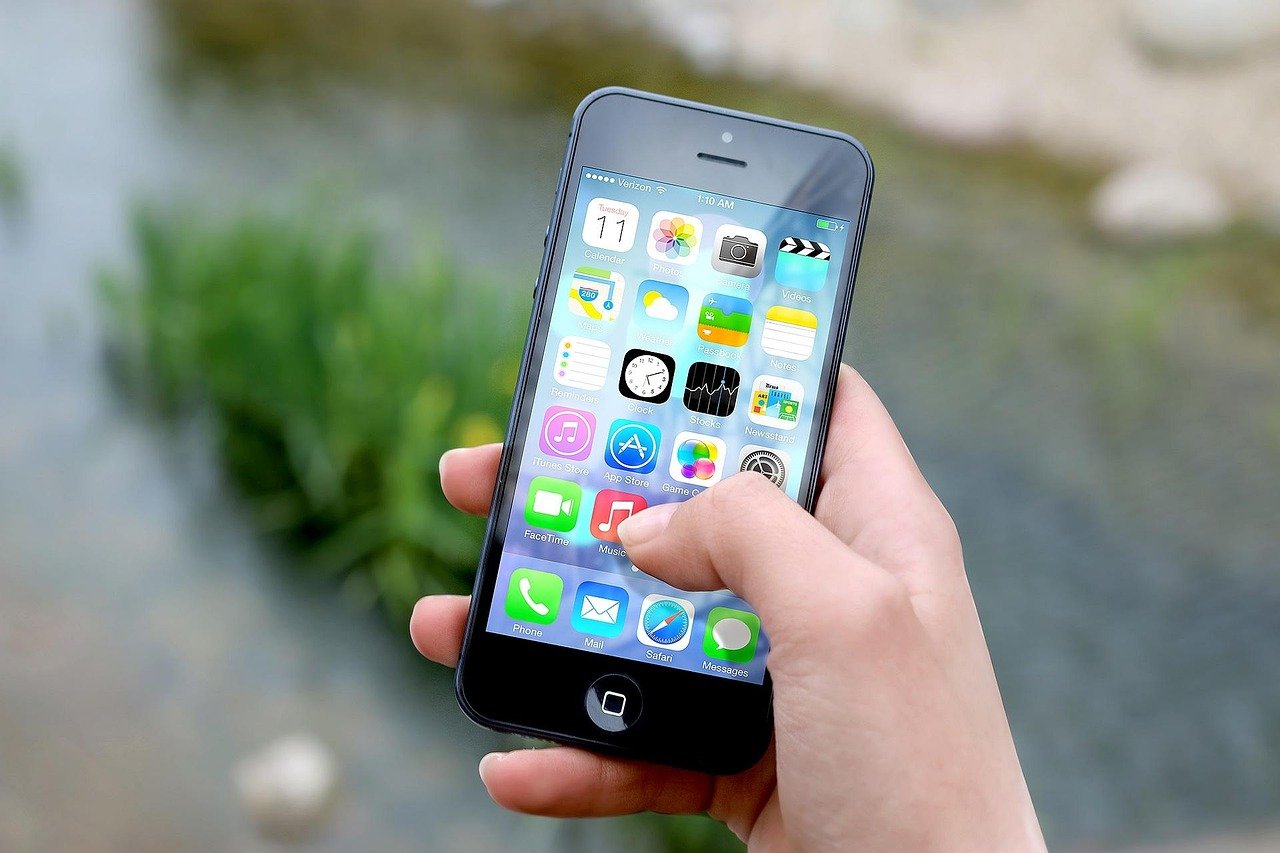
The sunglasses are doing their job—until the phone seems to vanish behind them.
On a bright pavement, waterway, or ski slope, glare may suddenly ease behind polarized lenses. Then a phone map, boarding pass, message, or camera setting turns almost black. Rotate the handset a quarter-turn and the image returns; rotate it back and it fades again.
That oddly dramatic switch is the important clue. It is not usually a dim screen, a failing battery, or a display damaged by sunlight. The lenses and the display are each filtering light by direction, and their preferred directions can sometimes oppose one another. At one angle, enough display light passes through to remain readable; near the crossed angle, the lenses block much of it. The result can feel like a screen has been switched off, even while the phone is operating normally.
- A 90-degree phone rotation that restores the image strongly indicates a polarization mismatch, rather than a brightness-setting problem.
A simple model: light with a preferred direction
Ordinary light: every orientation mixed together
Sunlight and most unfiltered light contain waves vibrating in many planes at once—rather like a jumble of strings pointing in every direction. A polarizing filter does not create darkness by itself; it admits the portion aligned with its transmission axis and blocks much of the rest.
Polarized light: one orientation selected
A linear polarizer behaves like a picket fence for light’s vibration direction. It passes light aligned with its slots and rejects light vibrating across them. Rotating the filter changes which component can pass.
Why sunglass lenses are usually vertical
Reflections from broad horizontal surfaces—wet roads, water, snow, vehicle hoods, and windows at shallow angles—tend to become strongly horizontally polarized. Glare is especially intense near the angle where reflection preferentially favors that horizontal component.
The lens blocks the glare component
Most polarized sun lenses are made with a vertical transmission axis. That orientation blocks predominantly horizontal reflected light while allowing more vertically polarized light through, improving contrast and reducing the bright sheen spread across a flat surface.
The phone-screen connection
An LCD commonly emits light polarized along one fixed axis before it reaches the viewer. When that axis is close to perpendicular to the sunglasses’ vertical axis, little light survives both filters; at roughly a quarter-turn, their axes align more closely and the screen brightens again.
Why the screen is already polarized
An LCD does not simply shine ordinary, unpolarized light toward the viewer. The backlight is unpolarized, but the stack includes polarizing films that affect how light reaches the polarized sunglasses phone screen.
That arrangement is central to how an LCD creates an image. Liquid-crystal cells rotate light polarization by differing amounts; color filters supply red, green, and blue. A second polarizer converts those changes into visible bright and dark pixels on the polarized sunglasses phone screen. The result is a screen whose outgoing light is polarized even when the image itself looks normal.
Polarized sunglasses phone screen adds another filter in front of that output. The decisive detail is the relative angle between the lens’s transmission axis and the screen’s polarization axis:
- When the axes are roughly aligned, much of the screen light passes through the lens.
- As the axes rotate apart, less light is transmitted.
- Near 90° apart—a crossed-polarizer arrangement—the lens rejects most of that light, and the display can look nearly black.
This is why rotating either the phone or the wearer’s head by about a quarter turn can restore the picture. It changes the relationship between the two axes; it does not repair the display or alter the sunglasses’ tint.
The blackout is rarely perfectly complete. Real polarizers are not ideal, screen light can be slightly depolarized by protective glass and coatings, and viewing angle changes the LCD’s behavior. Brightness settings also affect how noticeable the loss appears. But the dramatic rotation-dependent dimming is a normal optical interaction, not evidence that either device is defective.
OLED phones can show the effect too, although their pixels emit light rather than relying on an LCD backlight. Their cover layers and display optics may still produce polarized or direction-dependent output; the strength and rotation at which dimming occurs can vary substantially by model.
Think of the display’s front polarizer and the sunglass lens as slatted blinds. Light passes when their openings point the same way; crossing the slats blocks most of it.
Turn the phone
-
View it
-
Turn 90°
-
Check brightness
-
Tilt slightly
Darkness varies with device, head tilt, and exact lens alignment.
Screen darkness and rotation
Jordan Keyes shows polarization dimming a smartphone screen and demonstrates how rotation restores the image.
Why OLED phones may look different
LCDs usually produce the clearest version of this effect. Their operation requires two linear polarizers: one establishes the light’s orientation, and the other analyzes light after it passes through the liquid-crystal layer. The image light leaving the panel therefore retains a strong linear-polarization component. When that component is crossed with a polarized sunglass lens, the screen can dim dramatically.
OLED pixels emit their own light, so they do not need the same backlight-and-liquid-crystal arrangement. That does not make OLED screens immune to polarized sunglasses. Many OLED phone stacks include a circular polarizer—typically a linear polarizer paired with a quarter-wave retarder film—to reduce mirror-like ambient reflections from internal metal layers.
Circular is not the same as unaffected
A circular polarizer converts suitably oriented linear light into rotating electric-field light, and can make the interaction with a linear sunglass lens less stark in some orientations. In practice, the result varies with the specific stack, viewing angle, wavelength, display brightness, and any cover layers. Some OLED phones remain noticeably darker in one rotation; others show a milder, less cleanly directional change than a typical LCD.
Apparent differences are also easily misattributed to panel type. The cover glass and anti-reflective coatings chiefly alter reflections, glare, and perceived black level rather than the basic polarization of emitted image light. A matte protector scatters light, which can soften contrast and partly scramble polarization cues. Privacy filters add strong angle-dependent attenuation and may include polarizing films, so they can create or intensify darkening that is not inherent to the phone display.
The useful comparison is therefore not “LCD versus OLED,” but the behavior of the complete screen-and-accessory optical stack behind a particular pair of lenses.
Why the effect varies between pairs
A polarized lens has an axis: the direction of light it passes most readily. In ordinary sunglasses that axis is intended to be close to vertical, but a few degrees of rotation from frame fit, a tilted head, or a slightly skewed lens can change how strongly it opposes a phone’s output. The result is often dimming rather than a perfectly black screen.
Lens shape adds another variable. Strongly wrapped sport frames present different parts of each lens at different angles, so the image can darken unevenly across the display. Prescription lenses, especially high-wrap or digitally surfaced designs, may also introduce small local changes in polarization behavior through their materials, stresses, and geometry.
A darker lens tint does not cause the rotation-dependent blackout. Tint reduces overall light transmission in every orientation; the dramatic change on rotation comes from the relationship between the screen’s polarizing stack and the lens axis. Manufacturing tolerances, mounting stress, and lens alignment can therefore make two apparently similar pairs behave differently.
Circularly polarized eyewear is uncommon and is not a dependable workaround. A circular polarizer still contains a linear polarizing element, while phone displays use multi-layer optical stacks whose behavior changes with angle, screen type, and accessories.
Why turning up brightness only partly helps
A screen can look dim outdoors for two separate reasons. Ambient washout occurs when sunlight and reflections add a bright veil over the display; the image is still reaching the eye, but its contrast is reduced. Raising screen brightness can improve that contest by making the intended image brighter relative to the surrounding light.
The rotation-dependent blackout is different. With the phone and lens axes close to crossed, the sunglass lens rejects a large share of the display’s polarized light. Increasing brightness sends out more display light, but much of that additional light encounters the same rejection. The result may be some improvement, yet not a proportional one—and the screen can remain conspicuously dark.
A useful outdoor comparison
- Washed out at every angle: ambient light, surface reflections, and limited display luminance are likely dominant. Maximum brightness, shade, or changing viewing angle can help.
- Much darker only after a quarter-turn: polarization alignment is the main cause. Rotating the phone toward the lens’s transmitting axis is typically more effective than brightness alone.
Strong sunlight often combines both effects, which is why a brighter setting can make a phone more usable without making a crossed-polarizer view normal.
Make a dark screen usable without giving up glare control
-
Rotate the device first
Turn the phone 90 degrees and check whether the image returns. A strong recovery after the quarter-turn is the clearest field sign that the screen and lens polarizers were crossed.
-
Alter the viewing geometry
A small tilt of the phone, a change in head position, or moving the display away from a bright reflected surface can improve perceived contrast. These changes also reduce distracting reflections on the cover glass.
-
Create shade, then adjust the display
Shielding the screen with a hand, hat brim, or vehicle visor reduces ambient washout. Higher brightness and an appropriate accessibility or contrast setting can then help, although they cannot fully overcome crossed polarizers.
-
Match the lens to the activity
Polarized lenses remain valuable around water, snow, wet roads, and other broad reflective surfaces. For cockpit instruments, phone navigation, or camera monitors, dependable display visibility may matter more than maximum glare suppression.
-
Test the display that matters most
Before settling on a pair, view a frequently used phone, dashboard, or wearable in portrait and landscape orientations outdoors. If neither orientation is satisfactory, inspect screen brightness, reflections, protective films, and display settings as well as the lenses.
A quarter-turn is a useful diagnostic, not the whole answer
- Glare control and display legibility can pull in opposite directions for navigation- and instrument-heavy activities.
- Portrait and landscape testing exposes problems that a quick indoor try-on may miss.
When screen visibility returns after rotation, crossed polarization is the likely cause. When it does not, ordinary sunlight, cover-glass reflections, brightness limits, and display settings can be equally important.
The more a day depends on reading instruments or navigation, the more lens choice becomes a trade-off rather than a simple upgrade in glare reduction.



6 Comments
For fishing, polarized lenses are non-negotiable because seeing through glare is the whole point. But I also use a phone map on the water.
Are there sunglasses made specifically with a less aggressive polarization setup for pilots/boaters, or does that basically defeat the purpose? I don’t want to buy “driving” glasses and then lose the glare reduction I need.
It does not have to be all or nothing. Some activity-specific lenses prioritize display readability, and non-polarized high-quality tinted lenses can still reduce brightness and improve comfort, just without the same glare-cutting effect on water. For boating, it is worth testing your actual phone and chart display with a prospective pair, because screen orientation matters as much as the lens label.
A friend who flies uses non-polarized brown lenses for exactly this reason. Less magic on windshield/water glare, but he says being able to read every instrument screen is worth the trade.
Interesting distinction between LCD and OLED here. My OLED phone still gets darker in one orientation, but it never goes completely black like my old tablet did. I assumed OLED meant “not polarized,” apparently not.
The quarter-turn test is a neat little diagnostic. I tried it on my phone and yep—dark at landscape, readable at portrait. Physics hiding in my glove compartment 😂
Does a laptop screen behave the same way? I’ve seen the effect on my phone, but on my work laptop it seems more like a rainbow or weird color shift rather than a straightforward dark screen.