

A hotel room is private only until a door opens, a cleaner arrives, or checkout becomes a rush.
At 6 a.m., a shower, room-service knock, or sudden checkout can turn an otherwise controlled handgun into an exposed object on a nightstand or in an open bag. A hotel room has unknown sightlines, intermittent staff access, and furniture that may be light enough to carry away. That changes the storage problem.
A home bedside safe can rely on a fixed location and familiar routines; vehicle storage may rely on a built-in anchor or a locked compartment. Temporary lodging needs a container that travels with the handgun yet resists a quick grab when it is unattended. A compact steel lockbox with a tethering cable can add delay and remove easy access, but the cable is only as useful as the attachment point. A loose chair, luggage rack, or unanchored table is not a meaningful anchor. Keyed access also shifts attention to the key: separation from the box matters as much as the box itself, especially during sleep or a hurried departure.
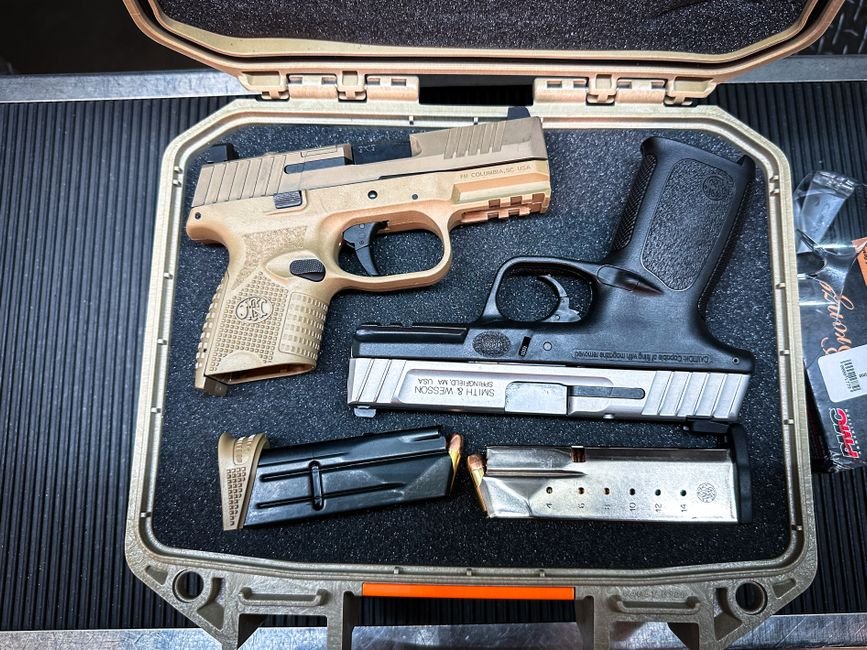

A portable safe is a delay device, not a vault
A well-made portable handgun safe can reduce casual, opportunistic access: a child, a guest, housekeeping staff, or a thief looking for items that can be taken in seconds. Its central value is time and friction. A locked steel box, especially when tethered to a fixed point, is harder to open, conceal, or remove than an unsecured firearm.
That is not the same as resisting a determined attacker with tools, privacy, and time. Portable safes use thinner steel, smaller locking hardware, and lighter construction than permanently installed residential safes. The cable is a restraint, not an impenetrable barrier; the surrounding furniture or fixture also sets the real limit.
Why the room safe may not be enough
An in-room hotel safe is designed primarily for passports, wallets, and small electronics—not necessarily for secure handgun storage. Interior dimensions may be too shallow, biometric or keypad reliability may be unknown, and the safe may not be anchored in a way that resists removal. Hotel staff or management may also have override access, while its operating history and maintenance are invisible to the guest.
A dedicated portable safe keeps control of the lock, access method, and anchoring arrangement with its owner. It can complement the room safe in limited circumstances, but it is not automatically replaced by one.
The useful question is not whether a portable safe is “theft-proof.” It is whether it meaningfully limits unauthorized handling and makes rapid removal less likely during an unattended interval.
Prove the loadout fits before judging the lock
- Measure the real footprint
Use the handgun’s unloaded, travel-ready configuration—not catalog dimensions. Add the optic’s height, weapon light’s forward reach, and any protruding controls; foam compression is not extra capacity.
Look forInternal length, width, and height with clearance around every hard edge.AvoidSizing based on a bare-pistol product listing or an exterior safe measurement. - Account for the full carry set
A spare magazine, cable, keys, and retained holster can turn a nominal fit into a lid that will not close. The same dimensional check exposes fit problems common to center-console safes, where irregular interiors steal usable volume.
Look forA layout that closes without forcing items against the lock housing or lid.AvoidStacking the magazine on top of the handgun or relying on loose items to stay put. - Check lid depth and trigger-guard clearance
Usable lid depth matters more than the deepest point of a shell: hinge arms, lock modules, lining, and tapered walls reduce it. A retained holster may be desirable for coverage, but it needs room so the trigger guard is not pressed or distorted.
Look forA closed lid with visible clearance and no pressure on the holster or trigger-guard area.AvoidA tight closure that flexes the lid, shifts the firearm, or bears on controls. - Test the packed orientation
The best fit leaves room to operate the latch and route the cable without unloading the entire case. Test the intended hotel-room placement as well; a compact safe that fits the firearm may still be awkward beside a bed frame or inside luggage.
Look forRepeatable placement, latch access, and cable routing with the case packed.AvoidA barely closed arrangement that changes each time it is packed.
Cut a rectangle to the maker’s internal dimensions, then place the unloaded setup, holster, magazine, and cable on it. This quickly reveals whether the published footprint is merely possible or genuinely usable.
A safe that closes only when packed perfectly is undersized.
Read the box, not the claims
A portable handgun safe is best judged as a delay box: it can frustrate an opportunistic grab, but its small size gives a determined attacker leverage options that a built-in safe avoids. Terms such as “solid steel” say little without thickness, folds, and the way the lid meets the body.
Look at the attack surfaces
Lid geometry matters more than a broad flat panel. A recessed lid or overlapping lip denies a pry bar a clean starting gap; a flush lid with a visible seam is less favorable. Inspect the lock area for a reinforced plate or surrounding steel that resists local flex. A lock can be sound while the thin metal around it yields.
Hinges deserve the same scrutiny. Internal hinges or hinges shielded by a lid return are harder to attack than exposed hinge barrels. Press gently at the front corners and along the lid edge when handling a sample: excessive corner flex can widen a seam under force. For a deeper look at whether portable gun safes are easy to pry open, focus on where leverage can enter, not on a claimed “pry-resistant” label.
A tether cable primarily prevents a quick carry-off. Its security is limited by the anchor point: a swaged or bolted cable loop through a reinforced slot is preferable to a thin stamped tab. The cable must also be routed around a genuinely fixed structure; a detachable furniture component defeats the concept.
The SentrySafe PP1K illustrates useful features to verify in person: it is described as solid steel with a pry-resistant top lid and hinges, plus a steel tether cable. Its key lock and one-handgun layout make it a compact lockbox, not a substitute for a heavier, permanently installed container.
SentrySafe PP1K: a compact steel lockbox for one handgun
The tether can matter more than weight
A heavier lockbox offers little advantage if it can be carried away in seconds. In a hotel room, the tether interface often determines whether the safe creates meaningful delay: the cable, its termination at the box, its routing, and the object on the other end all matter together.
Inspect the cable as more than a listed diameter. A tightly wound, multi-strand steel cable with a durable jacket generally resists casual cutting and abrasion better than a thin, loosely constructed cable. The jacket should not conceal fraying, crushed sections, or exposed wire. Also examine the safe-side attachment: a recessed or shielded cable port that cannot be released while the lid is locked is preferable to an exposed clip or easily reached fastener.
Loop design affects real-world fit. A small loop may not pass around a substantial fixed point; an oversized loop can leave excess slack that makes the box easier to manipulate. Routing should avoid sharp metal edges, pinch points, and a path that lets the cable simply be lifted off its anchor.
Furniture is not automatically an anchor. A bed frame may be sturdy while its removable rail is not; a desk leg may be hollow or detachable; plumbing and fixtures can be unsuitable. The distinction is central to when a portable safe can and cannot be bolted down.
A cable’s strength rating does not upgrade a weak anchor. The practical system is limited by its easiest-to-defeat link: loop, termination, route, or furniture attachment.
Choose the lock for travel failure modes
A lock’s opening speed is not its resistance to attack. The broader quick-access gun-safe discussion helps separate those two questions; on the road, dependable entry often matters as much as nominal speed.
- Keyed locks avoid batteries and tolerate darkness, but a lost, bent, or separately stored key can defeat access. Keyways can also be awkward when the safe is wedged beside furniture.
- Mechanical push-buttons need no power and can be operated by feel, though small buttons, an easily observed code, and limited combinations are trade-offs.
- Electronic keypads permit longer codes and usually clearer feedback in low light, but batteries, membrane switches, and lockout behavior are failure points. Battery replacement access with the safe closed deserves inspection.
- Biometric readers can be fast after enrollment, yet wet fingers, poor alignment, cold hands, and changing hand position can produce inconsistent reads. A tested PIN or key override is essential.
Dual-access designs combine a fast method with a non-electronic fallback, but the backup must be genuinely usable: accessible when tethered, workable in darkness, and not dependent on a key kept beside the safe. Audible beeps and motor noise also matter in thin-walled hotel rooms; models with configurable sound can be less conspicuous.
Carry characteristics decide real-world use
A lockbox that is technically portable but awkward to pack often gets left behind. Outside dimensions matter as much as internal capacity: a case that fits a carry-on’s flat panel, a vehicle compartment, or an ordinary day bag is easier to bring consistently. Weight has a similar trade-off. More mass can improve stability and discourage a grab-and-go theft, while excessive weight reduces the chance that the safe travels at all.
Details that matter after check-in
Rounded corners, low-profile hardware, and a finish that does not advertise its purpose make a case less conspicuous and less likely to snag fabric or luggage linings. Textured powder coating and durable polymer shells also tend to tolerate scuffs better than glossy surfaces.
Inside, dense foam, a formed tray, or adjustable padding can keep the firearm and lock hardware from shifting, rattling, or pressing against the lid. A usable travel case also accommodates several situational placements: inside luggage, within a larger bag, or cabled to a suitable fixed object when one exists. None of those locations is universally secure; room layout, furniture construction, and exposure all change the risk.
Make the travel setup repeatable
-
Verify current rules and property terms
Check applicable transport and destination requirements through current official sources, then confirm the specific hotel’s firearm and package-handling policies directly. Airline, airport, and property rules can change independently.
-
Pack the exact loadout
Place the intended unloaded, secured contents, holster if used, and any protective insert in the box. Close, lock, and fit the safe inside the actual travel bag; test that zippers and handles remain unobstructed.
-
Separate keys from the safe
Keep mechanical override keys away from the lockbox and from any bag that may be left behind. Confirm that the chosen storage location remains accessible without turning unpacking into a conspicuous search.
-
Check power and backup entry
Install fresh batteries where applicable, test the keypad or biometric reader several times, and verify that the override method works before travel. Bring no loose key or tool that defeats the separation plan.
-
Inspect the tether and anchor route
Look for frayed strands, crushed ferrules, bent lockbox loops, and a route that can slip over or be lifted from the chosen anchor. Test the closed loop under steady hand force.
A property may permit a secured item in a room while an airline, airport authority, or destination jurisdiction imposes different conditions. Treat each leg of the trip as a separate verification task, using current authoritative information rather than old booking notes, forum posts, or a prior stay’s experience.
Frequently Asked Questions
Can a portable handgun safe stop a determined thief?
Not fully. A portable safe is best understood as a delay device that reduces casual, opportunistic access from a child, guest, or housekeeping staff. It uses thinner steel and lighter hardware than a permanently installed residential safe, so it cannot resist someone with tools, privacy, and time the way a built-in safe can.
Is a hotel room's in-room safe a good substitute for a dedicated handgun safe?
Not automatically. An in-room hotel safe is designed primarily for passports, wallets, and small electronics, not secure handgun storage. Its interior dimensions may be too shallow, its lock reliability is unknown, and hotel staff or management may have override access. A dedicated portable safe can complement the room safe, but it is not replaced by one.
Does a tether cable actually keep the safe from being carried off?
Only as well as its anchor and routing allow. The cable, its termination at the box, its routing, and the object it is looped around all matter together. A cable looped around unanchored furniture, such as a removable bed rail or a hollow desk leg, does not provide meaningful security even if the cable itself is strong.
Where should the safe's key or access code be kept while traveling?
Separately from the safe itself. Mechanical override keys should be kept away from the lockbox and from any bag that might be left behind, and any backup PIN or key override should be tested before travel so it is genuinely usable in an unfamiliar room.
Which lock type is best for hotel travel: keyed, keypad, or biometric?
Each has trade-offs. Keyed locks avoid batteries but can be defeated by a lost or separated key. Mechanical push-buttons need no power but have limited combinations. Electronic keypads allow longer codes but depend on batteries. Biometric readers are fast once enrolled but can misread wet or cold fingers. Dual-access designs that pair a fast method with a genuinely usable non-electronic fallback are the most dependable choice.
Do hotel firearm storage policies replace airline or destination transport rules?
No. A hotel property may permit a secured firearm in a room while an airline, airport authority, or destination jurisdiction imposes separate conditions. Each leg of a trip should be verified independently using current official sources rather than a prior stay’s experience.
Buy the Safe That Will Be Used
- A slightly less compact box that closes easily around the real loadout is often the more secure travel choice.
- Test the entire routine—packing, tethering, opening, and repacking—before the first trip.
Fit is the first filter. A safe that cannot close cleanly around the actual unloaded storage configuration, or that is too awkward to pack, will eventually be left behind. Once fit is confirmed, prioritize a tether that works with plausible room anchors, then a shell and lock area that resist fast opportunistic attack.
Finally, access must remain dependable after a late arrival, a drained battery, or a room change. The strongest purchase is not necessarily the heaviest box; it is the one whose packing, anchoring, and opening routine stays practical for every stop on the itinerary.
SentrySafe Portable Gun Safe with Key Lock, Steel Cable, and Carrying Handle has a One Handgun Capacity, Gun Safe for Car or Home, PP1K
Features
| Lock Type | Key |
| Additional Features | DOJ-Certified, Portable |
| Mounting Type | Tabletop |
| Alarm | anti-theft |
| Water Resistance Level | Not Water Resistant |
| Smart Home Compatibility | Not Smart Home Compatible |
| Control Type | Key Control |
| Item Dimensions D x W x H | 10.1"D x 11.3"W x 3.4"H |
| Capacity | 0.1 cubic feet |
| Item Weight | 7.5 Pounds |
| Chamber Height | 3 Inches |
| Chamber Width | 9.8 Inches |
| Chamber Depth | 7.3 Inches |
| Color | Black |
| Material Type | Alloy Steel |
| Brand Name | SentrySafe |
| Included Components | 1 |
| Model Number | PP1K |
| UPC | 049074023058 049074021610 049074021474 |
| Global Trade Identification Number | 00049074023058 |
| Manufacturer Warranty Description | Warranty |
| Manufacturer Part Number | PP1K |
| Item Type Name | Portable Gun Safe |
| Manufacturer | SentrySafe |
| Unit Count | 1.0 Count |
| ASIN | B00FYO3310 |
- HANDGUN SAFE: Gun storage for one standard handgun with compression foam lined interior to protect guns from scratching
- FIREARM SECURITY: Gun lock box has a pry resistant door and solid steel construction providing strength and security against unauthorized access to firearms
- PORTABLE PISTOL SAFE: Gun lock box with steel tethering cable allows you to secure the unit while traveling
- CONVENIENT CARRYING HANDLE: Small gun safe has a key lock and carrying handle for portable security
- PROTECTION AND READINESS: SentrySafe empowers homeowners with leading-edge and tactical firearm storage; a pistol lock box you can count on when it matters most
- Capacity: 0.1 cubic_feet





11 Comments
I appreciate the reminder that these are delay devices, not tiny Fort Knox boxes. Too many product listings make it sound like a zipper bag with a cable is somehow a vault. The honest framing here is much more helpful.
How concerned should I be about an electronic lock’s battery dying while I’m away? The article says to have a usable backup path, but is carrying the override key in the same suitcase really a bad idea if the suitcase stays with me?
Battery failure is usually more of an access problem for you than a security feature, so test the battery status and backup entry method before each trip. Keeping an override key in the same bag as the safe defeats much of the separation benefit if the bag is stolen. A separate, controlled location is generally the more resilient approach, while still ensuring you can access it when needed.
One thing I wish manufacturers stated more clearly is the inside height at the hinge side. Exterior dimensions are nearly useless when the lid curves inward or the lock housing eats up space.
I bought one based on the listed size and technically it fit, if “fit” means closing it while muttering under my breath. Returned it. 😄
Are the slim cable boxes actually worth considering if they only fit the bare item? I like the idea of less bulk in a carry-on, but I worry that having to remove the holster and rearrange everything every single time means I’ll eventually stop using it.
Good checklist, especially confirming the tether is intact before leaving. I had never thought about checking the cable termination instead of just looking at whether the cable itself seemed thick.
Maybe a dumb question, but what counts as a credible anchor in a typical hotel room? Bed frame? Closet rod? I don’t want to loop it around something that is basically decorative particle board 😅
Not dumb at all. The anchor is often the weakest part of the whole arrangement. Look for a fixed, substantial structural point that cannot be easily removed or slipped out of the cable loop; many closet rods, desk legs, and lightweight furniture pieces are poor choices. Because rooms vary so much, it helps to inspect the available anchor points when you arrive rather than assuming one will work.
This has been my issue too. In some rooms the bed frame is usable, and in others it is just a thin metal rail with lots of easy ways to slide a loop off. I bring the safe, then spend five minutes playing hotel-room furniture detective.
The point about measuring the actual loadout was useful. When you say lid clearance, do you mean I should test it with the holster too, not just the unloaded firearm? Mine looks like it fits until I try to close the lid.
Yes—test the exact unloaded setup you intend to store, including the holster if it will travel in the box. A safe that only closes when everything is positioned perfectly is frustrating in a hotel room, especially in low light. Check for pressure on the lock mechanism and hinges as well as whether the lid closes normally.