

A case price is only a bargain once it survives the cart.
A shopper sees a low per-round figure on a case of ammunition, then reaches checkout: freight, tax, a hazardous-material fee, adult-signature handling, or a remote-area surcharge changes the arithmetic in seconds. The advertised price is merely the starting point.
The comparison that matters is landed cost per equivalent round at the delivery address. Divide the final order total—not just the merchandise subtotal—by the number of rounds actually received. Equivalent means matching cartridge, bullet weight and construction, manufacturer or quality tier, and packaging count. A discounted 500-round lot is not automatically comparable with a 1,000-round case, nor is inexpensive full-metal-jacket practice ammunition interchangeable in value with a premium bonded defensive load.
Taxes and carrier charges vary by destination, while shipping often changes in steps as package weight, box count, and order total rise. A larger order can spread a fixed fee across more rounds; it can also trigger another parcel and erase the apparent saving. The cart total at that specific address is the useful number.
- Use the delivered quantity, not the advertised case label, when calculating per-round cost.
- Compare like-for-like loads; bullet type and weight can matter more than a small price difference.
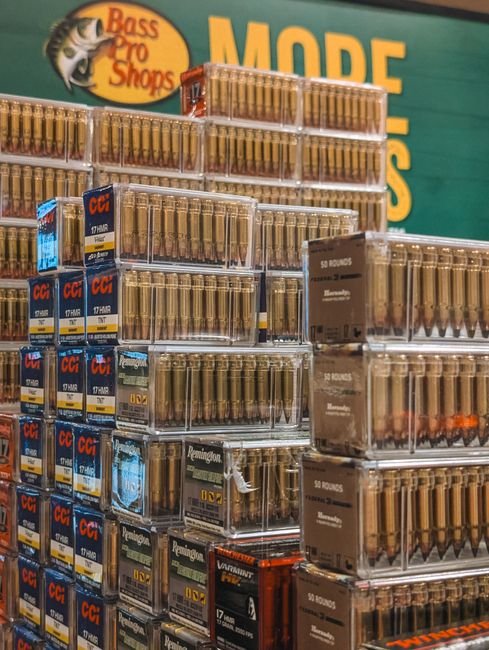
The number that makes bulk worthwhile
A bulk purchase has three separate values that are easy to blur together: all-in cost per round, cash required today, and the convenience of having a reserve on hand. The first supports an apples-to-apples comparison; the second determines whether a case-size order fits the buyer’s budget; the third has value but cannot reduce the receipt total.
The repeatable calculation is:
All-in cost per round = (merchandise subtotal − eligible discounts + shipping + tax + required fees) ÷ total rounds received
For example, a percentage promotion, coupon applied at checkout, loyalty credit, rebate that is actually expected to be redeemed, or a seller’s volume-tier reduction belongs in the calculation. A credit-card reward, future-store coupon, or unrelated membership benefit is usually better recorded separately: it may affect personal value, but it does not change this transaction’s invoice cost.
Shipping and tax need to be allocated across the entire order, not mentally attached to one box. If the cart mixes calibers or products, dividing those charges by total rounds gives an order-wide average; assigning them by each item’s share of merchandise value gives a more precise item-level result. Either method is useful when applied consistently.
A per-round cost calculation also needs the same load specification on both sides—caliber, bullet weight, case material, and whether the item is new manufacture or a comparable alternative. A cheap case is not necessarily a cheaper substitute.
-
Record the delivered quantity
Use the actual number of rounds in the order, including any bonus units.
-
Start with the merchandise subtotal
Add the listed item prices before checkout adjustments.
-
Subtract transaction-specific savings
Include only discounts, credits, or rebates that directly reduce this purchase’s effective cost.
-
Add unavoidable checkout charges
Include shipping, sales tax, and any required order fees shown for the destination.
-
Divide once, then compare like for like
Compare the resulting unit cost only against equivalent ammunition specifications and package quantities.
Inventory convenience is a separate consideration from the delivered unit-cost comparison.
Why freight changes the bulk equation
Ammunition is unusually expensive to move because it is dense, heavy, and often subject to carrier handling rules. A compact case can weigh far more than a similarly sized box of ordinary retail goods, so freight quotes tend to respond quickly to package weight, destination zone, and service availability.
The retailer’s shipping model matters
With flat or fixed freight, one shipment charge is spread across more rounds as the order grows. A single box may carry a large shipping burden per round; adding compatible cases can reduce that burden sharply, provided the order remains within the retailer’s parcel or freight threshold.
With weight-based shipping, each additional case adds much of its own transportation cost. The case’s advertised discount may still be real, but the delivered per-round advantage can remain nearly unchanged from a smaller order. Some sellers use tiered models: a fixed base charge plus weight increments, or free shipping once a merchandise threshold is reached.
Carrier zone is the other major variable. A warehouse nearby may produce a favorable delivered price even with a modest shelf discount, while a deeper-zone shipment can erase a stronger advertised deal. Remote-area surcharges, adult-signature requirements where offered, and split fulfillment can further alter the result.
A meaningful comparison keeps the same cartridge specification and total round count in view, then divides the final checkout total by rounds delivered. It also checks whether a larger order crosses a weight break or causes the retailer to ship multiple cartons.
A larger order is not automatically more efficient. The best all-in result often sits just below a carrier weight tier, or just above a retailer’s free-shipping threshold. Split shipments can defeat the expected savings when items originate from different warehouses.
Taxes and fees change at checkout
Sales and use tax treatment generally follows the actual ship-to destination. A seller may display an estimated tax early, but the checkout calculation can change once the full delivery address, local jurisdiction, and final basket are known. The same ammunition listing can therefore produce different all-in unit costs for buyers in different locations.
In some jurisdictions, shipping or delivery charges are taxable when the underlying goods are taxable; in others, they may be treated differently. Tax may also apply to certain added services, depending on how the charge is described and local rules. The relevant figure is the tax shown on the completed order, not a tax rate assumed from a neighboring area or a prior purchase.
Other charges deserve the same treatment: include them only when they actually appear in the cart. These can include:
- marketplace or payment-processing charges;
- adult-signature or other delivery-service charges;
- optional shipping insurance;
- remote-area, oversize, or carrier-access surcharges.
None is universal, and some are avoidable only by changing fulfillment or delivery options. A sound comparison captures each seller’s final landed total, then divides it by the same number of rounds. It also separates optional protection or premium delivery from mandatory charges, so the comparison remains like for like.
A pre-checkout total is useful for screening offers. The final cart is the evidence for comparing them.
Where the larger order starts to win
Consider two equivalent loads of the same cartridge: a smaller case and a larger case with a modestly lower listed cost per round. The smaller order carries a flat delivery charge; the larger one enters a higher weight band, adding more freight but not doubling it. If tax applies to both merchandise and freight, it rises with each cart as well.
The useful comparison is the total checkout difference divided by the number of additional rounds. Suppose moving to the larger case adds 500 rounds. Its merchandise discount saves an amount per round, while the heavier shipment adds a fixed incremental freight-and-tax burden. The larger case becomes cheaper only when:
Per-round merchandise savings × total rounds exceeds the added checkout cost.
For example, if the larger case saves enough on the item subtotal to absorb the extra delivery charge across its full quantity, its landed unit cost falls below the smaller case’s. If the delivery tier jumps sharply at that weight, the saving can disappear—even though the shelf price per round is lower.
Why there is no universal threshold
A published “buy at least this many rounds” rule is usually unreliable. The crossover changes with:
- Retailer shipping design: flat-rate, free-shipping threshold, zone-based freight, or weight tiers produce different curves.
- Destination: distance, remote-area surcharges, and the tax treatment of shipping can alter the final total.
- Fulfillment pattern: one order split across warehouses may generate multiple parcel charges.
- Packaging and load: case dimensions, hazardous-material handling where applicable, and carrier limits can move an order into a new bracket.
In some carts, every additional weight band adds freight faster than the product discount accumulates. In that case, a larger order never overtakes the smaller one at that retailer and destination. Only side-by-side checkout totals for equivalent ammunition reveal the actual crossover.
Only Compare Truly Equivalent Ammition
- Match the cartridge and load
A lower per-round figure is meaningful only when caliber, bullet weight, projectile type, pressure rating, and intended load class align. A practice FMJ, a defensive hollow point, and a specialty low-recoil load are different products even when the headstamp caliber matches.
CompareSame caliber, bullet construction, weight, and load specification.Do not treat as equalUsing caliber alone as proof of equivalence. - Separate new production from alternatives
Factory-new brass-cased ammunition generally belongs in a different comparison from remanufactured, steel-cased, aluminum-cased, corrosive-surplus, or mixed-lot offerings. Condition, case material, lot consistency, and stated warranty can explain a price gap that quantity cannot.
CompareThe same condition, casing material, and production category.Do not treat as equalCalling a lower-grade or uncertain-condition listing a bulk bargain. - Treat availability and fulfillment as part of the offer
An in-stock case shipped as one order is not interchangeable with a backordered listing, a marketplace offer, or a cart split among warehouses. The mechanics behind buying ammunition in bulk matter because partial shipments, substitutions, and separate freight charges can alter the landed cost.
CompareIdentical stock status, seller, shipment count, and delivery method.Do not treat as equalComparing an advertised listing price with a ready-to-ship cart total. - Price memberships on their actual terms
A member-only price can be compared only after including the required fee, renewal cadence, minimum order, and any exclusions on ammunition or freight. A discount tied to a qualifying subscription or store program may not apply to the same order size or destination.
CompareAll membership conditions and cart thresholds included.Do not treat as equalCounting a gated price while omitting the cost of access.
Why 1,000 Rounds Does Not Always Win
It can be, but two 500-round orders may cross a free-shipping threshold separately or qualify for a smaller-package rate.
A case that moves into a heavier freight tier can add more delivery cost than its product discount saves. The relevant comparison is the final total for each complete cart.
Some sellers discount at 500, while the next meaningful price step may not begin until a larger quantity—or may exclude certain loads.
Comparing the value of 500 versus 1,000 rounds requires the actual tiered item price, not an assumed bulk rate.
A combined cart can incur one high delivery charge; separate orders can also duplicate handling, shipping, and taxable freight.
Split fulfillment, carrier limits, and promotion rules determine which arrangement produces the lower landed per-round cost.
The cheapest case can still cost more
A lower landed cost is not automatically the better purchase. A large case ties up cash that might otherwise cover range fees, accessories, or a later sale; its advantage exists only if the ammunition will be used before preferences or availability change. Storage also has an operational limit: cartridges are best kept cool, dry, and protected from moisture, contamination, and unauthorized access.
The value of a single lot
For training or testing, one production lot can reduce a variable. Velocity, point of impact, and reliability can still vary, but a consistent lot makes it easier to identify whether a change came from the firearm, magazine, or ammunition. Splitting an order among several lots can, however, make sense when availability matters more than repeatability.
Delivery deserves the same planning as the cart. Someone may need to be present for a signature-required ammunition delivery, depending on the seller, carrier, destination, and order handling. That is friction—not a universal surcharge—and missed attempts, holding periods, or pickup distance can outweigh a small per-round edge. Confirming stock status and shipment consolidation can prevent paper savings from arriving in several inconvenient boxes.
Bulk value also depends on usable storage, lot consistency, inventory timing, and whether delivery can be received without disruption.
Frequently Asked Questions
What is the real cost per round when buying ammo in bulk?
The all-in cost per round is the merchandise subtotal, minus eligible discounts, plus shipping, tax, and any required fees, divided by the total number of rounds received. This landed cost per equivalent round is the number that actually reflects what a buyer pays at checkout.
Does a lower shelf price always mean a better deal on a larger case?
No. A larger case can move into a heavier shipping tier, adding more freight than its merchandise discount saves. The larger case only becomes cheaper when the per-round merchandise savings across all its rounds exceeds the added checkout cost.
How does shipping affect bulk ammunition orders?
It depends on the retailer’s shipping model. With flat or fixed freight, one shipping charge is spread across more rounds as the order grows, which favors larger orders. With weight-based shipping, each additional case adds much of its own transportation cost, so the delivered per-round advantage can remain nearly unchanged from a smaller order.
Are taxes the same for every ammo order?
No. Sales and use tax generally follows the actual ship-to destination, so the same listing can produce different all-in unit costs for buyers in different locations. In some jurisdictions shipping charges are taxable when the underlying goods are taxable; in others they are treated differently.
Is a 1,000-round case always cheaper than two 500-round orders?
Not automatically. Two smaller orders can each cross a free-shipping threshold or qualify for a smaller-package rate, while a single 1,000-round case can move into a heavier freight tier. The final total for each complete cart determines which option is actually cheaper.
What else should be considered besides unit cost when buying ammo in bulk?
Bulk value also depends on usable storage, lot consistency, whether the cash tied up in a large order could be used elsewhere, and whether delivery can be received without disruption, such as being available for a signature-required delivery.
Use the landed-cost test every time
- Compare the exact cart, not a retailer’s headline price or a remembered prior deal.
- Treat a small unit-cost edge as provisional when it depends on a threshold, split shipment, or uncertain stock.
- Keep the calculation with the order details so later purchases can be checked against the same baseline.
The useful comparison is final landed cost per round for equivalent loads: merchandise, shipping, tax, fees, and any immediate discount divided by the actual round count. A larger quantity only merits its extra commitment when that remaining per-round advantage is meaningful after every checkout charge is included.
Save the calculation—or a screenshot of the final cart—alongside the load specifications and destination. Promotions expire, freight tiers shift, inventory moves between warehouses, and tax treatment can differ by seller and order, so an old “best deal” is a reference point, not a standing result.






13 Comments
Good reminder not to count a membership fee as “free shipping” unless you were going to keep the membership anyway. Otherwise the first order is paying for that free shipping, which is very on-brand retail math.
One wrinkle: my local shop charges sales tax but no freight, while online sellers sometimes have a lower shelf price and a handling fee on top of shipping. The local option also means no waiting around for a signature-required delivery.
That delivery friction is hard to put into a spreadsheet, but it’s real. Taking time off or arranging a pickup can erase a tiny online saving pretty fast.
This is why I use a small “convenience cost” in my own notes. It’s not exact, but if the online order only wins by a dollar or two, I just buy local and move on.
That is a practical use of the landed-cost test. The invoice calculation establishes the financial comparison, then delivery time, pickup effort, storage, and cash commitment can decide whether the small numerical saving is worth pursuing. They should be acknowledged rather than hidden inside the per-round figure.
For equivalent loads, would you also separate brass-cased factory new from remanufactured ammo even when the listed bullet weight and velocity are similar? I see comparisons online that treat them as interchangeable because they’re both the same caliber.
Yes. Condition and manufacturing category belong in the equivalence check. Factory-new and remanufactured products may be perfectly suitable for different uses, but they are not automatically the same product for a price comparison; case condition, component consistency, warranty/return terms, and intended use can differ.
The point about taxable freight caught me off guard. I’ve definitely compared the item total and shipping separately, then wondered why the final per-round math was off by a couple cents.
I wish more checkout pages showed the shipping logic before the very last step. Split fulfillment is especially annoying: one cart looks like it cleared free shipping, then two boxes appear and the “deal” vanishes.
Does the break-even calculation still work if the shipping rate jumps at 30 lb, rather than being a flat charge? I’m guessing there may be no smooth crossover at all—just a weird dead zone where adding another box makes every round more expensive.
How would you handle a retailer that gives store credit after purchase? They advertise it like a discount, but it can only be used on a later order and may expire.
Seems right to leave it out of the current landed cost, but I can see people counting it to justify a bigger case purchase.
That’s the sensible distinction. A credit earned after this transaction is not an invoice discount, so it should not reduce the current order’s landed cost. You can track it separately as a possible future benefit, but only value it at what you realistically expect to use before expiration—not necessarily its full face value.
Exactly. I have “rewards” sitting in two accounts that are basically imaginary money because the next order still needs a shipping minimum. They’re not a discount until they actually get used.
The 500 vs. 1,000 example is the one people need to see more often. “Buy more to save more” works right up until shipping decides to become a second mortgage 😅