
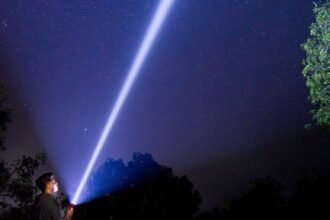
A distant target needs definition, not merely a splash of light.
At 30 yards, almost any respectable rifle light can look impressively bright. Across a field edge or down a long trail, that same broad glow may illuminate foreground brush while leaving the far subject as an unreadable silhouette. Real throw is controlled beam geometry, not a lumen contest.
Candela—the intensity concentrated in the beam’s hottest area—largely determines whether a light reaches outward with enough contrast to identify terrain, movement, and landmarks. A tight hotspot helps at distance, but usable long-range lights also retain enough spill to preserve orientation around it. Reflector depth, emitter size, lens clarity, and regulation under heat all shape that balance. Claimed beam distance is only a starting point: atmospheric haze, wet vegetation, and light-colored ground can expose weak beam control quickly.
- High candela supports distance; useful spill prevents tunnel vision.
- Sustained output matters more than a brief turbo peak.


Picking a long-range rifle light comes down to candela, not the lumen number on the box — a tight, high-candela hotspot is what lets you read detail across a field or down a long trail, while flood-heavy beams lose that definition past a few dozen yards. The picks below are matched to five different terrain and mounting scenarios, from wide-open ground to short, crowded rails, so the beam you choose fits the distances you actually shoot at.
Match the Beam to the Ground Ahead


- Candela
Peak beam intensity in a direction. It largely determines how tightly a light can concentrate output at range; candela matters for rifle-light throw more than headline lumen count.
- Lumens
Total light leaving the emitter. Higher output can broaden near-field awareness, but does not by itself promise a defined distant hotspot.
- Rated beam distance
A calculated ANSI FL1 figure based on 0.25 lux at the target—roughly moonlight-level illumination, not reliable positive identification.
- Practical identification distance
The range at which target shape, movement, and distinguishing detail remain readable in the actual terrain and ambient light.
Comparison favors the beam that delivers recognizable detail rather than the longest box claim. Each light is judged as a mounted field tool, where output figures meet switches, batteries, and terrain.
A concentrated, clean hotspot is assessed at distance, along with spill that reveals nearby branches, trail edges, and peripheral movement without excessive foreground glare.
Tailcap and remote-switch behavior, momentary access, rail fit, cable routing, and mounting rigidity matter as much as beam output when the light is used on a long gun.
Runtime and thermal step-down, battery format, weather sealing, and carried mass are weighed against the role of the rifle rather than treated as isolated specifications.
Published distance can contract sharply in wet brush, haze, pale ground, or competing artificial light.
Leaves and grass scatter a broad beam; fog and dust return light to the shooter; dark fur absorbs it. Reflective signs or eyeshine can appear far beyond the distance at which an object’s identity is actually clear. A useful long-range light therefore combines intensity with enough controlled spill to read the ground between the muzzle and the hotspot.
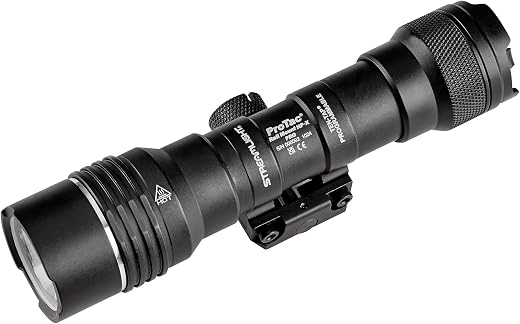
HP-X Pro for distant detail, not broad flood
01
Best for maximum throw and target clarity
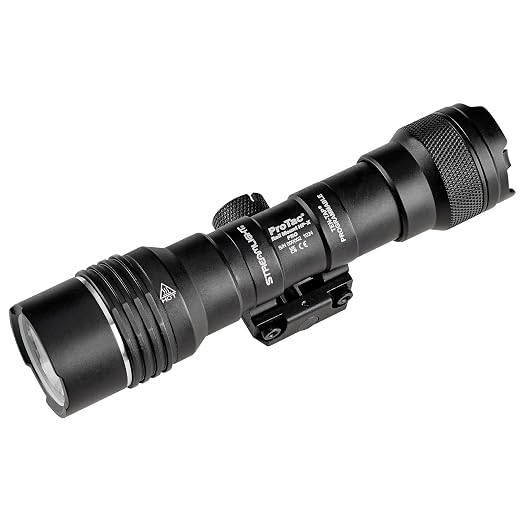
The Streamlight ProTac Rail Mount HP-X Pro is built around one priority: putting a defined white hotspot far downrange. Its 105,000-candela beam and 800-lumen output make it the natural default where long lanes, field edges, cutlines, and open ground matter more than lighting every step nearby. The rail-mounted body and Jack-Cap system also allow either remote pressure-pad activation or a conventional tailcap configuration.
- 105,000 candela concentrates light at distance
- Defined hotspot helps separate distant objects
- Remote switch or tailcap setup
- Compact rail-mounted format
- Limited broad spill versus flood-oriented lights
- Bright close foreground can overwhelm dark-adapted vision
- One CR123A battery platform
Quick take A purpose-built thrower that prioritizes distance and hotspot definition. It gives up generous nearby coverage to do that job well.
For sustained attention on distant terrain, this is the roundup’s default choice. The concentrated beam places more useful intensity on far objects than a wide, high-lumen pattern can. That same specialization means the area immediately around the muzzle and along the feet receives less even illumination; on tight trails or inside dense cover, a broader beam pattern can be easier to work with.
The Jack-Cap switching arrangement is a meaningful practical advantage, since the light can be set up around a pressure switch or retained with tailcap operation.
A hard-driving hotspot for long, open sightlines
Top choice for tightly focused distance illumination
The Nightstick LGL-160-T Turbo is built around reach rather than broad, comfortable illumination. Its 100,000-candela, 800-lumen beam uses a high-intensity parabolic reflector to place a distinctly concentrated core on distant detail, with a stated 632-meter beam distance.
That character suits open ground, long lanes, and situations where reflective markers, terrain features, or a distant subject need separation from the background. The included tailcap and 6-inch remote switch both support momentary and constant-on use, while the reversible thumb-screw mount and included offset mount provide useful latitude around front sights and support-hand placement.
The same tight beam changes the near-field experience. At walking distances, the brightest portion can feel narrow and can leave more of the immediate sides dependent on ambient light or deliberate muzzle movement. On a long gun, pressure-pad routing and mount position matter: a switch placed where the support hand naturally settles helps retain rapid, controlled activation without reaching forward or changing grip.
- 100,000 candela drives a pronounced central hotspot
- Stated 632-meter beam distance
- Tailcap and remote switch offer momentary or constant-on operation
- Offset and reversible Picatinny mounting options
- Narrower near-field coverage than a spillier beam
- Peripheral detail can require more deliberate light placement
- Cable and pad placement need attention on longer handguards
Streamlight ProTac HL-X Pro for changing terrain
Strong balance of output, reach, and flexibility
The ProTac Rail Mount HL-X Pro occupies the useful middle ground between a close-range flooder and a purpose-built throw light. Its 50,000-candela beam reaches into open ground while retaining enough surrounding illumination to read brush, trail edges, and intervening obstacles.
That broader working beam makes sense on rifles and carbines that move between timber, field margins, and mixed-distance sightlines rather than staying dedicated to long, unobstructed views. The supplied Picatinny clamp and M-LOK mount broaden placement options; its low-profile mounting approach is generally easier to accommodate around common optic and accessory layouts than a large standalone light body.
- 50,000 candela with useful spill
- 447-meter rated beam distance
- Jack-Cap supports tailcap or remote switch
- Picatinny clamp and M-LOK mount included
- Waterproof long-gun construction
- Less distant intensity than dedicated throwers
- Peripheral light can increase nearby splash
- Single CR123A power format
The HL-X Pro is the more versatile choice when the rifle’s working distance is not predictable. Its 1,000-lumen, 50,000-candela pattern gives up some far-end definition to dedicated 100,000-candela-class lights, but gains spill that remains useful around cover and uneven ground. The Jack-Cap also lets the light suit either a simple tailcap setup or remote-switch layout without changing the core light.
Olight Odin S Compact for short rails and low-bulk carbines
- Compact integrated-mount format preserves rail real estate
- Magnetic rechargeable battery avoids spare-cell handling
- 15,600 candela provides more reach than a flood-first light
- Screw-secured remote switch is designed to stay put
- Its 15,600-candela beam cannot match dedicated long-throw lights
- Integrated battery requires a deliberate charging routine
- Compact thermal mass limits sustained high-output expectations
UC20: a dedicated green-light option for hunting setups
- Green beam preserves a specialized hunting-light role
- Claimed long-distance reach
- Includes Picatinny mount and pressure switch
- Simple single-output operation
- Not a substitute for a white navigation light
- Green light distorts color recognition
- Budget-grade mount and switch merit close inspection
- Hunting-light use may face local restrictions
Choose the Beam—and the Mounting Details That Preserve It
- Open ground and long lanes
The HP-X Pro and LGL-160-T suit distant treelines, fields, and cutlines. Mount far enough forward to reduce barrel shadow, then confirm the optic does not clip the hotspot or create distracting flare.
Look forTight hotspot, rigid forward mount, clean sight picture.AvoidA narrow beam blocked by muzzle, optic, or handguard. - Woods meeting fields
The HL-X Pro’s broader usable spill better supports transitions from close brush to open ground. Check for rings, dark holes, and other beam artifacts against pale bark and reflective vegetation.
Look forUsable peripheral spill with defined distance detail.AvoidTunnel vision or artifact-prone beam edges. - Short carbines and crowded rails
The Odin S keeps bulk down, but its compact layout makes cable routing critical. A pressure pad should lie naturally under the support hand without crossing a hot barrel, snagging, or changing the firing grip.
Look forProtected cable path and repeatable activation.AvoidPinched leads, accidental activation, or compromised grip. - Hunting-specific setups
The UC20’s green output can limit disturbance in selected hunting contexts, but it sacrifices natural color recognition. Verify mount clearance around larger barrels and test switch retention under the rifle’s actual recoil.
Look forPurpose-specific color, secure mount, recoil-proof controls.AvoidAssuming green light replaces general navigation light.
-
Confirm the battery ecosystem
Verify whether the light accepts CR123A, 18650, proprietary rechargeable cells, or more than one format; output and runtime can change with the cell.
-
Derate runtime for cold
Lithium cells lose usable capacity in low temperatures, so a claimed high-mode runtime is not a field guarantee.
-
Plan charging and spare power
A magnetic or USB charging system needs access to power; carry protected spare cells or primary batteries in a secure, dry carrier.
-
Inspect the mount interface
Match the mount to the rail, torque fasteners to the maker’s specification, and check that recoil cannot shift the light or loosen the hardware.
-
Check beam obstruction
At the intended distance, inspect for barrel, front-sight, sling, or suppressor shadow; tight throw beams make partial blockage especially obvious.
-
Prove the controls safely
In a lawful, controlled setting, cycle the mount and switch arrangement through recoil, glove use, and awkward positions before relying on it outdoors.
Test sustained output, not only activation. A light that steps down from heat, a drained rechargeable pack, or a pressure pad that shifts under recoil can erase the practical advantage of high candela. Confirm the chosen mode returns predictably after battery changes and remounting.
Frequently Asked Questions
What does candela measure, and why does it matter more than lumens for rifle-light throw?
Candela measures the beam’s peak intensity, the concentration of light in its hottest area, which largely determines how far a rifle light can reach with a defined, readable hotspot. Lumens measure total light output and can broaden near-field brightness without producing that same distant hotspot.
Which rifle light in this roundup has the most throw?
The Streamlight ProTac HP-X Pro leads with a 105,000-candela beam and 800 lumens, closely followed by the Nightstick LGL-160-T Turbo at 100,000 candela with a stated 632-meter beam distance.
Is a rated beam distance the same as being able to identify a target?
No. Rated beam distance is a calculated ANSI FL1 figure based on 0.25 lux at the target, roughly moonlight-level illumination, not the level of light needed for positive identification. Practical identification distance is the range at which shape, movement, and detail actually remain readable in real terrain.
What can shorten a rifle light's effective range in the field?
Fog, dust, wet vegetation, and pale or reflective ground can scatter or return light before it reaches the target, while dark fur or clothing absorbs it. Reflective signs or eyeshine can also appear identifiable far beyond the distance at which the object’s actual identity is clear.
Which light is better for mixed terrain instead of pure long-range throw?
The Streamlight ProTac HL-X Pro is the more adaptable choice for terrain that alternates between brush and open ground. Its 50,000-candela beam and 1,000 lumens keep a usable hotspot at distance while retaining enough spill to read nearby trail edges and obstacles.
Why choose the green-beam UC20 instead of a white light?
The UC20 is a dedicated green-light kit built for nighttime hunting applications where that specialized role matters. Green illumination distorts natural color recognition, so it is not a substitute for a white navigation light, and hunting-light use may face local restrictions.
Choose for Clear Identification, Not the Biggest Number
- Use the HP-X Pro for open ground where distant detail is the priority; choose the HL-X Pro when the route alternates between open lanes and nearby cover.
- The LGL-160-T suits setups built around a very tight, long-reach hotspot, while the Odin S favors compact, rechargeable carbines. The UC20 is the specialized green-light choice for hunting contexts.
For the longest controlled sightlines, the Streamlight ProTac HP-X Pro is the strongest all-around choice; its concentrated beam reaches distant detail without committing as fully to a tunnel-like pattern as the Nightstick LGL-160-T Turbo. The HL-X Pro is the more adaptable answer for mixed woods, field edges, and changing distances.
A simple rule: choose the HP-X Pro for open ground, HL-X Pro for varied terrain, LGL-160-T for maximum throw, Odin S for compact rails, and UC20 for dedicated green-light hunting. Glare control and reliable positive identification at the distances actually encountered matter more than a headline lumen or throw claim.
Streamlight 89015 ProTac Rail Mount HP-X Pro 800-Lumen 105000-Candela Tactical LED Flashlight, Jack-Cap Switch, for Picatinny Rails, M-LOK Mount, Black
Features
| Additional Features | Adjustable Light Modes, High Power, Long Range, Mountable, Weatherproof |
| Power Source | Battery Powered |
| Light Source Type | LED |
| White Brightness | 800 Lumens |
| Voltage | 3 Volts |
| Battery Type | Lithium Metal |
| Number of Batteries | 1 CR123A batteries required. (included) |
| Water Resistance Level | Waterproof |
| Light Output Maximum | 800 Lumens |
| Battery Description | Lithium |
| Mounting Type | Gun Mount |
| Battery Life | 5 Hours |
| Wattage | 4.6 Watt-hours |
| Number of Light Sources | 1 |
| Batteries are Included | Yes |
| Light Source Special Features | Adjustable Light Modes, High Lumens |
| Light Path Distance | 648 Meters |
| Runtime | 2 hours |
| Item Dimensions D x W x H | 5.63"D x 1.38"W x 1.72"H |
| Item Weight | 0.4 Pounds |
| Size | 5.63 x 1.38 x 1.72 |
| Item Dimensions L x W x H | 5.63"L x 1.38"W x 1.72"H |
| Material Type | Aluminum |
| Included Components | Flashlight |
| Brand Name | Streamlight |
| Recommended Uses For Product | Camping, Emergency, Hiking, Security, Tactical |
| Global Trade Identification Number | 00080926890152 |
| Manufacturer | Streamlight |
| UPC | 080926890152 |
| Manufacturer Warranty Description | Limited lifetime warranty. |
| Manufacturer Part Number | 89015 |
| Set Name | Pro System Non-USB |
| Model Number | 89015 |
| Item Type Name | Weapon Mounted Light |
| Unit Count | 1.0 Count |
| Item Length | 7.4 Inches |
| ASIN | B0DPNK6Z6N |
| Color | Black |
| Style Name | System |
| Finish Types | Brushed |
| Shape | Rectangular |
| Warranty Type | Lifetime |
| Specification Met | ANSI FL1, CE, IP67 |
- Nomex
- Made in the USA or Imported
- HIGH-CANDELA LONG-RANGE BEAM PERFORMANCE: Delivers 800 lumens and 105,000 candela with a beam distance designed for long-range illumination, providing intense center brightness and useful peripheral light for low-light environments
- JACK-CAP SWITCH SYSTEM WITH REMOTE OPTION: Features Streamlight’s Jack-Cap tail switch, enabling use with a remote pressure switch or standard tailcap operation for flexible activation based on user preference
- RAIL MOUNT DESIGN FOR LONG GUN APPLICATIONS: Engineered for secure attachment to MIL-STD-1913 Picatinny rails, making it ideal for rifles, carbines, and other long gun platforms requiring dependable mounted lighting
- LOW-PROFILE DESIGN WITH M-LOK MOUNTING: Includes M-LOK mounting hardware for streamlined attachment and a low-profile setup that helps maintain balance and handling
- BUILT STREAMLIGHT TOUGH: Precision-machined aircraft-grade aluminum construction with durable anodized finish, IPX7 waterproof rating, and impact resistance for reliable performance in demanding environments
Streamlight 88126 ProTac Rail Mount HL-X Pro 1000-Lumen 50000-Candelas Long Gun Light with Jack-Cap, M-LOK Mount and Remote Pressure Switch, Black
Features
| Additional Features | Adjustable Light Modes, High Lumens, High Power, Lightweight, Long Range |
| Power Source | Battery Powered |
| Light Source Type | LED |
| White Brightness | 1000 Lumens |
| Voltage | 3 Volts |
| Battery Type | Lithium Metal |
| Number of Batteries | 1 CR123A batteries required. (included) |
| Water Resistance Level | Waterproof |
| Light Output Maximum | 1000 Lumens |
| Battery Description | Lithium |
| Mounting Type | Gun Mount |
| Battery Life | 5 Hours |
| Batteries are Included | Yes |
| Light Path Distance | 447 Meters |
| Runtime | 1 hour |
| Color | Black |
| Style Name | CR123A System |
| Finish Types | Brushed |
| Shape | Round |
| Warranty Type | Limited Lifetime |
| Specification Met | ANSI, CE, IP67 |
| Included Components | ProTac Rail Mount HL-X Pro |
| Brand Name | Streamlight |
| Recommended Uses For Product | Emergency, Security, Tactical |
| Global Trade Identification Number | 00080926881266 |
| Manufacturer | Streamlight |
| UPC | 080926881266 |
| Manufacturer Warranty Description | Limited lifetime. |
| Manufacturer Part Number | 88126 |
| Model Number | 88126 |
| Item Type Name | Weapon Light |
| Unit Count | 1.0 Count |
| Item Length | 7.4 Inches |
| ASIN | B0CLRHHHDS |
| Item Dimensions D x W x H | 5.43"D x 1.45"W x 1.72"H |
| Item Weight | 0.45 Pounds |
| Size | 5.43 x 1.45 x 1.72 |
| Item Dimensions L x W x H | 5.43"L x 1.45"W x 1.72"H |
| Material Type | Aluminum |
- HIGH-CANDELA PERFORMANCE: Delivers up to 1,000 lumens, 50,000 candelas, and a 447-meter beam distance, producing a concentrated beam designed for long-range illumination, target identification, and enhanced situational awareness in low-light environments
- LONG-RANGE TARGET IDENTIFICATION: Engineered with a focused high candela beam that projects light deep into dark environments while maintaining useful peripheral illumination, helping identify targets, obstacles, and surroundings at extended distances
- JACK-CAP REMOTE SWITCH READY: Features Streamlight’s Jack-Cap system with both push-button activation and remote pressure switch compatibility, providing flexible operation and dependable control across a variety of rifle and carbine platforms
- WHAT’S IN THE BOX: Includes ProTac Rail Mount HL-X Pro, Jack-Cap, M-LOK mount, momentary pressure switch, mounting hardware, and standard accessories
- BUILT STREAMLIGHT TOUGH: Machined aircraft-grade aluminum construction with a durable anodized finish, gasket-sealed glass lens, IP67-rated waterproof performance, and 2-meter impact resistance for reliable operation in demanding conditions. No standalone rechargeable lithium batteries are sold with this product
Nightstick LGL-160-T Turbo High Candela Long Gun Light Kit - 2 CR123 - Black
Features
| Additional Features | Adjustable |
| Power Source | Battery Powered |
| Light Source Type | LED |
| White Brightness | 800 Lumens |
| Battery Type | Lithium Metal |
| Number of Batteries | 2 A batteries required. |
| Water Resistance Level | Waterproof |
| Light Output Maximum | 800 Lumens |
| Battery Description | Lithium |
| Bulb Base | GX5.3 |
| Mounting Type | Gun Mount |
| Battery Life | 2 Hours |
| Number of Light Sources | 1 |
| Batteries are Included | No |
| Light Source Special Features | Adjustable |
| Light Path Distance | 632 Meters |
| Runtime | 2 hours |
| Bulb Shape Size | B10 |
| Item Dimensions D x W x H | 5.3"D x 1.4"W x 1.4"H |
| Item Weight | 0.39 Pounds |
| Item Dimensions L x W x H | 0.75"L x 0.75"W x 0.75"H |
| Material Type | Aluminum |
| Included Components | Long Gun Light |
| Brand Name | Nightstick |
| Recommended Uses For Product | Emergency |
| Manufacturer | Bayco Products Inc. |
| UPC | 017398809344 |
| Manufacturer Warranty Description | Limited lifetime. |
| Manufacturer Part Number | LGL-160-T |
| Set Name | Nightstick LGL-160-T Turbo High Candela Long Gun Light Kit |
| Model Number | LGL-160-T |
| Item Type Name | Long Gun Light |
| Unit Count | 2.0 Count |
| ASIN | B0DLXWSYV9 |
| Color | Black |
| Style Name | Turbo - High Candela |
| Finish Types | Anodized |
| Shape | Cylindrical |
| Warranty Type | limited warranty |
| Specification Met | True |
- 800 Lumens
- 100,000 candela
- IP-X7 Waterproof
- 632 meter beam distance
- Runs on 2 CR123 Batteries (included)
OLIGHT Odin S Compact MLOK Rechargeable Tactical Flashlight, 1500 Lumens 15600 Candela 250m Beam Distance Weaponlight, Upgraded Remote Pressure Switch,...
Features
| Additional Features | Durable, High Lumens, Rechargeable, Strobe Mode, Weatherproof |
| Power Source | Battery Powered |
| Light Source Type | LED |
| White Brightness | 1500 Lumens |
| Battery Type | Lithium Polymer |
| Number of Batteries | 1 Nonstandard Battery batteries required. (included) |
| Water Resistance Level | Waterproof |
| Light Output Maximum | 1500 Lumens |
| Battery Description | Nonstandard Battery |
| Mounting Type | Rail Mount |
| Number of Light Sources | 1 |
| Batteries are Included | Yes |
| Light Source Special Features | Customizable Strobe, Rock-Solid Mounting |
| Light Path Distance | 250 Meters |
| Runtime | 5 hours and 10 minutes |
| Color | Black |
| Style Name | Mlok Rail |
| Finish Types | Black |
| Shape | Cylindrical with Rectangular Head |
| Included Components | Battery Holder x 1, User Manual x 1, H2.5 Wrench x 1, Screws x 2, Self-Locking Band x 4, H3.0 Wrench x 1 (For M-LOK version), Nuts x 2 (For M-LOK version), Odin S (Battery Included) x 1, Rail Mount x 1, Charging Cable x 1, Pressure Switch x 1, Pressure Switch Mount x 1 |
| Brand Name | OLIGHT |
| Recommended Uses For Product | Hunting, Security and Safety, Shooting, Tactical |
| Manufacturer | OLIGHT |
| UPC | 764749053658 |
| Manufacturer Warranty Description | lifetime warranty. |
| Manufacturer Part Number | O-ODINS-BK-300000 |
| Set Name | M-LOK, Picatinny |
| Model Number | O-ODINS-BK-300000 |
| Item Type Name | Tactical Flashlight |
| Unit Count | 1.0 Count |
| ASIN | B0D1DT2WP9 |
| Item Dimensions D x W x H | 1.14"D x 1.14"W x 5.02"H |
| Item Dimensions L x W x H | 5.02"L x 1.14"W x 1.14"H |
| Material Type | Aluminum |
- [Powerful and Compact] The Odin S delivers an impressive output of up to 1500 lumens and a beam distance of 250 meters, providing a bright hotspot and spill
- [Double-locked Pressure Switch] Upgraded magnetic remote switch with a secure screw cap design for a snug fit. Ensuring secure and stable light control
- [Secure and Professional Design] Features an upgraded integrated mounting bracket and screw-locking rail clamp for secure support even under heavy recoil. MLOK and Picatinny versions cater to preferences
- [Customizable Strobe] Quickly press the tail switch or remote switch five times or more,and hold it for more than 1 second at the last press to enable or disable the Strobe function. Once the Strobe function is enabled,double pressing the tail switch or remote switch can activate it
- [Dual Power Options] The first Olight dual-power long weaponlight, with standard 3500 mAh rechargeable battery included, while compatible with 2*non-rechargeable batteries
- [Note] When using non-rechargeable batteries, please do not attempt to charge the light with the MCC
UC20 Green Hunting Light Flashlight kit,1586 Yards Green LED Light, 2000 High Lumens, Picatinny Mount, Pressure Switch, Long Distance Night Hunting Gifts for...
Features
| Additional Features | Adjustable Focus, Adjustable Strap |
| Power Source | Battery Powered |
| Light Source Type | LED |
| White Brightness | 2000 Lumens |
| Battery Type | Lithium Ion |
| Number of Batteries | 1 Lithium Ion batteries required. (included) |
| Water Resistance Level | Waterproof |
| Battery Description | 18650 Battery |
| Light Source Wattage | 20 Watts |
| Mounting Type | Rifle Mount |
| Battery Life | 100000 Hours |
| Wattage | 10 Watt-hours |
| Number of Light Sources | 1 |
| Batteries are Included | Yes |
| Light Path Distance | 1450 Meters |
| Runtime | 5 hours |
| Item Dimensions D x W x H | 1.18"D x 1.85"W x 6.18"H |
| Item Weight | 7.2 ounces |
| Size | UC20 |
| Included Components | Battery |
| Brand Name | ANEKIM |
| Recommended Uses For Product | Hunting |
| Manufacturer | ANEKIM |
| UPC | 633690006078 |
| Manufacturer Warranty Description | 24. |
| Manufacturer Part Number | ANEKIM |
| Model Number | ANEKIM |
| Unit Count | 1 Count |
| ASIN | B0928HQ9WV |
| Color | Black |
| Style Name | Tropical |
| Finish Types | Matte |
| Shape | Cylindrical |
| Material Type | Aluminum |
- 【Super Bright & Long-Distance】The ANEKIM UC20 green hunting flashlight emits up to 2000 lumens at 1586 yards, providing long-range visibilities for hunters of all levels, spot prey early to make decisions and stay safe in the wilderness.
- 【Rail Mount & Remote Switch】Green light hunting flashlight comes with picatinny rail mount, perfectly fits for all 20mm standard picatinny/weaver rail. Two modes remote pressure switch: one for button switch, press to light up, press to light off. One for pressure switch, press to light on, release to light off.
- 【Single Mode】UC20 green hunting light only single mode makes that you’re much less likely to spook it, and that much more likely to bag it.
- 【Built to Last】All-metal matte black body, aero-grade aluminum to give you the best compromise between strength and weight. This green flashlight rated IP68 rated 5m submersible and 1 meter impact resistance, makes the UC20 a reliable tool in all weather conditions and compatible with most accessories.
- 【Special Design for Hunting】Ease of assembly and disassembly of, UC20 hog pig hunting tactical flashlight be able to withstand shots, for example, from .308 or .30-06 caliber. From coyote to hog hunting, UC20 green hog light will greatly improve hunting success and meet different tactical needs.



6 Comments
Why no SureFire or Modlite comparison? I get that this is about real throw rather than brand-name points, but those are the lights a lot of people already have on rifles. Curious whether the HP-X Pro’s 105k candela actually holds up after a few minutes or if thermal regulation knocks it down hard.
Fair question. The list focused on lights with clearly differentiated beam roles and readily comparable published configurations, rather than trying to cover every premium ecosystem. SureFire and Modlite both have relevant options, but their best fit depends heavily on head/body/battery combinations. Sustained output matters more than the headline candela figure, which is why the article recommends checking runtime data and testing the light in the conditions where you’ll use it.
The point about narrow beams making switch placement more consequential is spot on. A Turbo-style hotspot can look amazing down a field, then feel pretty awkward the second you need to scan around a gate or tree line. Biggest-number shopping is how people end up buying a tiny lighthouse 😂
Glad you called out green light’s limitations instead of treating the UC20 like magic hunting gear. It can make sense for a dedicated setup, sure, but navigating, reading terrain, and figuring out what you’re actually looking at gets weird fast. Why wasn’t a white/green dual-output option included, though?
Could you add a budget pick next time? The HL-X Pro seems like the sensible middle-ground option here, especially with the included M-LOK mount, but it still isn’t cheap once you start adding batteries and a spare switch.
Also, is the Odin S really worth considering if the rifle may sit in a vehicle for weeks? “Charging-dependent readiness” sounds like a polite way of saying it may be dead exactly when I need it.
I’d lean HL-X Pro for that use too. Rechargeables are convenient, but for something that sits unused I prefer being able to toss in fresh primary cells and forget about it for a while.