

An enclosed emitter solves the weather problem; it does not erase every compromise.
A pistol carried through rain, lint, vehicle interiors, and hard training does not ask the same things of an optic as one that spends most of its life on a range belt. The ACRO P-2 puts structural confidence and a deeply established duty-oriented mounting ecosystem first, but its heavier, taller package and dedicated footprint can complicate an otherwise simple slide setup. The EPS is notably trimmer and typically easier to integrate on common carry pistols, while delivering the enclosed-emitter advantage at a more accessible level.
Neither is a universal winner. A handgun assigned to sustained professional use may justify the ACRO’s durability margin and ecosystem depth. A concealed-carry pistol, where slide width, holster fit, direct mounting, and overall spend matter every day, may make the EPS the more coherent choice. The primary role of the pistol—not a spec-sheet trophy—sets the priority.
Pick by mission, then confirm the cut


Enclosed does not mean maintenance-free
Both optics place the LED emitter behind sealed windows, so rain, pocket lint, airborne dust, and splashed mud are far less likely to block the projected dot than on an open-emitter design. That is the practical advantage in the open- versus enclosed-emitter comparison: a dirty exterior may still permit a usable aiming reference.
The enclosure is not immunity. A packed layer of mud, fogged window, snow, oil film, or a damaged front lens can still obscure the dot or target. The ACRO P-2’s more substantial housing offers strong protection around the optic; the EPS achieves similar emitter isolation in a trimmer carry-oriented package. Neither eliminates the need to inspect both lens faces, clear contamination with appropriate materials, and verify the dot after harsh exposure.
Backup iron sights remain meaningful. They provide a reference if the window is blocked, the dot is lost, or electronics fail. Just as important, target-focused presentation—bringing the pistol to the visual line rather than searching for the dot—helps maintain a fast, usable sight picture when conditions are imperfect.
Lens obstruction is the remaining weak link. Clean glass and usable backup sights complete the reliability system.
| Duty-ready pick Aimpoint ACRO P-2 Enclosed Duty Red Dot | VS | Carry-focused value Holosun EPS Full-Size Enclosed Optic |
|---|---|---|
ACRO-specific | Mount interface |
K / modified RMSc |
Side CR2032 | Battery change |
Side CR1620 |
3.5 MOA dot | Reticle options |
2/6 MOA, MRS variants |
Often needs taller irons | Iron-sight relationship |
Often factory-height compatible |
Broader, taller body | Carry profile |
Lower, slimmer body |
| Check fit | Check fit |
The decisive question is not whether either optic is enclosed, but whether its mounting stack and controls remain workable on the specific pistol. An adapter can add height, fasteners, and another interface whose fit merits scrutiny.
The P-2 requires an ACRO-pattern solution. The EPS uses the K/modified-RMSc interface; the supplied RMR-to-K plate expands compatibility, but direct mounting usually keeps the window lower and reduces tolerance stacking. Confirm screw length, recoil-lug engagement, and slide-specific manufacturer guidance.
EPS’s lower deck can preserve a useful co-witness with many factory irons, whereas P-2 installations commonly change iron-height requirements. The P-2’s single 3.5-MOA dot is deliberately simple; EPS variants offer finer dots or circle-dot references, but the selected reticle must remain uncluttered during presentation and through a dirty window.
Both have side-access batteries, so battery replacement need not disturb the mount. Periodic checks of mounting hardware, brightness-button access around the slide, and zero after hard use matter more than an isolated housing-strength claim.
ACRO P-2: built around hard-use pistol roles
Top choice for proven durability and long battery life
The Aimpoint ACRO P-2 is the established enclosed-emitter option for pistols expected to see sustained holster wear, rough handling, and institutional-style use. Its dedicated ACRO footprint has produced a mature ecosystem of direct mounts and adapter plates across service pistols, slide-milling packages, and carbine mounts.
It makes the most sense where confidence in the mounting system and a long-established duty record matter more than keeping the slide as trim as possible.
- Fully enclosed aluminum housing
- Proven hard-use track record
- 50,000-hour constant-on battery
- Positive, glove-friendly controls
- Deep ACRO mount ecosystem
- Bulkier than the EPS
- Often needs an adapter plate
- Higher optic and mount cost
- Tall setup can require taller irons
In brief The P-2 treats compactness as a secondary concern. Its payoff is a famously resilient enclosed optic with uncomplicated controls and broad support from serious-duty mounting systems.
The ACRO P-2 is the more convincing choice when the pistol’s job prioritizes durability, mounting provenance, and simple operation. Its tall, blockier form is noticeable in concealment, and many common optics-ready slides add plate height and another interface to manage.
That extra mass and expense can be justified on a hard-use pistol; on a discreet carry gun, the lower-sitting EPS often makes the cleaner package.
Holosun EPS: enclosed carry efficiency with a broader feature set
Best for versatile handgun compatibility at a lower price
The full-size EPS places an enclosed emitter in a notably compact pistol-optic envelope. Its low-deck K-pattern architecture makes it especially relevant for concealed-carry pistols and slide cuts where a tall adapter stack would compromise sight picture or holster clearance.
The wider EPS window remains large enough for purposeful presentation and tracking through recoil, rather than feeling like a micro-optic concession. It suits shooters seeking an enclosed system without making the pistol feel configured around a duty-sized optic.
- Enclosed emitter in a compact housing
- Useful window for its carry-oriented footprint
- Low deck can preserve factory-height iron-sight usability
- Side-loading battery avoids removing the optic
- Multiple reticle and illumination configurations
- Exact reticle package varies by SKU
- Solar Failsafe is not universal across configurations
- K footprint may require a plate or slide-specific hardware
- Screw length and thread engagement demand verification
In brief The EPS gives the carry-oriented buyer an unusually complete enclosed-optic package. Its fitment details deserve more scrutiny than its clean exterior suggests.
The EPS is the more carry-efficient enclosed choice when low mounting height, a practical window, and configuration breadth matter most. Dot-only, circle-dot, color, and solar-assist availability depend on the specific model; an MRS designation is a useful clue, not a substitute for checking the listing. Confirm the pistol cut, included plate, screw specification, and iron-sight clearance before treating it as a direct swap for an ACRO P-2. For institutional duty programs, the P-2 may still carry more weight where approved mounting systems, procurement continuity, and established hard-use precedent drive selection.
-
Identify the slide cut
The ACRO P-2 needs an ACRO-specific interface; the EPS uses the Holosun K-pattern footprint. A direct fit depends on the slide’s actual lug pattern and recess depth, not the optic’s general category.
-
Map the mounting route
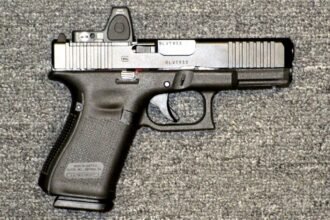
A purpose-cut slide may take either optic directly, while many factory optic-ready pistols require the maker’s plate system. For example, Glock 19 MOS red-dot setups commonly begin with selecting a plate that correctly converts the MOS cut to the chosen footprint.
-
Use the hardware assigned to that route
Plate screws and optic screws are not interchangeable. Correct length prevents bottoming out, contact with internal parts, or inadequate thread engagement; torque should follow the optic, plate, and pistol manufacturer’s specification.
-
Check the finished sight picture
The lower EPS mounting geometry can preserve more of the factory iron sights on a compatible cut. An ACRO on a plate often sits higher and may require taller backup sights; visible irons are useful, but their absence is not proof of a poor mount.
-
Inspect the system after use
Confirm screw witness marks, optic stability, and plate movement after initial firing and during routine cleaning.
A quality steel or properly engineered aluminum plate is not inherently a weak link. Problems usually trace to poor fit, incorrect screws, improper torque, or neglected inspection—not the mere presence of a plate.
The trade is geometric: every plate adds height and another interface. If the host pistol supports a secure direct mount for the preferred optic, that route is simpler; if it does not, a proven plate system can make either sight fully viable.
Choose for the pistol’s actual job
For a duty pistol, the ACRO P-2’s case rests on more than its enclosed housing. Its established mounting ecosystem, widespread institutional familiarity, and reputation for environmental resilience matter when an optic must remain supportable across hard use, replacement parts, plates, and holsters. The tradeoff is a taller, bulkier package.
For a concealed-carry pistol, the EPS often makes better use of the slide. Its lower K-pattern-oriented geometry can reduce plate dependence and sight-height complications, while its smaller profile is easier to accommodate in a carry setup. That does not make it fragile; it means packaging efficiency is a larger part of the decision.
For a mixed-role pistol, neither label settles the matter. The relevant questions are how often the pistol is carried, whether agency-style support matters, and whether the specific slide cut preserves a low, secure mount. A duty-rated optic is not inherently the best concealed-carry optic; the mounting stack and daily profile can be more consequential than the durability headline.
Will an EPS mount directly to the slide?
Only if that exact EPS model and slide cut share the required K-pattern geometry. Verify recoil lugs, screw length, and manufacturer instructions before installation.
Does the ACRO P-2 need a plate?
Many slides require an ACRO-specific plate; a dedicated direct-milled cut does not. Plate height changes screw engagement and backup-sight visibility.
Which optic sits lower?
An EPS on a compatible direct K-pattern cut commonly sits lower than a plate-mounted ACRO. Actual sight picture depends on the slide and iron-sight set.
Are all EPS versions interchangeable?
No. Full-size EPS, carry variants, solar versions, and reticle configurations differ; confirm the exact model designation and supplied hardware.
Choose the system, not just the optic
- Confirm the exact optic configuration, slide cut, plate, screws, sight height, and current manufacturer documentation together.
The ACRO P-2 remains the stronger conditional choice where a proven duty-oriented interface and hard-use emphasis outweigh bulk. The EPS fits better where lower carry profile, direct K-pattern mounting, and feature flexibility matter most.
Either choice can be undermined by incorrect hardware or geometry. Treat the optic, slide, mount, fasteners, and backup sights as one system before committing.





One Comment
Which one did you end up choosing for your own carry gun? Curious whether writing this comparison changed your mind at all.