

A weapon light’s usefulness is written in the shape of its beam, not one oversized spec.
Two lights can sit side by side with the same 1,000-lumen claim and behave nothing alike at night. One may cast a broad, comfortable pool that reveals a doorway and its immediate surroundings; the other may drive a tight, intense center far downrange while leaving more of the near field comparatively dim.
That difference is the gap between lumens—the total visible light leaving the emitter—and candela—the intensity concentrated in a particular direction. Neither figure is a universal verdict. High output without enough intensity can look impressive nearby yet lose definition at distance. Extreme intensity can reach through darkness, ambient light, or photonic barriers, but a narrow hotspot may provide less contextual detail. Reflector geometry, lens design, LED size, beam spill, color temperature, and sustained output after heat regulation all decide what the number means in use.
- Beam distance is conventionally derived from candela: ANSI/PLATO FL 1 uses the distance at which the beam reaches 0.25 lux.
- A light rated at 25,000 candela has a calculated ANSI throw of about 316 meters; real identification distances are much shorter and condition-dependent.
Two Measurements, Two Different Questions
Lumens (lm)
Lumens are total luminous flux: the visible light leaving the emitter and optic in all directions. They describe the size of the light budget, not how tightly that budget is aimed.
Candela (cd)
Candela is luminous intensity in a particular direction. For a weapon light, the published figure generally describes the brightest part of the central hotspot, where the optic concentrates output.
Beam angle
A broad beam spreads a given number of lumens across more area, lowering intensity per direction. A narrow beam can produce much higher candela from the same—or even fewer—lumens.
Hotspot and spill
The hotspot supplies long-range identification and contrast; spill illuminates the surrounding scene. Lumens contribute strongly to useful spill, while candela largely determines how forcefully the hotspot reaches through distance and ambient light.
Lux at the target
Lux is the light arriving on a surface. In free space, illuminance falls with the square of distance: lux ≈ candela ÷ distance², making candela the more direct predictor of beam reach.
Two lights can each claim 1,000 lumens yet behave very differently. A floody optic may distribute that output across a wide area, while a tighter reflector or TIR optic concentrates more of it into the hotspot and posts far higher candela.
Conversely, a high-candela light is not inherently brighter everywhere. Its intense center can leave less light in the periphery. The meaningful comparison is therefore output, intensity, beam pattern, and sustained output together—not either headline number alone.
What candela means downrange
Illuminance falls with the square of distance: lux = candela ÷ distance². A light rated at 25,000 candela produces roughly 2.5 lux at 100 meters and 0.6 lux at 200 meters, assuming a clear line of sight and the beam aimed directly at the subject. Quadrupling candela to 100,000 raises those figures to about 10 and 2.5 lux respectively; it does not merely add a little more reach.
Manufacturers commonly derive beam-distance figures from the ANSI/PLATO FL 1 method. That calculation asks where the hotspot declines to 0.25 lux, approximately the illumination of a full moon on an open night. For 25,000 candela, the mathematical FL 1 distance is about 316 meters. This is a standardized comparison point, and it is valuable for comparing lights tested under the same method.
Distance rating is not positive identification distance
At 0.25 lux, a reflective object or silhouette may be visible, but fine detail can remain ambiguous. The useful distance for recognizing clothing, hands, obstacles, or other decisive features is often far shorter and changes with conditions such as:
- Target reflectivity and contrast: light-colored or retroreflective surfaces appear sooner than dark, matte ones.
- Ambient light: streetlights, moonlight, and backlighting can help or defeat a hotspot.
- Atmosphere and obstructions: rain, fog, dust, glass, and vegetation scatter or block light.
- Beam shape: spill reveals nearby context, while a tight hotspot concentrates range.
- Output over time: thermal regulation and battery voltage may reduce candela after initial activation.
Candela therefore describes a light’s potential to place illumination at range. It cannot, by itself, establish what a person can reliably identify there.
The beam is the real interface
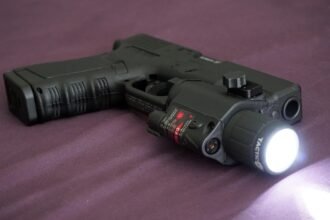
A weapon light is not experienced as a lumen number; it is experienced as a pattern on walls, foliage, and a target. That pattern usually has four parts:
- Hotspot: the brightest central area. A tighter hotspot concentrates more of the available flux into a small angle, raising candela.
- Corona: the transitional ring around the hotspot. A smooth corona helps the eye move from the bright center to the surrounding scene without a harsh step.
- Spill: lower-intensity light outside the center, useful for seeing hands, nearby obstacles, and the wider environment.
- Beam edge: where spill fades into darkness. A soft edge feels broad but can be less precise; a defined edge can make the beam seem more controlled.
Reflector depth, reflector texture, LED emitter size, and a TIR lens all decide where the light goes. They redistribute output rather than creating it: the same emitter can produce a broad, high-lumen-looking flood or a narrow, high-candela center. For that reason, comparing rifle lights built for genuine throw requires looking beyond the central spot to the usable area around it.
Why more throw is not always more useful
A highly focused optic can place enough intensity on a distant subject to preserve contrast against ambient light. At close range, however, its small hotspot may illuminate only a fraction of the scene. The surrounding spill may be comparatively dim, leaving peripheral detail less apparent.
This is most noticeable indoors and around reflective surfaces. A bright, tight center on a pale wall can force the eye to adapt to the hotspot while detail just outside it appears darker. In brush, rain, dust, or light-colored barriers, intense backscatter can similarly make a narrow beam feel less informative than its candela figure suggests.
The most balanced patterns retain a purposeful hotspot while providing enough corona and spill to orient the user. Beam shots at a fixed distance are useful, but only when exposure is locked; automatic camera exposure can make weak spill look stronger, or a hotspot look less intense, than it is.
A light can excel at distance yet feel narrow nearby. Beam shape determines whether its output is useful between those extremes.
What extra lumens actually add
Extra lumens are most valuable when the beam has enough spill and corona to distribute them. They can brighten doorways, room corners, nearby ground, and peripheral detail that a tight hotspot leaves dim. In practical terms, higher output often makes it easier to interpret a larger scene at short and moderate distances rather than forcing attention onto one intensely lit point.
That benefit depends on optical design. A higher-lumen light with a wide, evenly blended beam can make a confined area look substantially brighter than a lower-output model. But if those added lumens are placed mostly into spill, the hotspot may gain little intensity—and distant objects may not receive meaningfully more illuminance.
Candela remains the better indicator of reach because it describes how tightly the light is concentrated. Two lights can produce the same 1,000 lumens: the floody version may illuminate a broad nearby area, while the throw-oriented version places far more light on a small target at distance. Neither specification is sufficient alone; the beam profile determines where the output is useful.
Common lumen claims, clarified
Match the beam to the working distance
A compact pistol light usually has less bezel diameter and less room for thermal mass than a rifle light. That often favors a wide, moderate-intensity beam: enough hotspot to direct attention, with corona and spill that reveal nearby walls, hands, doorways, and floor transitions. It is a tendency, not a rule—some compact lights use tightly focused optics, and some full-size lights prioritize flood.
For enclosed, short-distance settings, excessive intensity can make pale surfaces look like a bright veil and reduce visible detail around the hotspot. The useful question is not simply output, but how many lumens a pistol light needs indoors alongside beam width, surface reflectivity, and the distance at which detail must be distinguished.
Size changes the optical options
A full-size rifle can carry a larger reflector or TIR optic, supporting higher candela without an unusably tiny hotspot. That is valuable when the task includes looking farther across open ground, through photonic barriers, or into deep exterior shadow. It does not make maximum throw automatically superior: a narrow beam can leave adjacent terrain unobserved and may be slow to work through at close range.
Compare published candela, beam images, and sustained output at the actual expected distances. A balanced rifle beam may be preferable around structures; a concentrated one earns its place where distance and competing light dominate.
How to compare weapon-light specifications
Published figures become meaningful only when the conditions behind them match. Comparing one light’s advertised turbo output with another’s sustained high mode can make a broad beam look stronger—or a focused beam look weaker—than it is in practical use.
Put every number on the same basis
- Match the mode and timing. Peak lumens and peak candela are usually measured immediately after activation. Record whether a claim is a start-up reading, a 30-second figure, or an output maintained after thermal step-down.
- Check the test method. ANSI/PLATO FL 1 reporting provides defined methods for output, peak beam intensity, runtime, and beam distance. It improves comparability, but a logo or claim does not establish that every published figure was independently verified.
- Read runtime as a curve, not a single number. FL 1 runtime typically ends when output reaches 10% of its initial level. A light can list a long runtime while spending much of it far below its initial brightness.
- Account for heat and power source. Compact bodies shed heat poorly. Thermal regulation may reduce output within minutes, while battery chemistry, charge state, and cold conditions can further change both lumen output and intensity.
A useful comparison table lists initial lumens, initial candela, candela after several minutes, and the corresponding runtime mode. That framework makes an X300 Turbo versus TLR-1 HL comparison more revealing than headline lumen figures alone: the relevant question is which beam intensity remains available, for how long, under the same conditions.
Independent integrating-sphere measurements, lux-meter readings at a known distance, and runtime graphs are especially valuable. Look for the stated battery, ambient temperature, test distance, and sample count. One unusually strong or weak sample proves little; repeated measurements and a visible output trace offer better evidence of a light’s real regulation and thermal behavior.
Peak candela establishes the beam’s starting intensity. The runtime graph shows whether that intensity is still present when heat management takes over.
Choose the beam before the headline number
- Start with the farthest distance at which useful illumination is needed; candela sets the intensity requirement.
- Then assess the environment: broad spill favors nearby, cluttered spaces, while a defined hotspot carries farther outdoors.
- Confirm that size, mount position, switch setup, holster or accessory clearance, and sustained output fit the host platform.
A weapon light is best selected as a beam-and-hardware system, not by its largest lumen claim. Lumens describe available light, while candela reveals how tightly that light is delivered at distance.
Compare lights in the same mode, examine beam photographs and regulated runtime data, and prioritize the pattern that matches the likely environment and working range. Broader selection guidance can help reconcile those optical needs with mounting and control constraints.


4 Comments
I appreciate the warning that FL 1 throw distance is only to 0.25 lux. I see retailers list “300 meters” with no explanation and it sounds like the light is a magic telescope. It’s really just a standardized endpoint, not a promise that you can identify what’s at 300 meters.
One thing I wish more reviews showed is the beam after 10 or 20 minutes, not just the first 30 seconds. A light that starts at 100k candela and steps down hard may be less useful than one that holds a moderate level.
Do you think manufacturers should publish a sustained-candela figure alongside the FL 1 numbers? It seems like that would make comparisons much less murky.
Absolutely. The advertised peak figure is fine as long as it is labeled as peak, but it tells me almost nothing about a longer search or class. Runtime graphs have saved me from a couple of flashy spec-sheet purchases.
For a home-defense rifle in a typical house, would you generally prioritize a wider corona/spill over high candela? Most of my longest sight line is maybe 35 feet, but I still want enough hotspot to see past the porch if needed.