Tactical on the label, unclear in hand.
In a dark parking lot, someone holds a pocket flashlight stamped ‘TACTICAL’ and wonders whether it helps or creates risk. The decision hinges on three tensions: activation speed versus pocketability, headline lumens versus usable beam, and feature overload versus legality. A light designed for instant one-handed activation may be thicker or less pocketable; a very high-lumen torch can blind briefly but offer little useful mid-range illumination; added features (strobes, bezels, weapon mounts) increase capability and regulatory scrutiny.
A mission-first approach prioritises how quickly the light must be ready, the distance and shape of illumination needed, and whether any features could cause legal or practical problems.
- Activation: tail-switch supports momentary-on; rotary switches trade speed for compactness.
- Beam metrics: lumens = total output; candela/throw and beam width show usable range.
What manufacturers mean by “tactical”
The label “tactical” is rarely a formal standard; it describes a set of design choices optimized for reliability, rapid use, and compatibility with defensive or professional tasks. Think of it as a purpose-driven configuration rather than a single spec.
Recognizable markers and why they matter
- Activation system (tailswitch, forward click, momentary-on): enables instant and predictable on/off or momentary signaling during high-stress transitions. Predictable activation reduces fumbling and supports weapon mounting.
- Simple, robust controls: few modes or mode memory to avoid accidental selection. Simplicity favors reaction speed and repeatability.
- Durable construction and finish: hard-anodized aluminum, sealed switches, and meaningful IP/impact ratings protect performance in wet, dirty, or rough environments.
- Beam profile and output (lumens vs candela): a focused hot-spot (high candela) for reach plus enough spill for situational awareness is common.
- Mounting and ergonomics: compatibility with weapon mounts, removable clips, textured grips, and strike bezels support use as a tool in hand or on equipment.
- Power and serviceability: common battery types, easy swap, and thermal management prioritize sustained output when needed.
These markers explain why a light is marketed as tactical: design choices tuned for fast, repeatable performance under stress, not merely high lumen counts.
Why lumens alone lie
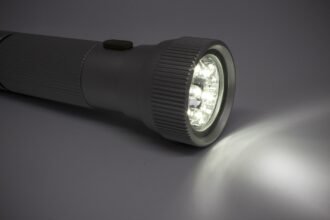
Manufacturers report lumens as total light output, but human perception and task performance depend on how those lumens are distributed. A small, intense hotspot will look far brighter on-axis than a wide, soft flood with the same lumen number. That difference changes what the light is good for.
Hotspot, spill, flood and throw
- Hotspot: concentrated center; high intensity (candela) — best for long-distance illumination and signaling. See the deeper explainer on how beam throw affects distance.
- Spill (flood): low-intensity outer ring — fills near-field tasks like reading maps or room illumination.
- Mixed beams provide usable near and far light but may sacrifice peak throw or uniformity.
Practical effects:
- A 1,000-lumen thrower with a tight hotspot can illuminate a distant object more effectively than a 2,000-lumen floody light.
- A wide flood feels brighter at arm’s length despite lower candela because more surface area is lit.
Match the profile to the task: select flood-dominant beams for close work and scene awareness, throw-dominant beams for signaling or identifying distant targets. For guidance on realistic lumen expectations for daily use, consult the everyday lumen guidance.
Quick checks before buying: compare candela/throw specs, study beam photos, and prioritize published beam profiles over raw lumen claims.
Examine real beam shots — they reveal hotspot size, spill reach, and glare. Manufacturer lumen numbers are useful only when paired with candela/throw and real-world images.
Construction and sealing
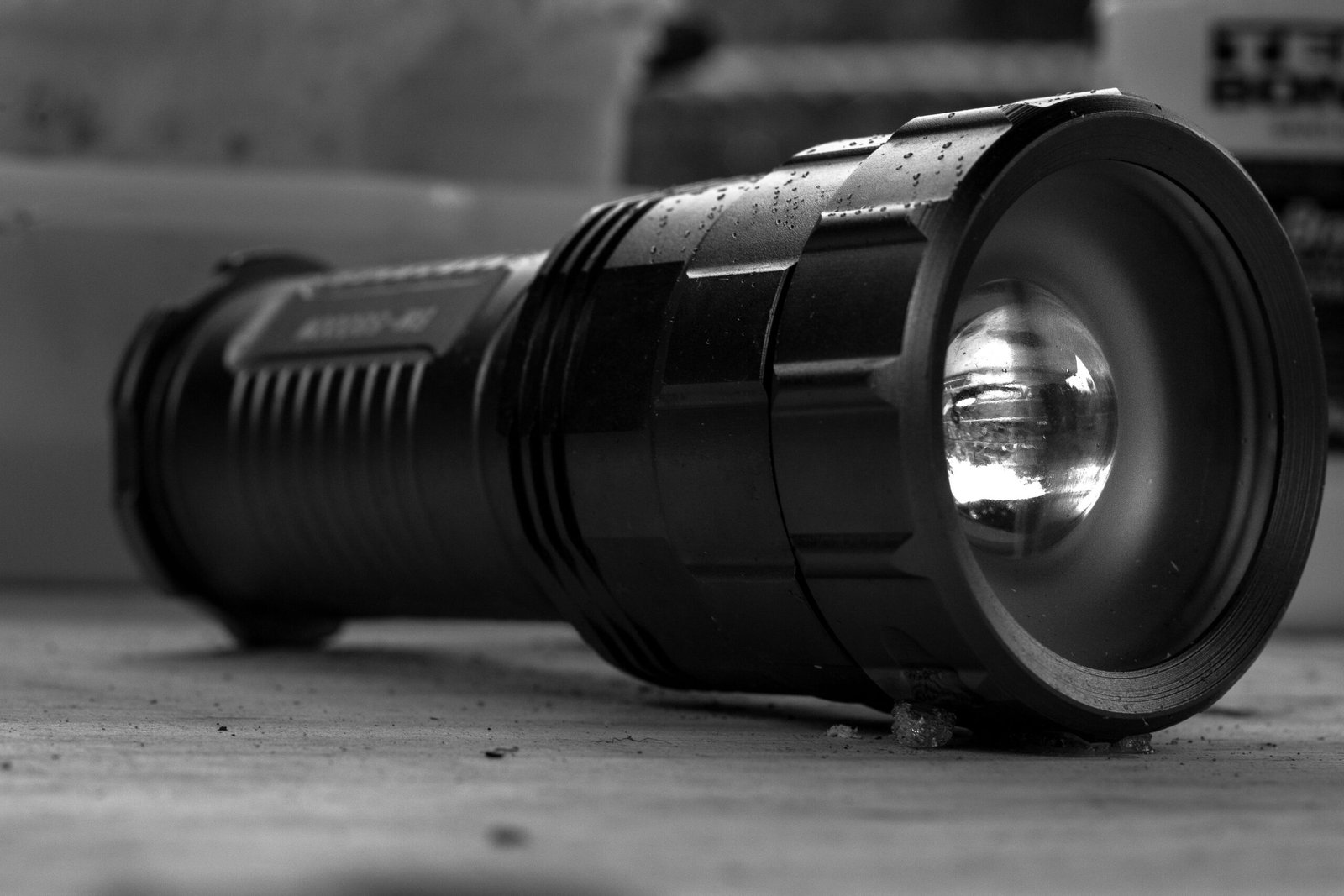
Durability starts with materials. Hard‑anodized aluminum bodies balance strength, weight, and corrosion resistance and are the most common choice. Stainless steel and titanium add toughness and abrasion resistance at a weight and cost penalty; engineering polymers improve corrosion resistance and lower weight but sacrifice some impact resistance.
bezel, head, and lens
The bezel and head design affect both protection and handling. Thick walls, recessed or crowned bezels, and tempered‑glass or sapphire lenses resist chips and shattering. Crenellated or strike bezels add protection (and controversial self‑defense utility) but can snag. Cooling fins or mass in the head help dissipate heat from high outputs.
Impact protection is a system: durable lens, secure internal mounts, and robust tailcap/switch design prevent failure from drops. Look for explicit drop testing or reinforced battery retention.
Sealing uses O‑rings, silicone greases, and sealed switch assemblies. IPX labels matter in the field — see how IPX7 and IPX8 perform in real conditions for practical differences. For wet, dirty, or rough use, prioritize:
- hard‑anodized or stainless body
- recessed/scratch‑resistant lens
- redundant O‑rings and sealed switch
- proven drop testing or reinforced internals
Battery choices: chemistry, size, and the portability trade-off
Battery selection is the single biggest determinant of a tactical flashlight’s real-world capability: cell voltage, capacity (mAh), and maximum continuous discharge set both peak brightness and usable runtime.
Small primaries (AA, AAA, CR123A) favor pocketability and low weight but cap high-output performance. High-capacity Li-ion cells such as 18650 dramatically increase runtime and allow drivers to sustain higher currents, which is why the question of whether 18650 lights are worth the size keeps recurring among users who need throw or long runtimes.
Quick comparison:
- AA/AAA (alkaline/NiMH): compact, widely available, fine for occasional carry and low-to-moderate outputs. Alkaline sags under heavy load and in cold.
- CR123A/lithium primaries: smaller than 18650, better high-current and cold performance than alkaline; non-rechargeable.
- 18650 (Li-ion): high capacity and discharge, enables high lumens and long runtimes at the cost of bulk.
Rechargeable cells justify their size when frequent use, high-output bursts, or long patrols are required; they enable built-in charging and lower long-term waste. For infrequent or emergency carry, alkalines or lithium primaries remain acceptable and simple. Practical tip: match cell discharge specs to the flashlight’s driver and store spare cells charged or safely protected.
Why advertised runtime is optimistic
Manufacturers often quote runtime from ideal lab tests — fresh cells, controlled temperature, and a specific cutoff point (for example when output reaches a tiny fraction of initial lumen rating). In use, thermal throttling (driver reduces output as temperature rises), battery voltage sag and regulator mode‑hopping (timed turbo that steps down) cause usable light to fall well before the spec number.
Common causes
- Thermal throttling: turbo mode runs hot and drivers reduce current.
- Voltage sag and cell age: voltage falls under load, lowering output.
- Regulation/profile choices: some drivers hold brightness briefly then step down.
- Test definitions: manufacturers may report time to a low endpoint, not to visible dimming.
Practical checks and fixes
- Confirm the starting mode and use fresh, correctly rated cells.
- Time from full charge and note visible dimming; compare to spec.
- Run sustained lower modes, allow cool‑downs, or carry spare cells.
- For deeper diagnostics, consult the runtime troubleshooting guide.
Check mode before timing a run — specs often assume a specific setting.
Prefer lights that publish per‑mode runtimes or thermal graphs; those specs are more realistic.
Controls, switches, and mode programming
Common switch layouts
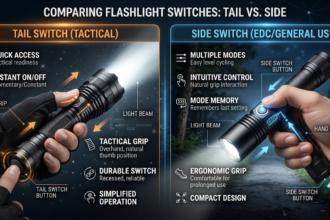
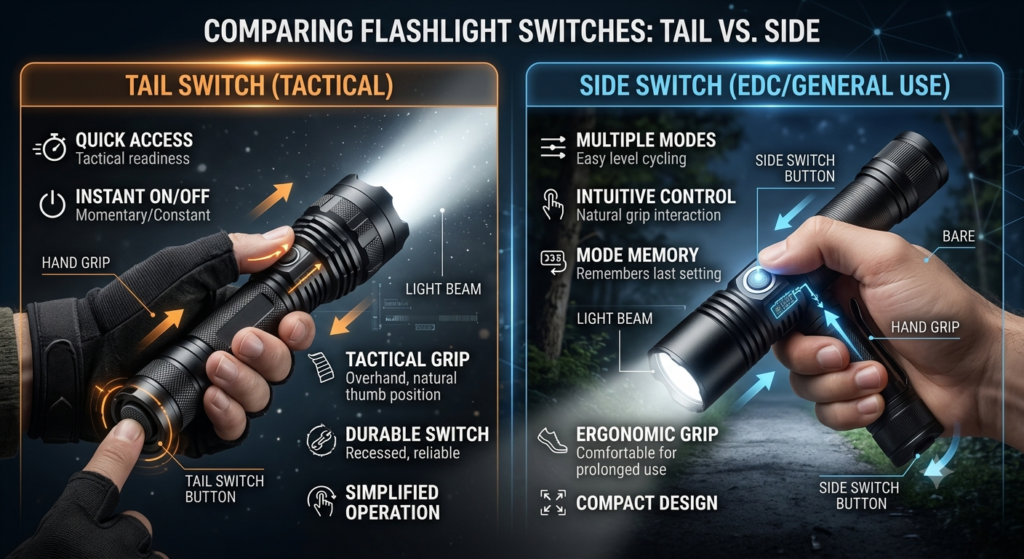
Two physical layouts dominate: tail switch and side switch. Tail switches give the fastest, instinctive momentary-on because the thumb or index finger can keep pressure while aiming; side switches are easier for palm-hold or when mounted on gear. For a detailed comparison of grip implications, consult the tail-versus-side control explainer.
Mode programming and error profiles
Programming choices matter as much as hardware. Ramping gives smooth brightness control but risks accidental over-brightening under stress. Stepped modes reduce surprises by offering predictable jumps. Common shortcuts (double-press for turbo, long-press for strobe) speed access but increase accidental activation unless lockout or dedicated buttons exist.
Decision rules:
- Fastest activation: single-stage tail switch with momentary-on.
- Least mode errors: stepped modes with minimal shortcut combos.
- Best compromise for duty use: dual controls (tail for on/off, side for modes) to separate functions.
Midrange example
A midrange duty light balances ergonomics, output, and controls; see the practical differences in the comparison of two popular midrange models. Those examples show how button placement, bezel size, and mode memory interact to make an interface either intuitive or confusing under stress.
Home security — which tactical attributes add value?
Clear value: quick, reliable activation and a broad spill for room/porch illumination; waterproofing and durable construction. Marginal: extreme throw or ultra-high lumen outputs. Strobe is usually no value unless part of an alarm protocol.
Personal defense — which tactical attributes add value?
Clear value: immediate, intuitive activation (momentary/tail‑switch) and compact size for retention. Marginal: bezel for striking and short burst strobe for disorientation. High-throw optics are generally no value at typical engagement ranges.
Law enforcement — which tactical attributes add value?
Clear value: robust construction, high candela/throw for suspect ID, reliable mode programming, and weapon‑mount compatibility. Marginal: ultra-high lumen flood unless combined with throw; strobe useful but situational. Tiny pocket EDC lights are no value for many police tasks.
Night hiking — which tactical attributes add value?
Clear value: long runtime, efficient flood/medium beam for trail work, good waterproofing. Marginal: momentary tail switches or aggressive bezels. High-candela throw and weapon mounts are no value for navigation tasks.
Search and rescue (SAR) — which tactical attributes add value?
Clear value: high candela/throw for signaling and long-range spotting, long runtime and rechargeable battery options, mounting for helmets. Marginal: strobes for location marking; compact EDC lights are no value as primary SAR lights.
Everyday carry (EDC) — which tactical attributes add value?
Clear value: small size, simple predictable activation, decent spill for close inspection. Marginal: momentary tactical tails or variable strobes. Heavy, high‑throw or very high‑lumen lights are generally no value for daily tasks.
In-store checklist: pick the right tactical flashlight
-
Primary mission
Define the flashlight’s main role — EDC, long‑range observation, weapon‑mount, or hands‑free work — because that single choice determines beam shape, size, and activation needs.
-
Beam and output
Decide hotspot (throw) versus wide spill (flood) and judge candela for distance rather than lumens alone; inspect the beam pattern at realistic distances to confirm usable light.
-
Switch and controls
Match switch type (tail, side, or dual) to the intended grip and speed of activation; test momentary function, mode order, and any lockout to avoid accidental use.
-
Power format and runtime
Choose battery chemistry that fits the mission — high‑capacity 18650/21700 for sustained high output, AA/CR123 for availability — and expect manufacturer runtimes to be optimistic, so plan spares or charging accordingly.
-
Durability and sealing
Check construction (anodized aluminum, crown/bezels), impact feel, and IP rating; higher IP (e.g., IPX8) and solid o‑ring joints give better real‑world water and dust resistance.
-
Size, weight, and maintenance
Confirm pocketability and clip orientation with batteries installed, and verify user‑serviceable parts: replaceable O‑rings, accessible contacts, and simple disassembly for cleaning and battery changes.
In the store, test activation, mode order, and beam at the distances expected in real use.

Final decision flow
- Select only features that directly advance the mission; everything else adds weight, complexity, or failure modes.
- Beam profile and switch ergonomics drive real-world performance more than peak lumen numbers.
- Match battery chemistry and spare/recharge logistics to expected use and maintenance capabilities.
First, identify the mission: long-range observation, close-quarters EDC, weapon-mounted use, or utility tasks. Remove features that don’t serve that mission (avoid oversized lumens, irrelevant mounts, or complex programming). Prioritize beam profile and switch ergonomics—hotspot width, spill, and momentary/pressure activation determine real-world utility. Then confirm battery logistics: cell type, recharge versus spares, size footprint, and predictable thermal/runtime behavior; factor in serviceability and sealing. Concrete next steps: read the linked explainers for beam, batteries, and controls; make a 3–5 model shortlist; handle each flashlight in person to test grip, switch reach, and carry before buying.