

On an indoor lane, protection can be real and still feel insufficient.
The first shot breaks, the muffs are already clamped down, and yet the sound still lands with a hard crack that feels closer than expected. That reaction does not automatically mean the earmuffs are defective. Indoor ranges stack reflected impulse noise on top of the direct blast, so the ear is dealing with a sharper, more crowded acoustic event than the same firearm would produce outdoors.
The real question is whether this setup is enough in this room. A muff’s lab rating can look strong on paper, but seal gaps from safety glasses, shallow ear cups, poor headband tension, and low-frequency energy from short barrels or brakes can erode real-world performance fast. In other words, the issue is often not “muffs or no muffs,” but fit, firearm, and reflections interacting at once.
- Indoor reflections can make identical guns seem noticeably harsher than outdoors.
- Eyewear temples are a common source of small seal leaks that reduce attenuation.
Sometimes—but often not by themselves
Earmuffs can be enough in some indoor setups, but they are not automatically enough. Their real-world adequacy depends on four variables working together: the firearm and load, the room’s acoustics, the quality of the seal, and how long exposure lasts. Indoors, those variables usually leave less safety margin than they do outside, which is why a broader shooting ear protection guide often treats indoor use more conservatively.
A .22 rifle in a large, well-managed lane is a very different problem from a short-barreled centerfire pistol in a hard, reflective bay. The first may be reasonably handled by a well-fitted high-NRR muff; the second can push beyond what muffs alone comfortably control, especially once side blast and reflected pressure are added.
What changes the answer most:
- Firearm and barrel length: louder sources create sharper peak impulse.
- Range design: concrete, steel, low ceilings, and partitions increase reflected energy.
- Fit: glasses, hat brims, hair, or jaw movement can break the seal.
- Duration: repeated strings reduce tolerance for small protection losses.
So the practical answer is conditional: earmuffs may be adequate for lower-noise indoor shooting when fit is excellent and the room is forgiving, but many common indoor conditions narrow that margin enough that muffs alone become a weaker bet.
Why indoor gunfire taxes hearing protection
Indoor gunfire is not just louder in a casual sense; it is acoustically more complicated. A gunshot is impulse noise: a very fast pressure spike with most of its damaging potential packed into milliseconds. Outdoors, that spike expands and decays into open air. Indoors, hard walls, lane dividers, ceilings, and stalls send part of the blast back toward the shooter as reflections, stretching one event into a cluster of arrivals.
What the room adds
Those reflections matter because earmuffs do not receive a single clean pulse. They receive the muzzle blast, then a rapid series of secondary peaks from nearby surfaces and neighboring lanes. Short-barreled firearms, rifles with brakes, and high-pressure handgun loads can make this worse by throwing more energy sideways. The result is a harsher sound field with less recovery time between peaks.
Adjacent shooters add another problem: exposure is not limited to one firearm. A person in one lane may get the direct blast from a .22, then a much stronger side-on pulse from a braked rifle two stalls over. That unpredictability is one reason indoor range noise often feels more fatiguing than the same firearm outdoors.
What earmuffs can do
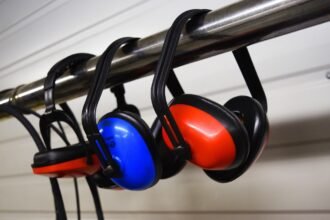
Passive earmuffs reduce sound by mass, foam, and a tight cushion seal. They can work well against mid and high frequencies, especially when fit is excellent. Their protection is usually less impressive at low frequencies, where indoor blast and concussion often feel strongest.
Where earmuffs reach their limits
Earmuffs cannot cancel the pressure wave itself, and they cannot outperform a broken seal. Safety glasses arms, hat brims, thick hair, and stock weld can open tiny gaps that sharply reduce real-world attenuation. Laboratory ratings also summarize continuous test noise; they do not perfectly describe repeated indoor impulses arriving from multiple angles.
Electronic earmuffs add microphones and level-dependent circuitry, not magical extra isolation. Their advantage is situational awareness during quiet moments while the electronics clamp down during loud ones. The underlying physical barrier is still the earcup, seal, and padding.
What the NRR on the box really means
NRR is a lab comparison number, not a field guarantee.
The rating comes from controlled testing and ideal fit. Real attenuation changes with head shape, cushion wear, eyewear, hair, and how consistently the seal stays closed during repeated shots.
A slightly lower-rated muff with a better seal can outperform a higher-rated one in practice.
A few lost decibels matter. Glasses arms, hat bands, cheek contact, or a loose clamp can open small leaks that erase the lab advantage of a premium rating.
Impulse peaks and reflected low-frequency blast can make fit and frequency performance more important than a small rating gap.
Indoor ranges punish weak seals and cup leakage. Two muffs close on paper may behave differently once short, high-level impulses and room reflections enter the picture.
Small fit mistakes that undo good earmuffs
A well-rated muff can lose much of its practical protection through ordinary, easy-to-miss leaks. Indoors, that matters more because the ear is not facing a single blast wave; reflected pressure arrives from the sides, behind the head, and off the lane walls. Any break in the cushion gives that sound a path in.
Where seals commonly fail
- Eyeglass temples: thick or sharply angled arms create a narrow channel under the cushion.
- Hat brims and hoodie fabric: material trapped under the cup prevents full contact.
- Hair and hat bands: even a small ridge can lift one section of the seal.
- Jaw movement: talking, chewing gum, or opening the mouth widely can shift cup position.
- Poor cup placement: a muff sitting too high or too far back may cover the ear but not seal around it.
- Worn cushions: flattened foam and cracked vinyl stop conforming to the head.
The result is not always obvious. The muff may still feel snug while attenuation drops where it is needed most. That is why fit discipline matters: consistent cup position, unobstructed cushions, and periodic pad replacement can matter nearly as much as the model itself on an indoor range.
A single pair of quality earmuffs is most defensible in the easiest indoor conditions: a mild-caliber handgun, a roomy lane, limited neighboring fire, and a short session. Even then, the margin may be modest rather than generous.
The case weakens quickly as several factors stack up:
Louder firearms: short-barreled pistols, magnum revolvers, braked rifles, and compact carbines produce sharper, more forceful impulse energy. Louder rooms: narrow concrete bays and hard partitions send more of the blast back to the ear instead of letting it decay. More shooters nearby: a crowded firing line means exposure is not only from one firearm but from repeated off-axis impulses on both sides. Longer sessions: the sound of each shot does not change, but the total acoustic dose keeps accumulating.That is why earmuffs that seem acceptable during a few magazines of standard-pressure 9 mm can start to feel marginal during a busy hour, or become clearly strained when rifle fire enters the room. In practice, muffs-only tends to lose confidence first in echoey bays, crowded lanes, and high-blast guns—especially when all three appear at once.
Doubling up adds margin
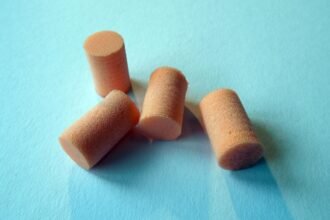
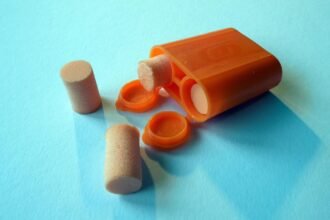
When indoor conditions turn harsher, double protection often becomes the sensible escalation: earmuffs plus earplugs worn under earmuffs. That does not mean the two Noise Reduction Ratings simply add together. Real-world attenuation depends on fit, frequency, skull conduction, and how impulse noise reaches the ear, so the gain is usually meaningful but not mathematical.
What layering often does best is add margin. Earplugs reduce sound at the ear canal, while muffs add a second barrier around the outer ear and help cover small plug-fitting errors. If one layer underperforms slightly, the other can still preserve useful protection.
Double protection is most relevant when exposure piles up, such as:
- Short-barreled rifles or braked guns in enclosed bays
- Busy lanes with shooters on both sides
- Longer sessions where repeated impulses accumulate
- Reflective indoor ranges that keep blast energy in the room
It is still not a magic fix. Poorly inserted plugs, broken muff seals, or eyewear gaps can undermine the combined result. But in demanding indoor environments, layering protection is less a sign of overreaction than a practical way to widen the safety margin when muffs alone start looking thin.
A fast test for adequacy
- Read the room Hard walls, narrow stalls, and constant lane traffic usually mean stronger reflections and less real-world muff performance.
- Count the guns A rimfire lane is not a short-barreled centerfire lane. Louder guns nearby can make a muffs-only setup feel marginal fast.
- Check the seal Pads must sit flat against skin. Glasses, hat brims, hair, jaw movement, or tired cushions can quietly erase useful attenuation.
- Notice sharpness If the report still feels painfully sharp, startling, or fatiguing, the setup may lack margin even if the muffs carry a solid rating.
That last cue is not a measurement, but it is a practical warning sign when indoor conditions are stacking against the headset.
- Good earmuffs can be enough in quieter bays with modest firearms, limited reflection, and an uncompromised seal.
- In many indoor ranges, plugs plus muffs is less about perfection than about preserving margin when the environment gets harsher.
Indoor earmuffs are not automatically inadequate; in some rooms, with some firearms, and with an excellent seal, they can cover the job.
But indoor range noise is variable and unforgiving. Once the bay gets sharper, the gun mix gets louder, or the seal gets imperfect, muffs often make more sense as one layer in a broader protection system.





10 Comments
I shoot indoors with foam plugs + electronic muffs because the lane next to me is always a surprise party 🙃
One thing I wonder about: if doubling up doesn’t add in a simple arithmetic way, how should regular people think about the benefit? Not asking for exact math, just trying to understand whether the “extra margin” is mostly for the really loud peaks, or if it also helps with the cumulative fatigue from a whole session.
Also, do you think people get overconfident with electronic muffs because they can still hear speech and assume that means they’re more protected?
“Extra margin” is a good way to think about it. The benefit helps with both the sharp peaks and the overall toll of repeated exposure across a session, especially once the room, nearby shooters, and firearm mix start stacking the odds against muffs-only.
And yes, people absolutely can overread what electronics are doing. Being able to hear speech is a convenience feature of the microphones/processing; it doesn’t mean the physical barrier is suddenly blocking dramatically more blast than a comparable passive muff.
Totally agree on the overconfidence part. My buddy bought fancy electronic muffs and acted like he’d unlocked invincibility 😂
They’re nicer to use, sure, but the boom is still the boom.
What about a pretty mild setup: .22 pistol lane, not crowded, decent-fitting muffs, and only like 20-30 minutes? Your article says “sometimes” muffs are enough, so is that basically the textbook case where muffs-only can be fine, or do you still lean plugs + muffs no matter what?
That’s one of the more favorable cases for muffs-only: lower-output firearm, shorter session, fewer adjacent shooters, and a good seal.
I still frame it as conditional rather than guaranteed, because indoor reflections and neighboring lanes can change the exposure quickly. If the report still feels sharp or fatiguing, or the room is lively/reflective, adding plugs is the safer call.
The NRR thing is what annoys me most, honestly. The box makes it sound so clean and scientific, then real life shows up with glasses, jaw movement, and the guy three lanes over touching off something obnoxious 😅
Is there any reliable consumer-level way to compare two earmuffs for indoor use besides just fit-testing them yourself? Or is it basically trial and error plus common sense about doubling up?
That frustration is fair. NRR is useful as a lab reference, but it doesn’t fully represent reflected impulse noise, seal leaks, or the randomness of indoor lanes.
For consumers, fit and consistency matter a lot more than tiny differences on the box. If you can, a personal fit-test is best; otherwise look for solid cushion condition, stable clamp force, compatibility with your eyewear, and then judge in actual use whether the sound still feels sharp or tiring.
Yeah, this matches my experience. I had two pairs with similar ratings and one was WAY better for me just because it sealed around my glasses better.
Super scientific method: the one that made me stop wincing won lol.
The part about glasses breaking the seal hit home. I always assumed if the muffs felt tight, I was good.
If someone wears fairly thick prescription frames, is the practical answer basically “always double up indoors,” or are some muff cushions better at dealing with that than others?
The “fast adequacy test” section was helpful, but I kind of wanted a harder rule. I get why you can’t give one, yet “if it still feels sharp” seems a bit subjective.
Would you say lingering ear fatigue after a session is basically the sign you already pushed it too far, meaning your setup was inadequate even if nothing sounded painfully loud in the moment?