

A discreet carry setup can fail before the cover garment even settles.
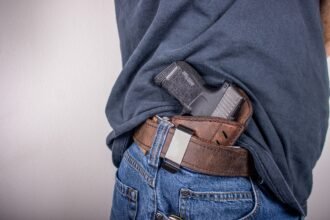
A pistol can seem hidden at first, then start telegraphing itself the moment a soft casual belt sags at the buckle and twists under the holster clip. That small collapse changes grip angle, lets the muzzle tip outward, and creates the tell many people blame on the holster.
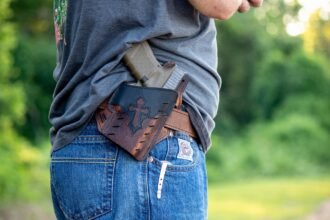
The opposite mistake is just as common: overly rigid web belts with thick buckles, loud stitching, and obvious hardware. They hold weight, but under office chinos or a plain tee they can read as gear, not clothing. Good concealment support is usually stiff vertically, modest in thickness, and visually ordinary—enough structure to anchor the gun without making the beltline the first thing anyone notices.
Fast wardrobe picks


A stiffer belt is not always the quieter choice.
Loopless outfits: belly-band systems tend to disappear better. Belted pants: slim 1.5-inch ratchet belts usually balance support and lower-profile hardware better than oversized tactical buckles.What a concealment belt actually does
A concealment belt is narrower in purpose than a general gun belt. Its job is not simply to hold weight; it must support a holster while keeping the waistline visually quiet under normal movement, light bending, and sitting. That usually means a mix of moderate rigidity, controlled flex, and low-bulk hardware.
Maximum stiffness can help resist sag, but it can also create new problems. An overly rigid belt tends to bridge across the hips, push the grip outward, and form a hard horizontal line under a shirt. Seated, that same rigidity can increase pressure at the buckle and muzzle end, making the belt feel stable while actually worsening printing.
Useful signs of a concealment-focused design include:
- Torsional support more than board-like vertical stiffness
- Small or low-profile buckle geometry
- Fine adjustment for small tension changes between standing and sitting
- Enough compliance to let the holster settle into the body
That is why a reinforced ratchet belt and a belly-band setup solve different concealment problems, even when both carry securely.
How a belt looks before it conceals
Before a shirt hem does any work, a belt has already signaled what it is. Many “tactical” tells live right at the belt line: an oversized buckle, shiny metal corners, ladder-like webbing, or contrast stitching that reads as equipment rather than clothing.
Low-profile belts usually blend in because their details borrow from ordinary casual wear:
- Buckle bulk: flatter faces, rounded edges, and minimal overhang past the first loop
- Surface texture: smooth leather, matte nylon, or a fine weave instead of coarse seatbelt-style webbing
- Stitching: tone-on-tone rows look quieter than thick contrasting thread
- Reinforcement: internal stiffeners disappear better than visible polymer tracks or obvious double layers
Small cues matter too. A subdued keeper, trimmed belt tip, and hardware in matte black or brushed nickel often draw less attention than bold logos, rescue-belt styling, or heavily milled ratchet buckles.
A belt can still carry firmly when its stiffness is mostly hidden inside the strap. When the outside reads like a standard casual belt, the waistline tends to invite fewer second looks.
How the picks were judged
Support was only part of the score. Fine adjustment, buckle bulk, seated comfort, and visual blending mattered too.
Small ratchet steps or forgiving stretch helped tune tension around the holster, not just clamp harder.
Slim buckles and flat tails usually hid better under tees and polos.
Appendix, strong-side, and seated carry did not reward the same belt shape.
Edge finish, sheen, stitching, and visible reinforcement can telegraph tactical intent before sag ever appears.
Belly band for loopless and summer clothing
01
Carries your own IWB holster for consistent draw
This Tactical Schnauzer belly band takes a different approach from standard concealment belts: it wraps the body and lets the user mount an existing IWB holster instead of relying on a sewn elastic pouch. That makes it a strong fit for joggers, gym shorts, scrubs, and other outfits where belt loops, rigid waistbands, or visible buckles create the problem in the first place. It suits carriers who need the lowest-profile path under light clothing and can accept a softer, body-hugging carry feel.
- Works with an existing IWB holster for familiar draw angle
- Maintains full trigger-guard coverage when paired with the user’s holster
- No buckle or belt loops to print through thin clothing
- Useful with athletic wear, lounge wear, and other loopless outfits
- Carry feel is less anchored than a rigid belt setup
- Neoprene-style wrap can run hot in humid or high-output wear
- Comfort varies more by torso shape and placement height
- Repositioning can take longer than clipping onto a standard belt
For clothing that simply does not cooperate with belts, this is one of the more sensible belly-band designs because it preserves the user’s own holster and its retention characteristics. That consistency matters more than it may seem, especially for carriers already tuned to a specific draw stroke.
The compromise is not subtle: it wears warmer, feels less rigidly planted, and can be more body-type dependent than a conventional belt-and-holster setup. Still, for discreet carry under light or loopless clothing, it can solve a problem that normal concealment belts never fully fix.
FAIRWIN Ratchet Belt for low-cost, high-rigidity support
Rigid, tear-resistant webbing for heavy-duty use
FAIRWIN’s reinforced nylon ratchet belt is built around structure first: stiff 1.5-inch webbing, click-track adjustment, and a buckle system aimed at keeping holster weight from folding the waistband. It suits shoppers chasing dependable support without stepping into pricier carry belts.
The overall vibe is more utilitarian than discreet. That makes it an easier fit with jeans, work pants, range gear, and casual outer layers than with polished plainclothes outfits where buckle size, webbing texture, and hardware subtlety matter more.
- Very rigid under carry load
- Easy micro-adjust ratchet fit
- Lower-cost entry point
- Works well with casual/workwear
- More tactical visual signature
- Buckle can print on trim waists
- Less refined than dress-friendly belts
- Stiffness can feel overbuilt seated
Precision 1/4-inch micro-adjust ratchet buckle
Budget ratchet test case: the IDOGEAR SPORTS belt makes sense for someone trying to find out whether a reinforced carry belt fixes waistband sag, holster roll, or pressure points without moving straight to a more refined everyday belt.
Its appeal is less about looking discreetly upscale and more about sampling the core mechanics — stiffened webbing, quarter-inch ratchet adjustment, and easy on-body tightening — in a low-risk format.
- Noticeably supportive for the category
- Fine ratchet adjustment helps tune pressure
- Nylon body stays lighter than thick leather
- Useful as a low-commitment trial purchase
- Buckle is still on the bulky side
- Finish looks more functional than polished
- Webbing and hardware read more overtly tactical
- Overall refinement trails pricier concealment-focused belts
| Best with | Carry position | Beltline load | Front bulk | Support | ||
|---|---|---|---|---|---|---|
|
Belly Band That Accepts Your Own Holster Loopless clothing | Gym shorts | Appendix, high ride | Pistol only | None | 8.8/10 | View |
|
Reinforced Nylon Ratchet Tactical Gun Belt Heavier load | Jeans, chinos | Appendix or 3 o'clock | Pistol + mag | Medium | 8.6/10 | View |
|
Micro-Adjust Ratchet Reinforced Heavy-Duty EDC Belt Budget trial | Jeans, work pants | Appendix or 3 o'clock | Pistol + light load | Higher | 7.8/10 | View |
Small setup mistakes that create printing
-
Move the buckle off center
A centered buckle stacks extra thickness at the most visible part of the waist. Offsetting it by a loop often smooths the shirt front.
-
Keep clips away from dense hardware
When a holster clip sits beside a ratchet track, keeper, or overlap, the belt can kick outward. A small shift can give the clip a flatter bite point.
-
Tighten for stability, not compression
Too much tension can lever the grip outward and create seated hot spots. The cleanest result is often the loosest setting that still prevents sag.
-
Balance the beltline load
A spare magazine, phone, or empty side with no counterweight can change how the belt rolls. Better weight distribution often reduces the visible hinge effect.
-
Test the setup while seated
Some rigs vanish standing and print immediately in a chair. Minor ride-height or cant changes usually help more than another click of stiffness.
A very stiff belt cinched too hard may increase printing by forcing the holster to pivot outward. It can also turn normal pressure into sharp pressure points, especially with appendix carry and larger buckles.
The short answer
Start with the clothes, not the pistol. The Belly Band That Accepts Your Own Holster fits loopless shorts, athletic wear, and light summer outfits where any buckle would print. For belt-loop wardrobes and heavier beltline loads, the Reinforced Nylon Ratchet Tactical Gun Belt offers the firmest support here. The Micro-Adjust Ratchet Reinforced Heavy-Duty EDC Belt is the sensible low-cost test case for learning how much stiffness and ratchet adjustment actually help.
A concealment belt solves only part of the problem. Holster shape, clip spacing, buckle offset, and shirt weight often decide whether the setup disappears; the broader concealed-carry accessories overview matters too.
Wardrobe first: loopless or very light clothing favors the belly band.
Then support: heavier beltline loads favor the reinforced ratchet options.






5 Comments
I liked the wardrobe-first filter. That’s honestly the part most reviews skip.
But I’m a little skeptical of calling the belly band the “lowest-visibility fix” without more emphasis on draw consistency and reholstering tradeoffs. Concealment isn’t the only metric, and newer people might read that as a blanket recommendation.
Would love a women’s-specific follow-up honestly. “Just use a belt” advice falls apart fast when the waistband is thin, fake, or nonexistent.
This article at least acknowledged loopless clothing, which is more than most do. But yeah, I was expecting maybe one more non-belt alternative besides the Belly Band That Accepts Your Own Holster.
The belly band section was actually the most useful part for me. I wear a lot of athletic stuff and dresses in summer, so the loopless issue is real.
That said, why only one belly-band style mention here? There are a bunch of them now, and some are way less sweaty than the old neoprene sauna wraps lol.
Fair question. I kept that section narrow because the article was specifically about concealment support without looking overtly tactical, and I wanted one example that solved the loopless-clothing problem while still allowing use of your own holster. A lot of belly bands either force their own holster pocket setup or trade stability for thinner material, so I focused on the one that best matched that use case.
Yeah this was my thought too. Half the belly bands out there are comfortable for like 20 minutes and then start rolling or trapping sweat. Using your own holster is the big divider for me.