

The real test starts when alertness disappears.
At 2:17 a.m., the room is black, pulse spikes, and fine motor control shrinks. A bedside safe is not judged by lab speed alone; it is judged by what happens half-awake, off-angle, and with damp fingers.
Failure is broader than a lock that never opens. Biometric models can pause, misread, or lock out after bad scans; mechanical ones can invite fumbling through a stiff button sequence or tiny keyway. The worse flaw may be opening too easily under prying or simple bypass. The better design is the one that stays predictable after idle months, not merely fast on day one.
Three fast fits


Three ways a safe can fail
A handgun safe is not reliable in one universal way. Fast access, physical resistance, and day-to-day upkeep often move in different directions.
This covers false rejects, keypad fumbles, wake delay, and one-hand use in the dark. Biometric locks can be fastest until sensor condition or battery state interferes.
This covers pry resistance, latch strength, hinge exposure, and cable vulnerability. A thicker mechanical box may resist attack better even if it is slower to open.
This tracks batteries, fingerprint enrollment, app pairing, override-key storage, and maintenance drift. Low daily friction matters because neglected safes often fail long before the lock breaks.
A bedside safe can feel effortless for the owner yet fold under simple attack. The reverse also happens: a stout mechanical box may be reassuringly tough, but awkward fingers, darkness, and stress can turn toughness into delay.
What actually goes wrong with biometric and mechanical safes
Most misses come from bad finger placement, dry or dirty skin, rushed scans, or sleepy one-handed use—not the mere presence of a fingerprint reader.
Biometrics are usually fastest in ideal conditions, but bedside access punishes narrow scan windows and weak sensors.
A Simplex-style mechanical lock is often slower on its best run, yet more repeatable when batteries are dead, hands are cold, or electronics need waking.
Mechanical delay is usually human: recalling the code, hitting the sequence cleanly, and lifting the lid under stress.
Mechanical safes avoid charging and low-voltage lockouts, but they still fail through forgotten codes, mis-presses, worn controls, or weak anchoring.
Access reliability and break-in resistance are separate; a dependable lock on a lightly secured box is still a compromise.
Apps, logs, and multiple entry methods mainly improve convenience and management; they do not automatically improve steel strength or pry resistance.
If the feared failure is unauthorized entry, lock type matters less than door thickness, boltwork, hinge protection, and mounting.
| Cold-start access | Works without battery | Typical access failure | Steel/tamper bias | Upkeep burden | ||
|---|---|---|---|---|---|---|
|
BILLCONCH Smart Biometric Pistol Safe with App Smart access | Fast, variable | False reject | Charge/manage | View | ||
| Slower, steady | Code fumble | Near-zero | View | |||
| Slower, steady | Code fumble | Near-zero | View |
Smart biometric access with layered entry
Fast fingerprint and app access
BILLCONCH is the clearest argument for choosing a biometric handgun safe for convenience first. Its appeal is not that fingerprint entry becomes magically infallible; it is that the safe stacks several alternate paths—fingerprint, keypad, physical key, and app unlock—so one bad read does not automatically become a hard stop. That makes it a strong fit for buyers who want fast bedside-style access but are willing to accept a more electronic, feature-heavy system.
- Four access methods reduce single-point lockout
- App can manage fingerprints, battery status, and access records
- Stores many fingerprints for multi-user setups
- Voice/LCD setup lowers configuration friction
- Battery state becomes part of reliability
- More electronics means more upkeep variables
- App features add another dependency layer
- Not the cleanest pick for pure mechanical simplicity
BILLCONCH makes the strongest case for biometric speed because it treats fingerprint unlock as the first lane, not the only lane. Its keypad, key, and app fallback paths soften the usual false-reject problem, but that convenience comes with the normal costs of batteries, electronics, and software dependence. For shoppers comparing biometric against mechanical, this is the model that best shows how layered access can narrow the reliability gap without erasing it.
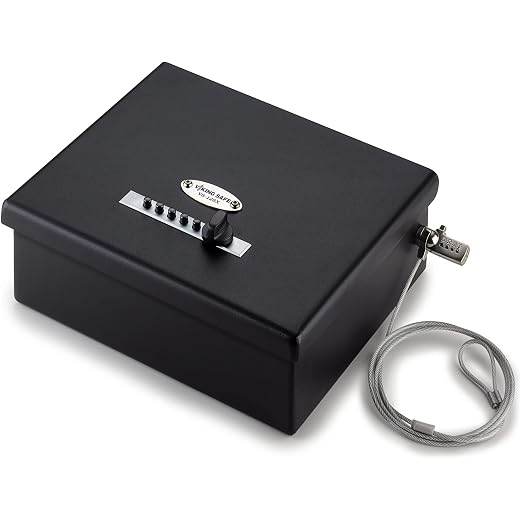
Viking VS-12LSX for long-term mechanical trust
Purely mechanical, pry-resistant construction
Built around a fully mechanical Simplex lock, the Viking is the clearest case for long-horizon dependability. No batteries, fingerprint reader, or app layer means fewer parts to drift with age, storage, or neglect. For readers comparing a Simplex bedside safe, this is the reference point.
It fits buyers who value predictable operation years from now more than the fastest possible opening in a rushed moment.
- No batteries or electronics to age out
- Simplex lock stays credible after long storage
- Pry-resistant steel build matches the lock philosophy
- Entry is more deliberate than biometric tap-open
- Fatigue or darkness can slow button input
- Limited code complexity versus electronic systems
This is the model that best illustrates why mechanical safes still matter. Its trust comes from simplicity: a proven pushbutton lock, no power chain, and fewer failure modes that creep in over time.
The compromise is equally clear. Access is usually consistent, but not effortless; in the dark, half-awake, or rushed, a mechanical sequence can be slower than a good biometric system.
Battery-free access in a lighter portable safe
- Simplex lock needs no batteries
- Predictable entry after long storage
- Easy to stash for travel
- Lower pry resistance than bolted safes
- Cable anchor can become the weak link
- Tight fit for larger pistols
Battery-free access is the main advantage. In compact travel safes, failure often moves away from the lock and toward the box itself: thinner steel, shorter overlap, and cable-based anchoring can leave the container vulnerable even when the push-button mechanism is the most trustworthy part.
-
Start with the failure most likely to matter
For pure lock reliability, mechanical usually fails less because it does not depend on batteries, sensors, or electronics. That makes the Viking VS-12LSX and the portable mechanical safe the steadier bets.
-
Test access in darkness and under a timer
If a fingerprint opens cleanly, repeatedly, and faster than a button sequence when hands are cold, damp, or shaky, biometric can be the lower real-world failure path for that owner. If not, its theoretical speed does not count.
-
Check the fallback path
Any electronic safe needs a backup that is reachable and memorable in the dark. Layered entry matters more than app features once the primary method misses.
-
Match the safe to usage frequency and threat level
Frequent bedside access can favor the BILLCONCH if enrollment and backup methods are well-practiced. Higher forced-entry risk favors heavier mechanical construction; light travel safes trade attack resistance for portability.
The safer choice is the one that misses least in its actual job
- Mechanical usually wins on independence.
- Biometric can win on access speed if it is repeatably faster for that specific user.
- Dark-room testing matters more than spec-sheet claims.
Mechanical generally fails less often overall because fewer systems have to cooperate. That is the cleaner answer on reliability alone.
Biometric becomes the better match only when repeated testing proves faster, cleaner access under stress, with a dependable backup if the sensor or battery does not cooperate. The right comparison is not smart versus simple; it is which failure mode is less likely in the conditions the safe will actually face.





7 Comments
The portable mechanical one seems like the classic “good at one job, bad at another” product. Battery-free access sounds great for travel or a car, but if the resistance to prying/crushing/cable theft is meaningfully lower, I wouldn’t want to fool myself into thinking it’s equivalent to the Viking.
That distinction gets lost a lot in product roundups.
One thing I wish more people discussed is upkeep. You touched on it, but it’s huge.
A biometric safe can be very fast when everything is maintained, charged, enrolled properly, and used often enough that the owner remembers every backup option. A mechanical safe asks less from you, but maybe more in terms of deliberate motion and practice. Those are two very different lifestyles, honestly.
App management on a handgun safe is one of those things that sounds cool until I imagine myself debugging Bluetooth at 2:13 a.m. 😂
Not saying smart access is bad, just that “more features” and “fails less” are definitely not the same sentence.
This article basically convinced me there isn’t a universal winner, which is annoying but probably true lol. The BILLCONCH seems best if someone genuinely tests faster with fingerprint + fallback methods, the Viking seems best for long-term nightstand trust, and the portable mechanical one seems best when battery-free access matters more than brute security.
So… which one did I *want* to win? The fancy biometric, obviously. Which one do I probably trust more after reading? Not the one with an app.
The part about “three ways a safe can fail” was honestly the most useful thing here. A lot of reviews act like speed is the only metric, but if the box opens fast and then gets peeled open with a screwdriver… cool, I guess 🙃
For a nightstand setup, I still lean mechanical unless somebody has actually tested the biometric one a bunch in the dark while half asleep. Did you end up personally favoring the Viking, or just saying it depends?
For my own priorities, I lean toward the Viking-style mechanical route for a dedicated nightstand safe because it reduces power and sensor-related failure points.
That said, the article’s main point is that “best” depends on the actual job. If someone consistently opens a biometric safe faster under realistic low-light, high-stress conditions and the safe has solid fallback entry, that can be the better fit for them.
Same. I realized I was overvaluing quick demo videos and undervaluing the “what if it says no” problem. In the dark, half your brain is still offline lol.