
Preparedness without bulk: the smallest, smartest carry beats noisy pockets.
At a café table with a dying phone and a pocket full of jangling dongles, the tradeoff between readiness and bulk becomes obvious. Common nuisances—dead batteries, brittle adapters, lint-clogged ports and privacy noise from unnecessary devices—add friction to ordinary days. A short, intentional checklist replaces guesswork: prioritise power, durability, and containment, and leave the rest at home.
- Limit essentials to three items: power, cable, organizer
- Use a short cable (≈5–6 inches) to avoid tangles
- Choose a GaN charger for high power in a small block
Three pocket-ready essentials

![Rixmie Short USB-C Cable [5 inch], 100W PD Fast Charging, 20Gbps Data Transfer, USB C to USB C Short Cable, Thunderbolt 3 for iPhone 17, MacBook, Android Auto, External SSD and More Type-C Devices](https://m.media-amazon.com/images/I/61l9g-Iu+aL._SS520_.jpg)

A quick decision framework
Start by naming the three core needs: power, connectivity (data, adapters), and utility/protection (tools, organization). Rank them by how often each is critical during a typical day.
Key checks before committing to an item:
- Compatibility: ports, plug direction, PD/fast‑charge protocols, and device voltage/current limits. Prefer devices that match the lowest common denominator across frequently used kit.
- Failure modes: identify what can fail (broken cable, drained battery, lost dongle) and what the immediate consequence would be.
Decide multifunction versus redundancy using a simple tradeoff test:
- If a capability is mission‑critical, favour redundancy (spare cable or small power bank) to avoid a single point of failure.
- If space is the limiting factor and the capability is occasional, favour a multifunction unit (multiport charger, combo cable).
Quick checklist: rank needs, confirm compatibility, list likely failures, then choose multifunction for occasional use and redundancy for critical reliability.
Power tradeoffs: tiny PD bricks vs pocket GaN
Carrying the smallest charger that actually meets needs starts with honest device ranking: which device must top up quickest, and which can wait. Gallium nitride (GaN) enables much higher power in a tiny package, but higher wattage still means a heavier, slightly larger brick and more heat under load.
Typical watt ranges and what they mean
- ~18–30 W — phone-first: fast for most phones and small tablets; great for a single-device pocket charger. See the practical picks for the smallest phone-focused PD bricks in the compact PD charger guide.
- ~30–45 W — crossover range: charges larger tablets and some ultraportable laptops slowly; useful when occasional laptop topping is needed.
- ~45–65 W — laptop-capable: reliably tops up many lightweight laptops and runs heavier phones at max speed. Modern GaN designs make this range pocketable for travel.
Accept slower charging when the session is a top-up (e.g., midday boost), during overnight charging, or when battery longevity and weight savings are priorities. If simultaneous charging is common, remember total-output specs matter: dual‑port designs split wattage, reducing per‑port speed.
Decide in three quick steps: rank devices by criticality, check each device’s USB‑C PD input rating, then choose the smallest charger that meets the highest required wattage plus headroom for multi‑port use. For thermal safety and real-world reliability, pair that choice with guidance on protective designs in the thermal and safety guide. When the goal is one charger for phone and laptop, the GaN laptop‑charger primer explains which watt profile to prioritize.
If daily use is phone-only and charging is usually overnight or opportunistic, accept a lower-watt PD brick to save pocket space and weight. For mission‑critical laptop use, choose higher-watt GaN instead.
Compact dual‑port GaN for phone and light laptop
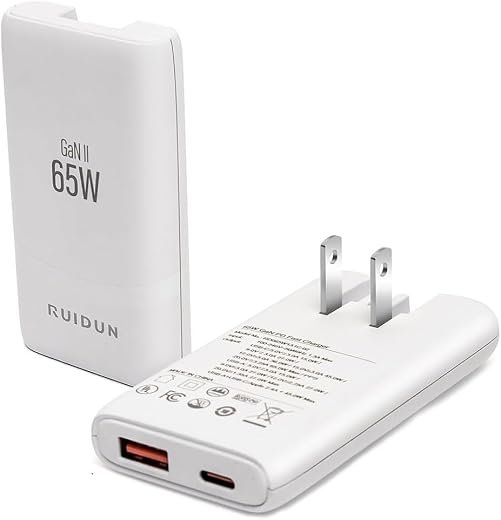
A compact GaN wall charger offering up to 65W from its USB‑C port and a secondary USB‑A port for legacy devices. Notably thin (about 0.55″) and smaller than a credit card, it supports PD 3.0 and QC 4.0 profiles and is designed to charge a laptop and phone simultaneously while reallocating power between ports. Use it when a single pocketable brick must cover both modern phones and lighter notebooks.
Cables and small connectors
Carry a single short USB‑C cable rated for PD and data when possible: a 5–8 inch cable with an E‑marker and 5A/100W capability handles laptop charging, fast phone PD, and high‑speed file transfer. For guidance on ideal lengths, consult the short cable length guide.
Compare three small-adapter styles:
- Magnetic tips: fast to attach, reduce wear from yanks; many do not pass full data or high wattage — check signal and power specs and read the magnetic cable safety explainer.
- Right‑angle plugs: bulk stays flush with the pocket and can reduce bending; their stress shifts are examined in the right‑angle cable analysis.
- Keychain dongles: tiny adapters for audio or USB can live on a ring, but expect exposed connectors; see real options in the tiny dongle review.
Durability tips: prefer braided insulation, reinforced strain relief, and tested connectors — details are covered in cable durability notes. Keep cables neat with a slim organizer; selected solutions appear in the pocket organizer roundup.
A single PD+data cable simplifies carry but requires confirmation of E‑marker and wattage; magnetic or mini adapters add convenience but can limit speed or power—match connectors to use cases.
Short PD + high‑speed data
5 inches, supports 100W/5A PD with an E‑marker and claims up to 20Gbps data and 4K video output; built for pocket carry and quick transfers to external SSDs. Known for no‑tangle braiding and compact length suited to minimal EDC.
Pocket‑Cable Myths, Debunked
For pocket‑length cables, termination quality, conductor gauge, and strain relief matter more than an extra outer braid.
Short cables concentrate bending and pull at the connector exits; well‑molded reliefs, solid soldering/tinning and adequate conductor thickness stop failures faster than a heavier jacket.
Shortness reduces bulk but increases stress at the ends; reinforced terminations, short slack loops, or proper right‑angle exits mitigate that stress.
Pocket movement causes repeated micro‑bends and connector fatigue; distributing strain away from the plug is the practical durability fix.
Many short cables omit E‑marker chips or use thin conductors; check for E‑marker, AWG rating, and declared USB data spec before assuming capability.
E‑markers negotiate high‑watt PD and correct CC wiring; missing SuperSpeed pairs or thin VBUS conductors limit charging and throughput regardless of cable length.
Low‑profile right angles and well‑designed magnetic tips can improve clearance, but they introduce different mechanical stresses and potential snag points.
Angles change bending moments at the plug; magnets focus pull on one interface—choose mechanically rated designs and prefer strain‑relief integration for pocket use.
Tiny audio dongles & keychain extras
Small dongles and keychain tools can be useful, but their value depends on frequency of use, build, and how noisy they make the pocket. Treat these items as utility tools, not decorations.
Weekly-usage thresholds
- Low value: used <2 times/week — likely pocket clutter.
- Moderate value: used 2–6 times/week — consider a collapsible or easily stowable option.
- High value: daily use — justify a robust, permanently carried item.
Mechanical robustness and design
Prioritize solid materials (stainless or anodized aluminum), enclosed swivels, and integrated strain relief for cables. Simple moving parts and exposed pins increase failure risk; sealed or foldaway connectors last longer.
Net value vs pocket noise
Keychain extras add weight, rattle, and abrasion. Consolidation—combining a dongle with a compact organizer or magnetic quick‑release—reduces friction and loss. If the item saves repeated frictional tasks or a trip to a bag, it adds net value; otherwise it is pocket noise.
Low‑bulk organization and pocket layouts
Small, consistent habits shrink perceived bulk and speed retrieval. Treat one pocket as a home for charging, another for audio, and a third for miscellany; predictability matters more than carrying fewer items.
Common pocket layouts
- Inside jacket pocket: best for fragile or valuable items (thin charger, short cable) — keeps shape and avoids lint. Align connectors toward the opening for fast grab.
- Outer pants pocket: quick-access items (earbuds, key dongle). Use low-profile sleeves to avoid sharp edges.
- Small pouch: group fragile bits and extra cables together to stop loose ropes from ballooning pockets.
One small cable organizer or a consistent routing habit (loop, tuck, elastic hold) reduces bulk by preventing tangles and collapsing unnecessary loops. Simple rules: coil short cables in a single figure‑8, secure with an elastic, and always return each item to its assigned pocket. This reduces search time and keeps silhouette slim.
Non‑negotiable safety checks for pocket chargers
-
Read labels and model numbers
Confirm manufacturer, model, input/output ratings printed on the case. Absence of clear markings suggests higher risk.
-
Verify safety certifications
Look for CE, UL, PSE or local marks and a certification number; counterfeit logos are common—compare with issuer databases.
-
Match rated output and protocol
Ensure voltage/current and protocols (PD, QC) match device needs. A mismatch can force the adaptor into unsafe operation.
-
Inspect build quality and connectors
Check for solid seams, proper strain relief, and E‑marked USB‑C cables for high‑power PD; loose ports or flimsy molding are red flags.
-
Perform a controlled functional and thermal test
Using a noncritical device or USB power meter, run a short charge and monitor output and surface temperature; hot or odd voltages are unacceptable.
Unbranded or unlabeled chargers may lack internal protections and quality control.
Prefer known manufacturers or certified replacements. If uncertain, use a short cable, monitor the first use, or replace the brick.Compact troubleshooting and maintenance checklist
-
Quick power check
Swap to a known-good cable and charger, inspect ports for lint, and try charging with the device off. See PD troubleshooting checklist.
-
Isolate slow or intermittent PD
Use a short, E-marked cable and a different PD brick; note heat or throttling—if problems appear only under load, suspect power-profile negotiation or cable E-mark failures.
-
Audio dropouts
Reseat adapters, clean contacts, and test with another dongle or headset; for wireless gear, reset and check firmware before replacing hardware.
-
Flaky magnetic tips
Wipe mating surfaces, confirm magnet alignment, and swap tips; test whether the cable still carries full current/data because some magnetic leads limit features.
-
Basic maintenance routine
Monthly contact cleaning with isopropyl, avoid tight kinks, inspect strain reliefs, retire frayed cables, and carry one spare for critical items.
Trackers: when to add one
A small Bluetooth tracker can turn frantic searches into a quick ping, but it introduces privacy, noise, and lifecycle tradeoffs. Trackers make most sense on items that are either mission‑critical (keys, transit pass) or repeatedly misplaced; avoid tagging low‑value objects that add complexity.
Consider:
- Value vs friction: high‑value or frequently lost items justify the extra bulk and battery checks.
- Privacy and noise: many trackers produce anti‑stalking alerts or false positives; review how lost notifications behave in practice and check regional rules. See the mechanics of lost alerts and what EDC users should know.
- Ownership and lifecycle: lost alerts can persist and regional behavior varies; transferring or selling a tracker usually requires explicit reset and can wipe history—follow the proper transfer steps in the ownership transfer guide.
Also verify attachment security and battery replacement ease before committing a tracker to daily carry.
Final notes
- Prioritize capabilities (power, connectivity, retrieval) over item count.
- Choose durable, PD/E‑marked components; quality reduces repeat swaps.
- Prune based on measured use — real pockets reveal weak links.
Minimal pocket tech is capability‑first, not item‑first. Favor multifunction power and durable connectors; test real use before adding or keeping extras. Run short trials and let usage guide pruning.
Minimal-pocket checklist
-
Core items
Phone, keys, slim wallet; keep them in consistent pockets for fast access.
-
Power kit
Short USB‑C cable, compact GaN charger, optional small powerbank for extended days.
-
Audio & adapters
TWS buds or a tiny dongle based on regular needs; prioritize items used daily.
-
Safety & compatibility
Use PD/E‑marked cables and clearly labelled chargers; check device power requirements.
-
Trial & prune
Perform a one‑week carry test; drop items unused during that period and reassess.
Three sample builds mapped to priority capabilities.
Sample builds
- Ultra‑minimal commuter — Phone, slim wallet, tiny TWS buds, short USB‑C cable, 20–30W GaN brick. Priority: lowest weight and instant access.
- Hybrid worker — 45–65W GaN charger, short PD cable, compact powerbank, small USB‑C hub, noise‑reducing buds. Priority: laptop power and interface flexibility.
- Travel‑lite — High‑density powerbank, multiport 65W GaN, varied cables, ANC buds, tracker. Priority: long runtime and redundancy.
Run a one‑week test: carry only the chosen build, note missing functions, remove rarely used items, and repeat until the load feels balanced.




10 Comments
Love the ‘Trackers: when to add one’ section but a couple things confuse me.
Does the article recommend always removing trackers before ownership transfer? And how does alert behavior vary — like do they ping you continuously if you leave something behind or only intermittently? I keep worrying about privacy and false alarms.
Good points. For ownership transfer: yes, remove or fully unregister trackers before giving or selling the item — it’s both a privacy and a safety issue (someone could track the new owner). Many trackers have an ownership transfer workflow or a factory-reset option.
Alert behavior varies by vendor: some devices send continuous alerts until you acknowledge (useful for security), others send periodic pings to conserve battery. The checklist recommends testing alert modes before you commit to carrying one regularly so you know how noisy it will be in daily life.
To add: I found turning on ‘lost mode’ (on my tracker app) reduces false alarms once you misplace something at home — it only notifies when truly out of range. YMMV depending on app though.
Thanks for the pocket layouts — I’m terrible at keeping cables tidy. Practical question: what’s the simplest cable‑routing habit for someone who keeps a tiny organizer and a short PD cable in the same pocket? Also, are the five safety checks for chargers doable on a busy commute?
Keep one end of the short PD cable tucked into the organizer loop and the other end facing out — that way you can pull the cable without flipping the whole organizer. Use a right‑angle or magnetic tip on the exposed end to reduce snagging.
As for safety checks: the five-step check is designed to be quick. On a commute, you can do a visual label check and a weight/feel test in under a minute. Reserve full tests (multimeter, load test) for at-home maintenance once a week or after you notice odd behavior.
One extra tip: adopt a one‑pocket rule for active cables — keep everything you need to unplug quickly in the same pocket (charger body, short cable, adapter). It reduces fumbling and speeds retrieval when you need to top up between stops.
Great checklist — quick question: how do you decide between an 18W vs 30W GaN charger for a phone + BT earbuds? I mostly commute and charge once a day. Is slower charging a big downside if I size for “smallest needed”?
Good question. Start by ranking how quickly you need a top-up: if you often do short top-ups between outings, 30W will noticeably be faster for most phones. If you charge once overnight and just want pocket smallness, 18W is usually enough.
Also check device PD profiles: some phones won’t use >20–25W, so a 30W charger gives headroom without being much bigger. Lastly, plan failures — if you might borrow a laptop-adjacent charger occasionally, 30–45W can be more versatile.
I carry an 18W for minimal bulk and it’s been fine for daily commuting. Only annoying when I’m low with 30min left and want a fast top-up — then I miss the speed of a 30W. Worth it if you’re impatient like me 😅
Quick nitpick: in ‘Pocket‑Cable Myths, Debunked’ you say right-angle connectors aren’t always better in pockets. Can you expand? My cables always snag at the seam.