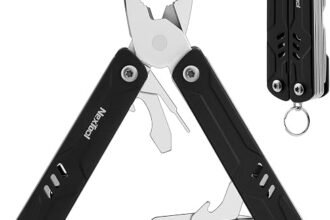
At the checkpoint, a multitool is judged by its parts—not its reputation.
A familiar multitool can sit harmlessly in a pocket for years, then become a costly surrender in the security tray. The decisive question is not its overall length, brand, weight, or whether the package calls it “travel friendly.” It is which implements fold out.
A cabin-bag multitool containing a knife blade is generally the problem, even if the blade is tiny or the tool’s main purpose is pliers. Scissors, awls, saws, wire cutters, files, and drivers raise different questions because their treatment depends on the specific item and, in some cases, the officer’s security assessment. That distinction matters because what an EDC multitool does often comes from several compact tools working together—not merely the pliers. A blade-free tool is not automatically guaranteed through screening, but it removes the most obvious disqualifying component. For certainty, the current rules of the departing airport and airline remain the relevant reference.
A blade changes the answer
For checked bags, pack the tool so sharp edges cannot injure baggage handlers or inspectors.
A multitool marketed as TSA-friendly is not automatically cleared for the cabin. Screening officers assess the actual item and its components, including implements that may be sharp, pointed, or otherwise restricted. If an item is questionable, it can be refused at the checkpoint even when its blade has been removed or omitted.
The strictest attachment sets the outcome
A security officer does not need to accept a multitool as a single, harmless object simply because it is marketed as “blade-free.” Screening centers on the individual implements available in the tool at that moment. If one attachment is prohibited in carry-on baggage, the whole assembled item can be refused at the checkpoint.
That is why the most restrictive deployed component effectively controls the result. A tool may include pliers, a file, drivers, scissors, a saw, or a cutting hook; each can be considered separately. The absence of a conventional knife blade is helpful, but it is not a blanket clearance.
Removable parts count too
Interchangeable accessories deserve the same scrutiny as fixed tools. A bit driver may be permitted as part of an otherwise acceptable design, while a removable cutting blade, pointed awl, or knife-like bit can change the carry-on assessment. Packing that piece elsewhere in the same cabin bag does not necessarily solve the issue: loose components are screened as items in their own right.
Practical examples include:
- A bladeless plier-based tool with screwdrivers may be easier to present than a similar model fitted with a removable utility-knife blade.
- A bit set can contain ordinary driver bits alongside specialty bits whose shape or sharp edge draws closer scrutiny.
- A detachable saw or replacement blade can make an otherwise cabin-suitable handle unsuitable as packed.
Screeners also consider whether an attachment is actually installed, readily deployable, or separately accessible. Removing a questionable implement before travel can reduce ambiguity, but it does not guarantee admission; checkpoint officers retain discretion based on the item they see and current security rules.
For the clearest carry-on setup, the useful question is not “Is this a multitool?” It is: What exact implements, bits, and replacements are present in this bag?
Small Does Not Mean Cabin-Approved
Knife blades are generally not permitted in carry-on bags, whether fixed, folding, locking, or non-locking.
The commonly cited length limits for other items do not create a knife exception. A multitool’s folded state does not change the fact that it contains a deployable knife blade.
That measurement applies to scissors: their blades must be less than 4 inches, measured from the pivot point.
The measurement is not the scissors’ overall length. Handles and body length do not determine the allowance; the blade distance from the pivot does.
The 7-inch threshold concerns many general tools, not knife-equipped multitools.
Screwdrivers, pliers, and similar implements may fall under the general-tool standard, but an attached knife blade remains the controlling issue.
Screeners assess the implement’s function, not merely its size or marketing label.
A compact blade on a keychain tool can be treated as a knife, while a genuinely bladeless tool is assessed through its remaining components.
What a cabin-practical multitool looks like
The narrowest low-friction category is the bladeless plier tool: pliers, wire cutters, drivers, and a file may be built into one body, but no knife blade can be present. A separate screwdriver handle with ordinary bits can also be practical when the kit contains no knife, razor, or other restricted accessory.
Small keyring tools may qualify when they offer functions such as a bottle opener, flat driver, or wrench—and no cutting implement. The size of the tool is not decisive; its individual components are. That distinction matters when comparing flight-friendly compact keychain multitools.
Saws, awls, cutting hooks, and removable blades are not reliable cabin choices. A saw may be short but still presents cutting teeth; an awl is sharply pointed; a hook can conceal a cutting edge. Detachable parts are assessed separately, and the screening officer retains final discretion. Current TSA guidance and the airline’s rules remain the useful check before travel.
Inspect every fold-out tool and accessory. A replaceable blade, rescue hook, or pointed awl can change the screening outcome even when the main tool has no knife.
Choose utility without the checkpoint gamble
For routine travel repairs, a separated, purpose-built tool is often less troublesome than a pocket multitool. A bladeless mini plier can handle a loose zipper pull or small fastener; a dedicated pen, cable organizer, or charging adapter may eliminate the need for improvised cutting and prying altogether.
Consider compact multitool alternatives by their individual parts, not their folded footprint. A tiny tool with a knife, saw, awl, or long driver can still create a carry-on problem. Conversely, a larger-looking but genuinely bladeless device may be easier to explain—though the screening officer still makes the final determination.
A practical travel setup favors items with obvious, limited jobs:
- Bladeless pliers with short, non-removable drivers
- A nail clipper where permitted, rather than a knife blade
- A small screwdriver set kept in checked baggage when bits or shaft length are uncertain
- Disposable or destination-purchased cutting tools for tasks that truly require a blade
The goal is not the smallest tool; it is the fewest questionable implements.
Make the packing decision at home
-
Open and inventory every implement
Unfold the tool completely and check for a knife, saw, scissors, awl, cutting hook, removable blade, loose bit, or separately carried attachment. The feature that seems least important can determine where the whole item belongs.
-
Assess the tool as a complete package
A compliant-looking pliers body does not override a cutting implement stored in its handle or pouch. Include sheaths, bit kits, replacement parts, and accessories in the same review.
-
Choose a cabin-safe substitute when needed
For tasks after arrival, a bladeless pliers tool, driver-only kit, or destination-purchased tool can preserve utility without bringing a questionable implement to screening. Travelers troubleshooting gear before a trip may also find common multitool repair fixes useful.
-
Put sharp tools in checked baggage—or leave them behind
When checking a knife-equipped multitool, close and lock all implements where possible, place it in a sheath or rigid protective case, and secure it so it cannot cut through the bag or injure baggage handlers. If no checked bag is planned, leaving it home avoids surrender at the checkpoint.
-
Check the carrier’s conditions as well
TSA screening rules govern the checkpoint, but airlines may impose additional limits on checked baggage, hazardous items, or specific routes. International departures and connections can introduce different security rules.
Final decisions at the checkpoint remain with the screening officer, even when a tool appears to match published guidance.
A compact, expensive, or sentimental multitool is not exempt because it is folded, keychain-sized, or marketed for everyday carry. Screening evaluates the actual implements available in the item.
If the tool would be difficult to replace, the lowest-risk travel plan is to keep it out of carry-on baggage unless every component is clearly permitted.
Inspect the kit, not just the multitool
A multitool pouch can conceal the item most likely to change a carry-on decision. Empty every pocket, elastic loop, sheath compartment, and organizer slot before packing; screening staff may treat the tool and its loose contents as separate items.
Removable cutters deserve separate scrutiny
Replacement utility-knife blades are cutting blades even when sealed in a plastic dispenser. A detachable saw blade, pruning blade, or cutting attachment likewise does not become cabin-suitable merely because it fits a multitool handle. Pack those items with checked baggage rather than leaving them in a “spares” pocket.
Driver accessories require a closer look, too. Ordinary short bits may be less conspicuous than blades, but unusually long, pointed, specialty, or loose attachments can still prompt additional inspection. Compatibility is separate from security status: whether a multitool accepts standard 1/4-inch bits says nothing about where those bits may travel.
Before departure, separate the kit into non-cutting accessories, cutting components, and uncertain specialty pieces. Reviewing each piece individually prevents a forgotten spare from determining the fate of an otherwise practical carry-on tool.
TSA rules end at the U.S. border
TSA guidance applies to screening at U.S. airports; it is not a worldwide permission slip. An airline can impose its own conditions of carriage, particularly for checked baggage, and its staff may apply rules that are more restrictive than the baseline screening guidance.
International and connecting flights
For an overseas departure, the local aviation-security authority—not TSA—sets the checkpoint standard. A transit airport may rescreen passengers even when the tool cleared the first airport, and a destination may restrict possession, importation, or carrying of particular blades or tools after arrival. The same uncertainty applies to other borderline items, such as tactical pens at TSA checkpoints.
Before packing, check the full itinerary: every departure airport, connecting airport, airline, and destination. Repeat that check for the return trip. A multitool accepted in a U.S. checked bag may be refused at a foreign checkpoint or subject to different local restrictions, regardless of what happened outbound.
Run one final configuration check
-
Open every implement
Confirm no blade, saw, cutting bit, or overlooked attachment remains in the tool or pouch.
-
Check current official guidance
Review TSA guidance for the exact item category and every airport on the itinerary.
-
Treat uncertainty as a packing signal
Place questionable tools in checked baggage, if permitted, or leave them behind.
-
Expect checkpoint discretion
Past screening success, packaging claims, and product labels do not bind the screening officer.
A multitool is evaluated in its actual packed configuration, not by its marketing name or previous trips. When any component is unclear, checked baggage or leaving the item behind avoids a checkpoint decision that can still go against it.