

Off-body carry can solve a daily problem while creating a different safety problem.
A diaper bag, laptop tote, fitted office wear, or hot-weather clothing can make on-body carry awkward enough that a bag feels like the practical answer. That choice is understandable. But the moment the firearm is placed in something that can be set down, hung on a chair, handed off, or rummaged through, the risk profile changes immediately.
The key question is not whether off-body carry feels easier; it is whether the firearm remains under continuous control. On-body carry mainly tests concealment and access. Off-body carry adds separation risk, unauthorized access, slower retrieval under stress, and more chances for negligent handling during routine bag use. In that sense, “safe enough” is less about preference and more about control discipline: who can reach the bag, how often it leaves contact, and whether the gun stays protected inside a dedicated, stable compartment.
- A bag can be forgotten, stolen, or opened by a child or curious bystander.
- Routine tasks—checkout counters, restroom hooks, vehicle loading—create brief separation moments.
- Dedicated compartments and consistent bag control reduce risk, but do not erase it.
Key terms
- Off-body carry
A firearm stored in a purse, backpack, briefcase, sling, or similar container rather than in a holster attached to the body or clothing.
- Unauthorized access
Any opportunity for a child, thief, companion, or bystander to reach the firearm without the carrier’s immediate control.
- Retention and custody
The ability to keep both the firearm and its container from being lost, stolen, forgotten, or set down out of reach.
- Consistent access under stress
The ability to reach and draw from a predictable location and orientation while startled, moving, seated, or limited to one hand.
- On-body carry
A carry method secured to the body or clothing with a holster that keeps the firearm positioned and the trigger protected during normal activity.
The minimum standard for “safe enough”
The three-part test
Off-body carry is more than “a gun in a bag.” It places the firearm inside a separate object that can be set down, handed over, searched, stolen, or opened by someone else. Because separation is built into the method, safety has to clear three tests at once.
- Unauthorized access: no easy path for another person to reach the firearm.
- Retention and custody: the bag stays under continuous control and is not casually abandoned or detached.
- Consistent access under stress: the firearm can be reached from a known position even during movement, surprise, or one-handed access.
A method that fails any one of these is not made safe by comfort or convenience.
Why on-body is usually the safer baseline
On-body carry begins with a structural advantage: the firearm is attached to the person rather than merely nearby. That reduces accidental separation, lowers snatch risk, and keeps the grip angle and draw path more repeatable. A proper holster also fixes orientation and protects the trigger in a way many general-purpose bags do not.
Off-body setups can narrow the gap with dedicated compartments and rigid organization, but they still depend on uninterrupted custody of a second object. That extra object is the recurring weakness.
Risk usually appears during the handoff
Most off-body failures do not begin with a dramatic attack. They begin when the bag is set down for a second during an ordinary transition, and that second quietly becomes a gap in control.
Where control slips
Common examples follow the same pattern:
- Shopping carts: a bag in the basket can drift out of reach while attention shifts to children, payment, or loading items.
- Chairs and restaurant booths: hanging a bag on the back of a seat hides it from view and makes removal easy.
- Restroom hooks: the bag is physically separated at the exact moment attention is divided.
- Gym floors or locker areas: a bag often moves between bench, locker, and machine, creating repeated unattended intervals.
- Vehicles: placing a bag on a passenger seat, floorboard, or trunk turns entry, fueling, and unloading into multiple handoffs.
The technical issue is not the location itself. It is the transition: hand to cart, shoulder to chair, seat to hook, arm to bench. Each transfer interrupts retention, slows retrieval, and increases the chance of simple forgetfulness as much as theft.
A bag can be under visual awareness yet still be outside immediate control. Once it is on a surface, hook, or seat, off-body carry has shifted from carried storage to unattended storage—even if only briefly.
Why access often breaks down
More steps, more variance
Even when a bag stays physically secure, access usually requires extra actions: locating the dedicated compartment, bringing the bag into position, opening it, clearing the entry, and only then establishing a firing grip. Each action adds time. More importantly, each action adds variation, which is what makes a fast draw hard to repeat.
A holster worn on the body tends to stay in a fixed relationship to the torso. A bag does not. Strap length, shoulder choice, zipper direction, and whether the bag has rotated to the hip, back, or front can all change the starting geometry.
Small disruptions matter
Posture and surroundings can change access more than expected:
- Zippers can bind at corners or catch fabric.
- Straps can twist, slide, or pin the bag behind the arm.
- Seated posture can trap the compartment against the body or seat.
- Crowding and movement can prevent the bag from being brought to the same spot every time.
- Outerwear and carried items can block the opening hand or drawing hand.
Under stress, these are not trivial details. Off-body access often depends on fine motor tasks—grabbing a small zipper pull, separating layers, defeating internal retention, and building a clean grip inside a soft compartment. Those tasks tend to degrade faster than a simple, well-practiced on-body draw. The result is often not just slower access, but less reliable access from one repetition to the next.
What makes an off-body setup safer than average
- Purpose-built carry compartmentA safer bag separates the firearm from keys, chargers, cosmetics, and other loose items. The draw path stays consistent because nothing else belongs in that space.Look forA dedicated access point with a repeatable opening motion.AvoidA general-use pocket shared with everyday gear.
- Rigid trigger protectionThe critical feature is not padding or thick fabric, but hard-sided trigger coverage that resists collapse under pressure. Soft sleeves can shift, fold, or admit foreign objects.Look forA fixed holster or insert that fully covers the trigger guard.AvoidLoose placement, soft pouches, or elastic sleeves alone.
- Compartment disciplineSafety improves when one compartment has one job. Mixing medical gear, snacks, electronics, or papers into the same space increases snagging and orientation errors.Look forA dedicated compartment kept empty except for the secured firearm.AvoidMulti-use storage that changes shape day to day.
- Continuous controlThe bag matters less than the custody pattern. A strong setup stays on the body, in hand, or under direct control instead of being parked on chairs, hooks, or car seats.Look forConsistent body contact and the same carry position every time.AvoidFrequent setting down during routine transitions.
A bag can look discreet, expensive, or well organized and still be a poor off-body platform. What matters is not style but structure: rigid trigger coverage, a dedicated compartment, stable orientation, and uninterrupted control.
That is why discussions about the best off-body carry bag can miss the point when they focus on size, fashion, or storage volume. The safer setup is usually the one that does fewer things, in the same way, every time.
Convenience alone is not enough
Comfort complaints do not make off-body equivalent to on-body carry.
Once the firearm leaves the body, retention, access, and orientation depend on managing the bag itself.
Newer carry apparel and support accessories have expanded what on-body can look like.
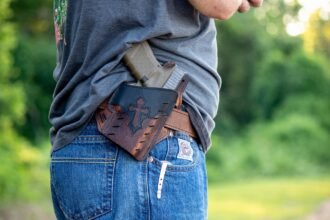
Chassis systems, concealment belts, leggings, undershirts, belly bands, and pocket-support accessories can keep the firearm attached without a classic belt-and-holster setup.
Ease and safety are not the same metric.
On-body attachment removes many forgotten-bag, handoff, and awkward-angle failures. Off-body remains a situational workaround when clothing, tasks, or body fit truly block workable on-body methods.
Transitions are where off-body carry gets harder
Off-body carry rarely stays in one condition all day. The harder problem is not the bag itself, but the sequence of transitions around work, errands, transit, social visits, hotels, and overnight storage. Every stop can force a decision: carry, secure, transfer, unload, lock, or leave.
Small changes create big exposure
A routine day can add several handoffs:
- entering a prohibited workplace or posted venue
- parking before an appointment and securing the firearm in a vehicle
- moving between backpack, purse, luggage, or bedside storage
- visiting a private home with different household expectations
- passing through transit, rideshare, or hotel check-in environments
Each step creates another chance to mishandle the bag, forget where the firearm was placed, or leave it in a less secure space than intended. Off-body systems often look manageable in a single setting, then become fragile once the schedule starts changing.
Rules also shift by location and circumstance. Employer policies, venue restrictions, lodging practices, private-property rules, and local transport rules may not align, which means the safe routine in one place may be the wrong routine in the next.
A bag that seems secure during steady daily carry can become riskier during repeated park-lock-return-transfer cycles. Complexity, not just access speed, is often what undermines consistency.
A hard test for everyday carry
-
Count every handoff
If the bag is routinely set down, hung up, stowed in a vehicle, or passed to another person, risk compounds quickly. Frequent transitions are the first warning sign.
-
Check access under stress
The draw path should stay consistent while walking, seated, buckled, or crowded. If orientation, zippers, or body position regularly change, repeatability is weak.
-
Inspect the compartment, not the bag
A safer setup uses a dedicated compartment, rigid trigger protection, and anchored orientation. General-purpose pockets and loose contents undermine all three.
-
Measure physical control honestly
“Nearby” is not the same as attached and controlled. Any routine that depends on memory, visual monitoring, or short separations is fragile.
-
Compare it to competent on-body carry
If the off-body setup is chosen mainly for comfort or convenience, it is not outperforming the safer baseline. The comparison standard is stable attachment and immediate access.
- Low-handoff routines perform better than high-transition routines.
- Purpose-built compartments matter more than bag brand or style.
Off-body carry can be safe enough only when the system is purpose-built and control is disciplined at every moment. For everyday use, though, it usually remains less safe than competent on-body carry because separation, access, and transition failures are harder to eliminate than they are to overlook.







2 Comments
My mild gripe is with the phrase “continuous physical control.” It sounds clear until you hit gray areas. If the bag is looped around your leg at a coffee shop, is that “control”? If it’s on a hook inside a restroom stall, probably not… but people will absolutely argue otherwise lol.
I did like the hard test at the end because convenience really does become the excuse for everything. “It’s easier” is not exactly a safety metric, even if people want it to be.
The stress-access section was the one that made me pause. People really do assume “I can reach into my bag” equals “I can access it reliably under pressure,” and those are obviously not the same thing 😅
Would you say vehicle use is basically the deal-breaker for off-body everyday carry? Because that transition in/out of the car seems like where the memory errors start: seat, console, floor, back seat, grab on the way out… or forget. Feels like a mess.