

Affordable is useful; uncertain is not.
A light that flickers after recoil, sheds its mount, or drains itself in storage turns a low-light problem into a worse one. Positive target identification is the non-negotiable job: enough usable spill to read hands and surroundings, a beam pattern that does not collapse into glare at close range, and controls that work without hunting for them.
Premium-duty lights earn their cost through validated output, rugged switches, sealed housings, and deep track records. A budget model need not match all of that, but it must clear a defined floor: secure rail engagement, repeatable activation, honest runtime behavior, recoil tolerance, and a battery system that remains practical. Features such as extreme lumen claims, magnetic chargers, or included remote switches matter only after those basics hold.
- Inspect mount hardware and tighten it to the maker’s stated specification; loose crossbolts are a frequent budget-light failure point.
- Test activation, beam stability, and heat during several short live-fire or dry-handling sessions before relying on the light.
Choose by platform, then verify


| Listed mount | Power | Control | Claimed output | Hard-use evidence | ||
|---|---|---|---|---|---|---|
|
M300A Scout-Style Weapon Light With Remote Switch Long-gun layout | 20 mm Picatinny | 1× CR123A | Remote momentary | 600 lumens | Not established | View |
|
GAZESHOT Mini Pistol Light With USB Rechargeability Rechargeable pistol | Glock/Picatinny | USB rechargeable | Strobe listed | 800 lumens | Not established | View |
|
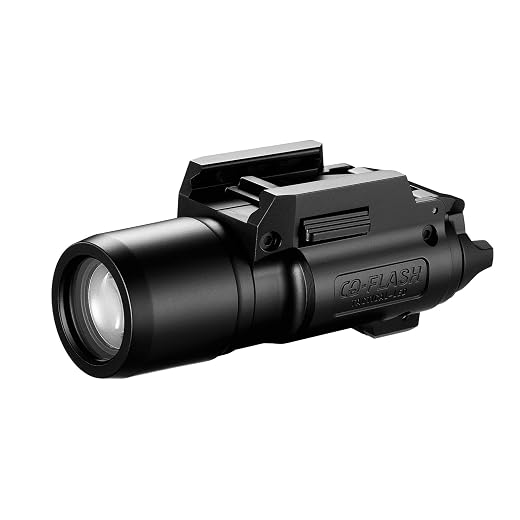
Tokyo Marui CQ-FLASH Compact Rail-Mount Light Bare-bones budget | Picatinny/Weaver | 3× LR44 | Not stated | Not stated | Not established | View |
What “serious use” has to mean
- The light stays put and works the same way every timeA credible minimum starts with a mount that resists loosening and an activation method that can be found without changing a safe firing grip. Momentary and constant-on functions need to be distinct rather than accidental.Look forPositive rail engagement, repeatable switch feel, and protected controls.AvoidClamp play, wandering remote pads, or activation through incidental contact.
- The beam and power reserve fit the roleFor home or administrative readiness, a practical beam, known battery status, and routine function checks can be enough. Duty, field, and harsh-environment use raise the bar: sustained regulated output, recoil validation, weather sealing, cable durability, and a proven support system matter more than a high lumen claim.Look forUseful spill and reach, predictable runtime, and a defined low-power plan.AvoidBrief turbo figures, vague runtime claims, or reliance on USB charging alone.
A light that remains secure during occasional checks and provides a usable indoor beam may suit a limited readiness role. That does not establish reliability through repeated recoil, rain, mud, temperature swings, hard impacts, or extended shifts.
Remote switches deserve particular skepticism: the cable, plug, pad retention, and mounting path create more failure points than a body-mounted control.
Read the beam, not the box
A large lumen claim says little about what the light does downrange. Candela measures beam intensity: more of it generally carries the hotspot farther and cuts through photonic barriers better. Spill illuminates the surrounding area, but excessive spill can create close-range glare and reduce perceived reach.
Output that holds up
The useful question is whether the advertised mode is regulated—held near its intended output—or simply an initial peak that falls rapidly as the cell drains or heat builds. Published runtime can also include low-output tail time, so a light that claims a long run may deliver its brightest beam only briefly. The full weapon-light selection framework explains how to compare those claims, battery formats, and beam patterns in more depth.
Mounting remains part of the system. Confirm that a pistol light fits the intended rail profile and that a Scout-style body has a compatible Picatinny or M-LOK mounting solution; “universal” fit is often conditional. A remote switch improves activation from supported shooting positions, but adds a cable, connector, and pressure pad—each another potential snag or failure point. Secure routing and a dependable tailcap switch matter as much as the pad itself.
M300A Scout-Style Light: the adaptable long-gun layout
01
Top choice for high-output budget rail lighting
The M300A follows the compact Scout-pattern formula: a short, rail-mounted light body paired with a tailcap remote switch and a stated 20 mm rail interface. On carbines and similar long guns, that geometry leaves room to place the light forward while bringing momentary activation back to the support hand.
Its real appeal is not the advertised 600-lumen figure; it is access to a widely copied mounting and switching layout. That makes it a sensible format-first option for airsoft, training replicas, and low-consequence experimentation with light placement.
- Compact Scout-pattern body
- Remote momentary activation included
- Stated 20 mm rail fit
- Common mount and switch geometry
- Sold as an airsoft replica
- Output claim lacks beam data
- No stated ingress rating
- No documented recoil validation
Bottom line This is the strongest budget long-gun concept in the group because its form factor supports practical placement and remote activation. Its published evidence, however, does not establish the reliability expected of a defensive or duty light.
The Scout-style pattern is proven as an ergonomic idea: compatible-looking mounts, tailcaps, and tape switches can make setup far easier than with a generic cylindrical light. That is ecosystem compatibility, not a durability certificate.
This listing does not document waterproof sealing, output regulation, switch life, impact resistance, or recoil testing. A unit that fits a rail and accepts Scout-pattern accessories still needs verification on the actual host firearm: mount retention, cable routing, activation consistency, battery contact under firing, and zero effect on nearby controls all matter.
GAZESHOT Mini: compact USB-charged pistol-light format
Best for compact pistols and rechargeable convenience
The GAZESHOT Mini is a rail-mounted pistol light marketed around an 800-lumen output, magnetic USB recharging, and a strobe mode. Its appeal is straightforward: a compact, self-contained light for a compatible Glock-pattern or Picatinny-railed handgun without keeping disposable cells on hand.
That convenience needs a harder look before the light is treated as a serious-use choice. Rail-key geometry determines whether the body sits tight and correctly positioned on a given frame; “GL Glock and Picatinny” compatibility in a listing does not establish fit across rail generations, compact frames, or aftermarket rails. The same restraint applies to the charging interface: magnetic charging can avoid an open socket, but the listing does not document sealing, cable retention, or resistance to fouling and impact.
Runtime matters more than the initial lumen claim. No regulated-runtime curve or thermal step-down behavior is provided, so sustained output and low-battery performance remain unknown. Controls also merit hands-on confirmation: a pistol light needs switches that are reachable without accidental activation or an awkward altered grip. Most importantly, the light and its exact rail position must be supported by a quality holster. Anyone comparing it with the best Glock 19 light options should confirm a holster maker lists this specific model—not merely a similarly shaped light—before treating it as a carry-ready setup.
- Magnetic USB charging reduces battery logistics
- Compact format suits smaller rail-equipped pistols
- Strobe is available as a secondary signal mode
- Rail-key fit is not documented by the listing
- No published runtime or thermal step-down data
- Charging-interface sealing is unverified
- Dedicated holster support may be limited
CQ-FLASH: a compact light for low-demand training
A low-cost choice for basic airsoft illumination
Tokyo Marui’s CQ-FLASH is a plastic-bodied, 20 mm Picatinny/Weaver-mounted light built around the airsoft market, not a documented firearm-duty standard. Its compact format can make sense for casual replica use, dry practice, or as a low-stakes fit-and-function experiment.
Before it is assigned any more serious role, the host rail, clamp engagement, activation under handling, beam performance, and battery behavior merit direct inspection. Live-fire use also calls for platform-specific recoil testing: a light that stays put on one setup may loosen, flicker, or fail on another.
- Compact 20 mm rail format
- Picatinny and Weaver mounting listed
- Low-cost airsoft-oriented option
- Plastic construction
- Three LR44 cells required
- No documented output or runtime
- No established firearm recoil tolerance
Fit before features
A light can have a credible beam and still be the wrong purchase if its mount does not locate positively on the host rail. Compare the supplied crossbar or rail key with the rail-slot position, not simply a “universal” compatibility claim. A key that does not fully enter a slot, or a clamp bearing only on angled rail surfaces, can shift under recoil.
With the firearm unloaded and verified clear, confirm that the tightened mount has clearance from the frame, dust cover, barrel, front sight, and any moving controls. Check activation from the intended grip; a compact pistol light can sit too far forward or leave the switch crowded against the trigger guard. The M300A’s remote switch also needs a natural pad location and a cable path that cannot snag, pinch under a cover, block sights, or cross controls.
Holster fit is often determined as much by the light body and bezel as by the pistol. Light-bearing holsters commonly index on the mounted light, so a GAZESHOT-equipped pistol may need a holster specifically listed for that exact combination. “Fits light-bearing pistols” is not meaningful fitment evidence.
Compare rail-key dimensions, screw clearance, and holster listings against the exact light variant. Similar-looking compact lights rarely share retention geometry.
Power is part of the reliability test
A weapon light is only as dependable as its power chain. For Scout-style lights, confirm the manual’s approved cell type and length; protected rechargeable cells can be longer than primary cells and may cause intermittent contact or prevent the tailcap from fully closing. The practical tradeoffs between CR123A and 18650 cells include more than capacity: primary lithium cells store well and handle cold reliably, while rechargeables demand a known-good charger and a deliberate recharge schedule.
The GAZESHOT’s built-in USB charging simplifies top-offs, but it also makes cable, port, and charge-state verification part of pre-use checks. It is sensible to avoid storing any rechargeable light indefinitely at a depleted state and to confirm it reaches full output after charging.
The CQ-FLASH’s LR44 cells are its limiting contingency. Keep matched, fresh spares in their packaging; button cells lose usefulness quickly under higher draw. Across all three formats, clean dry contacts, inspect seals, replace damaged cells, and function-check the light after battery changes.
Prove the light on the setup that will carry it
-
Install it cleanly and mark its position
Degrease the rail and clamp surfaces, use the maker’s specified fastener treatment and torque where available, then witness-mark screw heads and the mount. Confirm the rail key fully occupies a compatible slot and that the bezel clears the muzzle and support hand.
-
Exercise every control path
Cycle the body switch, momentary and constant-on functions, and any remote pad repeatedly with the firearm unloaded. Check that cables neither snag nor activate when gripping, slinging, or moving the action through its normal range.
-
Check seals and power interfaces
Inspect O-rings, battery doors, charging ports, magnetic contacts, and lens retention for grit, pinched seals, or looseness. A USB-rechargeable model merits a full charge, recharge, and confirmation that its indicator behavior matches actual operation.
-
Run it for heat and decline, not just ignition
Start on the intended cell or charge and leave the light on long enough to reveal step-down, flicker, thermal cycling, or a sudden cutoff. Repeat after cooling; a light that works for a brief bench check may still fail during a longer problem.
-
Confirm retention under lawful live fire
At a lawful range, inspect witness marks and function after a modest firing sequence, then after realistic handling and sling movement. Any shift, intermittent output, loosened fastener, or changed switch feel is a fault worth resolving before relying on the light.
Short checks are excellent at exposing bad rail fit, weak switches, poor contact pressure, and early thermal problems. They cannot establish long-term recoil survival, water resistance, corrosion resistance, or electronics life—especially for lightly documented budget models.
Keep inspecting witness marks, output behavior, seals, and charging or battery contacts over normal use. A light that develops intermittent behavior is no longer a proven component simply because it passed its first range session.
The sensible shortlist
- A light that shifts on the rail or activates unpredictably is not rescued by a high lumen claim.
- An inexpensive model earns a place only after its mount, switch, runtime, and recoil retention have been observed on the actual setup.
For a budget long gun, the M300A Scout-style light is the strongest starting point: its familiar mounting pattern and remote-switch layout suit rifles and carbines, provided the specific mount and cable hold through live fire. For a pistol, the GAZESHOT Mini is the more practical compact choice when rechargeable convenience matters and rail/holster fit has been confirmed.
The Tokyo Marui CQ-FLASH belongs only on a low-demand training setup after accepting its airsoft lineage, small-cell runtime, and uncertain recoil margin. Before settling on any of them, consider whether a weapon light is necessary for the platform’s actual role. The deciding evidence is a secure fit, controllable activation, credible usable output, and reliability demonstrated in use—not a marketing specification.




One Comment
Glad you separated “serious use” from duty use. Too many budget-light lists act like a USB charger and a giant lumen number automatically equal reliability.
Why wasn’t the Streamlight Protac Rail Mount HL-X included as the obvious budget long-gun alternative? It’s more money than the M300A clones, sure, but there’s a pretty big difference between cheap and cheap-enough-to-trust.