

A spotless patch can be persuasive—and still miss the fouling lodged in the bore’s corners.
A patch may emerge nearly white while carbon remains in the throat, powder residue clings at the lands, or copper persists as a thin film. Brushing addresses deposits that solvent and patch pressure do not always lift, but more aggression is not automatically more cleaning. Excessive stroke counts, a damaged brush, or reversing a brush abruptly at the muzzle can create needless wear and leave bristles behind.
Bronze and nylon are therefore tools matched to the job, not opposing camps. Bronze provides more mechanical bite for routine powder fouling and stubborn deposits; nylon is gentler, particularly where a strong copper solvent could attack bronze bristles and make the brush itself appear to be fouling. Caliber fit matters: an undersized brush accomplishes little, while an oversized or worn one raises resistance unnecessarily. Cleaning frequency, barrel finish, ammunition residue, and the solvent label all change the sensible choice. Before any work, the firearm is unloaded, action open, and ammunition removed from the area; manufacturer instructions remain the controlling procedure.
Choose by fouling and solvent


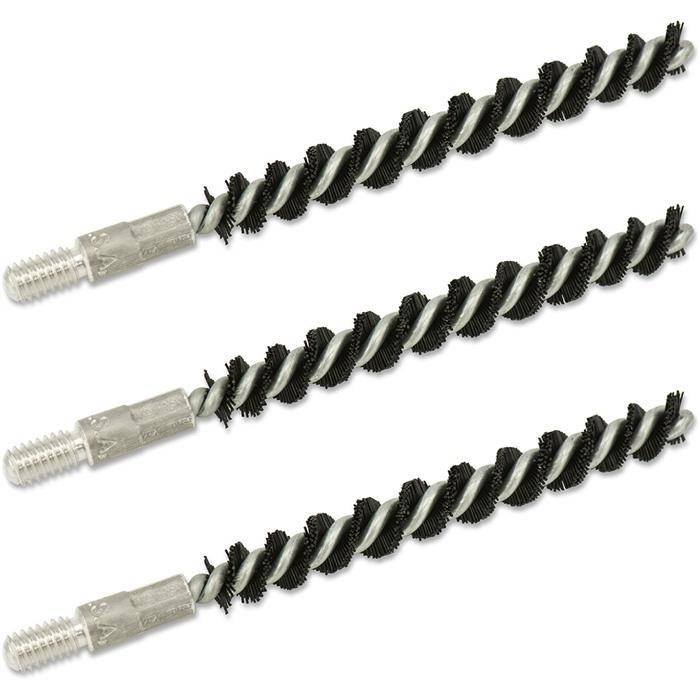
A bronze brush is not a universal “deep-clean” answer. Correct caliber and rod-thread compatibility matter first; an undersize brush skates over deposits, while excessive diameter raises drag and can distort the cleaning stroke.
Nylon can be worked longer with strong solvent present, but it removes stubborn carbon more slowly. Bronze is generally the better first pass for ordinary fouling, followed by patches to confirm whether brushing actually changed the bore condition.
What the brush actually does in the bore
A phosphor-bronze brush has enough spring and bristle stiffness to scrub across the tops of the lands and into the groove corners. That mechanical bite disrupts powder residue, soft carbon, and some adherent fouling even before a solvent has fully done its work. It is most useful when a patch alone leaves a stubborn, uneven deposit.
Nylon bristles flex more readily. They still sweep residue from lands and grooves, but their cleaning power depends more heavily on the solvent loosening the deposit first. That makes nylon particularly sensible with aggressive copper solvents or for light, frequent maintenance, where the goal is to circulate solvent without adding much abrasion.
A correctly sized bronze brush is normally softer than barrel steel and is not inherently harmful in routine use. The more credible sources of damage are poor handling:
- A brush that is oversized, bent, or shedding bristles can drag unpredictably.
- A rod entering off-center can rub the throat or bore edge.
- Reversing a bronze brush mid-bore loads the bristles and can make it snag.
- Contact with the muzzle crown deserves special care; a bore guide can help keep the rod aligned from the chamber end.
Brushes are consumable tools. Once bronze bristles lose their set, or nylon bristles mat down, the brush cleans less effectively and invites extra passes. Replacement is preferable to forcing a worn brush to do harder work.
Bronze may discolor in ammonia-based copper solvent as the solvent reacts with the brush itself. That color is not automatically evidence that copper is still leaving the bore; nylon avoids this misleading feedback.
| Firm mechanical scrubber McJ Tools Bronze Bore Brush Set | VS | Solvent-tolerant option Tipton Nylon Bore Brush Three-Pack |
|---|---|---|
Stubborn carbon, lead | Best at |
Light carbon, residue |
Can react with bristles | Ammonia solvent |
Resists ammonia solvents |
High, firm contact | Scrubbing force |
Moderate, flexible contact |
Eventually takes a set | Wear pattern |
Can splay or soften |
Tight fit adds drag | Fit sensitivity |
Correct size still matters |
| View brushes | View brushes |
Copper-removing solvents can attack bronze bristles. The resulting blue or green staining may be dissolved brush metal rather than copper continuing to leave the bore, so repeated brushing can create a misleading “still fouled” signal.
Nylon avoids that reaction and is useful when solvent dwell time matters, but it is not permanent: bristles can splay, collapse, or lose effective contact. Bronze is likewise not inherently harmful; correct caliber fit, a straight rod, and a sound crown matter more than the material alone. For deposits that need more than solvent, carbon buildup can be removed safely with controlled passes rather than relentless force.
A bronze baseline for routine multi-caliber maintenance
Best for thorough, repeat barrel cleaning
McJ’s bronze brushes make a sensible working supply for a cleaning bench that handles several common rifle and pistol bores—provided each brush is selected for its actual caliber. The bronze bristles give patches a useful follow-up after ordinary firing residue has been loosened with solvent, rather than treating a brush as a cure for every stain in the bore.
A 10-brush supply also suits regular rotation: a brush that has lost its full diameter or has visibly bent bristles no longer gives the intended wall contact. Keeping fresh, correctly sized brushes on hand is more meaningful than forcing an undersized brush through a bore or stretching the life of a worn one.
Because bronze can react with copper-removing solvents, blue-green residue after brushing does not cleanly distinguish dissolved jacket fouling from the brush itself. Nylon remains the clearer choice when patch color is being used to judge copper-remover progress.
- Bronze scrub for routine powder fouling
- Ten-brush supply supports timely replacement
- Steel core and brass coupler construction
- Exact caliber matching is essential
- Can tint patches with copper solvents
- Not a clean indicator of copper removal
Bottom line A practical bronze replenishment set for normal brush-and-patch cleaning. Its usefulness rests on the correct bore diameter and retiring brushes before their bristles lose contact.
Tipton Nylon Bore Brush Three-Pack for Solvent-Heavy Maintenance
A solvent-resistant option backed by a lifetime warranty
Tipton’s .22-caliber three-pack is a practical reserve for rifles cleaned often with ammonia-based copper solvents, or for light fouling between more intensive cleanings. Each brush uses a one-piece wire core with a looped end and standard 5-40 threads, so it fits common small-caliber cleaning rods and avoids an exposed wire tip at the bore end.
The appeal is not aggressive scrubbing; it is having fresh, chemically tolerant brushes on hand when a bronze brush would muddy the reading of solvent-colored patches. Three brushes also make it easier to retire a softened or splayed nylon brush rather than asking one worn brush to do precision work.
- Three brushes make timely replacement inexpensive
- Nylon tolerates ammonia-based solvents
- Looped wire end avoids an exposed tip
- Standard 5-40 threads fit common .22 rods
- Less bite on hardened carbon and lead
- Worn bristles can lose bore contact quickly
- Not a substitute for bronze on neglected fouling
A .22 Nylon Brush for Low-Force Rimfire Cleaning
Gentle nylon cleaning for .22 caliber firearms
The Proof Positive .22 Caliber Nylon Bore Brush three-pack is a deliberately narrow tool for routine .22 rimfire upkeep, not a substitute for a multi-caliber brush kit. Its role is to work with solvent on the waxy or greasy bullet lubricant, light carbon, and ordinary firing residue that can accumulate without requiring aggressive abrasion.
That restraint matters with rimfire barrels: a dark patch does not automatically indicate a deposit that needs hard scrubbing. A solvent dwell followed by controlled nylon passes can clear routine contamination while avoiding the false urgency created by every stained patch. The three-brush format also makes it practical to retire a brush once its bristles no longer maintain useful contact.
Nylon is not a cure for genuinely tenacious deposits. A pronounced lead or carbon ring near the chamber or throat may call for a correctly sized bronze brush or another deposit-specific method after solvent compatibility is confirmed.
- Nylon tolerates many ammonia-based cleaners
- Three brushes allow timely replacement
- Dedicated .22 sizing supports consistent contact
- Limited mechanical bite on hard lead or carbon
- Not useful beyond .22-caliber bores
- Worn nylon can lose cleaning contact quickly
Let the fouling dictate the tool
-
1. Read the first patch
Push a snug, solvent-dampened patch through from chamber to muzzle and inspect it under good light. Dry black or gray residue points to carbon; waxy deposits and flakes suggest lead; blue-green color may be copper fouling—or, after bronze brushing, material from the brush itself.
-
2. Match solvent to the deposit
Use a carbon solvent for powder residue, a lead-capable product where appropriate, and a copper solvent only when copper is the concern. Nylon is the safer default with strong ammonia-based copper chemistry; bronze is best kept for solvents that do not attack it.
-
3. Let chemistry work first
Allow the solvent to dwell for its labeled interval, keeping the bore wet rather than repeatedly scrubbing a dry surface. A follow-up patch often reveals whether the deposit has softened enough to move without a brush.
-
4. Brush only when patches stall
If fouling remains, use a correctly sized nylon brush for light, chemistry-led cleaning or a bronze brush for controlled mechanical removal of stubborn carbon, lead, or baked-on residue. Make full chamber-to-muzzle strokes; reversing direction only after the brush exits avoids bunching bristles at the crown.
-
5. Patch clean, then reassess
Run dry patches until they stop carrying dissolved residue, then inspect again rather than continuing by habit. A one-piece rod gives the most controlled brush alignment; a pull-through is useful for quick field maintenance, but the bore-snake-versus-rod decision for routine cleaning depends on how much fouling remains.
Replace brushes once bristles stay flattened, shed, or pass with noticeably less resistance.
Build a cleaning kit around evidence, not allegiance
- Replace brushes when bristles relax or the core begins to twist.
- Treat the final dry patch and bore inspection—not a pass count—as the stopping signal.
A complete kit benefits from both materials: bronze for deposits that remain after solvent has had time to work, and nylon for ammonia-based copper treatments, light maintenance, or low-force cleaning. Select the brush only after considering bore diameter, chamber or bore geometry, solvent, and what the patches and inspection actually show.
The brush is only one part of the system. A caliber-correct one-piece rod or quality pull-through, a rotating handle, bore guide, correctly sized patches and jag, suitable solvent, and a light source make results more repeatable while reducing crown and throat contact. Stop when patches and inspection indicate the bore is clean—not when an arbitrary number of strokes has been reached.






4 Comments
Good breakdown. I had been using nylon with solvent for everything because it felt safer, then wondered why stubborn carbon never seemed to move. Bronze for the dirty work, nylon when the solvent calls for it—apparently the boring answer is to own both.
I keep seeing blue patches after using a bronze brush with copper solvent, so this was a useful reminder not to assume the barrel is still dumping copper. For general centerfire cleaning, which one did you end up choosing from the McJ bronze set versus the Tipton nylon pack?
For a general multi-caliber centerfire kit, I’d choose the McJ bronze set as the baseline because it gives more reliable mechanical contact on ordinary carbon and fouling. I’d add nylon brushes if I regularly used strong ammonia-based copper solvents, rather than treating either material as a universal winner.
A little skeptical of the “ten bronze brushes” approach as a baseline, mostly because brush fit seems to matter more than how many are in the package. I’ve had bargain brushes that felt loose after only a couple sessions and then everyone calls bronze ineffective.
Still, I agree with the main point: inspect the bore and replace worn brushes. A nylon brush that has lost contact is basically just taking a guided tour through the barrel.