
In a dark hallway, certainty matters more than speed.
A crash downstairs at 2 a.m. creates a dangerous gap between hearing something and knowing who—or what—made the sound. A teenager getting water, an expected guest leaving late, a pet knocking over a bin, or a responding officer outside the home can all be misread in poor light. A firearm must never be aimed at an unidentified person.
That is why positive identification is the central safety question, not merely whether a light makes a firearm easier to use. Ambient light from a streetlamp or phone screen can produce silhouettes, but silhouettes do not establish identity, hands, actions, or whether a perceived object is actually a threat. A properly used white light can reveal those details briefly and at distance. It can also expose the person holding it, create glare from pale walls or mirrors, and encourage premature decisions if light is treated as proof rather than information. The practical standard remains simple: no clear identification, no shot.
- White light reveals color, movement, hands, and context; it does not by itself establish hostile intent.
A weapon light is optional; clear identification is not
Darkness turns uncertainty into risk
Low light does not simply hide a scene. It strips away the visual information needed to interpret it accurately: facial features, hand position, clothing, objects, distance, and direction of travel. The result is an information problem, not merely an inconvenience.
Human vision often detects motion before it resolves detail. A shifting silhouette in a hallway may reveal that something moved, but not whether it is a household member, a guest, a pet, or an intruder. Even when a person is apparent, darkness can obscure what that person is holding and what they are doing.
Detection, identification, and assessment
These are separate tasks, and they become harder at different rates as illumination falls:
- Detection: noticing a sound, shape, shadow, or movement.
- Identification: determining who or what is present.
- Assessment: understanding behavior, location, available cover, and whether an object is actually a weapon.
Peripheral vision is relatively sensitive to movement in dim conditions, while fine detail and color recognition degrade sharply. Glare, backlighting from a window, dark clothing, and visual adaptation after waking can deepen the ambiguity. A light can restore detail long enough to distinguish a person, object, and action—but it cannot supply judgment or turn an unclear situation into a confirmed threat.
What a mounted light solves—and what it can worsen
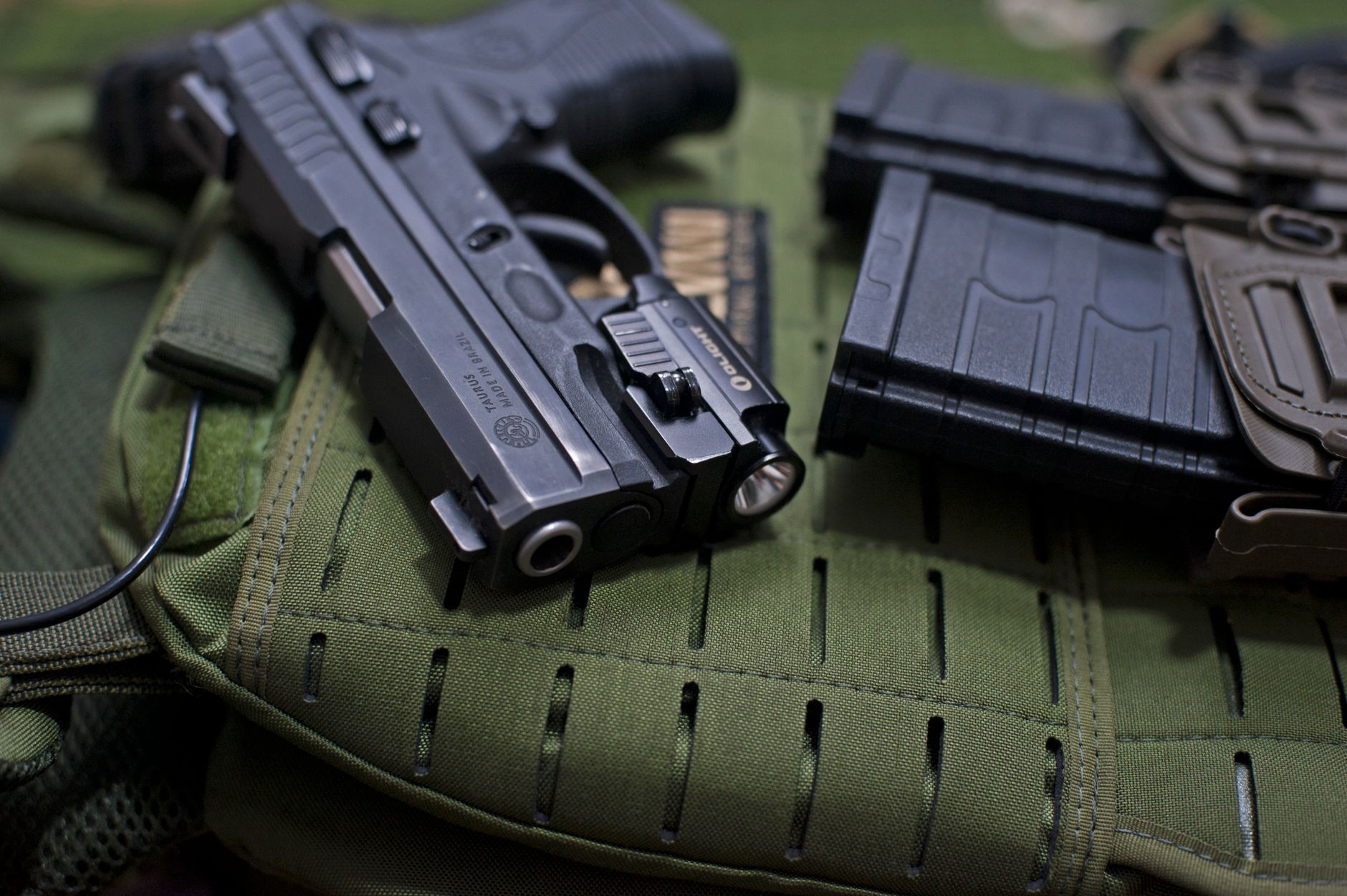
Once a firearm is already in hand and its direction is justified, a mounted light can be remarkably practical. It keeps the support hand available for opening a door, moving a phone, managing a family member, or using a separate handheld light. The beam also stays aligned with the firearm’s orientation, reducing the awkwardness of trying to maintain two independent sight lines under stress.
A capable mounted light can provide more than brightness. Its focused center helps reveal hands, waistlines, and objects at useful indoor distances; spill light can expose nearby movement and room boundaries. Momentary activation limits continuous backscatter from pale walls, mirrors, smoke, or dust, while a consistent switch location can be easier to operate than searching for a handheld light.
The beam follows the muzzle
That same alignment is the defining compromise. To illuminate an unidentified sound source with a weapon light, the firearm generally points in the same direction. A hallway noise may be a family member, pet, neighbor, or responder—not a confirmed threat. Light discipline cannot remove that problem; it only reduces how long the area is illuminated.
A handheld light can investigate without indexing a firearm toward the subject. Some households treat the two tools as complementary: the handheld light handles uncertain investigation, while the mounted light is available if circumstances have already established a need to have the firearm oriented toward a potential threat.
The right setup therefore depends less on lumens than on likely home layout, household members, nighttime routines, and the ability to keep identification separate from muzzle direction when facts remain unclear.
A weapon light can improve one-handed control after a firearm is in use. It does not make it safe to use the firearm as a general-purpose searching tool.
What Light Output Means Inside a House
Lumens
Lumens measure total light leaving the lamp, not how far it remains useful. In a small bedroom with pale walls, a very high-lumen burst can flood the room with reflected light rather than reveal more detail.
Candela
Candela describes peak beam intensity and is often the better clue to reach and penetration. Higher candela can carry through a long hallway or doorway, though a tight hotspot can be harsh when it lands on a mirror, glass frame, or glossy appliance.
Hotspot
The hotspot is the beam’s brightest central area. It can help distinguish a hand, object, or face at distance, but an overly small hotspot may leave nearby corners and the space beside a doorway poorly read.
Spill
Spill is the lower-intensity light around the hotspot. Useful spill gives context across furniture and room edges without repeatedly sweeping the beam; its value is central to how much light is actually needed indoors.
Backscatter and glare
Backscatter is light reflected back toward the observer by pale paint, smoke, dust, or shiny surfaces. Glare can temporarily obscure detail, so usable output depends on beam shape, surface reflectivity, and room size—not the largest headline number.
Build layers, not a single solution
A home-defense lighting plan begins before an unexpected noise. Working household lights—entry lamps, hall fixtures, stair lighting, and exterior approaches—reduce the need to investigate unfamiliar spaces in darkness. Switch locations and reliable bulbs matter as much as output; a bright room can reveal a person without anyone handling defensive equipment.
A handheld flashlight remains the most flexible layer. It can check a power outage, locate a pet, or examine a sound while keeping any firearm stored. A mounted light has a narrower role: it can provide illumination when a firearm is already being handled for a credible defensive purpose, while leaving the support hand available for other tasks. It is not a general-purpose searchlight.
Redundancy covers ordinary failures. A charged handheld light near sleeping areas, another near a main exit, and readily available battery or charging backups avoid dependence on one device. Lights require periodic function checks; batteries can leak, cells can age, and switches can fail unnoticed.
Storage connects the whole plan. Defensive equipment benefits from being secured against unauthorized access while remaining promptly available to its authorized user. A quick-access gun safe can keep a firearm and its dedicated light together, while separate handheld lights remain accessible for routine tasks—making it less likely that a mounted light becomes the first answer to every disturbance.
The safest first layer is often the one that illuminates a hallway or room without introducing a firearm at all. Mounted and handheld lights then serve distinct, complementary roles.
What Separates a Serious-Use Light From a Bright One
- A locked-in fit on the actual firearmThe light’s rail interface must match the firearm and stay tight through repeated firing, handling, and cleaning. Correct key selection, full cross-bolt engagement, and a mount that does not shift are more important than an impressive specification sheet.Look forA model-specific or proven rail fit that remains immobile.AvoidUniversal fit claims without secure, repeatable engagement.
- Controls that work under pressureMomentary activation, constant-on operation, and any strobe function should be distinct enough to use without hunting for the switch. Controls need to be reachable without altering a sound firing grip or placing fingers near the muzzle.Look forPositive, repeatable switches accessible from the normal support-hand position.AvoidMushy paddles, accidental activation, or controls requiring a grip break.
- Supported power and a useful beamCommon, widely available batteries and clear runtime behavior make a light easier to keep operational. Indoors, the beam needs enough center intensity to identify details while retaining usable spill; raw lumen numbers reveal neither beam shape nor sustained output.Look forVerified runtime, dependable battery support, and an indoor-capable beam pattern.AvoidChoosing solely by peak lumens or brief turbo claims.
- Durability beyond the benchA serious light needs impact resistance, weather sealing, a protected lens, and electronics that tolerate recoil. For holstered handguns, dedicated holster availability matters: a secure light that cannot be safely carried in the intended configuration may be the wrong fit.Look forRecoil-rated construction and compatible, retention-safe holsters where carry is relevant.AvoidAirsoft-grade mounts, unknown recoil ratings, or improvised holster modifications.
Fit the light to the actual setup
A light can lock onto a rail and still be a poor match. Its activation paddles must fall where the supporting hand can reach them without changing a secure firing grip or unintentionally pressing the switch. This varies with hand size, frame contour, trigger-guard shape, and whether the light sits flush with, or extends beyond, the muzzle.
Compact pistols need especially careful selection. A model marketed as universal may mount, yet place controls too far forward, block a preferred grip, or protrude enough to collect more blast residue. For a common compact platform, comparisons of the best Glock 19 light for the nightstand are more useful when they specify the exact generation, rail geometry, and light body rather than treating every compact pistol alike.
Check the system, not just the rail
Before choosing a model, confirm these practical details:
- Holster support: a holster is cut for the exact pistol-and-light combination; a light change commonly requires a different holster.
- Battery access: determine whether the battery door or cap can be opened while mounted, and whether removal changes the mount’s position.
- Lens fouling: lights extending past the muzzle may accumulate carbon on the lens; a usable beam depends on keeping that lens clear.
- Storage clearance: measure safe, drawer, lockbox, or staging-space dimensions with the light installed—not the pistol alone.
- Control behavior: identify constant-on, momentary, and strobe actions by feel, including what happens under pressure or from either side.
A compatible light preserves handling and storage practices; an incompatible one adds a bright object without making the system easier to operate.
Answers that clarify the trade-offs
Does a mounted light replace a handheld light?
No. A handheld light can illuminate a sound, doorway, or family member without placing the firearm in that direction; a mounted light is most useful once its alignment with the firearm is justified.
How much output is useful indoors?
Enough candela to identify details across the longest room or hallway matters more than an extreme lumen figure. Broad spill can help with peripheral context, while excessive close-range reflection can degrade vision in pale rooms.
Is maximum brightness always better?
Not necessarily. Useful lights provide a controlled, repeatable beam and sustained output rather than a brief headline peak that produces distracting glare.
Why does secure storage matter to lighting?
Storage is part of the access plan, not a separate concern. It can keep firearms unavailable to unauthorized people while allowing lighting tools to be staged independently for ordinary outages or uncertain noises.
Identification is the requirement
- A mounted light earns its place only when it improves the complete system rather than complicating storage, controls, or safe handling.
- The strongest plan separates routine searching from the decision to aim a firearm.
A weapon light is not a universal requirement for home defense. The non-negotiable standard is a credible way to identify what is happening before force is considered—including who is present, what they are holding, and whether the apparent threat is real.
A mounted light can be a useful part of that plan when it fits the firearm securely, operates predictably, works with the chosen storage method, and does not become the only source of illumination. A separate handheld light preserves the ability to inspect a sound, navigate a room, or account for household members without pointing a firearm at an unknown person. The accessory is optional; reliable identification is not.




One Comment
The distinction between “illumination is required” and “a weapon light is required” is the clearest part of this. I think people skip straight to mounting the biggest lumen number they can find.
For a small house with white walls, how do you think someone should weigh spill versus a tighter beam? Too much reflected light seems like it could be almost as bad as having no useful light.