
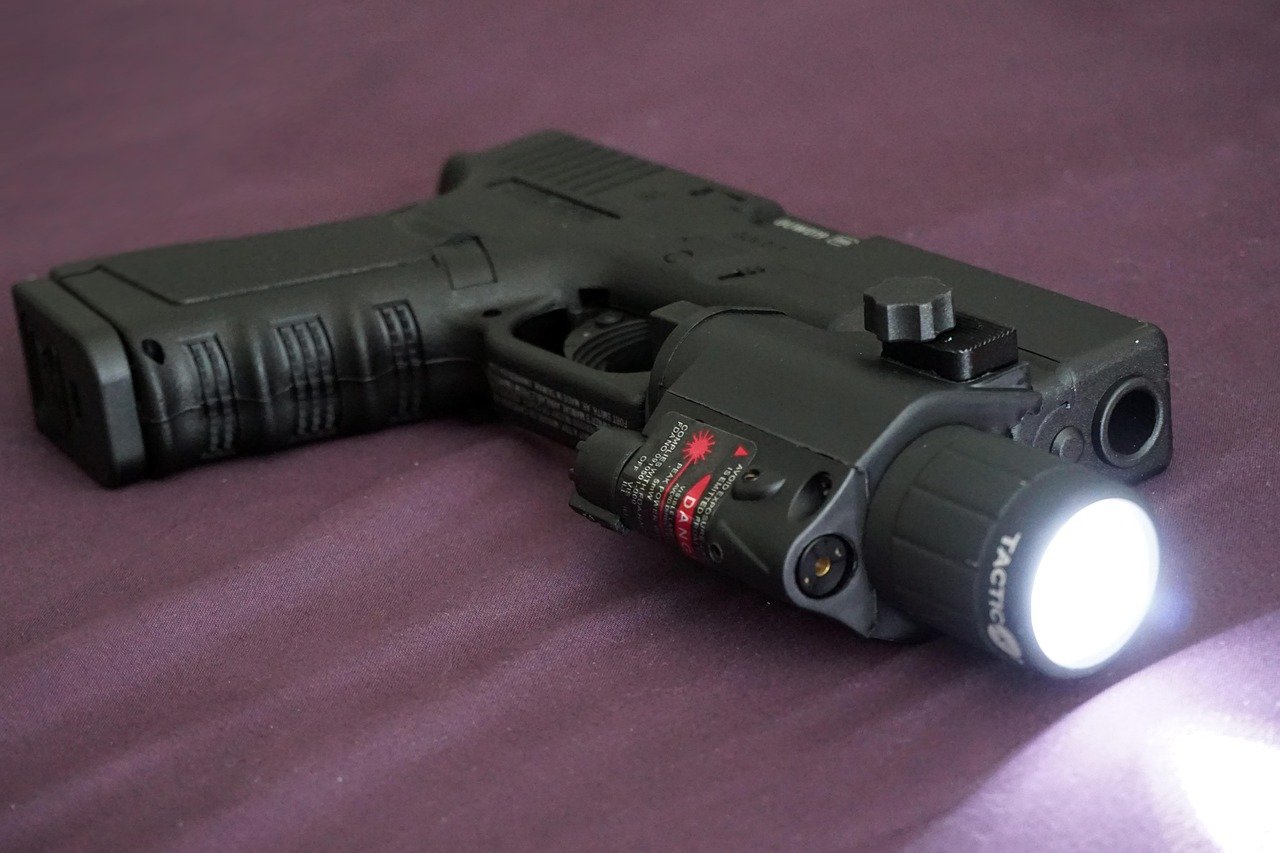
A lumen rating describes output; it does not describe the room’s reaction to that output.
At the end of a dark hallway, a white door, pale walls, a mirror, and framed glass can throw a pistol light’s spill straight back toward the shooter. In that moment, a package claim of 1,000 lumens says little about whether facial features, hands, or objects can be distinguished—or whether reflected light causes glare and visual disruption.
Indoor use is a close-range problem. Light-colored finishes amplify spill, glossy surfaces create hotspots, and a broad beam can illuminate an entire room while washing out the center of attention. Lower output is not automatically gentler, nor is higher output automatically clearer: beam shape, peak intensity, tint, and the distance to reflective surfaces determine how the light actually feels.
A workable indoor starting point
Lumens describe total emitted light; beam shape and candela determine how concentrated that light appears.
Why the Same Lumens Can Look Completely Different Indoors
Lumens
Lumens measure total visible light leaving the flashlight. They describe quantity, not where that light lands. A 500-lumen rating therefore cannot, by itself, predict whether a room will be evenly lit or whether distant details will stand out.
Candela
Candela measures peak intensity in the brightest part of the beam. Higher candela concentrates more of the available output into a tighter hotspot, which can make a similarly rated light appear far more forceful at distance. The crucial comparison is how lumens differ from candela, not lumens alone.
Spill
Spill is the lower-intensity light surrounding the central hotspot. Indoors, broad spill can reveal doorways, furniture, and room edges without moving the beam much, while also sending more light onto pale walls and nearby surfaces.
Beam pattern
Two 500-lumen lights can produce very different rooms: one may put much of its output into a narrow, high-candela center; another may spread it across a wide, softer field. The first favors reach and a pronounced hotspot; the second often provides more immediate peripheral context. Reflective paint, mirrors, and light-colored flooring can amplify either pattern, making beam distribution more important than the headline lumen number.
Why some rooms feel brighter than others
Pale painted walls, white ceilings, glossy tile, and light-colored countertops return a substantial share of a weapon light’s spill back into the room. In a short hallway, the beam has little distance to spread before it reaches a wall and rebounds toward the observer. The result can be a bright, evenly filled scene even when the light is aimed low or off-center.
Glass, framed art, televisions, phones, mirrors, and polished fixtures behave differently: they can create small, intense specular reflections rather than broad, soft bounce. A screen or mirror near the beam’s center can appear dazzling because it sends concentrated light back along a narrow angle. That is a placement problem as much as an output problem; a slight change in beam angle can move the reflection out of the direct line of sight.
Darker paint, unfinished wood, heavy fabric, and open-plan rooms absorb or disperse more light. Their surfaces produce less return, while longer sightlines let spill fade before it reaches a boundary. The same 500-lumen light that feels overwhelming in a tiled bathroom may look restrained in a dark living room.
“Splashback” therefore does not automatically mean the light has excessive output. It indicates that the room, distance, surface finish, and beam position are returning enough light to affect vision. Useful evaluation includes several familiar indoor spaces, not one reflective hallway.
Broad wall bounce can improve general scene visibility. Sharp reflections from glass or mirrors are more likely to create momentary distraction and are highly angle-dependent.
Choosing an output band
A lumen rating is best treated as a trade-off between room command and reflection management, not as a simple more-is-better scale.
Under 300 lumens
Lower-output lights are often comfortable in close, pale-walled rooms and create less severe splashback from mirrors, tile, and white paint. Their limitation appears in larger, darker spaces: identification at distance and through ambient light can become slower. A concentrated beam can partly offset modest total output.
300–600 lumens
This band commonly balances usable spill with manageable indoor reflections. It can light a typical room, reveal peripheral detail, and retain enough intensity for modest hallway distances without making every nearby white surface overwhelmingly bright. Beam pattern remains decisive; a broad 500-lumen beam and a tight 500-lumen beam behave very differently.
600–1,000 lumens
Higher output gives more reserve for open-plan interiors, darker finishes, and light spilling in from outside. It also makes glossy counters, framed glass, appliances, and light-colored walls more punishing when the beam is aimed carelessly. Momentary activation and a controlled hotspot become increasingly valuable at this level.
Above 1,000 lumens
Very high output can provide substantial reach and strong contrast in large or mixed indoor-outdoor environments. In a small reflective room, however, it may produce enough near-field glare to obscure details the light is meant to reveal. These lights reward disciplined aiming and a beam with spill that is useful rather than excessive.
Brightness Is Not a Reliable Incapacitation Tool
A bright beam may cause momentary discomfort or visual disruption, but its effect is unpredictable.
Pupil response, room lighting, beam angle, distance, prior light exposure, and the person’s response all change the result. Light is far more dependable for seeing than for controlling another person.
A firearm-mounted light is primarily an aiming-adjacent identification tool, not general-purpose illumination.
Using it to inspect an unknown sound or person can mean directing a firearm where a separate handheld light could provide information without that alignment. This distinction also informs whether a weapon-mounted light is necessary for home defense.
The useful setting is the one that permits positive identification while preserving enough visual information to interpret the room.
Excessive splashback from pale walls, mirrors, or glossy surfaces can obscure hands, faces, doorways, and background details. A controlled beam and deliberate light placement matter more than a promised “blinding” effect.
What makes a pistol light feel comfortable indoors
Two pistol lights with the same lumen rating can feel radically different in a hallway. The difference is usually beam geometry: how much output is concentrated in the hotspot, how broadly the spill fills the room, and how the beam handles objects only a few feet away.
Hotspot, spill, and nearby detail
A high-candela hotspot can reach through a larger room and distinguish detail at distance, but its bright center may be fatiguing when it lands on a white door, appliance, or wall at close range. A broader, softer beam often feels calmer indoors because it distributes light across the scene rather than creating one intensely reflective point.
Spill is not wasted light. In a short room, useful spill reveals hands, floor hazards, doorframes, and adjacent furniture without constantly sweeping the hotspot across every surface. Excessively broad spill, however, can turn pale walls into a large source of reflected light and reduce contrast in the near field.
Small optic effects can change the view
A pistol-mounted optic adds another reflective surface. Light returning from a close wall can produce haze, lens reflections, or a distracting glow around the optic window, especially when the window is dirty, wet, or scratched. Bright-colored optic bodies, white sight outlines, and light-finished sight housings can also catch spill and draw attention near the sight picture.
These effects are secondary to beam pattern, but they explain why a light that appears manageable on a bare wall may feel busier when viewed through the complete sighting setup. Evaluating the assembled system in representative indoor lighting reveals more than lumen figures alone.
Check the light in the rooms where it will live
-
Start with published numbers, then look past them
Compare claimed lumens, candela, beam distance, battery type, and regulated runtime at the stated output. A lumen claim without candela or runtime says little about whether the beam will reach a darker hallway without flooding a pale wall at close range.
-
Observe the beam in representative spaces
With the firearm confirmed unloaded, ammunition kept in a separate area, and the muzzle maintained in a safe direction, examine the beam in a bedroom, hallway, and the largest open room. Note hotspot intensity on white paint, mirror or television reflections, spill at arm’s length, and whether common interior colors remain recognizable.
-
Test the controls without changing the firing grip
Momentary and constant-on controls should be reachable consistently without awkward hand shifts or accidental activation. Switch feel matters more than a feature list: a stiff, ambiguous, or easily bumped paddle can undermine an otherwise excellent beam.
-
Confirm the mount and holster as a system
Verify that the rail key fits the specific pistol rail, the light sits securely, and activation controls clear the trigger guard. A holster must be made for that exact pistol-and-light combination; do not force a light-bearing pistol into a generic holster.
-
Watch runtime and heat, not just initial brightness
Run the light long enough to see whether output steps down and whether the housing becomes uncomfortable to handle. Short high-output bursts can look impressive, while sustained output is more relevant to repeated checks, interruptions, or extended outages.
-
Make battery access uneventful
Check whether cells can be replaced or recharged without removing the light, losing the mounting hardware, or disturbing zero-sensitive accessories. Keep the manufacturer’s specified battery type on hand and inspect the battery door or cap for secure closure.
Controlled observation is more informative than a lumen number alone; avoid directing a weapon-mounted light at people during testing.
Choose for the Space, Then Confirm It
- A lumen rating is only a starting point; beam pattern, candela, controls, and holster compatibility decide whether the light works well.
- A light that is manageable in a white hallway may be insufficient in a dark garage, yard-facing doorway, or larger open interior.
For a primarily indoor pistol-light role, roughly 300–600 lumens is a sound place to begin. It commonly supplies enough spill and usable reach for room-scale identification without making every pale wall an overwhelming reflector.
Higher output can make sense when the space is larger, darker, less reflective, or regularly connects to outdoor areas. The final test is not the package rating: it is how the complete pistol, light, sights, controls, and holster behave in the actual rooms and lighting conditions involved.





3 Comments
How much does weapon-mounted optic window reflection change this? I have a fairly bright front sight and a pistol optic, and indoors I sometimes notice little reflections or haze at close distances. Is that mostly a light-placement issue, or is it a sign the output is simply too high for the room?
I’ve noticed the same thing with a light-colored front sight. On mine, changing the angle a little helped more than dropping brightness, but shiny walls and mirrors can still make it messy. The beam pattern seems to matter a lot.
What about an apartment with lots of ambient light from street lamps? My living room is never truly dark, but the bedroom is much darker and has pale walls. Would you still start around 300–600, or lean lower because the contrast is already high?