

The right first range bag makes ordinary gear easier to find, carry, and keep together.
A box of ammunition under the seat, eye protection in a door pocket, and magazines rolling around in a trunk can turn a simple range visit into a scavenger hunt. A dedicated bag gives each item a predictable home: unloaded handgun cases, ammunition kept in its factory packaging, magazines, eye and ear protection, targets, a staple gun, and a small cleaning kit.
For a new owner, the useful features are separation and structure, not a military-looking exterior. Padded pistol compartments limit gear-on-gear contact; rigid or reinforced bases keep the bag upright on gravel or a bench; labeled pockets prevent live rounds, tools, and personal items from becoming one loose pile. Lockable zipper pulls can add a layer of access control where appropriate, while a discreet, ordinary-looking bag draws less attention during transport. Capacity matters, but an overlarge bag often becomes a place to carry forgotten clutter.
- A removable divider system can adapt as the kit grows from one handgun to two.
- A wipe-clean interior is valuable: powder residue and range dust accumulate faster than most new owners expect.
Choose the bag that matches the first range routine



A beginner-friendly bag makes every item easy to find—and hard to damage
- Protected handgun storageDedicated padded sleeves or removable cases keep handguns from contacting magazines, tools, and each other. Retention straps help contents stay put when the bag is set down or carried.Look forPadded, separated handgun compartments with secure closures.AvoidA single open cavity where metal items can collide.
- Separation that works at a glanceMagazine pockets, an eye-protection compartment, and a clearly distinct ammunition area reduce loose-item hunting. High-contrast lining and wide-opening zippers make the layout more usable in practice.Look forVisible zones for magazines, eye/ear protection, and small tools.AvoidDeep, dark pockets that turn essentials into loose clutter.
- Stable construction under a real loadA stiff base, reinforced handles, smooth zippers, and a shoulder strap that does not twist matter once ammunition is added. A bag that sags or rolls is awkward before it is full.Look forStructured base, reinforced stitching, and balanced carry points.AvoidThin fabric and narrow handles on an oversized bag.
- Capacity measured by packed weightAdvertised pistol count rarely reflects usable range capacity. Two protected handguns plus ammunition, magazines, hearing protection, eye protection, and a small cleaning kit can fill a modest bag quickly.Look forRoom for the complete routine without overstuffing.AvoidChoosing by the largest pistol-count claim alone.
A bag labeled for four handguns may fit four unloaded pistols, yet leave little practical room for the gear that supports a range session. The more useful test is whether it carries the intended handguns in protected compartments while remaining balanced with ammunition and protective equipment inside.
Savior Specialist: a tidy two-handgun baseline
01
Top choice for organized, protected range trips
The Savior Specialist is built around the range routine many new handgun owners actually develop: one or two pistols, a defined set of magazines, eye and ear protection, and small support items. Its padded main compartment separates the handguns and provides dedicated space for six magazines, while the front pocket keeps bulky protective gear from becoming loose clutter.
The footprint remains approachable for a first bag—substantial enough to keep gear in assigned places, without becoming a rolling locker. A 600D PVC shell and lockable zipper sliders add useful protection and security-minded storage for transport.
- Padded slots for two handguns
- Six dedicated magazine positions
- Front pocket fits earmuffs and glasses
- Lockable main-compartment zipper sliders
- Structured, manageable first-bag size
- Limited headroom for match-day equipment
- No room for large ammunition loads
- Front pocket can crowd with accessories
Quick take A notably well-organized starting point that makes a modest handgun kit easy to pack consistently. It is deliberately a range bag, not an all-day competition hauler.
For a first dedicated handgun range bag, the Savior Specialist gets the fundamentals right: protected pistol separation, repeatable magazine storage, and a practical place for hearing and eye protection. Its organization encourages a consistent packing routine, which matters more than surplus capacity for occasional or developing shooters.
The ceiling arrives with high-round-count practice and match gear. Those loads call for more ammunition space, additional pockets, and often a larger platform.
DSLEAF Four-Handgun Tactical Range Bag for bigger range days
Best for carrying multiple handguns and essentials
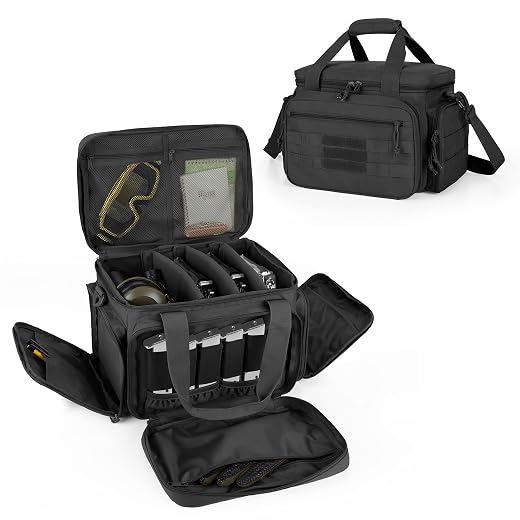
The DSLEAF is built around a larger, modular main bay: three removable dividers can create protected positions for up to four handguns, while mesh pockets hold hearing protection and eye protection. Six dedicated front magazine slots and several exterior pockets make it a natural fit for an established range setup, shared household equipment, or sessions that involve several pistols and a deeper supply of ammunition.
Its soft-sided nylon format keeps the bag more adaptable than a rigid case. MOLLE webbing also leaves room to tailor the outside with compatible pouches when the standard layout is not enough.
- Divided space for up to four handguns
- Six front magazine slots
- Removable dividers adapt the main bay
- Multiple pockets separate small essentials
- Reinforced nylon construction
- Bulky once fully loaded
- Soft shell offers less crush protection
- Extra capacity can encourage overpacking
- External tactical styling is conspicuous
The DSLEAF makes sense when a two-handgun bag has stopped being enough. The removable divider system is the important feature: it lets the main compartment scale from a mixed gear load to separated handgun storage without dedicating every inch to fixed sleeves.
Loaded with pistols, magazines, ammunition, and protective gear, however, this becomes a substantial shoulder bag. Packing by session rather than filling every pocket helps preserve the organization and carry comfort that make the design useful.
WELIDAY: tough shell for routine two-pistol trips
Heavy-duty construction with padded handgun compartments
The WELIDAY is aimed at the regular vehicle-to-range user who wants a dedicated home for two handguns without moving into a larger, more elaborate bag. Its three-compartment format separates the handgun area from ammunition and range accessories, while removable dividers allow the main space to follow the actual loadout.
This is a practical fit for sessions built around two pistols, several magazines, eye and ear protection, and basic cleaning gear. It favors a hard-wearing, tactical-looking carry solution over the more discreet, office-bag-style approach of some beginner options.
- 1000D outer material suits frequent car-to-range handling
- Reinforced bottom and double-stitched stress points support dense loads
- Dedicated padded pistol section helps prevent contact between handguns
- Six magazine slots and removable dividers make the interior adaptable
- Zipper pulls can accept a small lock
- Soft-sided construction offers less crush resistance than a hard case
- Budget-grade fit, zipper action, and stitching merit inspection
- Padding thickness may be less substantial than premium range bags
- Fully loaded bag can become awkward on the shoulder
The WELIDAY makes a convincing case for a budget two-pistol range bag: reinforced carry areas, a sturdy-looking 1000D shell, and an interior designed around a realistic range kit. Still, exterior toughness does not automatically equal refined protection. Before relying on it for frequent use, inspect divider attachment, padding coverage, zipper travel, and stitching consistency—details that often separate an inexpensive bag from a long-term one.
ITHWIU: a simple two-pistol starter bag
Affordable setup for basic handgun range days
ITHWIU keeps the format deliberately small: a soft, padded case sized around two handguns, magazines, and the few accessories that make up an occasional range outing. Its compact footprint makes more sense for a basic kit than for a growing collection of gear.
- Compact two-pistol layout
- Dedicated magazine elastic
- Removable main dividers
- Carry handle and shoulder strap
- Lockable zipper pulls
- Limited space once loaded
- Soft sides offer modest structure
- Not a secure storage case
The ITHWIU covers the fundamentals without pretending to be a full-size range hauler. Its magazine elastic, padded handgun area, and movable dividers help keep a modest load from becoming a loose pile. Capacity is the trade-off: earmuffs, ammunition, cleaning gear, and two pistols can fill it quickly.
Lockable zipper pulls can keep the two sliders together and may deter casual opening. They do not turn a soft bag into a rigid security container, prevent cutting or crushing, or replace any applicable firearm transport, storage, venue, or carrier requirements. Those rules can vary by location and situation.
Choose size by the kit that will actually travel
-
Begin with one handgun
A compact bag handles a pistol, several magazines, eye and ear protection, a loader, basic cleaning items, and a modest amount of boxed ammunition without becoming awkward to carry.
-
Add a second bay only when it has a job
Two-pistol layouts make sense for a second handgun, a training partner’s firearm, or keeping a rimfire and centerfire setup separated. Empty padded compartments add bulk, not capability.
-
Reserve large bags for shared or belt-heavy days
Four-handgun bags suit multiple firearms, holster belts, spare ear protection, tools, and pooled supplies—but ammunition can make them punishingly heavy before every pocket is full.
-
Match the carry style to the range trip
A duffel opens wide on a bench, making magazines and protective gear easy to stage. A backpack carries better across parking lots or outdoor ranges, though its deeper compartments can slow access.
-
Check the loaded, not empty, bag
The useful limit is where dividers still protect firearms, the zipper closes without strain, and the handles remain comfortable with the planned ammunition load.
Pack by task, not by empty pocket
Start with protected, unloaded handguns in their padded sleeves or dedicated compartments. Keeping them in the same positions on every trip prevents loose items from contacting finishes, sights, or controls—and makes it immediately apparent when a slot is empty.
Magazines work best as one group: dedicated elastic loops if the bag has them, or a labeled pouch if it does not. Keep ammunition in its factory boxes or a purpose-made carrier, ideally in a separate compartment from the handguns. This division makes it easier to count what is present and avoids digging through loose cartridges for a magazine.
For a first range-trip bag checklist, assign the remaining essentials permanent homes:
- Front or top pocket: eye and ear protection, ID, and range paperwork
- Small organizer pocket: staple gun, targets, marker, and tape
- Side pocket: bottled water and a basic cleaning cloth
- Main accessory area: ammunition and a compact cleaning kit
Before leaving, open each zone in the same order: firearms, magazines, ammunition, protection, then targets. At the bench, reverse that sequence. A bag arranged this way becomes a visual checklist rather than a deep box of gear.
Know when a starter bag has done its job
A compact two-pistol bag is not a temporary failure; for a solo recreational session, it is often the cleaner, lighter choice. An oversized tactical bag can encourage loose packing, become awkward in a vehicle, and hide small essentials at the bottom.
A larger format earns its bulk when the load changes consistently, not for an occasional extra box of ammunition. Clear signs include:
- Two or more firearms traveling on most range days, with magazines and ammunition for each.
- Shared equipment for a partner, student, or family member.
- A competition belt, holster, timer, tools, spare parts, and weather gear that no longer fit without crowding protective handgun compartments.
- Strained zippers, bowed seams, or a bag that will not close cleanly—all evidence that capacity has been exceeded.
For someone building a bag for a first USPSA match, a larger divided design such as the DSLEAF can keep match gear from pressing against firearms. Otherwise, the Savior, WELIDAY, or ITHWIU sizes remain practical rather than limiting.
Start Small, Stay Organized
- For a first dedicated range bag, the Savior’s structured two-handgun layout is the most balanced place to begin.
- The DSLEAF earns its larger footprint only when multiple firearms, belt gear, or shared supplies are genuinely part of regular sessions.
- ITHWIU’s lockable zipper pulls can deter casual opening but do not make the bag a secure storage solution.
The Savior Specialist Double Handgun Range Bag is the strongest all-around starting point: it keeps a realistic beginner kit separated without inviting excess gear. The DSLEAF Four-Handgun Tactical Range Bag fits confirmed high-capacity days, while the WELIDAY Two-Handgun Tactical Shooting Bag favors a harder-wearing, value-led setup. For the lowest-cost entry, the ITHWIU Two-Pistol Lockable Range Bag covers the basics—provided its limited expansion room is accepted.
Choose the smallest model that holds the actual firearms, magazines, ammunition, eye and ear protection, and a few essentials without crowding. A little unused space is useful; a bag packed until zippers strain is not. Neat separation protects the kit, speeds up setup, and makes the next several range sessions easier to repeat safely.




2 Comments
Surprised not to see any backpack-style range bags. Are they a bad choice for beginners, or were they left out because they encourage people to overpack? I like having both hands free, but maybe that is just me being lazy 😅
Could you clarify what you mean by discreet transport here? These are all still pretty range-bag-looking, especially the DSLEAF with all the exterior pockets. For someone walking from an apartment parking lot to the car, I might value a plain duffel appearance over extra mag slots.
Also, lockable zipper pulls seem to get marketed as security constantly. Good to see the article call that out, because a little luggage lock is not a magic force field.